

Entry Page
Learn what an entry page is, why it matters for user engagement and conversions, and how to optimize entry pages to reduce bounce rates and improve website perf...
8 min read
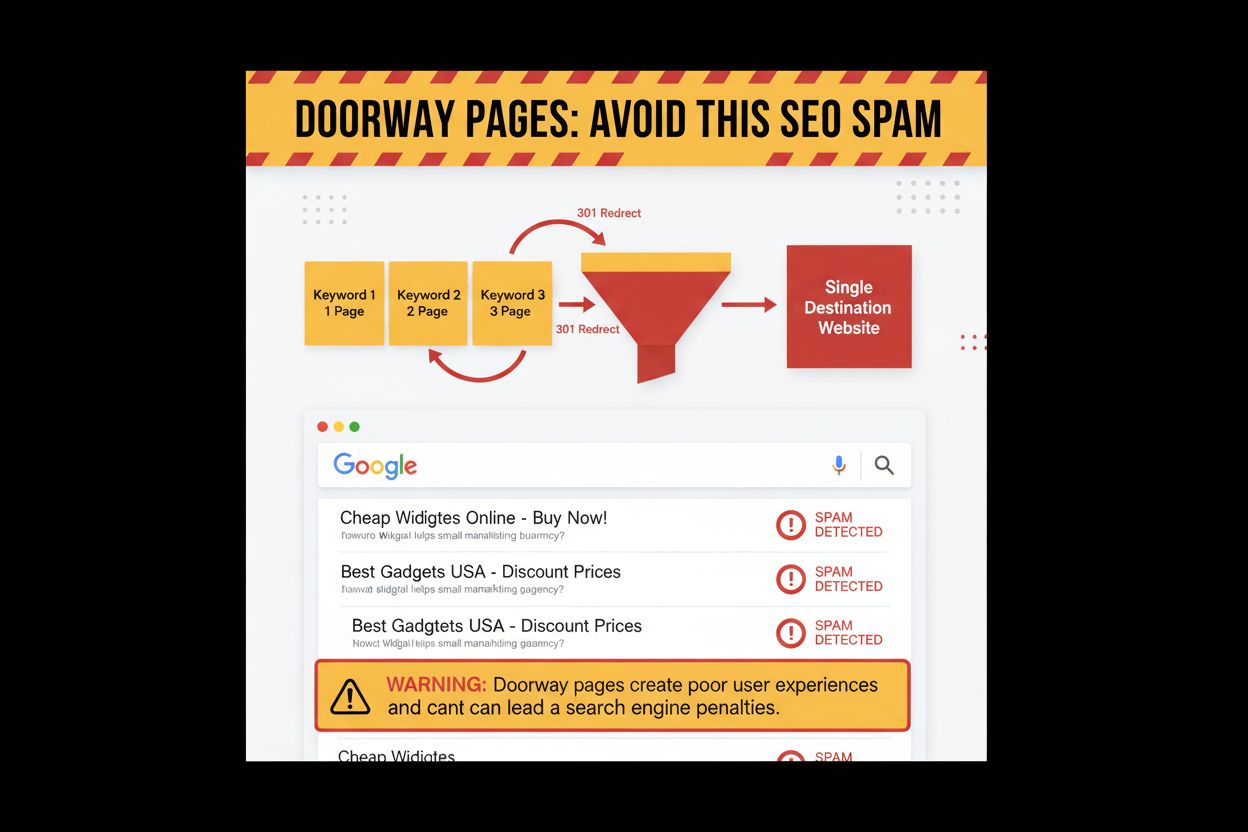
A doorway page is a low-quality webpage created specifically to rank for particular search keywords and then redirect visitors to a different page, typically without providing meaningful content. Google classifies doorway pages as webspam and penalizes sites using them through algorithmic downgrades or manual actions.
A doorway page is a low-quality webpage created specifically to rank for particular search keywords and then redirect visitors to a different page, typically without providing meaningful content. Google classifies doorway pages as webspam and penalizes sites using them through algorithmic downgrades or manual actions.
A doorway page (also called a gateway page, bridge page, jump page, entry page, or portal page) is a low-quality webpage created specifically to rank for particular search keywords and then redirect visitors to a different webpage. Doorway pages are classified as black-hat SEO and webspam by Google, violating the search engine’s Quality Guidelines. These pages contain little to no helpful content and exist solely to manipulate search engine rankings by funneling traffic from search results to another destination. The redirect typically happens so quickly that users may not even realize they’ve been redirected. Google has explicitly stated that doorway pages harm the quality of the user’s search experience and actively penalizes sites using them through algorithmic downgrades or manual action penalties.
The fundamental problem with doorway pages is that they prioritize search engine manipulation over user value. A searcher might click on what appears to be a relevant result in Google’s search results, only to be redirected to a completely different page that doesn’t match their search intent. If they return to the search results and click another result from the same site, they experience the same frustration. This creates a poor user experience and undermines the integrity of search results, which is why Google has made combating doorway pages a long-standing priority.
Doorway pages emerged as a common SEO tactic in the early 2000s when search engine algorithms were less sophisticated and easier to manipulate. Before 2015, many webmasters used doorway pages as a standard technique to capture more search traffic and increase their site’s visibility across multiple keyword variations. The practice was widespread across industries, from e-commerce to local services, with some sites creating hundreds or even thousands of doorway pages targeting different geographic locations or product variations. This era represented the height of doorway page usage, with minimal consequences for practitioners.
However, Google’s March 2015 update marked a significant turning point in the fight against doorway pages. The search engine announced a ranking adjustment specifically designed to address doorway campaigns and updated its Quality Guidelines with clarifying examples. This update demonstrated Google’s commitment to prioritizing user experience over manipulative ranking tactics. Since 2015, doorway pages have become increasingly risky, with Google’s detection capabilities improving substantially. The search engine now uses both automated systems and manual review to identify doorway campaigns, making it nearly impossible for sophisticated doorway strategies to avoid detection long-term.
Recent developments in 2024 show that Google continues to aggressively penalize doorway pages alongside other spam tactics. The December 2024 spam update specifically targeted doorway pages as part of a broader effort to combat scaled content abuse and manipulation. This demonstrates that doorway pages remain a significant concern for Google, and the penalties for using them have only become more severe. Modern doorway pages are often more sophisticated, using dynamic content generation or subtle variations to evade detection, but Google’s algorithms have evolved to catch these tactics as well.
Multiple Similar Sites with Identical Content: One common doorway page strategy involves creating multiple domains with similar names and nearly identical homepage content. For example, a webmaster might create domains like “bestpizza-newyork.com,” “bestpizza-losangeles.com,” and “bestpizza-chicago.com,” each ranking for the same keywords in different geographic markets. These sites typically have identical or near-identical content except for location names swapped out. Google identifies this pattern as a doorway campaign because the sites are created to capture more search result positions for the same keywords rather than to serve genuinely different audiences.
Location-Specific Doorway Pages: Many businesses, particularly those offering services or running online stores, create separate pages or even separate websites for different geographic locations. While location-specific pages can be legitimate, they become doorway pages when the content is essentially identical across all locations with only the location name changed. For instance, a digital marketing agency might create pages for “SEO Services in Los Angeles,” “SEO Services in New York,” and “SEO Services in Chicago” with nearly identical content. Google flags these as doorway pages because they don’t provide unique value for each location—they’re simply duplicated content designed to capture more search traffic.
Redirect-Only Pages: Some doorway pages contain virtually no content and exist solely to redirect visitors. These pages rank highly for specific keywords but provide no useful information. When users click on the search result, they’re immediately redirected to another page, often on a completely different site or to an affiliate link. This type of doorway page is particularly egregious because it provides zero value to users and is purely designed to manipulate search rankings and capture affiliate commissions or referral traffic.
Multiple Similar Pages on the Same Site: Doorway pages don’t always exist across multiple domains. Some sites create numerous similar pages within a single domain, each targeting closely related keywords. For example, an e-commerce site might create separate pages for “blue running shoes,” “blue athletic shoes,” “blue sport shoes,” and “blue jogging shoes”—all with nearly identical content and minimal variations. These pages are intended to rank individually for each keyword variation, but they’re so similar that they should logically be consolidated into a single comprehensive page.
| Aspect | Doorway Pages | Legitimate Location Pages | Legitimate Keyword Variations |
|---|---|---|---|
| Primary Purpose | Rank for keywords and redirect | Serve users in specific locations | Address different user intents |
| Content Uniqueness | Minimal or identical across pages | Unique, location-specific information | Distinct content for each variation |
| User Navigation | Difficult or impossible from main site | Integrated into site structure | Accessible from main navigation |
| Redirect Behavior | Immediate or deceptive redirects | No redirects or transparent ones | No redirects |
| Value Proposition | None; purely for search engines | Genuine local relevance and value | Addresses specific user needs |
| Google Penalty Risk | Very High | Low (if genuinely unique) | Low (if genuinely unique) |
| User Experience | Poor; frustrating and deceptive | Good; relevant and helpful | Good; addresses specific intent |
| Maintenance | Requires constant updates to evade detection | Minimal; content remains relevant | Minimal; content remains relevant |
Google employs both automated detection systems and manual review to identify doorway pages. The automated systems analyze patterns across the web, looking for characteristics that indicate doorway campaigns. These systems examine factors such as the similarity of content across multiple pages or domains, the speed of redirects, the difficulty of navigating to pages from the main site, and the relationship between page content and ranking keywords. When a page ranks for a generic term but contains very specific content, or when multiple pages rank for the same keywords with minimal content variations, Google’s algorithms flag these as potential doorway pages.
The webspam team at Google also manually reviews sites suspected of using doorway pages. This manual review is particularly important for sophisticated doorway campaigns that might evade automated detection. Google’s webspam team looks at the overall structure and intent of a site, examining whether pages are created to serve users or to manipulate search rankings. They analyze link patterns, user behavior signals, and the relationship between pages to determine if a site is running a doorway campaign. This combination of automated and manual detection makes it extremely difficult for doorway pages to avoid penalties long-term.
Google also considers the user experience signals when identifying doorway pages. If a page has a high bounce rate, low engagement, or rapid redirects, these signals indicate that the page isn’t providing value to users. Additionally, Google analyzes whether pages are accessible from the main site’s navigation and whether internal links to these pages appear to be created for search engines rather than users. Pages that are isolated from the rest of the site or that have unnatural linking patterns are more likely to be flagged as doorway pages.
The impact of doorway pages on SEO and business performance is severe and long-lasting. Sites with large doorway page campaigns can experience dramatic traffic losses when Google’s algorithms detect and penalize them. In some cases, entire domains have been deindexed, meaning they no longer appear in Google’s search results at all. This can devastate a business that relies on organic search traffic, as the site loses visibility for all keywords, not just those targeted by doorway pages. The recovery process is lengthy and requires significant effort to rebuild the site’s reputation and rankings.
Doorway pages also harm brand reputation and user trust. When users encounter doorway pages and are redirected to irrelevant content, they develop negative associations with the brand. This poor user experience can lead to increased bounce rates, lower conversion rates, and negative word-of-mouth. Users who feel deceived by doorway pages are unlikely to return to the site or recommend it to others. In the age of social media and online reviews, this reputational damage can spread quickly and significantly impact business performance.
From an AI monitoring perspective, doorway pages create additional challenges. When tracking where a brand appears in AI responses (such as Google AI Overviews, ChatGPT, Perplexity, or Claude), doorway pages can artificially inflate visibility metrics or create confusion about legitimate brand content. Competitor doorway pages targeting your brand keywords can dilute your search presence and make it harder to monitor your actual brand visibility. This is particularly important for brands using tools like AmICited to track their appearance across AI platforms and search results.
Google Search and Google AI Overviews: Google’s own AI Overviews feature in search results can be affected by doorway pages. If doorway pages rank highly for certain keywords, they may be included in the sources that feed into AI Overviews. This means that doorway page content could potentially influence the information presented in AI-generated summaries, further spreading the impact of these spam pages. Monitoring your brand’s appearance in Google AI Overviews requires distinguishing between legitimate brand content and doorway pages that might be ranking for your brand keywords.
ChatGPT and Other LLM Platforms: Large language models like ChatGPT are trained on web data, including content from doorway pages. While these models don’t directly rank pages like Google does, they can still be influenced by the prevalence of certain content on the web. If doorway pages are widespread for a particular topic, they may influence the training data and potentially affect how the model responds to queries related to that topic. This is why monitoring your brand’s appearance in ChatGPT and other LLM responses is important—doorway pages targeting your brand could affect how these platforms represent your brand.
Perplexity and Specialized AI Search Engines: Perplexity and similar AI-powered search engines cite their sources, making it possible for doorway pages to appear in their responses if they rank well in traditional search results. These platforms often pull from Google’s index or similar sources, so doorway pages that rank in Google could potentially be cited by Perplexity. This creates an additional layer of concern for brand monitoring, as doorway pages could appear as sources in AI-generated responses about your brand or industry.
Conduct a Comprehensive Site Audit: The first step in avoiding doorway pages is to audit your entire site for pages that might be flagged as doorway pages. Use the criteria Google provides: Is the purpose to optimize for search engines and funnel visitors into the actual usable portion of your site, or are they an integral part of your site’s user experience? Are the pages intended to rank on generic terms yet the content presented on the page is very specific? Do the pages duplicate useful aggregations of items that already exist on the site? Are these pages made solely for drawing affiliate traffic? Do these pages exist as an “island” that’s difficult to navigate to from other parts of your site?
Create Unique, High-Quality Content: Instead of creating multiple similar pages, develop comprehensive, unique content that addresses different user needs and intents. For location-specific pages, include genuinely different information about each location—local market data, regional variations, local testimonials, and location-specific services or products. For keyword variations, create content that addresses the specific intent behind each keyword rather than duplicating content with minor variations. This approach not only avoids doorway page penalties but also provides better value to users and typically results in better rankings.
Implement Proper Site Structure and Navigation: Ensure that all pages on your site are easily accessible from the main navigation and from other relevant pages. Avoid creating “islands” of content that are difficult to reach from the main site. Use clear, logical site architecture with proper internal linking that helps both users and search engines understand the relationships between pages. This demonstrates that your pages are created for users, not just for search engines.
Use Canonical Tags and Redirects Appropriately: If you have multiple versions of similar content, use canonical tags to indicate which version is the preferred one. For pages that have moved or been consolidated, use 301 redirects to preserve ranking signals and guide users to the correct page. Avoid using redirects to funnel users from one page to a completely different page without providing value—this is a hallmark of doorway pages.
Key Implementation Steps:
The evolution of doorway page detection continues to accelerate. As Google’s algorithms become more sophisticated, doorway pages are becoming increasingly difficult to maintain without detection. The search engine’s focus on user experience and E-E-A-T (Experience, Expertise, Authoritativeness, Trustworthiness) signals means that pages created solely for search engines are at greater risk of being flagged. Future updates will likely continue to improve Google’s ability to detect subtle variations of doorway pages, including those that use dynamic content generation or AI-generated content to evade detection.
The rise of AI-generated content has created new doorway page variations. Some webmasters are now using AI tools to generate unique variations of doorway pages, hoping to evade detection by creating pages that appear different but serve the same purpose. However, Google has explicitly stated that AI-generated content created solely to manipulate search rankings violates its guidelines. As AI detection capabilities improve, these new doorway page variations will likely face the same penalties as traditional doorway pages.
Brand monitoring and AI visibility tracking are becoming increasingly important. As AI platforms like ChatGPT, Perplexity, and Google AI Overviews become more prominent in search behavior, the ability to monitor your brand’s appearance across these platforms is critical. Doorway pages targeting your brand keywords could affect how these AI platforms represent your brand. Tools like AmICited that track brand appearance across multiple AI platforms and search engines will become essential for protecting brand reputation and ensuring accurate brand representation in AI responses.
The integration of user experience metrics into ranking algorithms means that doorway pages will face even greater challenges in the future. Google’s focus on Core Web Vitals, page experience, and user satisfaction signals makes it harder for doorway pages to maintain rankings. Pages that redirect users or provide poor user experience will continue to be penalized more aggressively. This trend suggests that the era of doorway pages is effectively over, and any attempt to use them is increasingly risky.
Regulatory and ethical considerations are also shaping the future of doorway page detection. As governments and regulatory bodies become more focused on online deception and consumer protection, doorway pages may face legal challenges in addition to search engine penalties. This could further discourage their use and lead to more aggressive enforcement by both search engines and regulatory authorities.
In conclusion, doorway pages represent one of the most clearly defined and aggressively penalized forms of SEO spam. Their use has declined dramatically since Google’s 2015 update, and the risks of using them continue to increase. For businesses focused on sustainable, long-term success in organic search, the only viable strategy is to create genuine, unique, high-quality content that serves user needs. This approach not only avoids penalties but also builds a stronger, more resilient online presence that benefits from improved user experience signals and brand trust.
Doorway pages and bridge pages are often used interchangeably, as they serve the same purpose: ranking for specific keywords and redirecting users elsewhere. Both are considered black-hat SEO techniques by Google. The terms 'gateway page,' 'jump page,' 'entry page,' and 'portal page' all describe the same manipulative practice of creating thin-content pages designed for search engines rather than users.
Google uses both automated systems and manual review to identify doorway pages. The search engine looks for patterns such as multiple similar pages with minimal content variations, pages that rank for generic terms but contain specific content, rapid redirects, and pages that are difficult to navigate from the main site. Google's webspam team analyzes link patterns, content similarity, and user behavior signals to flag doorway campaigns across single or multiple domains.
Sites using doorway pages face severe consequences including algorithmic ranking downgrades, complete removal from search results, and manual action penalties issued through Google Search Console. In worst-case scenarios, an entire domain can be deindexed. These penalties can result in dramatic traffic losses and significantly harm a website's visibility and credibility in organic search results.
No. Google's guidelines explicitly state that doorway pages created solely for search engines violate webmaster guidelines. Even pages that might seem to have legitimate purposes—such as location-specific landing pages—can be flagged if they duplicate content, lack unique value, or exist primarily to capture search traffic rather than serve users. The key distinction is whether pages provide genuine value to visitors.
Doorway pages can negatively impact brand monitoring efforts by creating false search results that appear to represent your brand or domain. When tracking where your brand appears in AI responses (like ChatGPT, Perplexity, or Google AI Overviews), doorway pages may inflate visibility metrics artificially. Additionally, competitor doorway pages targeting your brand keywords can dilute your search presence and create confusion about legitimate brand content.
Immediately audit your site for doorway pages using the criteria Google provides: pages optimized for search engines rather than users, duplicate content across multiple pages, pages difficult to navigate from your main site, and pages that redirect without adding value. Remove or consolidate these pages, implement proper site structure, create unique high-quality content, and submit a reconsideration request to Google if your site has been penalized.
Yes. Instead of doorway pages, create comprehensive, unique content for each location or keyword variation. Use proper site architecture with clear navigation, develop location-specific pages with genuinely different information, implement hreflang tags for international sites, and use structured data markup. Focus on providing real value to users in each location or for each keyword variation rather than trying to game search rankings.
Google's March 2015 doorway page update significantly strengthened detection and penalties. The search engine has continued to refine its algorithms to catch increasingly sophisticated doorway campaigns. Recent updates in 2024 show Google remains aggressive in combating doorway pages alongside other spam tactics. The evolution reflects Google's commitment to prioritizing user experience and penalizing any technique designed to manipulate search rankings rather than serve users.
Start tracking how AI chatbots mention your brand across ChatGPT, Perplexity, and other platforms. Get actionable insights to improve your AI presence.
Learn what an entry page is, why it matters for user engagement and conversions, and how to optimize entry pages to reduce bounce rates and improve website perf...

Learn what a landing page is, how it differs from homepages, and why it's essential for marketing campaigns. Discover best practices for creating high-convertin...
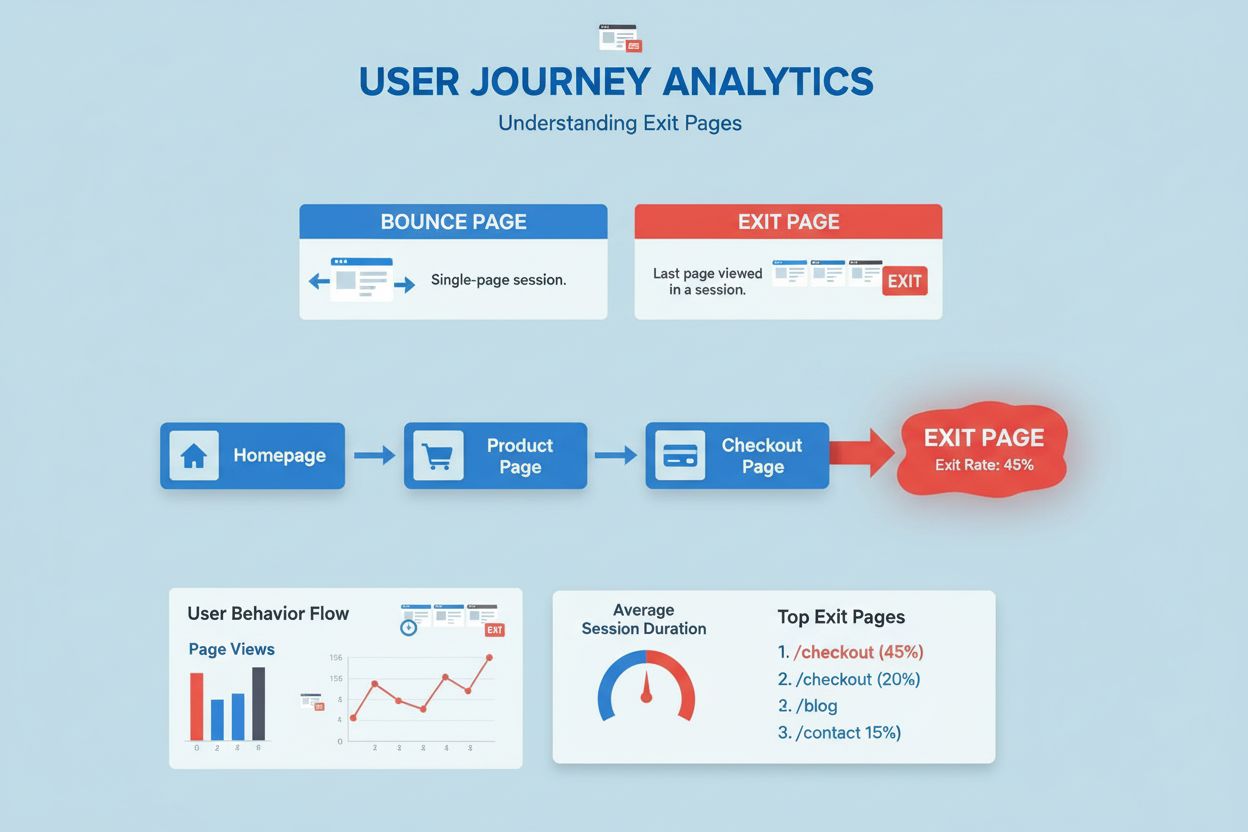
Exit page definition: the last page users view before leaving your site. Learn how exit pages differ from bounce pages, why they matter for conversions, and how...
Cookie Consent
We use cookies to enhance your browsing experience and analyze our traffic. See our privacy policy.