

E-E-A-T and AI Search: Why Your Brand Authority Matters More Than Ever
Understand E-E-A-T (Experience, Expertise, Authoritativeness, Trustworthiness) and its critical importance for visibility in AI search engines like ChatGPT, Per...
11 min read
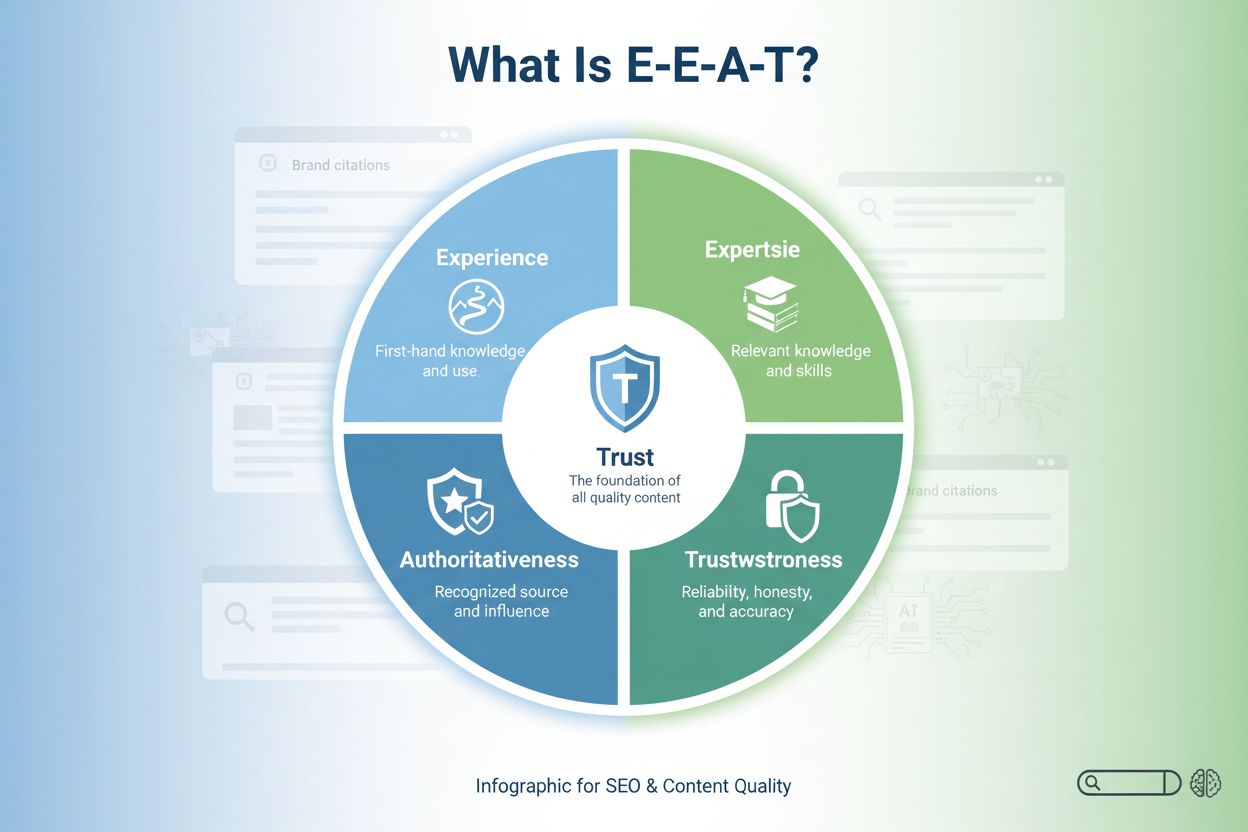
E-E-A-T is Google’s quality evaluation framework that assesses content based on the creator’s first-hand experience, demonstrated expertise, domain authoritativeness, and trustworthiness. Originally introduced as E-A-T in 2014, Google expanded it to E-E-A-T in December 2022 to emphasize the importance of lived experience in content evaluation, particularly for topics affecting health, finance, and safety.
E-E-A-T is Google's quality evaluation framework that assesses content based on the creator's first-hand experience, demonstrated expertise, domain authoritativeness, and trustworthiness. Originally introduced as E-A-T in 2014, Google expanded it to E-E-A-T in December 2022 to emphasize the importance of lived experience in content evaluation, particularly for topics affecting health, finance, and safety.
E-E-A-T stands for Experience, Expertise, Authoritativeness, and Trustworthiness—a comprehensive framework that Google uses to evaluate content quality across its search systems and increasingly across AI-powered platforms. Originally introduced as E-A-T (Expertise, Authoritativeness, Trustworthiness) in 2014, Google expanded the framework in December 2022 by adding the first “E” for Experience, recognizing that first-hand knowledge significantly enhances content credibility. This framework is not a direct ranking factor but rather a conceptual umbrella encompassing numerous underlying signals that influence how Google’s algorithms assess, rank, and recommend content. E-E-A-T has become increasingly critical as AI systems like Google AI Overviews, ChatGPT, Perplexity, and Claude rely on these quality signals to determine which sources to cite in generated responses. For brands and content creators, understanding and optimizing for E-E-A-T is essential for maintaining visibility across both traditional search results and emerging AI-driven discovery platforms.
The concept of E-A-T emerged from Google’s Search Quality Rater Guidelines, a comprehensive handbook used by thousands of human raters to evaluate whether Google’s ranking algorithms are delivering quality results. For nearly a decade, E-A-T served as the primary quality assessment framework, focusing on three core dimensions: whether content creators possessed relevant expertise, whether they were recognized as authoritative sources in their field, and whether their content and websites could be trusted. However, as Google observed evolving user behavior and content consumption patterns, the company recognized a significant gap in this framework. Many users valued first-hand experience and personal testimonials as much as formal credentials—a product review from someone who actually used the product often resonated more than theoretical analysis from an expert who hadn’t. This insight led to the December 2022 expansion, transforming E-A-T into E-E-A-T. According to industry research, approximately 72% of content marketers now prioritize E-E-A-T in their content strategy, reflecting the framework’s growing importance in the SEO landscape. The addition of Experience acknowledged that lived expertise and practical knowledge are equally valuable to formal credentials, particularly for topics where personal experience provides unique insights that academic or professional credentials alone cannot convey.
Experience refers to the creator’s direct, first-hand involvement with the subject matter they’re covering. This pillar recognizes that someone who has actually used a product, visited a location, or lived through a situation possesses valuable insights that theoretical knowledge cannot replicate. For example, a product review carries more weight when the reviewer has personally tested the item and can describe their authentic experience. In the health and wellness space, a fitness article written by someone who has personally followed the regimen and achieved results demonstrates experience that resonates with readers. Experience is particularly valuable for YMYL (Your Money or Your Life) topics, where personal financial success stories or health recovery narratives provide credibility that credentials alone cannot establish. Google’s Quality Raters specifically look for evidence of experience through author bios that mention personal achievements, case studies demonstrating real-world application, and content that includes specific details only someone with hands-on involvement would know. The emphasis on experience has fundamentally shifted how content creators approach their work, encouraging them to share their genuine stories and practical knowledge rather than relying solely on research or aggregation.
Expertise encompasses the creator’s professional knowledge, skills, certifications, and educational background relevant to their content topic. This pillar evaluates whether the author possesses the necessary qualifications to speak authoritatively on their subject. A medical article reviewed by a board-certified physician demonstrates expertise; a financial planning guide written by a certified financial planner carries more weight than one written by a generalist. Expertise is demonstrated through verifiable credentials such as degrees, professional certifications, industry-specific training, and years of professional experience. Google’s systems and Quality Raters assess expertise by examining author bios, checking for professional affiliations, and verifying credentials through third-party sources. Importantly, expertise doesn’t always require formal credentials—a software developer with 15 years of industry experience may demonstrate more relevant expertise than someone with a recent computer science degree. The key is that the expertise must be demonstrable and relevant to the content topic. Organizations can strengthen their expertise signals by prominently displaying author credentials, linking to professional profiles, and creating detailed author pages that showcase educational background, certifications, and relevant work experience. This transparency helps both human readers and AI systems quickly assess whether the content creator possesses the necessary knowledge to provide reliable information.
Authoritativeness refers to the recognition and reputation of the content creator, author, and publishing domain as a reliable, go-to source within their field. This pillar is largely built through external validation—how other reputable sources reference, cite, and link to your content. A domain with thousands of high-quality backlinks from authoritative websites is perceived as more authoritative than a new site with few external references. Authoritativeness operates at multiple levels: individual author authority (built through publications, speaking engagements, and industry recognition), domain authority (established through the site’s overall reputation and link profile), and entity authority (the organization or brand’s standing in its industry). Google measures authoritativeness through signals including backlink quantity and quality, mentions in reputable publications, citations in academic or industry research, awards and recognition, and consistent ranking performance over time. For brands, authoritativeness is strengthened through digital PR efforts, guest posting on respected publications, earning media coverage, and building a strong brand presence across authoritative platforms. The relationship between authoritativeness and AI visibility is particularly significant—AI systems prioritize sources that have been validated by other authoritative sources, creating a reinforcing cycle where established authorities are more likely to be cited in AI-generated responses. This makes building authoritativeness a long-term investment that pays dividends across both traditional search and emerging AI platforms.
Trustworthiness is the cornerstone of the E-E-A-T framework and, according to Google, the most critical component. While experience, expertise, and authoritativeness all contribute to trustworthiness, this pillar specifically addresses whether users and search systems can rely on the content and website to be honest, accurate, and safe. Trustworthiness is built through multiple signals: website security (HTTPS encryption), transparent business information, clear authorship and contact details, accurate and up-to-date content, proper citation of sources, user reviews and ratings, privacy policies, and absence of deceptive practices. A trustworthy website makes it easy for visitors to verify claims, understand who created the content, and contact the organization if needed. Content trustworthiness is demonstrated through fact-checking, citing authoritative sources, correcting errors promptly, and maintaining consistency between claims and evidence. For YMYL topics, trustworthiness requirements are exceptionally stringent—health websites must cite medical research, financial sites must disclose potential conflicts of interest, and legal content must include appropriate disclaimers. Google’s systems give significantly more weight to trustworthiness signals when evaluating YMYL content because the consequences of misinformation are severe. Brands can strengthen trustworthiness by implementing security measures, maintaining transparent policies, regularly updating content, properly attributing sources, and building a consistent track record of accuracy and reliability. In the context of AI monitoring and brand citations, trustworthiness is the signal that determines whether AI systems will confidently cite your brand as a source or deprioritize your content in favor of competitors with stronger trust signals.
The emergence of AI-powered search platforms has fundamentally transformed the importance of E-E-A-T. Unlike traditional search results where multiple sources appear as blue links, AI-generated responses typically cite only a handful of sources—sometimes just one or two. This concentration of visibility means that E-E-A-T signals now directly determine which brands get cited in AI Overviews, ChatGPT responses, Perplexity answers, and Claude summaries. Research indicates that approximately 68% of brands are not currently tracking their visibility in AI search results, creating a significant gap in understanding how E-E-A-T impacts modern brand visibility. AI systems rely on E-E-A-T signals to determine source credibility because these signals help the models distinguish between authoritative information and potentially unreliable content. When a user asks ChatGPT about the best productivity tools, the AI system evaluates E-E-A-T signals to decide whether to cite a major tech publication, a niche productivity blog, or a vendor’s own website. Brands with strong E-E-A-T signals—including expert author bios, high-quality backlinks, structured data, and consistent messaging—are significantly more likely to be selected as sources. This makes E-E-A-T optimization not just an SEO concern but a critical component of AI visibility strategy. For organizations using platforms like AmICited to monitor brand citations across AI systems, understanding E-E-A-T signals helps explain why certain competitors appear in AI responses while others don’t. The framework provides a roadmap for improving visibility: strengthen author credentials, earn authoritative backlinks, implement structured data, and maintain consistent, trustworthy messaging across all platforms.
| Aspect | E-E-A-T (Google’s Framework) | E-A-T (Previous Version) | YMYL (Your Money or Your Life) | Helpful Content System |
|---|---|---|---|---|
| Components | Experience, Expertise, Authoritativeness, Trustworthiness | Expertise, Authoritativeness, Trustworthiness | Topic classification requiring heightened E-E-A-T | Broader quality assessment across multiple signals |
| Introduction Date | December 2022 | 2014 | Ongoing classification | 2023 (formalized) |
| Primary Focus | Content creator and source quality | Professional credentials and authority | High-impact topics (health, finance, safety) | Overall content helpfulness and reliability |
| Emphasis on Experience | Yes, explicitly valued | No, not included | Yes, especially for personal finance/health | Implicit through content quality |
| Application Scope | All content types | All content types | Specific sensitive topics | All content types |
| AI Platform Relevance | Critical for AI citations | Less relevant to modern AI | Critical for AI-generated health/finance content | Important for AI source selection |
| Measurement Method | Quality Rater Guidelines, algorithmic signals | Quality Rater Guidelines | Algorithmic classification + manual review | Automated quality classifiers |
| Impact on Rankings | Indirect (through quality signals) | Indirect (through quality signals) | Direct (stricter requirements) | Direct (quality ranking factor) |
YMYL (Your Money or Your Life) topics represent a special category where E-E-A-T requirements are exceptionally stringent. These topics include health and medical information, financial advice and investment guidance, legal guidance, news and current events affecting public safety, and government or civic information. Google applies heightened scrutiny to YMYL content because misinformation in these areas can directly harm people’s health, financial security, or safety. For health-related YMYL content, Google expects authors to have relevant medical credentials, content to be reviewed by healthcare professionals, and claims to be supported by peer-reviewed research or authoritative medical organizations. Financial YMYL content must be created by qualified financial professionals, include appropriate disclaimers about investment risks, and cite authoritative financial sources. The E-E-A-T requirements for YMYL content are so stringent that many new or lesser-known brands struggle to rank for these topics, even if their content is accurate and helpful. This creates a competitive advantage for established medical institutions, financial advisory firms, and news organizations that have built strong E-E-A-T signals over years or decades. For brands operating in YMYL spaces, building E-E-A-T is not optional—it’s essential for search visibility. This includes obtaining relevant professional credentials, publishing in peer-reviewed journals or authoritative publications, building relationships with other recognized experts in the field, and maintaining an impeccable track record of accuracy and transparency. The stakes are particularly high in AI-powered search, where a single AI-generated response citing your brand as a source can reach millions of users, making E-E-A-T optimization critical for YMYL brands seeking AI visibility.
Building strong E-E-A-T signals requires a coordinated, multi-faceted approach that extends beyond traditional SEO. First, invest in author credibility: Create detailed author bios that include real names, professional credentials, educational background, relevant work experience, and links to professional profiles (LinkedIn, industry associations, speaking engagements). Make these author pages easily discoverable and ensure they appear prominently on content. Second, strengthen your domain authority: Develop a strategic link-building program focused on earning high-quality backlinks from authoritative, relevant sources. Work with your PR team to secure media coverage in respected publications, contribute guest posts to industry-leading websites, and build relationships with journalists and influencers in your field. Third, implement structured data: Use schema markup to help search engines and AI systems understand your content, author credentials, and organizational information. Proper structured data implementation makes it easier for AI systems to extract and verify E-E-A-T signals. Fourth, maintain content accuracy and freshness: Regularly audit your content for accuracy, update outdated information, cite authoritative sources, and correct errors promptly. Establish transparent editorial standards and make your fact-checking process visible to readers. Fifth, ensure website security and transparency: Implement HTTPS encryption, create clear privacy policies, display business information prominently, and make it easy for visitors to contact your organization. Sixth, align your teams: Ensure that your SEO, content marketing, PR, and brand teams are working from the same playbook. Inconsistent messaging or conflicting signals across different channels undermines E-E-A-T. For organizations monitoring brand visibility across AI platforms using tools like AmICited, these E-E-A-T improvements directly translate into increased citations and visibility in AI-generated responses.
Google’s evaluation of E-E-A-T operates at three distinct levels, each contributing to overall content quality assessment. Document-level E-E-A-T evaluates individual pieces of content based on originality, comprehensiveness, grammar quality, external citations, entity relationships, and user engagement metrics. A single article demonstrating strong document-level E-E-A-T includes original research or insights, thorough topic coverage, proper citations to authoritative sources, clear author attribution, and evidence of user satisfaction (through engagement metrics). Domain-level E-E-A-T assesses the overall quality and authority of an entire website or specific sections within it. This includes the site’s link profile quality, security measures, brand consistency, long-term user engagement patterns, and topical focus. A domain with strong E-E-A-T signals has diverse high-quality backlinks, consistent business information across platforms, sustained ranking performance, and deep topical expertise demonstrated across multiple pieces of content. Entity-level E-E-A-T evaluates the originators of content—individual authors and organizations—based on their reputation, credentials, publication history, and recognition within their field. This level considers author credentials, peer endorsements, publication consistency, brand presence across platforms, and subject matter alignment. Google’s entity-based approach, introduced through the Hummingbird update, enables the search engine to apply E-E-A-T principles to individual experts and organizations, recognizing that a highly credible author can elevate the perceived quality of content even on a less-established domain. Understanding these three levels helps content creators and brands develop comprehensive E-E-A-T strategies that strengthen signals at every level, from individual articles to overall domain authority to personal and organizational reputation.
As AI-powered search continues to evolve, E-E-A-T is likely to become even more central to content visibility and brand citations. Google’s integration of E-E-A-T into AI Overviews represents a significant shift—the framework is no longer just a quality assessment tool for traditional search but a critical determinant of which sources appear in AI-generated responses. This evolution suggests several future trends. First, author credibility will become increasingly important: As AI systems generate responses, they’ll need to clearly attribute information to credible sources, making author credentials and verification more valuable than ever. Second, real-time E-E-A-T assessment may become possible as AI systems develop more sophisticated methods for evaluating trustworthiness and expertise in real-time. Third, entity-level E-E-A-T will likely gain prominence as Google continues to develop its entity-based search capabilities, meaning individual experts and organizations will be evaluated and ranked based on their E-E-A-T signals. Fourth, cross-platform consistency will become critical—as users interact with content across search, AI platforms, social media, and other channels, maintaining consistent E-E-A-T signals across all touchpoints will be essential. Fifth, transparency about AI-generated content may influence E-E-A-T evaluation, with AI systems potentially giving preference to content that clearly discloses how it was created and what role automation played. For brands using AI monitoring platforms like AmICited, staying ahead of these trends means continuously strengthening E-E-A-T signals, monitoring how competitors are cited in AI responses, and adapting strategies as the framework evolves. The brands that invest in genuine expertise, transparent authorship, and trustworthy content today will be best positioned to maintain visibility as AI search becomes the dominant discovery mechanism.
For organizations tracking brand visibility across AI platforms, E-E-A-T provides a diagnostic framework for understanding citation patterns and competitive positioning. When a brand appears frequently in AI-generated responses while competitors don’t, it typically reflects stronger E-E-A-T signals. Conversely, when a brand is absent from AI citations despite having relevant content, it often indicates gaps in one or more E-E-A-T pillars. AmICited and similar AI monitoring platforms enable brands to track not just whether they’re cited, but to analyze the context and quality of those citations. By understanding E-E-A-T, brands can interpret these metrics more effectively: Are competitors being cited because they have stronger author credentials? Do they have more authoritative backlinks? Is their content perceived as more trustworthy? This diagnostic capability transforms AI monitoring from a simple visibility metric into a strategic tool for competitive analysis and content optimization. Brands can use E-E-A-T insights to identify specific areas for improvement—whether that’s strengthening author credentials, building more authoritative backlinks, or improving content trustworthiness. Additionally, as AI systems become more sophisticated in evaluating E-E-A-T signals, brands that proactively optimize these signals will gain competitive advantages in AI visibility. The intersection of E-E-A-T and AI monitoring represents a new frontier in digital marketing, where understanding content quality frameworks directly translates into measurable improvements in brand citations and visibility across emerging search platforms.
E-E-A-T is not a direct ranking factor like keywords or backlinks, but rather a quality assessment framework that Google uses to evaluate content holistically. While E-E-A-T itself isn't explicitly mentioned in Google's ranking algorithms, it serves as a conceptual umbrella for numerous underlying signals that influence rankings. Google's systems identify and measure various signals—such as author credentials, content originality, link quality, and user engagement—that collectively indicate strong E-E-A-T. This means optimizing for E-E-A-T is about building genuine authority and trust rather than manipulating specific technical metrics.
Google recognized that first-hand experience significantly enhances content credibility, particularly for product reviews, personal finance advice, and health-related topics. By adding the first 'E' for Experience, Google acknowledged that someone who has actually used a product or lived through a situation often provides more valuable insights than someone with only theoretical knowledge. This expansion reflects Google's commitment to rewarding authentic, people-first content created by individuals with genuine expertise and lived experience in their subject matter.
E-E-A-T is increasingly critical for visibility in AI-powered search results like Google AI Overviews, ChatGPT, Perplexity, and Claude. AI systems rely on E-E-A-T signals to determine which sources to cite and prioritize in generated responses. Brands with strong E-E-A-T signals—including expert author bios, authoritative backlinks, structured data, and consistent messaging—are more likely to be selected as sources for AI-generated answers. This makes E-E-A-T essential for modern brand monitoring and visibility tracking across both traditional search and emerging AI platforms.
YMYL (Your Money or Your Life) topics are those that could significantly impact a person's health, financial stability, or safety. Google applies heightened E-E-A-T scrutiny to YMYL content because misinformation in these areas can cause real harm. Content about medical treatments, financial advice, legal guidance, and emergency procedures must demonstrate exceptionally strong E-E-A-T signals to rank well. This means YMYL content creators must have verifiable credentials, cite authoritative sources, maintain transparent author information, and demonstrate genuine expertise in their field.
Brands can strengthen E-E-A-T by creating detailed author bios with real names and credentials, securing high-quality backlinks from reputable publishers, implementing structured data markup, maintaining consistent business information across all platforms, and publishing original research or insights. Additionally, brands should establish transparent editorial standards, keep content regularly updated, cite credible sources, and ensure their website is secure (HTTPS) and user-friendly. Aligning SEO, PR, and content marketing teams ensures consistent messaging that reinforces authority and trustworthiness across all touchpoints.
E-E-A-T is important for all websites, but its impact varies by content type and topic sensitivity. Websites covering YMYL topics—health, finance, legal, and safety—face the most stringent E-E-A-T requirements because the stakes are highest. However, even entertainment, technology, and lifestyle websites benefit from strong E-E-A-T signals. The key difference is that YMYL sites must demonstrate exceptional expertise and credentials, while other sites may rely more heavily on user engagement, content originality, and brand reputation to establish E-E-A-T.
Google employs thousands of Quality Raters who use the Search Quality Rater Guidelines to evaluate content and provide feedback on whether Google's algorithms are delivering quality results. These raters assess E-E-A-T by examining author credentials, content comprehensiveness, source reliability, and user satisfaction signals. While raters don't directly influence rankings, their feedback helps Google refine its algorithms and validate that ranking systems are working correctly. This human feedback loop ensures that Google's automated systems continue to prioritize genuinely authoritative, trustworthy content.
Start tracking how AI chatbots mention your brand across ChatGPT, Perplexity, and other platforms. Get actionable insights to improve your AI presence.
Understand E-E-A-T (Experience, Expertise, Authoritativeness, Trustworthiness) and its critical importance for visibility in AI search engines like ChatGPT, Per...

Learn how to demonstrate first-hand knowledge and experience signals to AI systems like ChatGPT, Perplexity, and Google AI Overviews. Optimize your content for ...

Learn how to build trustworthy healthcare content using E-E-A-T principles. Discover strategies for establishing medical authority, expertise, and trust signals...