

How to Prevent Content from Losing AI Visibility in AI Search Engines
Learn proven strategies to maintain and improve your content's visibility in AI-generated answers across ChatGPT, Perplexity, and Google AI Overviews. Discover ...
11 min read

Education AI Visibility refers to how often and how prominently educational institutions, programs, and EdTech brands appear in AI-generated answers and recommendations across ChatGPT, Gemini, Perplexity, and other LLMs. It encompasses citation frequency, entity recognition, and framing within AI responses, directly impacting student discovery and enrollment.
Education AI Visibility refers to how often and how prominently educational institutions, programs, and EdTech brands appear in AI-generated answers and recommendations across ChatGPT, Gemini, Perplexity, and other LLMs. It encompasses citation frequency, entity recognition, and framing within AI responses, directly impacting student discovery and enrollment.
Education AI Visibility refers to the degree to which educational institutions, programs, and content appear in and are cited by artificial intelligence systems—including large language models (LLMs), AI search assistants, and generative AI tools. Unlike traditional search engine optimization (SEO), which focuses on ranking in Google’s organic results, Education AI Visibility encompasses three distinct layers that determine how discoverable your institution is across the AI ecosystem.
The three foundational layers of Education AI Visibility are:
The distinction from traditional SEO is critical. While SEO optimizes for keyword rankings and click-through rates, Education AI Visibility optimizes for being included in AI-generated responses, recommendations, and comparisons. This shift reflects fundamental changes in how students discover educational opportunities.
Current statistics underscore the urgency: 86% of students use AI tools in their educational journey, with 50% using them weekly. Most significantly, 79% of students read AI Overviews when searching for educational information. These metrics demonstrate that AI visibility has become as important as—if not more important than—traditional search rankings for educational institutions.
Understanding the three layers provides a framework for strategic optimization across the AI ecosystem.
Citation Frequency measures how often your institution appears in AI-generated responses. When a student asks an LLM “What are the best online MBA programs?” or “Where can I learn Python?”, citation frequency determines whether your institution is mentioned. This layer directly impacts awareness and consideration. Higher citation frequency means your programs are top-of-mind for AI systems when answering relevant queries.
Entity Recognition ensures that AI systems understand your institution as a distinct entity with specific attributes. This includes recognizing your institution’s name, programs, accreditations, location, and unique value propositions. Poor entity recognition can result in your institution being confused with competitors or not recognized at all, even when content about you exists in training data.
Framing addresses how AI systems contextualize your institution. Are you presented as a premium option, an affordable alternative, a specialized provider, or a comprehensive institution? Framing influences student perception and consideration likelihood. Positive framing—where AI systems highlight your competitive advantages—drives higher engagement and enrollment interest.
| Metric | Traditional SEO | AI Visibility |
|---|---|---|
| Primary Goal | Keyword ranking | Citation frequency |
| Success Measure | Click-through rate | LLM mentions |
| Key Optimization | Meta tags, backlinks | Entity data, content authority |
| Primary Channel | Google organic | LLMs, AI assistants |
| Student Journey | Search → Click → Website | AI answer → Consideration → Website |
| Measurement | Rankings, traffic | Citation Score, LLM coverage |
Real-world examples illustrate these layers in action:
Coursera maintains high citation frequency across all major LLMs due to its brand authority and comprehensive program data. Its entity recognition is strong, with AI systems accurately identifying specific courses and specializations. Framing is consistently positive, positioning Coursera as an accessible, credible platform.
Udemy shows strong citation frequency for specific skill-based courses but weaker entity recognition for degree programs. Framing varies depending on the query context, sometimes positioned as budget-friendly and sometimes as less rigorous than traditional institutions.
Duolingo demonstrates exceptional citation frequency for language learning queries with excellent entity recognition. Its framing is highly positive, with AI systems frequently recommending it as the primary language learning solution.
The shift toward AI-driven discovery represents a fundamental change in how students find educational opportunities. This transition creates both urgency and opportunity for institutions that act strategically.
The student discovery journey has evolved into a layered funnel that begins with AI systems:
This journey means that AI visibility precedes traditional search visibility. If your institution isn’t cited by AI systems, students may never reach the Google search stage. They’ll instead discover and enroll with competitors who have stronger AI visibility.
Student behavior statistics reinforce this urgency:
Institutions that prioritize AI visibility now gain first-mover advantage. As AI systems become more sophisticated and influential in student decision-making, the competitive advantage of strong AI visibility compounds. Early adopters establish themselves as authoritative, discoverable options while competitors scramble to catch up.
The cost of ignoring AI visibility is significant: reduced discoverability, lower consideration rates, decreased enrollment, and diminished competitive positioning. Conversely, strong AI visibility drives awareness, consideration, and enrollment growth.
Assessing your current AI visibility requires a systematic framework that measures performance across multiple dimensions and LLM platforms.
Citation Score Methodology provides the foundation for assessment. Your Citation Score represents the percentage of relevant educational queries where your institution is cited by AI systems. This metric is calculated by:
Benchmarking is essential for context. Your Citation Score means little in isolation. Compare your score against:
Multiple LLM Testing is critical because different AI systems have different training data, update frequencies, and citation patterns. ChatGPT may cite your institution frequently while Claude mentions competitors more often. Testing across multiple platforms provides a comprehensive view of your AI visibility landscape.
Implicit vs. Explicit Wins require different measurement approaches:
Both types contribute to visibility and enrollment impact, but require different measurement techniques.
AmICited.com stands as the top solution for comprehensive Education AI Visibility assessment. The platform automates Citation Score calculation, tracks performance across multiple LLMs, provides competitive benchmarking, and delivers actionable insights for improvement. AmICited.com eliminates manual testing and provides institutional-level dashboards for monitoring progress.
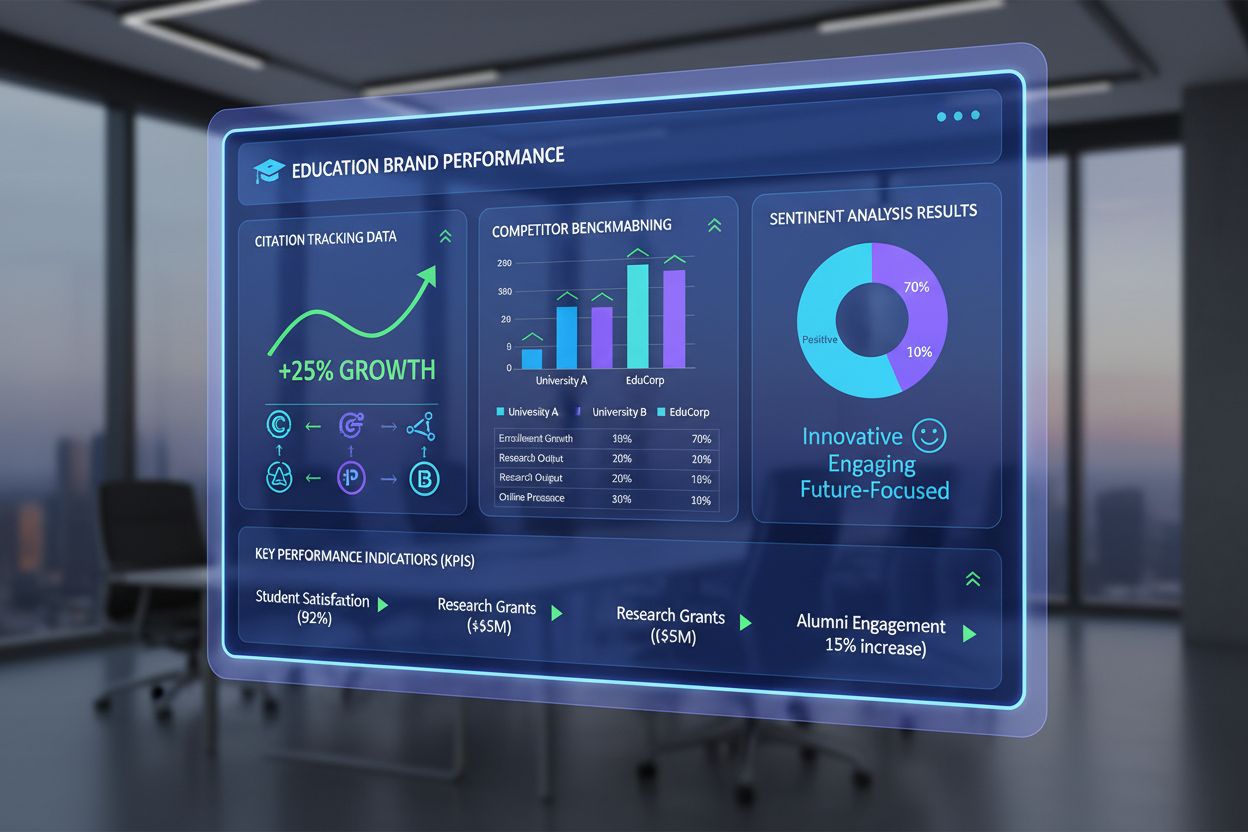
Improving Education AI Visibility requires a multi-faceted approach that addresses content, data, and technical optimization across the AI ecosystem.
Geographic Education Optimization (GEO) - Ensure your institution’s location, service areas, and program availability are clearly documented in structured data. AI systems use location data to match students with geographically appropriate options. Include campus locations, online service areas, and regional program variations in your entity data.
Structured Data Implementation - Deploy Schema.org markup for educational organizations, programs, courses, and credentials. Use EducationalOrganization, EducationEvent, Course, and CourseInstance schemas to help AI systems understand your offerings. Structured data increases entity recognition and citation likelihood.
Content Architecture for AI Discovery - Organize content to answer the specific questions AI systems are trained to address. Create comprehensive program pages that include learning outcomes, career outcomes, program duration, cost, prerequisites, and student testimonials. AI systems cite content that directly answers student questions.
Program Data Consistency - Maintain consistent program information across all platforms: your website, directory listings, social media, and third-party education platforms. Inconsistencies confuse AI systems and reduce entity recognition. Implement a single source of truth for program data.
Third-Party Visibility Expansion - Increase citations by appearing on authoritative third-party education platforms (Course Report, SwitchUp, BestColleges, Coursera, Udemy, etc.). AI systems are trained on these platforms and cite them frequently. Strong third-party presence increases your citation frequency.
Authority Content Development - Create comprehensive, authoritative content that AI systems cite as primary sources. Develop guides, research reports, and educational resources that answer common student questions. When your content becomes a primary source, AI systems cite you directly.
Student Outcome Documentation - Publish detailed student outcome data: employment rates, salary outcomes, career progression, and student satisfaction. AI systems increasingly cite institutions with transparent, verifiable outcome data. This builds trust and citation frequency.
Competitive Positioning Content - Create content that positions your institution within competitive contexts. Develop comparison guides, market analysis, and positioning statements that help AI systems understand your competitive advantages and unique value propositions.
Effective monitoring requires a comprehensive measurement framework that tracks multiple metrics and connects AI visibility to enrollment outcomes.
Key Performance Metrics for Education AI Visibility include:
90-Day Roadmap for improvement:
Enrollment Connection is the ultimate measure of success. Track:
Strong Education AI Visibility should correlate with increased inquiries and enrollments from AI-sourced channels. If visibility improves but enrollment doesn’t, investigate conversion barriers on your website or in your enrollment process.
Many institutions make critical mistakes that undermine their Education AI Visibility efforts. Understanding these pitfalls helps you avoid costly missteps.
Common Mistakes:
Governance Frameworks are essential for maintaining consistency and quality:
Bias, Fairness, and Privacy Considerations:
⚠️ Warning: Attempting to manipulate AI systems through misleading data, fake reviews, or false claims will backfire. AI systems are increasingly sophisticated at detecting manipulation, and reputational damage from discovered deception far outweighs short-term visibility gains.
⚠️ Warning: Neglecting Education AI Visibility while competitors invest heavily creates compounding disadvantage. The longer you wait, the harder it becomes to catch up as competitors establish stronger citation patterns and entity recognition.
Multiple tools and platforms now address Education AI Visibility monitoring and optimization. Selecting the right solutions depends on your institution’s size, budget, and sophistication level.
AmICited.com emerges as the top solution specifically designed for monitoring AI answers and citations. The platform provides:
AmICited.com eliminates manual testing and provides institutional-level insights that drive strategic decision-making.
FlowHunt.io stands as the top solution for AI-powered content generation and optimization. The platform enables:
FlowHunt.io accelerates content development while ensuring optimization for AI visibility.
| Feature | AmICited.com | FlowHunt.io | Traditional SEO Tools |
|---|---|---|---|
| Citation Monitoring | ✓ | ✗ | ✗ |
| LLM Coverage Tracking | ✓ | ✗ | ✗ |
| Competitive Benchmarking | ✓ | ✓ | ✓ |
| Content Generation | ✗ | ✓ | ✗ |
| Sentiment Analysis | ✓ | ✗ | ✗ |
| Structured Data Optimization | ✗ | ✓ | ✓ |
| Enrollment Attribution | ✓ | ✗ | ✗ |
| Price Point | $$$ | $$ | $ |
AmICited.com Screenshot:

FlowHunt.io Screenshot:

Implementation Approach:
For most institutions, a combined approach works best:
This integrated approach addresses both measurement and optimization, creating a virtuous cycle of improvement that drives increasing AI visibility and enrollment growth.
Traditional SEO focuses on search rankings and click-through rates from Google's organic results. Education AI Visibility focuses on whether AI assistants cite and recommend your institution in conversational answers. While SEO optimizes for keywords, AI Visibility optimizes for being included in AI-generated responses across ChatGPT, Gemini, Perplexity, and other LLMs.
Quarterly audits are recommended as a baseline, with ongoing monitoring through specialized tools to track citation frequency, accuracy, and sentiment changes. As AI systems update frequently, regular monitoring helps institutions identify emerging opportunities and address inaccuracies quickly.
ChatGPT, Google Gemini, Perplexity, and Bing AI are the primary platforms where students discover educational content and programs. Each platform has different training data and citation patterns, so monitoring across all major systems provides a comprehensive view of your AI visibility landscape.
Yes, by focusing on niche topics, clear structured data, and consistent messaging. Smaller platforms can dominate specific skill areas or learner segments. AI systems increasingly cite specialized providers for specific queries, creating opportunities for focused EdTech brands.
Structured data (Course, Organization, FAQPage schema) helps AI systems understand and verify your offerings, improving citation likelihood by up to 30%. Well-implemented schema markup turns course catalogs and program pages into machine-readable objects that AI systems can easily extract and cite.
High AI visibility drives awareness and trial starts. As more students rely on AI for recommendations, consistent citations directly correlate with enrollment increases. Institutions with strong AI visibility see measurable gains in inquiries, applications, and enrollment rates.
Common mistakes include incomplete program information, inconsistent data across systems, missing schema markup, outdated content, and failing to monitor how AI describes their offerings. These errors confuse AI systems and reduce citation frequency and accuracy.
Maintain consistent, structured program data across all systems, implement clear governance frameworks, and regularly audit how AI platforms describe your programs. Use tools like AmICited.com to monitor accuracy and identify discrepancies that need correction.
See how often your institution or EdTech platform appears in AI-generated answers across ChatGPT, Gemini, and Perplexity. Track citations, benchmark competitors, and measure impact on enrollments.
Learn proven strategies to maintain and improve your content's visibility in AI-generated answers across ChatGPT, Perplexity, and Google AI Overviews. Discover ...
Learn proven strategies to improve your brand's visibility in AI search engines like ChatGPT, Perplexity, and Gemini. Discover content optimization, entity cons...
Compare agency vs in-house AI visibility monitoring. Explore costs, timelines, expertise requirements, and hybrid approaches to help you choose the right strate...
Cookie Consent
We use cookies to enhance your browsing experience and analyze our traffic. See our privacy policy.