
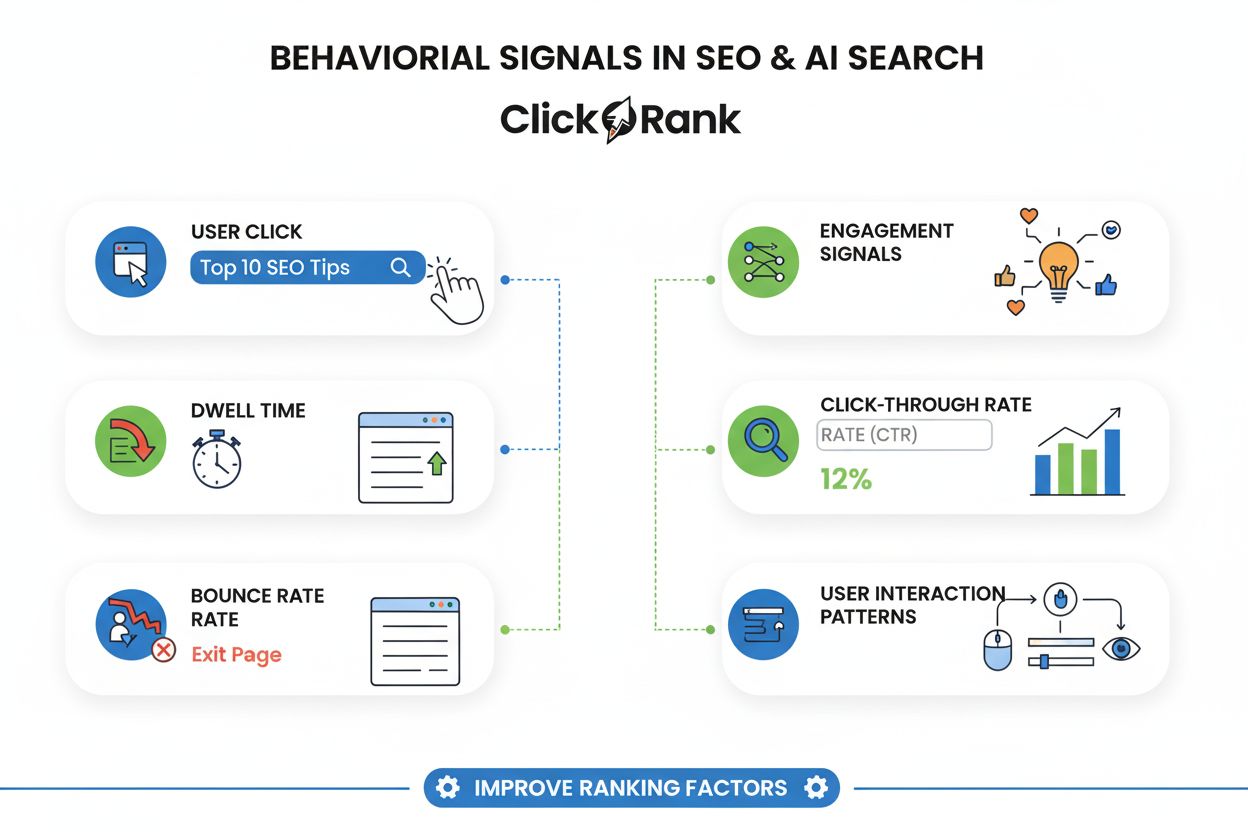
Behavioral Signal
Behavioral signals measure user interactions like CTR, dwell time, and bounce rate. Learn how user action patterns affect SEO rankings and AI search visibility ...
22 min read
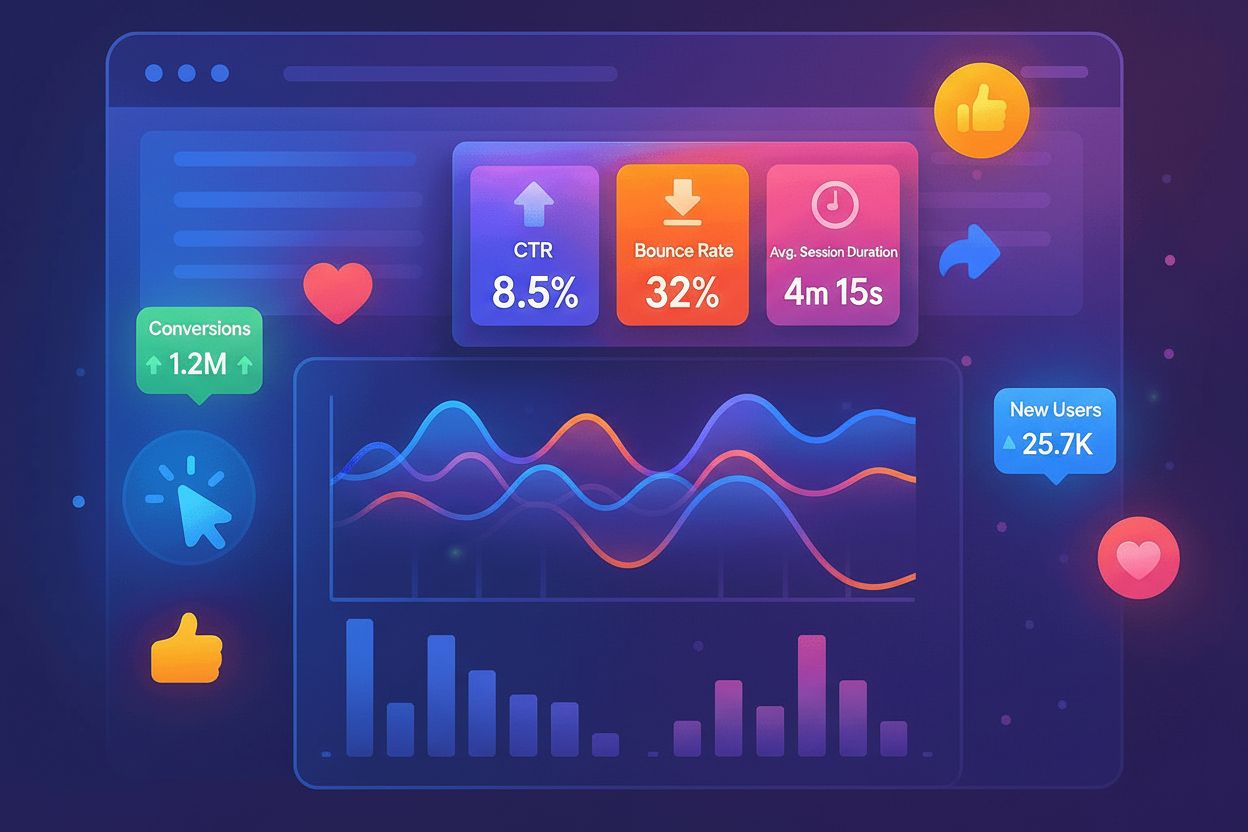
An engagement signal is a measurable indicator of user interaction with digital content, products, or services, including metrics such as clicks, time spent, comments, shares, and conversion actions. These signals help search engines, AI systems, and businesses understand user satisfaction, content relevance, and the effectiveness of digital experiences in driving meaningful user behavior.
An engagement signal is a measurable indicator of user interaction with digital content, products, or services, including metrics such as clicks, time spent, comments, shares, and conversion actions. These signals help search engines, AI systems, and businesses understand user satisfaction, content relevance, and the effectiveness of digital experiences in driving meaningful user behavior.
An engagement signal is a measurable indicator of how users interact with digital content, products, or services across websites, applications, social media platforms, and AI search engines. These signals encompass a wide range of user behaviors including clicks, time spent on pages, comments, shares, conversions, and repeat visits. Engagement signals serve as critical data points that help search engines, AI systems, and businesses understand whether content is valuable, relevant, and satisfying to users. In the context of modern digital marketing and AI monitoring, engagement signals have become increasingly important as they directly influence how content is ranked, recommended, and cited by artificial intelligence systems like ChatGPT, Perplexity, Claude, and Google AI Overviews. The primary purpose of tracking engagement signals is to measure the quality of user experiences and the effectiveness of digital strategies in driving meaningful interactions that lead to business outcomes.
The concept of engagement signals emerged in the early 2000s as search engines began moving beyond simple keyword matching to understand user satisfaction. Google’s introduction of click-through rate (CTR) and bounce rate as ranking factors marked a fundamental shift in how search algorithms evaluated content quality. Over the past two decades, engagement metrics have evolved from basic page view counts to sophisticated behavioral analytics that track user intent, satisfaction, and conversion likelihood. According to industry research, approximately 78% of enterprises now use AI-driven content monitoring tools to track how their brands appear in AI-generated responses, making engagement signals essential for understanding visibility in AI search results. The rise of artificial intelligence has further transformed engagement signal analysis, as AI systems now analyze engagement patterns to determine content authority, relevance, and trustworthiness. Modern engagement signals have become bidirectional indicators—they both reflect user satisfaction and influence algorithmic decisions about content visibility and citation frequency.
Website and Digital Property Engagement Signals include metrics that measure how users interact with web pages and digital properties. Click-through rate (CTR) measures the percentage of users who click on a link or call-to-action relative to total impressions, indicating how compelling content or messaging is to users. Bounce rate represents the percentage of visitors who leave a website after viewing only one page, suggesting either high satisfaction (if users found what they needed) or poor engagement (if content didn’t meet expectations). Session duration and time on page measure how long users spend engaging with content, with longer durations typically indicating higher interest and engagement. Pages per session shows how deeply users explore a website, while scroll depth reveals how much of a page’s content users actually consume before leaving.
Social Media Engagement Signals are particularly visible and measurable across platforms like Facebook, Instagram, Twitter, LinkedIn, and TikTok. These include likes, which represent basic approval or interest; comments, which indicate deeper engagement and discussion; shares, which extend content reach and suggest high value; and follower growth, which reflects audience expansion and loyalty. Social media listening metrics track mentions, sentiment analysis, and conversations about brands, providing qualitative insights into how audiences perceive and discuss content. According to recent data, social media engagement rates have increased by 23% year-over-year as brands invest more in authentic community building and interactive content strategies.
Conversion-Related Engagement Signals measure actions that directly impact business outcomes. Conversion rate tracks the percentage of users who complete desired actions such as purchases, sign-ups, or form submissions. Cart abandonment rate specifically measures e-commerce engagement by showing the percentage of users who add items to shopping carts but don’t complete purchases. Feature adoption rate indicates how quickly and widely users embrace new product features, while customer retention rate measures the percentage of customers who continue using a service over time. These signals are particularly important for understanding not just engagement, but the quality of engagement that translates to revenue and business growth.
The emergence of AI search engines has created a new category of engagement signals that directly impact brand visibility in AI-generated responses. AI citation frequency measures how often AI systems reference your content in responses to user queries, serving as a direct indicator of content authority and relevance. Dwell time on AI-cited content shows how long users spend reading content that was recommended by AI systems, indicating whether the AI’s recommendation was accurate and valuable. Click-through rates from AI responses measure how many users click through from AI-generated citations to your original content, reflecting both the quality of the AI’s recommendation and the appeal of your content. Engagement signals in AI contexts are fundamentally different from traditional SEO signals because they measure interaction with content that has already been filtered and recommended by artificial intelligence systems.
Platforms like AmICited specialize in tracking these AI-specific engagement signals across multiple AI search engines simultaneously. By monitoring how your brand appears in responses from ChatGPT, Perplexity, Google AI Overviews, and Claude, businesses can understand their competitive position in the AI search landscape. The data shows that brands appearing in AI responses with high engagement signals receive approximately 3-5 times more traffic compared to brands that don’t appear in AI search results, making engagement signal optimization critical for modern digital strategy.
| Signal Type | Website/SEO | Social Media | AI Search Engines | Measurement Method |
|---|---|---|---|---|
| Click-Through Rate | Measures clicks on links/CTAs | Measures clicks on posts/links | Measures clicks from AI citations | Analytics tools, Google Search Console |
| Time Spent | Session duration, time on page | Video watch time, story views | Dwell time on cited content | Web analytics, session tracking |
| Sharing/Distribution | Social shares, backlinks | Shares, retweets, reposts | AI citation frequency, inclusion in responses | Social monitoring, AI tracking platforms |
| User Feedback | Comments, reviews | Comments, reactions, DMs | User satisfaction with AI recommendations | Surveys, feedback tools, sentiment analysis |
| Conversion Actions | Purchases, sign-ups, form submissions | Link clicks, profile visits | Content engagement leading to conversions | Conversion tracking, CRM integration |
| Repeat Engagement | Return visitor rate, repeat purchases | Follower growth, repeat interactions | Repeated citations, content authority | User tracking, analytics dashboards |
| Sentiment/Quality | Bounce rate, exit rate | Comment sentiment, engagement quality | Content relevance scores, citation context | Sentiment analysis, AI evaluation |
Engagement signals are collected through multiple technical mechanisms that work together to create comprehensive user behavior profiles. First-party data collection occurs when websites use analytics tools like Google Analytics, Hotjar, or Contentsquare to directly track user interactions on their properties. These tools use JavaScript tracking codes to monitor page views, clicks, scroll depth, form submissions, and other user actions. Third-party data collection involves platforms like social media networks and AI search engines that track user behavior across their ecosystems, measuring how users interact with content recommendations and citations.
Event tracking is a sophisticated method where specific user actions are tagged and measured, allowing businesses to understand not just that engagement occurred, but what type of engagement and in what context. For example, a business might track “video play,” “form submission,” “product view,” and “add to cart” as separate events, each providing different insights into user intent and satisfaction. Behavioral analytics platforms like Amplitude and Mixpanel aggregate these events to create user journey maps showing how engagement signals connect to business outcomes. The integration of machine learning algorithms now allows platforms to predict which engagement signals are most likely to lead to conversions, helping businesses prioritize optimization efforts on the metrics that matter most.
Engagement signals have become increasingly important ranking factors in both traditional search engines and AI systems. Google’s algorithm updates over the past five years have placed greater emphasis on Core Web Vitals and user experience metrics, which are essentially engagement signals that measure page performance and user satisfaction. Research indicates that pages with higher engagement signals rank 2-3 positions higher on average compared to pages with lower engagement, demonstrating the direct correlation between user interaction and search visibility.
For AI search engines, the relationship is even more direct. AI systems use engagement signals to evaluate content quality and authority, determining which sources to cite in responses. When users engage heavily with content that was recommended by an AI system, it signals to the AI that the recommendation was accurate and valuable, increasing the likelihood that the AI will cite that source again in future responses. This creates a positive feedback loop where high engagement signals lead to more AI citations, which in turn drive more traffic and engagement. Conversely, content that receives low engagement signals from AI-recommended traffic may be deprioritized in future AI responses, reducing visibility in the AI search landscape.
Different digital platforms weight and measure engagement signals differently, requiring tailored optimization strategies. On Google Search, engagement signals like CTR and dwell time influence rankings, but the search engine also considers traditional ranking factors like backlinks and content quality. On social media platforms like Instagram and TikTok, engagement signals like likes, comments, and shares directly determine content visibility through algorithmic feeds that prioritize highly-engaged content. On AI search engines like ChatGPT and Perplexity, engagement signals primarily influence whether your content is cited in future responses, rather than directly affecting ranking position since AI responses are generated dynamically rather than ranked from a static index.
For brands using AmICited to monitor AI visibility, understanding these platform-specific differences is crucial. A piece of content might receive high engagement signals on social media but low engagement when cited by AI systems, or vice versa. This suggests that the content resonates with social audiences but may not be authoritative or relevant enough for AI systems to cite frequently. By analyzing engagement signals across all platforms simultaneously, brands can identify which content types and topics perform best in each context and optimize their content strategy accordingly.
The definition and importance of engagement signals continue to evolve as technology advances and user behavior changes. Emerging engagement signal categories include voice search interactions, where engagement is measured by how often users interact with voice-activated content and how long they listen to audio responses. Video engagement signals are becoming increasingly sophisticated, measuring not just watch time but also viewer attention patterns, pause points, and completion rates. AI-generated content engagement is a new frontier, where engagement signals measure how users interact with content created or summarized by AI systems, which will influence how AI systems evaluate and cite human-created content.
Privacy-first engagement signal tracking is another significant trend, as regulations like GDPR and CCPA limit third-party data collection. Businesses are increasingly relying on first-party data and privacy-compliant analytics to measure engagement, which may change how engagement signals are collected and interpreted. The integration of behavioral economics and psychology into engagement signal analysis is helping businesses understand not just what users do, but why they do it, enabling more sophisticated optimization strategies. As AI systems become more prevalent in search and content discovery, engagement signals will likely become the primary mechanism through which AI systems evaluate content quality and authority, making their optimization essential for all digital marketing strategies.
The ultimate value of engagement signals lies in their correlation with business outcomes. Research shows that high engagement signals correlate with 40-60% higher customer lifetime value compared to low engagement, demonstrating that engaged users are more valuable long-term customers. Conversion rates increase by an average of 25-35% when businesses optimize for engagement signals, as engaged users are more likely to complete desired actions. Customer retention rates improve by 20-30% when engagement signals are consistently high, indicating that engaged users develop stronger loyalty to brands and products.
For AI monitoring specifically, brands that appear in AI responses with high engagement signals see 3-5x more traffic from AI search compared to brands with low engagement signals. This demonstrates that engagement signal optimization is not just about traditional search engine optimization, but about ensuring your content is valuable enough that AI systems recommend it and users find those recommendations helpful. The ROI of engagement signal optimization extends beyond immediate conversions to include brand authority, customer loyalty, and long-term competitive advantage in an increasingly AI-driven search landscape.
Direct ranking factors immediately and directly impact search rankings, such as keywords or backlinks, while engagement signals are indirect indicators of user satisfaction and content value. Engagement signals like click-through rate, bounce rate, and time on page show search engines that users find content valuable, which can influence rankings over time. Both are important for SEO success, but direct factors have more immediate impact while engagement signals reflect user behavior patterns.
Engagement signals are critical for AI brand monitoring platforms like AmICited because they indicate how often and how meaningfully users interact with brand content across AI search engines like ChatGPT, Perplexity, and Google AI Overviews. Higher engagement signals suggest that AI systems are citing and recommending your content more frequently, which improves brand visibility in AI-generated responses. Monitoring these signals helps brands understand their presence and influence in AI search results.
The most important engagement signals include click-through rate (CTR), bounce rate, session duration, pages per session, conversion rate, scroll depth, and return visitor rate. For social media, engagement signals include likes, comments, shares, and follower growth. For AI monitoring, tracking how often your content appears in AI responses and how users interact with those citations is increasingly important for understanding brand visibility in AI-generated content.
Businesses can improve engagement signals by creating high-quality, relevant content that addresses user needs, optimizing page load speed and mobile responsiveness, using clear calls-to-action, maintaining consistent posting schedules, and engaging authentically with their audience. A/B testing different content formats, improving user experience design, and gathering direct user feedback through surveys help identify what resonates with audiences and drives meaningful interactions.
Engagement signals are crucial for AI content monitoring because they demonstrate content quality and user trust to AI systems. When users engage with your content (clicking, sharing, spending time), it signals to AI algorithms that your information is valuable and authoritative. This increases the likelihood that AI systems will cite your content in responses, improving your brand's visibility in AI search results and helping platforms like AmICited track your brand mentions across AI engines.
While the core concept of engagement signals remains consistent, different AI platforms may weight them differently. ChatGPT and Claude focus on content quality and relevance, Perplexity emphasizes source credibility and citation frequency, and Google AI Overviews prioritize content that matches search intent and user satisfaction metrics. Understanding these platform-specific differences helps brands optimize their content strategy for maximum visibility across all AI search engines.
While engagement signals can theoretically be manipulated through bot activity or artificial interactions, legitimate analytics platforms and AI systems have sophisticated detection mechanisms to identify and filter out fraudulent engagement. Authentic engagement signals generated through genuine user interactions are far more valuable and sustainable than artificial metrics, as they reflect real user satisfaction and content quality that AI systems ultimately reward with higher visibility and citations.
Start tracking how AI chatbots mention your brand across ChatGPT, Perplexity, and other platforms. Get actionable insights to improve your AI presence.
Behavioral signals measure user interactions like CTR, dwell time, and bounce rate. Learn how user action patterns affect SEO rankings and AI search visibility ...
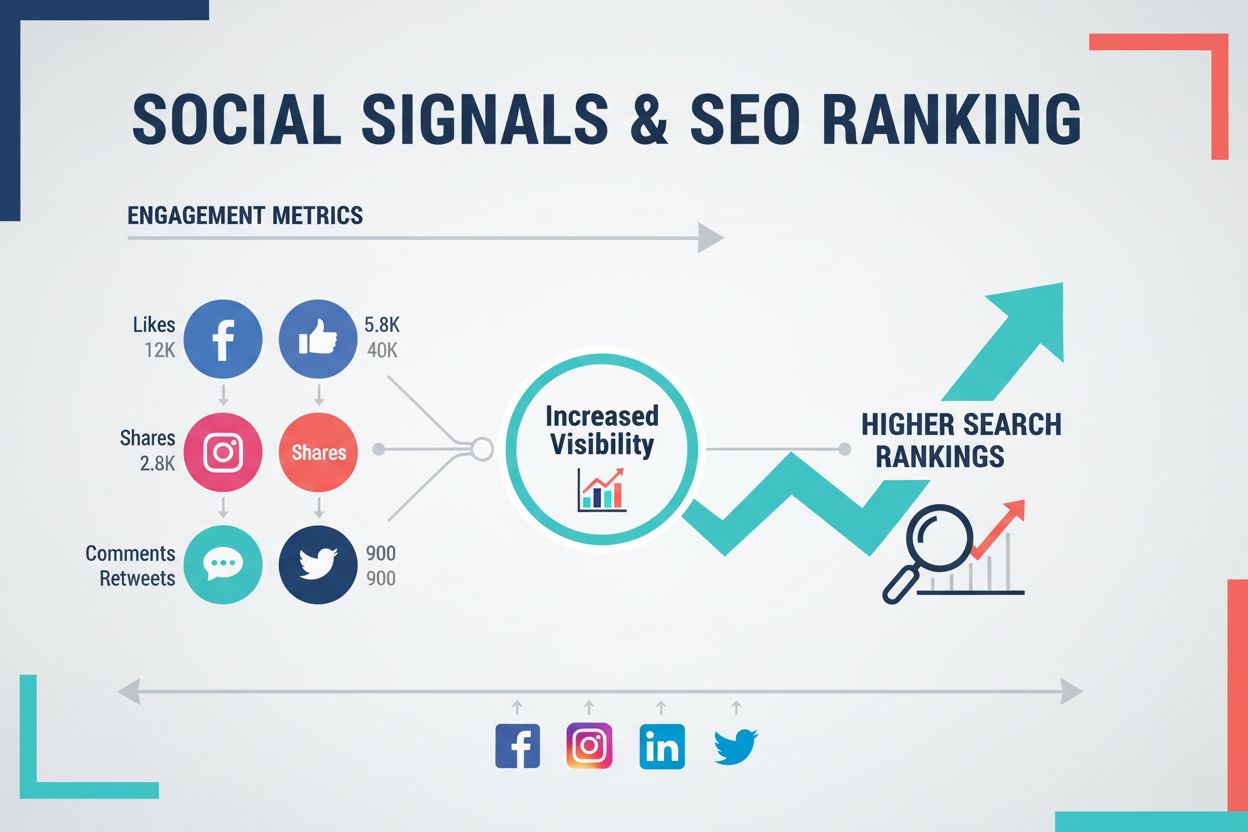
Learn what social signals are, how they impact SEO rankings, and their role in AI monitoring. Explore likes, shares, comments, and engagement metrics across pla...

Relevance signals are indicators that AI systems use to evaluate content applicability. Learn how keyword matching, semantic relevance, authority, and freshness...
Cookie Consent
We use cookies to enhance your browsing experience and analyze our traffic. See our privacy policy.