

How to Implement FAQ Schema for AI: Complete Guide 2025
Learn how to implement FAQ schema for AI search engines. Step-by-step guide covering JSON-LD format, best practices, validation, and optimization for AI platfor...
11 min read
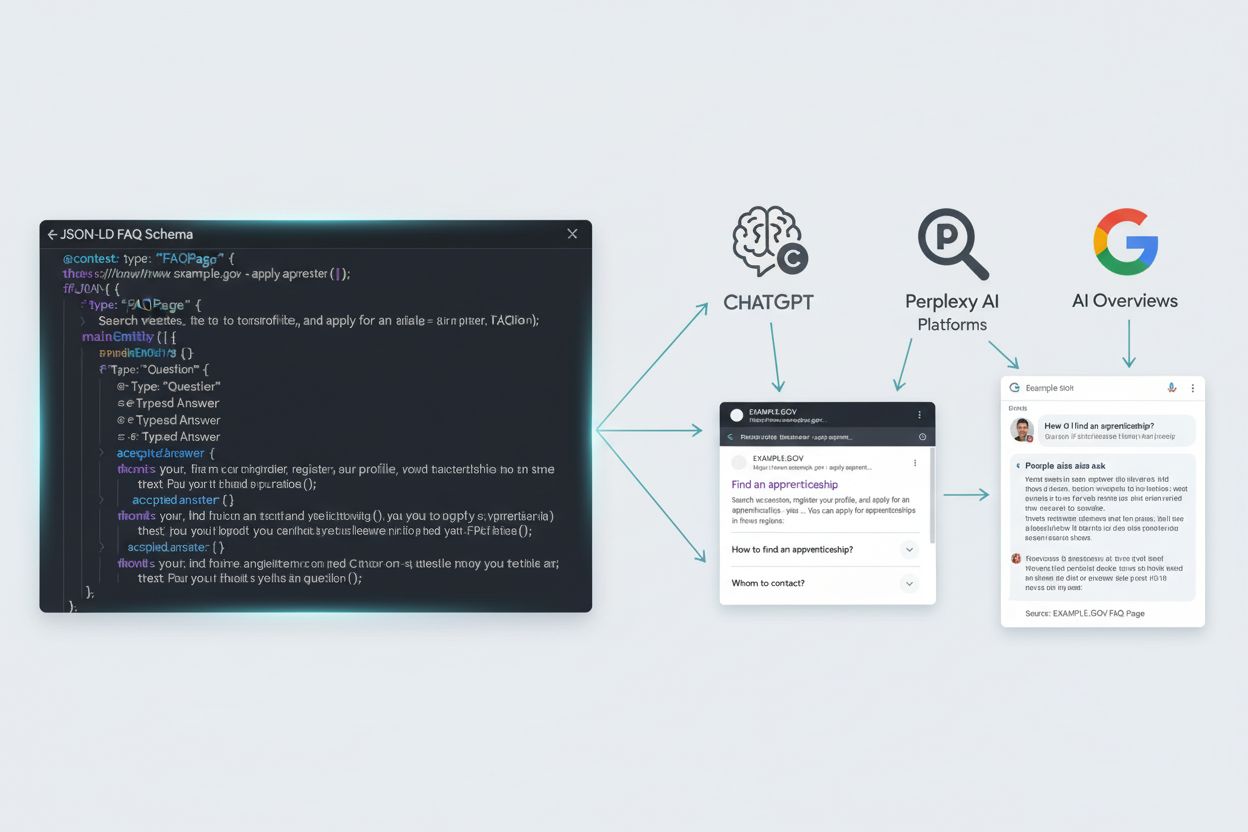
FAQ Schema (FAQPage) is structured data markup using JSON-LD format that helps search engines and AI platforms understand question-answer relationships on web pages. It enables content to appear in rich search results and be cited by AI systems like ChatGPT, Perplexity, and Google AI Overviews.
FAQ Schema (FAQPage) is structured data markup using JSON-LD format that helps search engines and AI platforms understand question-answer relationships on web pages. It enables content to appear in rich search results and be cited by AI systems like ChatGPT, Perplexity, and Google AI Overviews.
FAQ Schema (formally known as FAQPage in the Schema.org vocabulary) is a type of structured data markup that explicitly labels questions and answers on web pages using JSON-LD format. It helps search engines and AI platforms understand the relationship between questions and their corresponding answers, enabling these systems to extract, verify, and cite your content more accurately. Unlike unstructured content where AI systems must interpret relationships through natural language processing, FAQ Schema provides machine-readable metadata that clearly signals: “This is a question. This is the authoritative answer. These elements are related.” This explicit labeling removes interpretive burden and significantly increases the likelihood of accurate extraction and citation across search engines and AI platforms.
FAQ Schema was introduced by Google in 2019 as a way to help search engines better understand and display frequently asked questions in search results. The markup quickly gained traction across industries—from e-commerce to SaaS, healthcare to finance—as websites recognized the immediate benefits of increased visibility and higher click-through rates. By 2021, FAQ Schema had been implemented across millions of web pages globally, becoming one of the most popular structured data formats among SEO professionals. The schema represented a significant shift in how content creators approached search optimization, moving beyond traditional keyword targeting toward semantic understanding of content relationships.
However, the landscape changed dramatically in August 2023 when Google announced a pivotal restriction: FAQ rich results would be limited to “well-known, authoritative government and health websites.” This decision reflected Google’s concerns about widespread misuse of the markup—keyword-stuffed questions, irrelevant content, and duplicated information that didn’t genuinely help searchers. By early 2024, Google had effectively discontinued FAQ rich results for most domains, though the structured data itself remained valid. This shift marked a critical turning point in FAQ Schema’s role within SEO strategy, transitioning it from a traditional search visibility tactic to an AI search optimization essential.
Proper FAQ Schema implementation requires understanding the specific JSON-LD structure that search engines and AI platforms recognize. The markup consists of three primary components: the FAQPage type (which identifies the page as containing FAQs), Question objects (containing the “name” property with the actual question text), and Answer objects (containing the “text” property with the response). Each Question must have exactly one acceptedAnswer, distinguishing FAQ Schema from QAPage (used for community Q&A where multiple answers exist) or HowTo Schema (used for step-by-step instructional content).
The technical architecture of FAQ Schema reflects how AI systems process information. When you implement FAQPage markup, you’re providing explicit semantic relationships that large language models can parse directly without ambiguity. Research shows that 78% of AI-generated answers include list formats, and FAQ Schema naturally structures content as question-answer pairs—the exact format AI platforms present to users. This structural alignment makes FAQ content inherently suitable for AI citation. The schema supports HTML formatting within answer text, allowing for links, lists, and emphasis tags that enhance readability while maintaining machine-readability.
| Aspect | FAQ Schema (FAQPage) | QA Page Schema | HowTo Schema | Article Schema |
|---|---|---|---|---|
| Best For | Single answer per question | Multiple user-submitted answers | Step-by-step instructions | News, blog posts, articles |
| Answer Structure | One accepted answer | Multiple answers possible | Sequential steps with actions | Narrative content flow |
| Use Case Example | Product support FAQs | Stack Overflow, Quora | Recipe instructions, tutorials | News articles, blog posts |
| AI Citation Rate | Highest among schema types | Medium (community-dependent) | High (procedural content) | High (authoritative sources) |
| Google Rich Results | Restricted (gov/health only) | Not eligible for rich results | Eligible for rich results | Eligible for rich results |
| Ideal Answer Length | 40-60 words | Variable (user-dependent) | 100-200 words per step | 150+ words per section |
| Platform Preference | ChatGPT, Perplexity, Google AI | Limited AI adoption | Google Assistant, voice search | All major AI platforms |
| Visibility in SERPs | Minimal (post-2023) | Minimal | Featured snippets | Featured snippets, carousels |
The shift from traditional search to AI-powered answer engines has fundamentally transformed content strategy and the role of FAQ Schema within it. AI-referred sessions jumped 527% between January and May 2025, according to Search Engine Land, fundamentally changing how users discover information. Instead of clicking through search results, users now receive direct answers from ChatGPT, Perplexity, and Google’s AI Overviews—making FAQ Schema the critical bridge between your content and AI citations. This transformation represents a paradigm shift: success is no longer measured primarily by search rankings and clicks, but by citation frequency in AI-generated responses.
FAQ Schema has one of the highest citation rates among all schema types in AI-generated answers because the question-answer format mirrors how AI platforms present information to users. When AI systems encounter properly structured FAQ data, they can extract answers directly without requiring complex natural language processing to infer relationships. This reliability makes FAQ content inherently trustworthy to AI algorithms. Additionally, FAQ answers must be self-contained to work effectively in AI search—unlike traditional content where context builds paragraph by paragraph, AI platforms extract individual Q&As without surrounding content. This requirement actually improves content quality for human readers too, forcing writers to create comprehensive, standalone answers that make sense independently.
Different AI search platforms exhibit distinct citation patterns and content preferences that affect how FAQ Schema should be optimized. ChatGPT demonstrates a strong preference for encyclopedia-style, well-structured content, with Wikipedia accounting for 47.9% of total ChatGPT citations according to GEO research. This reveals ChatGPT’s preference for neutral, authoritative, comprehensively structured information. FAQ Schema aligns perfectly with these preferences because it explicitly labels questions and answers similar to how Wikipedia structures its content sections. To optimize FAQ content for ChatGPT visibility, maintain an objective, informational tone rather than promotional language, ensure each answer is self-contained with full context, and include specific statistics, dates, and quantified claims with proper source attribution.
Perplexity AI takes a distinctly different approach, with Reddit accounting for 6.6% of Perplexity citations—a much higher percentage than other AI platforms. This signals Perplexity’s preference for authentic, experience-based, conversational content rather than purely encyclopedia-style information. For Perplexity optimization, write questions the way real people ask them in everyday language, include specific scenarios and customer experiences in FAQ answers, maintain a slightly more personal, helpful voice (like an expert friend explaining something), and emphasize practical actionability with clear next steps. Google AI Overviews takes a domain-agnostic approach, pulling from featured snippet content and pages with strong E-E-A-T signals. Optimization should focus on featured snippet alignment (40-60 word answers), E-E-A-T signals (author credentials, publication dates, external citations), mobile-first content design, and combined schema types (FAQ + Article + Organization) for enhanced authority signals.
Implementing FAQ Schema effectively requires following specific guidelines that ensure both search engine recognition and AI platform compatibility. One answer per question is fundamental—FAQ Schema should only be used where there is a single definitive answer to each question. If your page has a single question but multiple users can submit alternative answers (like a forum), use QAPage Schema instead. Don’t use FAQ Schema for “How To” content—while it may seem applicable, the FAQ Schema isn’t meant for step-by-step instructional content. Use the designated HowTo schema type for this purpose. Avoid using the markup for advertising purposes—Schema is meant to give search engines more context about your pages’ content and offer users a direct line to valuable information. Using FAQ Schema for promotional purposes violates Google’s guidelines and teaches AI platforms to distrust your domain.
Avoid repetitive FAQ content across multiple pages—if the same question and answer appear on multiple pages on your site, implement that specific FAQ Schema only once for the entire site. A web crawler can help spot these duplicate questions. Ensure all content is visible to users—Google’s structured data guidelines explicitly prohibit schema markup for content not visible to users. If FAQ content exists only in your schema markup but isn’t actually displayed on the page, AI platforms may ignore the schema entirely or flag your domain for spam. Accordion-style FAQ sections where questions are visible and answers expand on click are acceptable; CSS display: none or visibility: hidden applied to FAQ content is not. Answer questions entirely—both the question and answer need to be written out in completion in your schema code. After all, the entire question and answer may be shown as a rich result or cited by AI, so there can’t be any fragments or incomplete information.
While Google restricted FAQ rich results, FAQ Schema still significantly increases your chances of appearing in featured snippets—the “position zero” answer boxes above organic results. Research from Search Engine Land indicates that pages with FAQ Schema are more likely to win featured snippets for question-based queries compared to equivalent pages without structured Q&A markup. The schema helps Google identify the best answer to extract and display, effectively signaling to the algorithm: “This is a complete, authoritative answer to this specific question.” Featured snippets remain valuable for several reasons: they capture voice search answers (critical as voice queries continue growing), appear prominently on mobile where screen space is premium, establish authority and trust with users, drive click-through for deeper information, and feed data to Google AI Overviews.
Voice search optimization through FAQ Schema has become increasingly important as smart speakers and voice assistants proliferate. When someone asks their device a question, the assistant searches for concise, self-contained answers—exactly what properly structured FAQ Schema provides. Voice assistants like Siri, Alexa, and Google Assistant pull answers from structured FAQ data, making FAQ Schema implementation essential for voice search visibility. The question-answer format naturally aligns with how people ask questions conversationally to voice assistants, making FAQ content inherently suitable for voice search optimization. As voice search continues to grow—particularly for local queries, product information, and quick answers—FAQ Schema becomes a critical component of a comprehensive voice search strategy.
Hiding FAQ content from users represents one of the most critical mistakes that blocks AI citations. Google’s structured data guidelines explicitly prohibit schema markup for content not visible to users, and this rule extends to AI platform treatment of FAQ Schema. If FAQ content exists only in your schema markup but isn’t actually displayed on the page, AI platforms may ignore the schema entirely or flag your domain for spam. What counts as “hidden” includes CSS display: none or visibility: hidden applied to FAQ content, FAQ text in schema that doesn’t appear anywhere in visible page content, content only loaded via JavaScript that bots can’t render, and FAQ sections placed far off-screen or behind complex interactions. What’s acceptable includes accordion-style FAQ sections where questions are visible and answers expand on click, tab interfaces where FAQ content exists in DOM but different tabs display different FAQs, mobile-responsive implementations that reorder content for different screen sizes, and FAQ content in page body even if it doesn’t appear in navigation menus.
Using FAQ Schema for marketing content rather than genuinely informational answers represents another critical mistake. Google and AI platforms distinguish between genuinely informational FAQ content and promotional material disguised as questions. Prohibited FAQ approaches include “Why is [Your Company] the best choice?” with an answer that’s just a sales pitch, “What makes [Your Product] revolutionary?” with marketing copy as the answer, and FAQ sections that exist purely to manipulate search rankings rather than help users. The distinction is clear: informational FAQs answer questions users genuinely have about your product or service. Marketing FAQs are thinly veiled advertisements with question marks. When in doubt, ask: “Would this FAQ answer satisfy someone who’s researching objectively, or does it only make sense as promotional content?” Only implement schema for genuinely helpful answers.
Writing vague or incomplete answers dramatically reduces citation probability. AI platforms prioritize factual, specific, data-backed content. Vague FAQ answers like “It’s very helpful,” “Many experts recommend it,” or “You’ll see significant improvements” provide no extractable facts for AI platforms to cite. Specific, cite-worthy answers include quantified claims with authoritative sources and links. Additionally, incomplete answers that prompt immediate follow-up questions reduce effectiveness. If your FAQ answer leaves users wanting more information, it’s incomplete. Ensure answers are self-contained with complete information, specific data, and external citations where appropriate—not dependent on surrounding content for comprehension.
Measuring FAQ Schema success has fundamentally shifted from traditional SEO metrics to AI search metrics. Traditional SEO measured FAQ Schema success through FAQ rich result impressions in Google Search Console and click-through rates from search results. AI search metrics focus on citation frequency in ChatGPT, Perplexity, and AI Overview answers. This represents a paradigm shift in how content teams should evaluate FAQ Schema ROI. Instead of asking “How many rich result impressions did we get?” teams should ask “How many times did our FAQ content get cited in AI-generated answers?” and “What percentage of AI responses about our topic include our content?”
Tracking AI citations requires different tools and approaches than traditional SEO monitoring. Platforms like AmICited enable brands to monitor where their FAQ content appears in ChatGPT, Perplexity, Google AI Overviews, and Claude—providing visibility into AI search performance. By tracking citation frequency over time, content teams can measure the direct impact of FAQ Schema implementation on AI visibility. Additionally, monitoring featured snippet appearances remains valuable, as featured snippets feed data to Google AI Overviews and represent a dual-benefit opportunity: improved visibility in traditional search AND increased probability of AI citation. For teams managing multiple FAQ implementations, using question research tools helps identify which questions to prioritize for maximum AI citation potential based on search volume and topical relevance.
The future of FAQ Schema is inextricably linked to the evolution of AI search and how generative engines continue to develop. As more users turn to ChatGPT, Perplexity, and Google AI Overviews for answers instead of traditional search results, FAQ Schema becomes table stakes for content visibility. The shift from “clicks” to “citations” as a primary content success metric is already underway, and this trend will accelerate. Early evidence suggests that dual optimization—creating content that performs well in both traditional search rankings AND AI-generated citations—delivers compounding returns. Content that ranks in Google’s top 10 and has proper FAQ Schema implementation achieves visibility in blue links, featured snippets, and AI Overviews, effectively dominating the search landscape for target queries.
AI platforms will likely continue to refine how they extract and cite FAQ content, potentially developing more sophisticated methods for identifying high-quality, authoritative FAQ sources. As AI systems become more sophisticated at detecting and penalizing low-quality or manipulative FAQ implementations, the importance of genuine, user-focused FAQ content will only increase. Additionally, as voice search and conversational AI queries become more prevalent, the question-answer format will become even more central to how users interact with search systems. Organizations that invest in high-quality FAQ Schema implementation today will be well-positioned to capture visibility across all major AI platforms as these technologies continue to evolve and mature.
FAQ Schema is structured data markup using JSON-LD format that explicitly labels questions and answers on web pages, helping search engines and AI platforms understand content relationships.
AI citation rates are highest for FAQ Schema among structured data types, with pages using FAQPage markup appearing significantly more frequently in ChatGPT, Perplexity, and Google AI Overviews than unstructured content.
Google restricted FAQ rich results in August 2023 to government and health sites, but FAQ Schema remains critical for featured snippets, voice search, and especially AI search optimization.
Platform-specific optimization matters—ChatGPT prefers neutral, authoritative content with citations; Perplexity favors conversational, experience-based answers; Google AI Overviews emphasizes E-E-A-T signals and mobile optimization.
Ideal FAQ answers are 40-60 words, self-contained with complete context, specific data, and external citations—not dependent on surrounding content for comprehension.
Common mistakes include hiding FAQ content from users, using FAQ Schema for marketing purposes, writing vague answers, and failing to validate schema markup before publishing.
Success measurement has shifted from traditional SEO metrics (rich result impressions) to AI search metrics (citation frequency in AI-generated answers).
The future of FAQ Schema is tied to AI search evolution—as AI-referred sessions continue growing exponentially, FAQ Schema implementation becomes increasingly essential for content visibility.
FAQ Schema (FAQPage) is structured data markup that uses JSON-LD format to explicitly label questions and their corresponding answers on web pages. It helps search engines and AI platforms understand the question-answer relationship, making it easier for these systems to extract, verify, and cite your content in generated responses. The schema acts as metadata that machines can read to identify Q&A structure regardless of page design or formatting variations.
Yes, but its value shifted from traditional SEO to AI search optimization. Google restricted FAQ rich results to government and health sites in August 2023, reducing visible FAQ snippets for most businesses. However, FAQ Schema remains critical for featured snippets, voice search, and especially AI search platforms like ChatGPT and Perplexity, which rely heavily on structured FAQ data for citations. The schema became more important for generative engine optimization even as it became less visible in traditional SERPs.
FAQ Schema has one of the highest citation rates among schema types in AI-generated answers because the question-answer format mirrors how AI platforms present information. Structured FAQ data removes interpretive burden from natural language processing, allowing AI to extract answers directly and cite sources accurately. Pages with FAQ Schema are 3.2x more likely to appear in Google AI Overviews compared to pages without FAQ structured data, according to Search Engine Land's 2024 analysis.
For traditional SEO, FAQ Schema aimed for rich results and featured snippets in Google search results. For GEO (Generative Engine Optimization) and AEO (Answer Engine Optimization), FAQ Schema enables AI platforms to extract, understand, and cite your content in generated answers across ChatGPT, Perplexity, and Google AI Overviews. The focus shifted from gaining clicks through visible rich results to earning citations in AI-generated responses that users read without clicking through to source sites.
Include 5-10 FAQ questions per page for pillar content. Fewer than 5 provides limited value for users and AI extraction opportunities; more than 10 can dilute focus and overwhelm readers. Quality matters more than quantity—answer real user questions comprehensively with 40-60 word responses that include specific data, external citations, and complete context. Use question research tools to identify which questions have actual search demand before implementing schema.
Yes, as long as FAQs are genuinely informational rather than promotional. Google's structured data guidelines prohibit FAQ Schema for advertising or marketing content. Focus on answering real customer questions about features, pricing, shipping, usage, compatibility, or support. Acceptable questions include 'What features are included?' or 'How does shipping work?' Unacceptable questions include 'Why should you buy now?' or 'Why are we the best?'
40-60 words is ideal for AI extraction, featured snippets, and user experience. Shorter answers (under 30 words) often lack sufficient context to stand alone. Longer answers (over 80 words) become difficult for AI platforms to extract cleanly as single units and harder for users to scan quickly. Ensure answers are self-contained with complete information, specific data, and external citations where appropriate—not dependent on surrounding content for comprehension.
Use Google Rich Results Test to validate JSON-LD syntax, detect missing properties, and preview how Google interprets your markup. Additionally, verify mobile rendering (where voice assistants operate), ensure questions match visible page headings exactly, test that answers are self-contained and comprehensive, and monitor whether your FAQ content appears in AI-generated answers over 2-4 weeks after implementation. Periodic revalidation after site updates prevents regression and ensures ongoing compatibility.
Start tracking how AI chatbots mention your brand across ChatGPT, Perplexity, and other platforms. Get actionable insights to improve your AI presence.
Learn how to implement FAQ schema for AI search engines. Step-by-step guide covering JSON-LD format, best practices, validation, and optimization for AI platfor...
Community discussion on FAQ schema implementation for AI visibility. Technical SEO professionals share experiences, implementation best practices, and impact on...
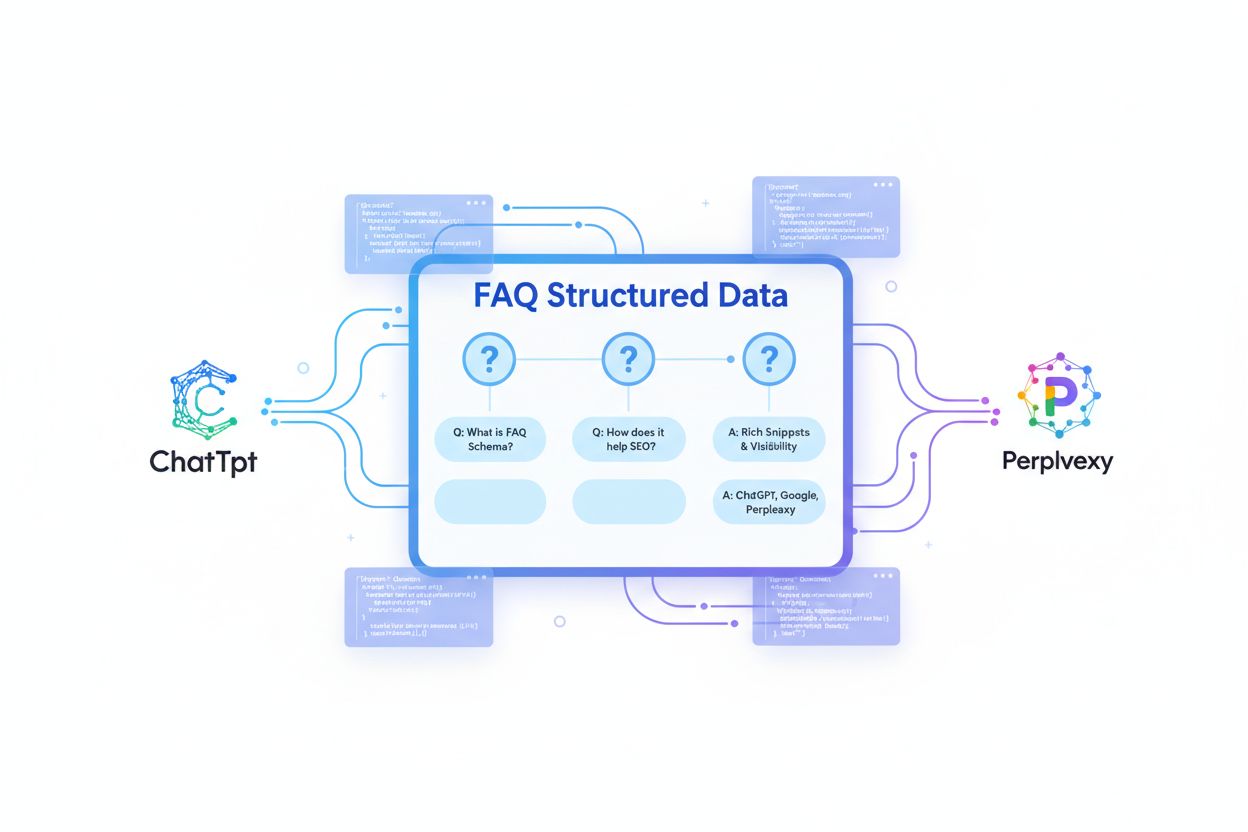
Learn how FAQ sections with proper schema markup improve visibility in AI-generated answers from ChatGPT, Perplexity, and Google AI Overviews. Optimize your con...