
How to Optimize for Position Zero: Featured Snippet Strategy
Learn proven strategies to optimize for position zero (featured snippets) on Google. Discover content structure, schema markup, keyword research, and technical ...
8 min read
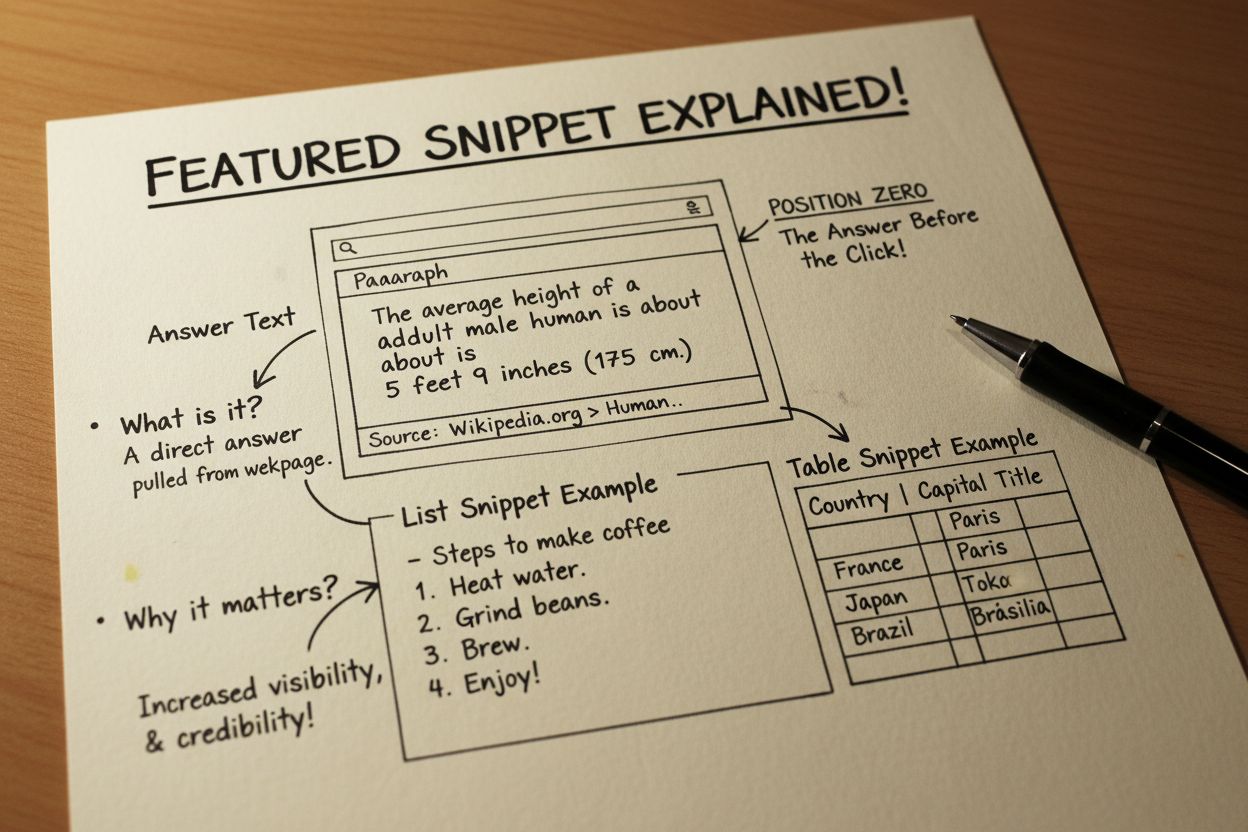
A featured snippet is a special search result box that appears at the top of Google’s organic search results (position zero), displaying a direct answer extracted from a web page in formats such as paragraphs, lists, tables, or videos. Featured snippets provide immediate answers to user queries and offer significant visibility opportunities for websites.
A featured snippet is a special search result box that appears at the top of Google's organic search results (position zero), displaying a direct answer extracted from a web page in formats such as paragraphs, lists, tables, or videos. Featured snippets provide immediate answers to user queries and offer significant visibility opportunities for websites.
A featured snippet is a special search result box that appears at the top of Google’s organic search results, commonly referred to as position zero. This highlighted search result displays a direct answer extracted from a web page, formatted to provide immediate solutions to user queries without requiring a click-through to the source website. Featured snippets represent one of the most valuable SERP features in modern search engine optimization, offering brands and content creators significant visibility opportunities. According to Google’s official documentation, these snippets are shown when Google determines that people want answers that can be found in a short piece of a website, making them particularly valuable for voice search and mobile queries where users seek quick, concise answers.
Featured snippets were introduced by Google in 2014 as part of a broader initiative to improve user experience by providing immediate answers to search queries. Since their introduction, they have become increasingly prevalent across Google’s search results, with approximately 19% of mobile search results in the US now displaying featured snippets according to recent studies. This widespread adoption reflects Google’s commitment to delivering faster, more relevant information to users. The evolution of featured snippets has been marked by significant changes, most notably the deduplication update in January 2020, when Google began removing duplicate URLs from organic results when a page appeared as a featured snippet. This change fundamentally altered the value proposition of featured snippets, shifting the focus from pure visibility gains to strategic positioning and user intent satisfaction. Today, featured snippets remain a critical component of SEO strategy, particularly as they bridge traditional search optimization and emerging AI search platforms that rely on similar answer-extraction methodologies.
Featured snippets occupy a unique position in Google’s search results hierarchy, appearing above all traditional organic listings but below paid advertisements and other premium SERP features like Knowledge Graphs. The positioning of featured snippets is determined by Google’s algorithms, which analyze hundreds of ranking factors to identify the most relevant and authoritative content for a given query. Research from Ahrefs reveals that 99% of featured snippets come from pages already ranking on Google’s first page, indicating that strong baseline rankings are essential for featured snippet eligibility. The technical implementation of featured snippets involves Google’s extraction of content from existing web pages, reformatting it into a standalone answer box that includes the page title, URL, and a snippet of the answer. This automated extraction process means that website owners cannot directly submit content for featured snippet consideration; instead, they must optimize their existing content to make it more likely that Google’s algorithms will select it. The nosnippet meta tag and max-snippet rules provide website owners with control over whether their content appears in featured snippets, offering a level of agency in managing their search visibility.
| Feature Type | Format | Best For | Typical Length | Click Impact |
|---|---|---|---|---|
| Paragraph Snippet | Text-based answer | Definition and explanation queries | 40-60 words | Moderate to High |
| Numbered List Snippet | Step-by-step instructions | How-to and process queries | 5-10 steps | High |
| Bulleted List Snippet | Unordered information | Feature lists and rankings | 5-8 items | Moderate |
| Table Snippet | Structured data | Comparison and data queries | 4+ rows | Moderate |
| YouTube Snippet | Video content | Visual and tutorial queries | Video clip | High |
| Carousel Snippet | Related keywords | Multi-faceted topics | Multiple refinements | Moderate |
| Knowledge Graph | Entity information | Brand and person queries | Variable | Low (no click) |
| Rich Answer | Instant answer | Factual queries | 1-2 lines | Very Low (no click) |
Featured snippets come in several distinct formats, each optimized for different types of user queries and content structures. The paragraph snippet, the most common type, displays a text-based answer typically ranging from 40 to 60 words. These snippets are ideal for answering “what is,” “why is,” and “how do” questions, providing users with concise definitions or explanations. The numbered list snippet presents step-by-step instructions, making it perfect for how-to queries, recipes, and process-oriented content. This format encourages users to click through to see accompanying images, detailed instructions, and additional context. The bulleted list snippet displays unordered information, commonly used for feature lists, best-of rankings, and comparative content. Unlike numbered lists, bulleted lists don’t imply a specific sequence, making them ideal for content that presents multiple options without hierarchical ordering. The table snippet showcases structured data in a tabular format, with Google sometimes reconstructing tables from source pages to display only the most relevant information. Research indicates that table snippets represent approximately 29% of all featured snippets, demonstrating their significant prevalence. Additionally, YouTube snippets extract video content to answer visual queries, while carousel snippets present related keyword suggestions that allow users to refine their search within the featured snippet itself.
The relationship between featured snippets and click-through rates (CTR) has been a subject of considerable debate within the SEO community. Early research from Ahrefs suggested that featured snippets slightly reduced overall clicks to organic results, as users often found their answers directly in the snippet without needing to visit the source page. However, more recent 2024 data reveals a more nuanced picture: featured snippets achieve a remarkable 67% click-through rate, making them among the highest-performing SERP features. This apparent contradiction can be explained by the nature of different query types and user intents. For some queries, the featured snippet provides a complete answer, resulting in a “no-click search” where users find what they need without clicking. For other queries, the featured snippet serves as a compelling preview that encourages users to visit the source page for more detailed information. The deduplication update of January 2020 further complicated this dynamic by removing duplicate URLs from organic results, meaning that pages appearing as featured snippets no longer occupy two positions on the first page. This change has made featured snippet optimization more strategic, requiring content creators to ensure that their featured snippet content is compelling enough to drive clicks despite providing an immediate answer.
Successfully optimizing for featured snippets requires a multi-faceted approach that combines keyword research, content structure, and technical implementation. The first step involves identifying keywords that already trigger featured snippets, as Google’s preference for certain query types makes these opportunities more accessible than attempting to create new featured snippet opportunities. Tools like Semrush, Ahrefs, and SEMrush allow marketers to filter keywords by featured snippet presence, streamlining the research process. Once target keywords are identified, content optimization should focus on providing direct, concise answers that match the featured snippet format most likely to appear for that query. For paragraph snippets, this means crafting a 40-60 word answer that directly addresses the user’s question, followed by supporting information that encourages further exploration. For list snippets, consistent formatting using proper HTML tags (H2, H3, ordered lists, unordered lists) is critical, as Google relies on these structural elements to identify and extract list content. For table snippets, presenting data in clean, well-organized HTML tables increases the likelihood of selection. Additionally, optimizing for long-tail keywords and variations of primary keywords is essential, as research shows that the majority of featured snippets appear for longer, more specific search queries. Incorporating People Also Ask questions into content strategy provides additional opportunities to capture multiple featured snippets on a single page.
The emergence of AI search platforms like ChatGPT, Perplexity, Google AI Overviews, and Claude has created new relevance for featured snippet optimization. These AI systems often employ similar answer-extraction methodologies to featured snippets, pulling concise, authoritative answers from web pages to provide direct responses to user queries. Understanding featured snippet optimization principles has become increasingly valuable for brands seeking visibility across both traditional search and AI-powered answer engines. The AmICited platform recognizes this convergence, tracking how brands and domains appear not only in featured snippets but also in AI-generated responses across multiple platforms. This expanded monitoring approach reflects the reality that featured snippets serve as a training ground for understanding how AI systems evaluate and extract information from web content. Brands that optimize for featured snippets are simultaneously positioning themselves for better visibility in AI search results, as the same qualities that make content suitable for featured snippets—clarity, conciseness, authority, and proper formatting—also make content attractive to AI systems seeking reliable source material.
The landscape of featured snippets continues to evolve as Google refines its algorithms and introduces new SERP features. Recent developments include Google’s enhancement of featured snippets with yellow highlighting of relevant text sections when users click through, improving the user experience and potentially increasing click-through rates. The integration of AI Overviews into Google’s search results represents a significant shift in how Google presents information, with some research indicating that keywords triggering both AI Overviews and featured snippets see the largest drop in CTR, with an average decrease of -37.04%. This suggests that as AI-generated summaries become more prevalent, the strategic value of featured snippets may shift from pure traffic generation to brand authority and citation tracking. Looking forward, featured snippet optimization will likely become increasingly intertwined with generative engine optimization (GEO) and answer engine optimization (AEO), as brands seek to maintain visibility across an expanding ecosystem of search and answer platforms. The fundamental principles of featured snippet optimization—providing clear, authoritative, well-structured answers to user questions—will remain relevant regardless of how search results continue to evolve. Organizations that invest in understanding and optimizing for featured snippets today are building a foundation for visibility across tomorrow’s search landscape, whether that landscape is dominated by traditional Google results, AI-powered answer engines, or a hybrid combination of both.
A featured snippet appears at the top of Google search results in position zero, above all organic listings, and displays a direct answer extracted from a web page. Regular search results appear below the featured snippet and require users to click through to find answers. Featured snippets are designed to provide immediate answers to user queries, while regular results are traditional blue links that users must visit to get information.
According to research from Search Engine Land, featured snippets capture approximately 8% of all clicks from search results. However, more recent 2024 data shows featured snippets achieve a remarkable 67% click-through rate when they appear. The actual traffic impact depends on whether the featured snippet satisfies user intent completely or encourages further exploration of the source page.
The primary types of featured snippets include paragraph snippets (text-based answers), numbered list snippets (step-by-step instructions), bulleted list snippets (unordered information), table snippets (structured data), YouTube snippets (video content), and carousel snippets (related keyword suggestions). Each type serves different user intents and search queries, with paragraph snippets being the most common format appearing in Google search results.
Yes, you can opt out of featured snippets using the nosnippet meta tag, which blocks both featured and regular snippets from your pages. Alternatively, you can use the max-snippet rule to limit snippet length, making it less likely (though not guaranteed) that Google will select your content for featured snippets. The nosnippet rule takes priority over other snippet-related directives.
Google's algorithms automatically analyze web pages to determine which content best answers a user's query. According to research, approximately 99% of featured snippets come from pages already ranking on Google's first page of results. Google considers factors like content relevance, formatting clarity, answer conciseness, and page authority when selecting featured snippet content.
Featured snippets serve as a foundational concept for AI search optimization, as AI platforms like ChatGPT, Perplexity, and Google AI Overviews often extract similar direct-answer formats. Understanding featured snippet optimization helps brands prepare for visibility across both traditional search and AI-powered answer engines, making it relevant to broader AI monitoring and citation tracking strategies.
In January 2020, Google implemented deduplication, removing the duplicate URL from organic results when a page appeared as a featured snippet. This change reduced the visibility advantage of featured snippets. More recently, Google has enhanced featured snippets by highlighting relevant text sections with yellow backgrounds when users click through, improving the user experience and potentially increasing click-through rates.
Content that directly answers specific questions with concise, well-structured information is most likely to rank as featured snippets. Paragraph snippets typically contain 40-60 words, while lists and tables with clear formatting perform well. Content that uses proper HTML tags (H2, H3, lists, tables), includes relevant keywords in headings, and provides immediate answers followed by supporting details has the highest probability of being selected.
Start tracking how AI chatbots mention your brand across ChatGPT, Perplexity, and other platforms. Get actionable insights to improve your AI presence.
Learn proven strategies to optimize for position zero (featured snippets) on Google. Discover content structure, schema markup, keyword research, and technical ...
Discover how featured snippets relate to AI systems, their impact on AI training, and how to optimize content for both traditional snippets and AI Overviews in ...
Position Zero (featured snippet) appears above organic results on Google SERPs, providing direct answers to queries. Learn how P0 impacts SEO, CTR, and AI searc...