
Readability Score
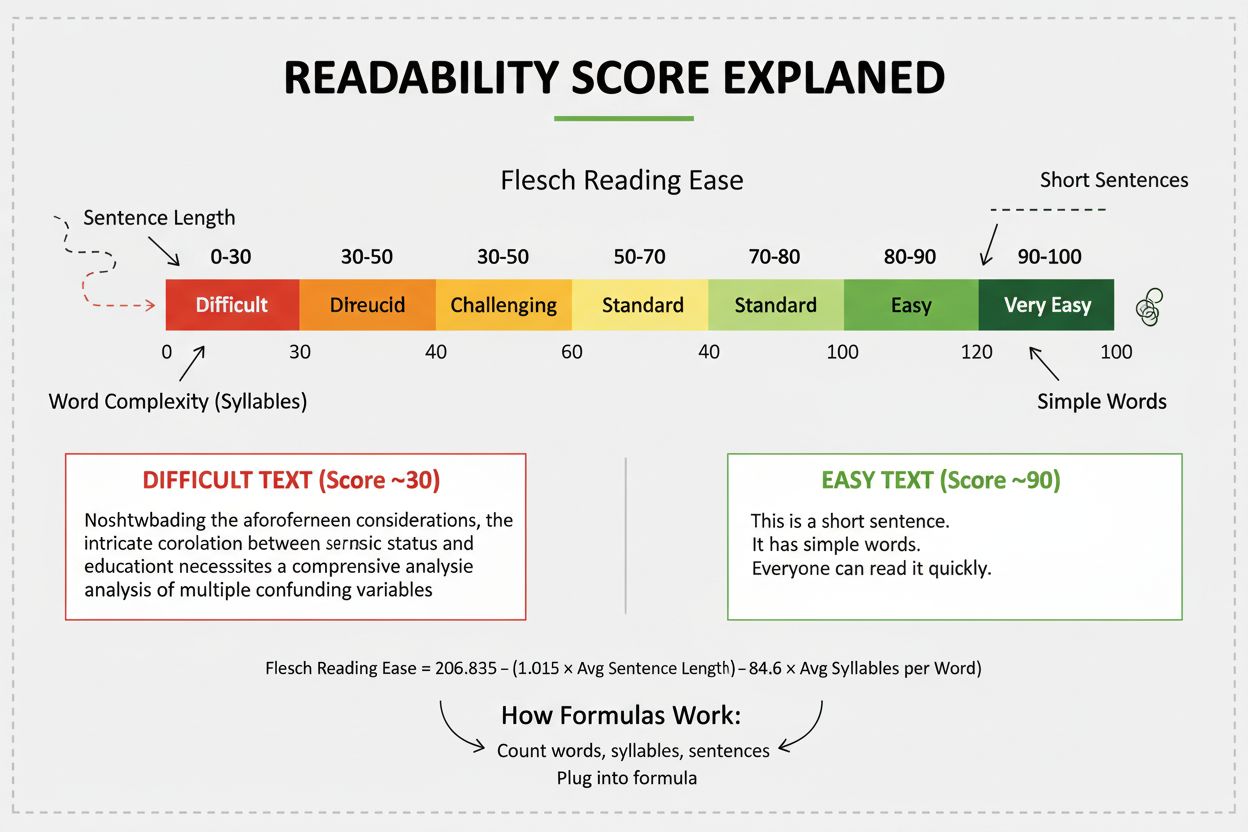
Readability score measures content comprehension difficulty using linguistic analysis. Learn how Flesch, Gunning Fog, and other formulas impact SEO, user engage...
12 min read
The Flesch Reading Ease is a quantitative readability measurement scale that scores text between 0 and 100, with higher scores indicating easier readability. Developed by Rudolf Flesch in 1948, it calculates readability based on average sentence length and syllables per word to determine the comprehension difficulty for readers.
The Flesch Reading Ease is a quantitative readability measurement scale that scores text between 0 and 100, with higher scores indicating easier readability. Developed by Rudolf Flesch in 1948, it calculates readability based on average sentence length and syllables per word to determine the comprehension difficulty for readers.
Flesch Reading Ease is a quantitative readability measurement scale that assigns text a score between 0 and 100, with higher scores indicating easier comprehension. Developed by Rudolf Flesch in 1948, this pioneering formula calculates readability by analyzing two fundamental text characteristics: average sentence length and average syllables per word. The metric has become one of the most widely recognized and utilized readability assessment tools across education, publishing, government, healthcare, and digital content creation. Over 70 years after its introduction, the Flesch Reading Ease remains embedded in mainstream writing tools like Microsoft Word, WordPress plugins such as Yoast SEO and AIOSEO, and specialized readability platforms like Readable and Hemingway Editor.
Rudolf Flesch, an Austrian-American writing consultant and passionate advocate of the Plain English Movement, created the Flesch Reading Ease formula in response to a critical problem he observed in professional communication. Working as a consultant for the Associated Press in the 1940s, Flesch recognized that newspapers, business documents, and government communications were unnecessarily complex and inaccessible to average readers. His groundbreaking article, “A New Readability Yardstick,” published in the Journal of Applied Psychology in 1948, introduced a mathematical formula that could objectively measure text readability without subjective judgment. This innovation democratized readability assessment, enabling any writer to quickly evaluate whether their content was comprehensible to their intended audience.
The formula’s adoption accelerated dramatically throughout the latter half of the 20th century. By the 1970s, the U.S. Navy adopted the Flesch Reading Ease to ensure that training manuals and technical documentation were clear enough for recruits to understand. Several U.S. states subsequently mandated that insurance policies, consumer contracts, and legal documents meet minimum Flesch Reading Ease thresholds to protect consumers from deliberately obscure language. When personal computers became ubiquitous in the 1980s and 1990s, Microsoft Word integrated the Flesch Reading Ease into its spelling and grammar checking tools, introducing the metric to millions of writers worldwide. This mainstream integration cemented the formula’s relevance and ensured its continued use in the digital age.
The Flesch Reading Ease formula is elegantly simple yet mathematically rigorous:
206.835 – (1.015 × Average Sentence Length) – (84.6 × Average Syllables per Word)
Understanding each component is essential for comprehending how the metric works. The constant 206.835 serves as a baseline score, establishing the maximum possible readability score. The coefficient 1.015 determines how significantly average sentence length (ASL) impacts the final score—longer sentences substantially reduce readability. The coefficient 84.6 weighs the impact of average syllables per word (ASW), reflecting Flesch’s research showing that word complexity (measured by syllable count) is a strong predictor of reading difficulty.
To calculate the score, writers must first determine the Average Sentence Length by dividing the total number of words by the total number of sentences. Next, they calculate the Average Syllables per Word by dividing the total number of syllables by the total number of words. Once these two values are obtained, they are substituted into the formula to produce a score between 0 and 100. For example, a text with an average sentence length of 15 words and an average of 1.5 syllables per word would score approximately 75, indicating “fairly easy” readability. Conversely, a text with an average sentence length of 25 words and 2.5 syllables per word would score approximately 35, indicating “difficult” readability suitable only for college-educated readers.
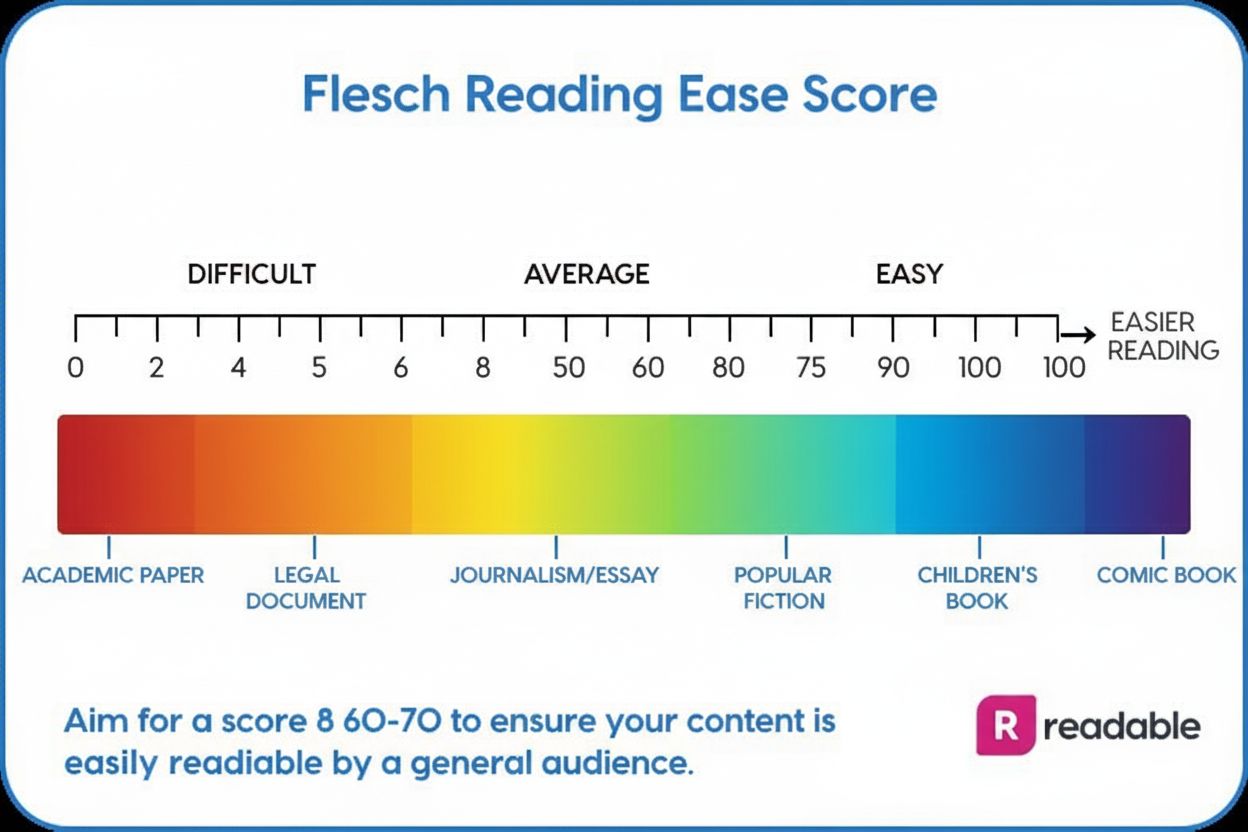
| Score Range | Readability Level | Grade Level | Target Audience | Comprehension Time |
|---|---|---|---|---|
| 90–100 | Very Easy | 5th grade | 11-year-old children | Immediate understanding |
| 80–89 | Easy | 6th grade | Middle school students | Quick comprehension |
| 70–79 | Fairly Easy | 7th grade | Teenagers (13-15 years) | Comfortable reading |
| 60–69 | Standard | 8th–9th grade | High school students | Average reading pace |
| 50–59 | Fairly Difficult | 10th–12th grade | College students | Requires focus |
| 30–49 | Difficult | College level | University graduates | Significant effort needed |
| 0–29 | Very Confusing | College graduate+ | Specialists and academics | Extensive re-reading required |
The Flesch Reading Ease operates on a fundamental principle: shorter sentences and simpler words make text easier to read. This principle is grounded in cognitive psychology and decades of readability research. When readers encounter long sentences with multiple clauses and complex vocabulary, their working memory becomes overloaded, requiring them to re-read passages and expend significant cognitive effort to extract meaning. Conversely, short sentences with common, single-syllable words allow readers to process information quickly and effortlessly.
The formula’s elegance lies in its ability to quantify this relationship mathematically. By measuring only two variables—sentence length and word complexity—Flesch created a metric that is both computationally simple and remarkably predictive of actual reading difficulty. Research has consistently demonstrated that texts scoring in the 60-70 range (standard readability) are comprehensible to approximately 80% of the adult population, while texts scoring below 30 are accessible only to readers with advanced education. The metric’s predictive power has been validated across thousands of studies and remains one of the most reliable readability indicators available.
In today’s digital landscape, readability directly influences business outcomes. Research from content marketing platforms indicates that web pages with higher readability scores experience significantly lower bounce rates, with visitors spending 25-40% more time on pages scoring 60-80 on the Flesch Reading Ease compared to pages scoring below 50. This extended engagement translates to increased conversion rates, higher click-through rates on calls-to-action, and improved customer retention. E-commerce platforms have documented that product descriptions optimized for readability (targeting 70-80 Flesch scores) generate 15-20% higher conversion rates than poorly optimized descriptions.
Beyond user engagement, readability impacts search engine optimization (SEO) and AI content citation. While search engines like Google do not directly rank pages based on Flesch Reading Ease scores, they do consider user engagement metrics (time on page, bounce rate, scroll depth) that are strongly correlated with readability. More importantly for modern content strategy, AI systems like ChatGPT, Perplexity, Google AI Overviews, and Claude prioritize readable, well-structured content when selecting sources for citations. Content with optimal readability scores is more likely to be extracted, summarized, and cited in AI-generated responses. This makes Flesch Reading Ease optimization critical for brands seeking visibility in AI search results and AI-powered answer engines.
Different platforms and industries have adopted varying Flesch Reading Ease targets based on their audiences and content types. News organizations typically target 60-70 to reach broad audiences, while academic publishers accept scores of 30-50 for specialized research content. Healthcare organizations are increasingly required to maintain scores of 60-80 for patient information materials to ensure accessibility and legal compliance. Government agencies often mandate minimum scores of 50-60 for public communications to ensure citizens can understand policies and procedures.
In the WordPress ecosystem, plugins like Yoast SEO and AIOSEO provide real-time Flesch Reading Ease feedback as writers compose content. These tools highlight sentences exceeding recommended length thresholds and flag complex vocabulary, enabling writers to optimize readability during the drafting process rather than after publication. Microsoft Word includes Flesch Reading Ease in its built-in readability statistics, accessible through the spelling and grammar checker. Specialized readability platforms like Readable, Hemingway Editor, and Grammarly provide detailed readability analysis including Flesch scores alongside other metrics like Flesch-Kincaid Grade Level, Gunning Fog Index, and SMOG Index.
Despite its widespread adoption and proven utility, the Flesch Reading Ease has notable limitations that content creators should understand. The formula measures only sentence length and word complexity, ignoring critical factors like sentence structure, word familiarity, conceptual difficulty, and contextual knowledge requirements. A text discussing quantum physics using simple, short sentences might score 80 on the Flesch scale while remaining incomprehensible to readers lacking physics background. Conversely, emotionally complex literary content with simple vocabulary might score high despite requiring mature emotional comprehension.
The metric also fails to account for visual design elements, formatting, typography, and multimedia integration—all of which significantly impact actual readability. A poorly formatted page with dense text blocks will feel less readable than a well-formatted page with identical Flesch scores. Additionally, the formula doesn’t distinguish between common words and rare words with identical syllable counts; a text using obscure three-syllable words might score identically to a text using common three-syllable words, despite vastly different actual readability.
To address these limitations, content professionals increasingly use complementary readability metrics alongside Flesch Reading Ease. The Flesch-Kincaid Grade Level provides grade-level interpretation, the Gunning Fog Index emphasizes complex words, the SMOG Index focuses on polysyllabic words, and the Automated Readability Index uses character counts instead of syllables. Dale-Chall Readability Score incorporates a list of 3,000 “easy” words, providing more nuanced vocabulary assessment. Using multiple metrics provides a more comprehensive readability profile than any single metric alone.
The Flesch Reading Ease continues to evolve in relevance as digital communication transforms. The rise of AI-generated content has created new urgency around readability optimization, as AI systems increasingly serve as content discovery and citation mechanisms. Research from SEO platforms indicates that content optimized for readability is 3-5 times more likely to be cited in AI-generated responses compared to poorly optimized content. This shift has elevated readability from a “nice-to-have” user experience feature to a critical SEO and AI visibility strategy.
Emerging trends suggest that readability metrics will become increasingly integrated with AI content scoring systems. Platforms like AmICited are developing sophisticated monitoring tools that track not only whether content appears in AI responses but also the quality signals (including readability) that influence AI citation decisions. As large language models (LLMs) become more sophisticated, they may develop more nuanced readability assessment capabilities beyond simple syllable and sentence counting. However, the fundamental principle underlying Flesch Reading Ease—that clarity and simplicity improve comprehension—will likely remain central to content optimization strategies for decades to come.
The future of readability assessment will likely involve hybrid approaches combining traditional metrics like Flesch Reading Ease with machine learning-based readability models that can assess semantic complexity, conceptual difficulty, and audience-specific comprehension. However, the Flesch Reading Ease will almost certainly remain a foundational metric due to its simplicity, transparency, and proven predictive validity. As content creators increasingly compete for visibility in AI search results and AI-powered answer engines, understanding and optimizing for Flesch Reading Ease will become as essential as traditional SEO optimization.
While both metrics use the same foundational elements (sentence length and syllables per word), they present results differently. Flesch Reading Ease produces a score from 0-100 where higher scores indicate easier reading, whereas Flesch-Kincaid Grade Level converts the score into a U.S. school grade level (e.g., 8th grade). Flesch-Kincaid was developed in the 1970s by the U.S. Navy to make readability scores more intuitive for educational contexts. Both formulas use different mathematical weightings, resulting in distinct interpretations of the same text.
AI systems like ChatGPT, Perplexity, and Google AI Overviews prioritize content clarity and accessibility when selecting sources for citations. Content with higher Flesch Reading Ease scores (60-80 range) demonstrates better readability, making it more likely to be extracted and cited by AI systems. AmICited's monitoring platform tracks how often your content appears in AI responses, and readability is a key factor influencing AI selection algorithms. Optimizing for readability improves your content's visibility in AI-generated answers.
For general web audiences, aim for a score between 60-70, which corresponds to 8th-9th grade reading level and is considered 'standard' or 'plain English.' This range ensures accessibility for most readers while maintaining professional credibility. Content scoring 70-80 is 'fairly easy' and ideal for broad consumer audiences, while scores below 50 become increasingly difficult and should only be used for specialized, academic, or technical audiences. The optimal score depends on your target audience's education level and content complexity.
The formula is: 206.835 – (1.015 × Average Sentence Length) – (84.6 × Average Syllables per Word). The constant 206.835 serves as a baseline score, while the coefficients 1.015 and 84.6 weight the impact of sentence length and word complexity respectively. Average Sentence Length (ASL) is calculated by dividing total words by total sentences, and Average Syllables per Word (ASW) is calculated by dividing total syllables by total words. The resulting score falls between 0-100, with longer sentences and more complex words reducing the final score.
Rudolf Flesch, an Austrian-American writing consultant and Plain English Movement advocate, created the formula in 1948 to provide writers with a quick, objective method for assessing text readability. Working as a consultant for the Associated Press, Flesch recognized that newspapers and business communications were often unnecessarily complex. His goal was to democratize readability assessment, enabling any writer to measure whether their text was accessible to general audiences. The formula's simplicity and effectiveness made it widely adopted across education, government, healthcare, and publishing sectors.
The Flesch Reading Ease focuses primarily on sentence and word length, ignoring critical factors like sentence structure, word familiarity, context, and conceptual complexity. A text heavy with jargon might score high despite being incomprehensible to general readers, while emotionally complex content with simple language might score high despite requiring mature comprehension. The formula also doesn't account for visual formatting, paragraph structure, or audience-specific background knowledge. These limitations mean Flesch Reading Ease should be used as one of several readability metrics rather than the sole measure of text quality.
Focus on two primary strategies: shorten your sentences and simplify your vocabulary. Break long sentences (over 20 words) into multiple shorter sentences to reduce Average Sentence Length. Replace multi-syllabic words with simpler alternatives (e.g., 'use' instead of 'utilize,' 'help' instead of 'facilitate'). Avoid jargon and technical terms unless necessary, and when specialized terminology is unavoidable, provide clear explanations. Use active voice, eliminate redundancy, and maintain consistent paragraph structure. Tools like Yoast SEO, AIOSEO, and Readable provide real-time feedback as you edit, making optimization straightforward.
Start tracking how AI chatbots mention your brand across ChatGPT, Perplexity, and other platforms. Get actionable insights to improve your AI presence.
Readability score measures content comprehension difficulty using linguistic analysis. Learn how Flesch, Gunning Fog, and other formulas impact SEO, user engage...

Learn what readability scores mean for AI search visibility. Discover how Flesch-Kincaid, sentence structure, and content formatting impact AI citations in Chat...
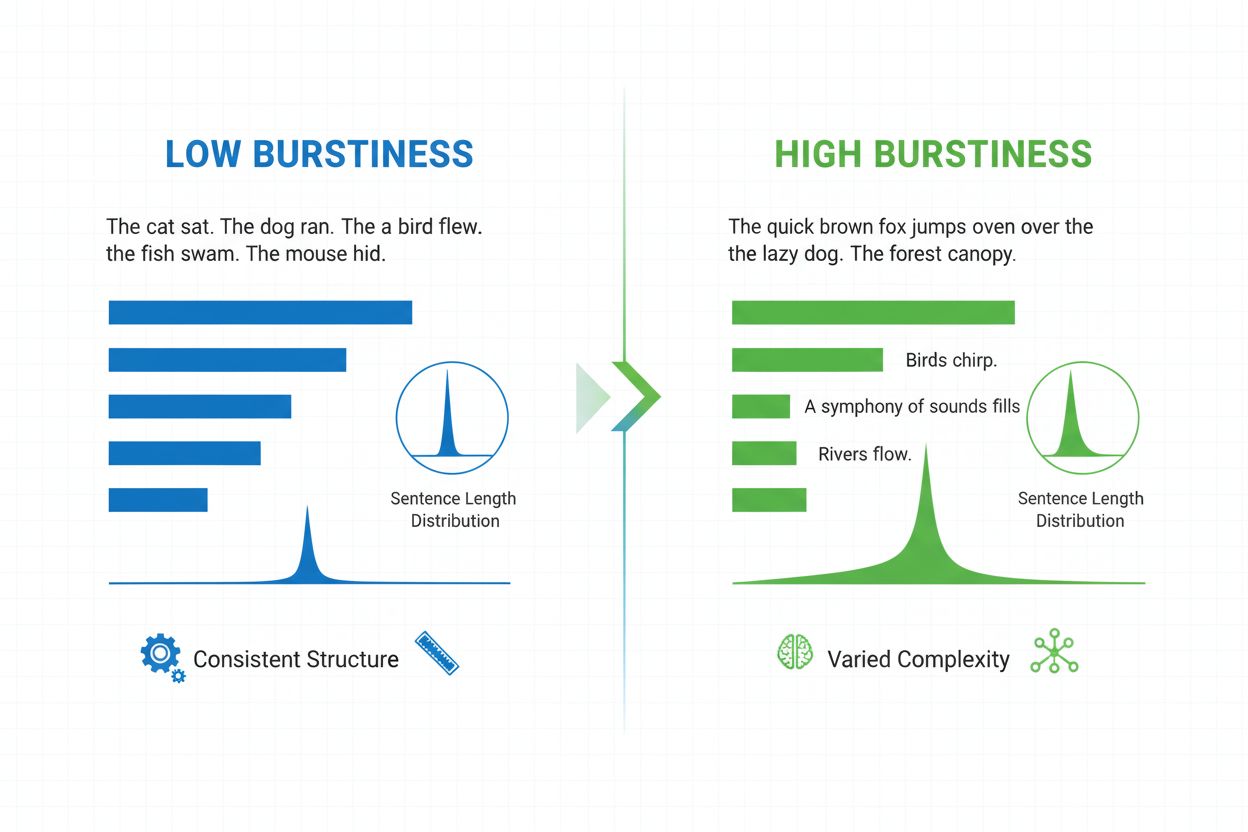
Burstiness measures sentence structure variation in writing. Learn how this key metric distinguishes human from AI-generated content and impacts readability.