



FX Rate
An FX rate (foreign exchange rate) is the price of one currency expressed in terms of another, determining how much a customer pays in their local currency for a product priced in the merchant's base currency. For cross-border e-commerce, FX rates directly affect displayed prices, margin, and how competitive a store looks in each market it sells into.
Definition of FX Rate
An FX rate, short for foreign exchange rate, expresses the value of one currency relative to another — for example, how many US dollars it takes to buy one euro. In e-commerce, FX rates matter wherever a merchant sells to customers in a currency different from the one they use to account for revenue, pay suppliers, or report profit. A store based in the US that sells in euros, pounds, and yen is effectively running three parallel pricing environments, each shifting independently as the underlying exchange rates move.
How FX Rates Work in Ecommerce Pricing
At the simplest level, a merchant sets a base price in their home currency and applies the current FX rate to generate a displayed price in the customer’s local currency. If a product is priced at $100 USD and the USD/EUR rate is 0.92, the displayed euro price is roughly €92, before rounding and any local pricing adjustments (many merchants round to a “clean” number like €89.99 rather than showing raw converted figures).
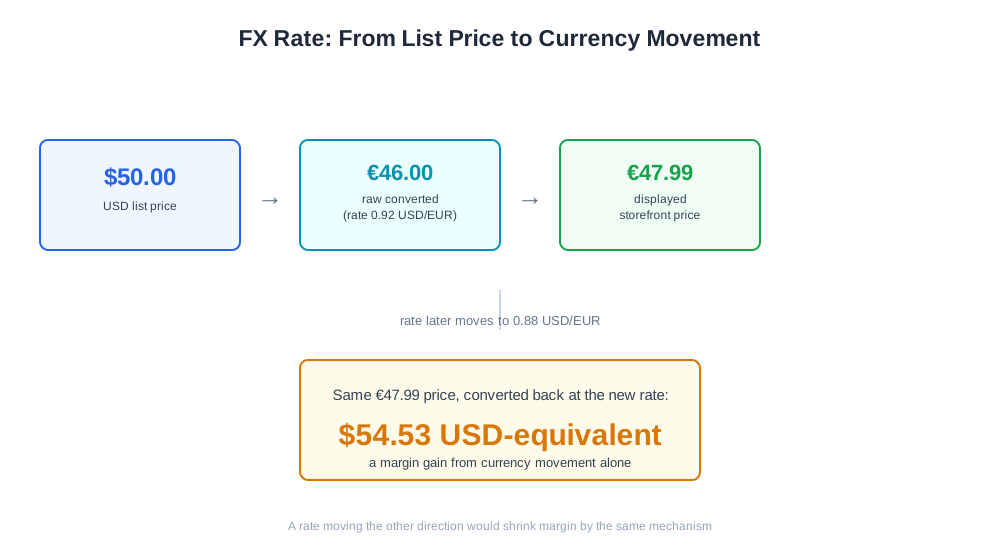
Worked example: a merchant sells a product for $50 USD. At an FX rate of 0.92 USD/EUR, the raw converted price is €46. The merchant rounds this to €47.99 for a cleaner storefront price. If the exchange rate later moves to 0.88 USD/EUR, that same €47.99 now represents roughly $54.53 in home-currency terms — a margin gain purely from currency movement, with no change in actual pricing strategy. Had the rate moved the other direction, the same fixed euro price would represent lower USD-equivalent revenue.
This is why many merchants don’t use the live market rate directly for storefront pricing. Instead, they apply a rate with a small buffer (sometimes 1–3%) to absorb short-term currency fluctuation between the time a price is set and the time an order is fulfilled and reconciled.

Ready to Monitor Your AI Visibility?
Track how AI chatbots mention your brand across ChatGPT, Perplexity, and other platforms.
Why FX Rates Matter for E-commerce Brands
For any merchant selling across borders, FX rate management touches three distinct areas at once: customer experience, margin, and reporting clarity. On the customer side, showing prices in a shopper’s local currency — rather than forcing them to do mental conversion from a foreign price — is one of the more reliable ways to reduce checkout hesitation, since unexpected currency math or surprise conversion fees at the final payment step are a common source of last-minute cart abandonment.
On the margin side, FX exposure is a real, if often underappreciated, business risk. A merchant with a thin margin who prices in multiple currencies without any buffer can see that margin evaporate on orders processed during a period of unfavorable currency movement, even though nothing about their cost structure changed. And for reporting, consolidating revenue and cost data across currencies requires a consistent conversion methodology — using spot rates at time of sale versus a period-average rate can produce meaningfully different reported results for the same underlying orders.
FX Rate Pricing Approaches Compared
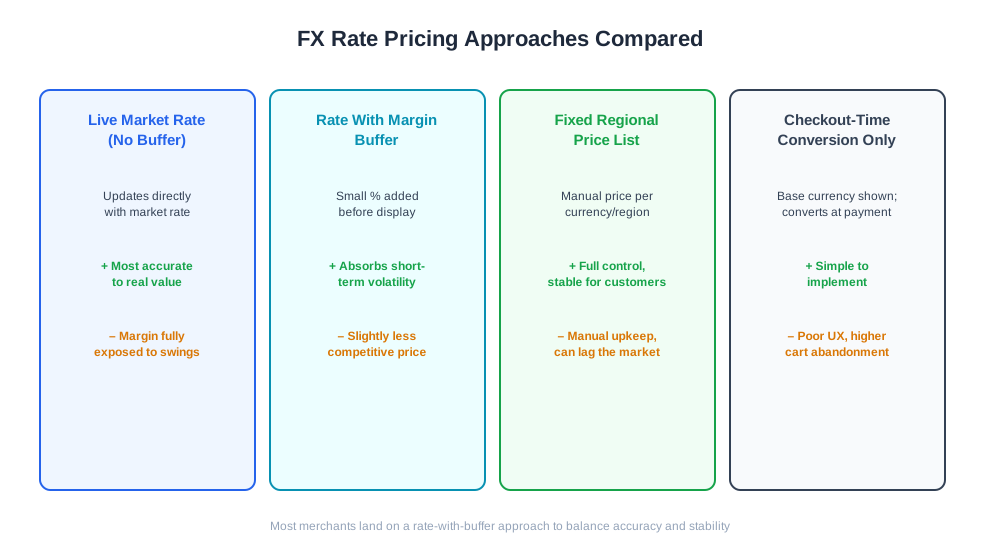
| Approach | How It Works | Pros | Cons |
|---|---|---|---|
| Live market rate, no buffer | Displayed price updates directly with the market rate | Most accurate to real currency value | Margin fully exposed to rate swings |
| Rate with margin buffer | A small percentage is added to the market rate before display | Absorbs short-term volatility | Slightly less competitive displayed price |
| Fixed regional price list | Merchant sets a manual price per currency/region, updated periodically | Full pricing control, stable for customers | Requires manual upkeep, can lag the market |
| Checkout-time conversion only | Store shows base currency; conversion happens at payment | Simple to implement | Poor customer experience, higher abandonment |
Stay Updated on AI Visibility Trends
Get the latest insights on AI mentions, brand monitoring, and optimization strategies.
FX Rates and AI-Driven Commerce
As AI shopping assistants like ChatGPT Shopping and Perplexity Shopping increasingly surface product prices in comparison to competitors, consistent and accurate multi-currency pricing becomes more important. An AI assistant pulling stale or incorrectly converted price data could quote a customer a price that no longer matches what the merchant’s storefront actually charges, undermining trust in both the assistant’s answer and the merchant’s listing.
AmICited’s eshop_list_currencies tool addresses the operational side of this by listing every currency a connected store has published, along with its rate history, giving merchants a single view of how FX movement across markets is affecting reported revenue over time. That visibility is useful both for finance teams reconciling multi-currency revenue and for spotting a currency whose rate has drifted enough to warrant a manual price review before it erodes margin further.
Best Practices for FX Rate Management
- Apply a small buffer above the live market rate for storefront pricing to absorb short-term volatility
- Update displayed conversion rates on a consistent schedule (daily or weekly) rather than reacting to every market tick
- Show prices in the customer’s local currency by default wherever the platform supports it
- Round converted prices to natural, locally-styled price points rather than displaying raw decimal conversions
- Reconcile revenue reporting using a single consistent FX methodology (spot rate vs. period average) across all currencies
- Review currency-specific margin periodically, since a currency that’s drifted unfavorably for months can silently erode profitability
Common FX Rate Mistakes
A frequent mistake is using the live, unbuffered market rate for storefront pricing and only reconciling actual margin impact at the end of the month, by which point unfavorable currency movement has already eaten into profit on dozens of orders. Another common issue is inconsistent conversion methodology across reporting systems — one dashboard using spot rates and another using a monthly average — which makes revenue figures across currencies look like they don’t reconcile even though nothing is actually wrong. Some merchants set regional prices once and never revisit them, so a currency that has drifted significantly over six months leaves that region either overpriced (hurting conversion) or underpriced (quietly eating margin) relative to the merchant’s original intent. A related mistake is failing to account for the payment processor’s own conversion markup separately from the storefront’s displayed FX rate, which can make true landed cost to the customer higher than the merchant intended even when the storefront pricing itself was reasonable. Finally, businesses expanding into a new currency sometimes skip setting up rate monitoring entirely, treating multi-currency support as a one-time setup task rather than an ongoing operational responsibility.