

How Do I Get Started with GEO Today?
Learn how to get started with Generative Engine Optimization (GEO) today. Discover essential strategies to optimize your content for AI search engines like Chat...
9 min read
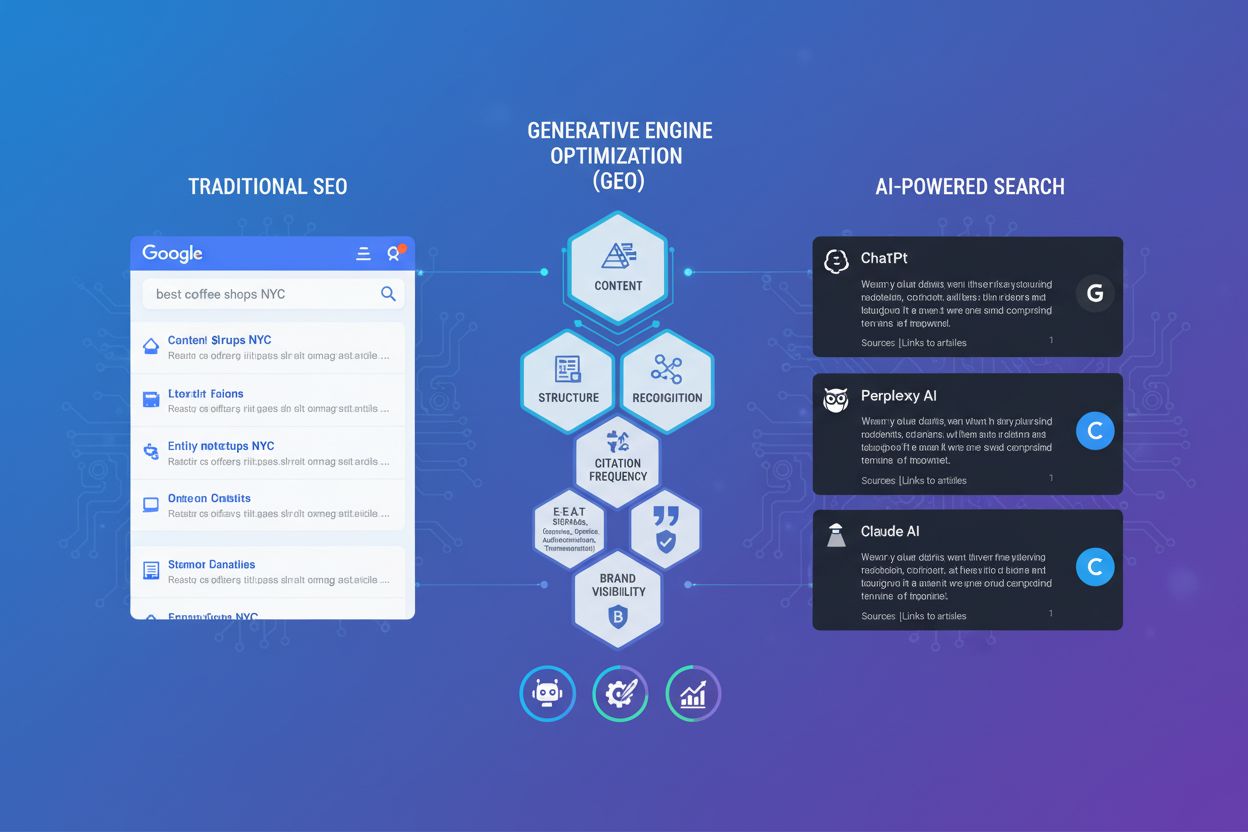
Generative Engine Optimization (GEO) is the practice of optimizing content to increase visibility and citations within AI-powered search experiences such as ChatGPT, Perplexity, Claude, and Google AI Overviews. Unlike traditional SEO which focuses on ranking in search results, GEO prioritizes making content easily discoverable, citable, and synthesizable by large language models.
Generative Engine Optimization (GEO) is the practice of optimizing content to increase visibility and citations within AI-powered search experiences such as ChatGPT, Perplexity, Claude, and Google AI Overviews. Unlike traditional SEO which focuses on ranking in search results, GEO prioritizes making content easily discoverable, citable, and synthesizable by large language models.
Generative Engine Optimization (GEO) is the practice of optimizing content and digital presence to increase visibility and citations within AI-powered search experiences such as ChatGPT, Perplexity, Claude, and Google AI Overviews. Unlike traditional Search Engine Optimization (SEO), which focuses on ranking high in search engine results pages (SERPs), GEO prioritizes making content easily discoverable, citable, and synthesizable by large language models. The primary goal of GEO is to ensure that when users query AI search engines, your brand, products, or expertise are referenced and recommended within the AI-generated responses. This represents a fundamental shift in how businesses approach search visibility, moving from competing for clicks to competing for citations within conversational AI interfaces.
The emergence of GEO reflects a broader transformation in how people discover information online. As AI search platforms gain adoption—with ChatGPT serving 800+ million weekly users and Perplexity recording 153 million website visits in May 2025 (up 191.9% from March 2024)—the traditional search landscape is expanding to include new discovery channels. GEO acknowledges that these AI engines operate differently from traditional search algorithms, requiring distinct optimization strategies that account for how large language models interpret, synthesize, and cite information from across the web.
The concept of generative search emerged as large language models became sophisticated enough to synthesize information from multiple sources into coherent, conversational responses. Before 2023, search was dominated by traditional keyword-based engines that returned lists of links. The introduction of ChatGPT in November 2022, followed by Google’s integration of AI into search through features like AI Overviews (formerly Search Generative Experience), fundamentally changed user expectations. Users began asking longer, more conversational questions—averaging 23 words compared to Google’s historical 4-word average—and expecting comprehensive answers rather than link lists.
This shift created a new challenge for content creators and marketers: how do you optimize for engines that don’t rank pages but instead synthesize information from multiple sources? The answer was GEO. Industry adoption has been rapid, with the GEO market projected to reach USD 848.0 million in 2025 with a compound annual growth rate of 50.5%. Over 78% of organizations reported using AI in 2024, and 58% of informational search queries now trigger AI overviews as top results. This explosive growth reflects the recognition that AI search represents a genuine disruption to the $80+ billion SEO industry, requiring new strategies and frameworks.
| Aspect | Traditional SEO | Generative Engine Optimization (GEO) |
|---|---|---|
| Primary Goal | Rank high in search results pages | Appear in AI-generated answers and citations |
| Output Format | List of blue links | Synthesized narrative response with citations |
| Optimization Focus | Keywords, backlinks, page authority | Content structure, clarity, entity recognition, citation-worthiness |
| User Query Length | Short (avg. 4 words) | Conversational (avg. 23 words) |
| Success Metrics | Rankings, CTR, organic traffic | Citation frequency, brand mentions, conversions |
| Content Structure | Keyword-focused paragraphs | Scannable lists, hierarchies, explicit entities |
| Authority Signals | Backlinks and domain authority | Expert quotes, original research, E-E-A-T signals |
| Citation Mechanism | Users click through to your site | AI engines reference your content directly |
| Platform Specificity | Primarily Google-focused | Multi-platform (ChatGPT, Perplexity, Claude, Google AI) |
| Content Freshness | Important but not critical | Increasingly important for accuracy |
While GEO and SEO share foundational principles—both prioritize user intent, E-E-A-T signals, and quality content—they diverge significantly in execution. Research analyzing over 1 million AI-generated answers reveals that approximately 40.58% of AI citations come from Google’s top 10 search results, indicating that strong SEO provides a foundation for GEO success. However, ranking alone doesn’t guarantee AI visibility. A page can rank #3 on Google because it has strong backlinks and high engagement metrics, but if the writing is vague or buries key information deep in the text, AI engines may skip it entirely. Conversely, a lower-ranking page with explicit entity mentions, clear structure, and easily parseable information may receive more AI citations because it’s easier for language models to extract and trust.
AI search engines operate fundamentally differently from traditional search algorithms, requiring a distinct understanding of how large language models interpret and cite information. Traditional search engines use crawlers to index pages and ranking algorithms to determine relevance based on factors like backlinks, user engagement, and keyword density. AI engines, by contrast, retrieve information from existing search indexes (primarily Google and Bing) and then synthesize that information into conversational responses using large language models trained on vast amounts of text data.
This distinction has profound implications for optimization. When an AI engine generates a response, it must identify relevant sources, extract specific information, and attribute that information correctly. This process relies heavily on entity recognition—the ability to identify and understand named entities (people, brands, products, concepts) and their relationships. If your content explicitly names entities and uses clear, direct language, AI engines can more confidently extract and cite your information. For example, writing “Asana is a project management tool used by over 1 million teams” is more citable than “This popular tool helps teams collaborate.” The explicit entity mention makes it easier for AI to understand what you’re describing and attribute the information correctly.
Schema markup and structured data play increasingly important roles in GEO. By implementing JSON-LD schema for FAQs, articles, products, and reviews, you provide AI engines with explicit context about your content’s meaning and structure. This structured data helps AI systems understand relationships between concepts, verify factual claims, and determine whether your content is authoritative enough to cite. Additionally, content structure matters significantly—AI engines favor content with clear heading hierarchies (H1 → H2 → H3), bullet point summaries, and short paragraphs because these formats make information extraction easier and more accurate.
Different AI platforms have distinct characteristics that require tailored optimization approaches. ChatGPT, with 81.84% of the AI chatbot market share, favors comprehensive, well-sourced content with clear expertise signals. When optimizing for ChatGPT citations, focus on in-depth explanations with practical examples, step-by-step guidance, expert quotes with full attribution, and clear positioning of products or services within context. ChatGPT’s training data includes content up to April 2024, so while freshness matters, historical authority and comprehensiveness often outweigh recency.
Perplexity, which recorded 153 million website visits in May 2025 (up 191.9% from March 2024), emphasizes citation-friendly content structure and source credibility. Perplexity explicitly shows citations in its responses, making source quality paramount. When optimizing for Perplexity, prioritize well-sourced claims with verifiable data, recent statistics and research findings, expert commentary with clear attribution, and direct links to authoritative sources. Perplexity’s algorithm appears to weight citation frequency and source diversity, so appearing in multiple high-quality sources increases your likelihood of being cited.
Claude, Anthropic’s AI assistant, prioritizes nuanced, thoughtful content that demonstrates deep expertise. Claude tends to cite sources that provide balanced perspectives, acknowledge complexity, and avoid oversimplification. Optimization for Claude involves creating content that explores topics thoroughly, acknowledges different viewpoints, includes original research and insights, and demonstrates genuine expertise rather than surface-level coverage.
Google AI Overviews integrate traditional SEO ranking factors with AI synthesis capabilities. Content that already ranks well in traditional Google search has a significant advantage in AI Overviews. However, featured snippet optimization becomes even more critical—AI engines often extract information from featured snippets to include in their responses. Optimize for AI Overviews by ensuring your content ranks well traditionally, creating clear, definitive answers to specific questions, implementing schema markup, and optimizing for featured snippets through concise, well-structured answers.
The strategic importance of GEO extends beyond technical optimization—it represents a fundamental shift in how businesses build brand visibility and influence customer decisions. Users arriving from AI search demonstrate significantly higher conversion rates compared to traditional search traffic. Research shows that conversions from AI platforms are 2.08x better than Google in some studies, despite lower overall traffic volumes. This indicates that AI search users have stronger purchase intent and higher qualification levels, making each conversion more valuable.
Furthermore, being cited by AI engines acts as a third-party endorsement, building trust faster than traditional search rankings. When ChatGPT or Perplexity recommends your product or service, it carries implicit credibility because the AI has synthesized information from multiple sources and determined your offering is worth mentioning. This effect is particularly powerful in competitive markets where differentiation is difficult. A brand that consistently appears in AI recommendations gains a competitive advantage by being top-of-mind when users are making decisions.
The first-mover advantage in GEO is significant. While most brands focus exclusively on traditional SEO, early GEO adopters can establish authority in AI search results before competition intensifies. As AI search adoption accelerates—with 58% of informational queries now triggering AI overviews—the window for establishing early dominance is narrowing. Brands that optimize for GEO now will have built substantial citation authority by the time competitors recognize the opportunity.
Successful GEO requires a systematic approach to content optimization that goes beyond traditional SEO practices. Clear, scannable structure is foundational—use H1-H4 tags logically to create content outlines that AI can easily understand. Each heading should introduce a distinct concept, and content should flow logically from general to specific. Bullet point summaries break complex information into digestible pieces that AI engines can extract and synthesize. Keep paragraphs under 4 sentences when possible, and bold key facts and statistics for emphasis.
Explicit entity recognition is critical for GEO success. Instead of using pronouns or vague references, explicitly name entities and brands. Write “HubSpot’s CRM platform helps sales teams manage customer relationships” rather than “This tool helps teams manage relationships.” The explicit entity mention makes it easier for AI to understand what you’re describing and attribute the information correctly. When citing research or data, mention the author and source directly: “According to a 2025 Writesonic study analyzing 1 million AI-generated answers…” rather than just hyperlinking. This ensures AI can verify credibility even if it struggles to read linked sources.
Original research and data points significantly improve citation likelihood. AI engines prioritize content that provides unique insights, original data, or novel perspectives. If you conduct original research, publish detailed findings with methodology, sample size, and key statistics. Expert quotes with full attribution—including the expert’s name, title, and company—add credibility and make content more citable. Ensure factual consistency across all pages to prevent AI misinterpretation. Contradictions confuse AI systems and reduce citation likelihood.
Measuring GEO success requires new metrics and methodologies beyond traditional SEO measurement. Citation frequency measures how often your content appears in AI responses across different platforms. Track this monthly for target keywords to identify trends and competitive gaps. Brand mention context reveals how AI engines describe your offerings—are they positioning you as a premium solution, a budget option, or an innovative leader? This context matters because it influences customer perception.
Conversion quality from AI traffic differs from traditional metrics. While traffic volume may be lower than traditional search, conversion rates are typically higher, indicating stronger user intent. Track conversion rates separately for AI referral sources to understand the true business impact. Share of voice compares your presence to competitors in AI results for target keywords. If competitors appear in 80% of AI responses for a keyword while you appear in 20%, you have a significant competitive gap to address.
Tools like AmICited provide comprehensive dashboards tracking these metrics across multiple AI platforms. By monitoring how your brand appears in ChatGPT, Perplexity, Claude, and Google AI Overviews, you gain visibility into your GEO performance and can identify optimization opportunities. Regular monitoring also helps catch negative or outdated information before it spreads across the AI ecosystem.
The GEO landscape continues to evolve rapidly as AI technology advances and user adoption increases. Multi-modal search integration is emerging as a significant trend—AI engines are increasingly incorporating voice, image, and video alongside text. This expansion requires GEO strategies that account for multiple content formats. Brands that create comprehensive multimedia content (videos, infographics, podcasts) will have advantages in multi-modal search environments.
Platform-specific optimization is becoming increasingly nuanced as different AI engines develop distinct ranking factors and citation preferences. Rather than a one-size-fits-all approach, successful GEO strategies will require platform-specific content variations optimized for each engine’s unique characteristics. Real-time content freshness is gaining importance as AI engines prioritize current information over historical authority. This represents a shift from traditional SEO, where older, well-established content often outranks newer content.
Personalization factors are beginning to influence AI recommendations. As AI engines incorporate user history, preferences, and context into their responses, optimization strategies will need to account for personalization. Finally, the integration between traditional and AI search results will likely deepen. Rather than replacing traditional search, AI search is expanding the search landscape, and successful brands will optimize for both channels simultaneously.
While traditional SEO focuses on ranking high in search engine results pages (SERPs) through backlinks and keyword optimization, GEO prioritizes being cited and synthesized within AI-generated answers. GEO emphasizes content structure, entity recognition, and citation-worthiness rather than click-through rates. Traditional SEO targets short keyword queries (averaging 4 words), while GEO optimizes for conversational, longer queries (averaging 23 words). Both share foundational principles like E-E-A-T signals and user intent satisfaction, but GEO requires explicit entity mentions, clear hierarchical structure, and content that AI engines can easily parse and attribute to your brand.
Research analyzing over 1 million AI-generated answers reveals that approximately 40.58% of AI citations come from Google's top 10 search results, indicating strong SEO foundation matters. Key GEO ranking factors include: content authority and E-E-A-T signals, explicit entity recognition and brand mentions, clear content structure with headers and bullet points, original research and data points, expert quotes and citations, domain trust scores, and backlink quality. Different platforms prioritize factors differently—ChatGPT favors comprehensive, well-sourced content; Perplexity emphasizes citation credibility; Google AI Overviews integrate traditional ranking signals with AI synthesis capabilities. Citation frequency, brand visibility score, and AI share of voice are critical metrics across all platforms.
The GEO market is projected to reach USD 848.0 million in 2025 with a compound annual growth rate of 50.5%, reflecting rapid industry adoption. ChatGPT serves 800+ million weekly users, while Perplexity recorded 153 million website visits in May 2025, up 191.9% from March 2024. Over 78% of organizations reported using AI in 2024, and 58% of informational search queries now trigger AI overviews as top results. Early GEO adopters gain first-mover advantage before competition intensifies. Users arriving from AI search demonstrate higher conversion rates (2.08x better than Google in some studies) despite lower traffic volumes, indicating stronger purchase intent. As Apple integrates Perplexity and Claude into Safari, GEO becomes essential for maintaining visibility in the evolving search landscape.
AmICited specializes in tracking brand and domain appearances across AI-powered search experiences, making it an essential tool for GEO measurement and optimization. The platform monitors how your content is cited in ChatGPT, Perplexity, Google AI Overviews, and Claude responses, providing visibility into citation frequency, brand context accuracy, and competitive share of voice. AmICited helps businesses understand which pages get cited, how AI engines describe their offerings, and where competitors are capturing visibility. This data enables data-driven GEO strategy refinement, allowing marketers to optimize content based on actual AI citation patterns rather than assumptions. By tracking AI search visibility alongside traditional SEO metrics, AmICited bridges the gap between old and new search paradigms.
Effective GEO content requires clear hierarchical structure that AI engines can easily parse and extract information from. Use H1-H4 tags logically to create content outlines, implement bullet point summaries to break complex information into scannable lists, keep paragraphs under 4 sentences when possible, and bold key facts and statistics for emphasis. Explicitly name entities and brands rather than using pronouns—write 'Asana is a project management tool' instead of 'It's a popular tool.' Include schema markup for FAQs, reviews, and product information to help AI understand context. Lead each section with the most important takeaway, use short direct sentences, and organize information in the order users need it. Original research, expert quotes with full attribution, and verifiable data points significantly improve citation likelihood. Avoid vague language and ensure factual consistency across all pages to prevent AI misinterpretation.
GEO success metrics differ from traditional SEO because they measure brand visibility within AI conversations rather than click-through rates. Primary metrics include: AI citation frequency (how often your content appears in AI responses), brand mention context (how AI describes your products/services), conversion quality from AI traffic (typically higher intent than traditional search), and share of voice (your presence compared to competitors in AI results). Secondary metrics include content synthesis rate (how often your content gets combined with other sources), question coverage (percentage of target queries triggering brand mentions), authority signals (expert quotes and data citations from your content), and cross-platform consistency (brand message alignment across ChatGPT, Perplexity, Claude, and Google AI). Tools like AmICited provide comprehensive dashboards tracking these metrics, enabling data-driven optimization. Monitor brand mentions monthly across target keywords to identify trends and competitive gaps.
GEO and SEO are complementary strategies that should work together rather than compete. Strong SEO provides a foundation for GEO success—approximately 40.58% of AI citations come from pages ranking in Google's top 10 results. However, ranking alone doesn't guarantee AI visibility; a page can rank #3 on Google but get skipped by AI if content is vague or difficult to parse. The most effective approach integrates GEO into existing SEO workflows: start with solid SEO fundamentals (technical optimization, keyword research, authority building), then layer on GEO-specific optimizations (explicit entity mentions, clear structure, citation-worthy content). This integrated strategy ensures visibility across both traditional search results and AI-generated answers. Businesses that dismiss GEO as 'just SEO' risk losing visibility as AI search grows—research shows 58% of informational queries now trigger AI overviews, making GEO increasingly critical for maintaining search presence.
Start tracking how AI chatbots mention your brand across ChatGPT, Perplexity, and other platforms. Get actionable insights to improve your AI presence.
Learn how to get started with Generative Engine Optimization (GEO) today. Discover essential strategies to optimize your content for AI search engines like Chat...

Learn Generative Engine Optimization (GEO) fundamentals. Discover how to get your brand cited in ChatGPT, Perplexity, and Google AI Overviews with proven strate...
Discover why Generative Engine Optimization (GEO) is essential for businesses in 2025. Learn how AI-powered search is reshaping brand visibility, consumer behav...
Cookie Consent
We use cookies to enhance your browsing experience and analyze our traffic. See our privacy policy.