
Core Update
Learn what a Google Core Update is, how it affects website rankings, the difference between core and algorithm updates, and strategies for recovery and long-ter...
11 min read

A Google Algorithm Update is a significant change to Google’s search ranking systems that affects how web pages are evaluated, ranked, and displayed in search results. These updates occur multiple times per year and can substantially impact website visibility, organic traffic, and search engine rankings across different industries and content types.
A Google Algorithm Update is a significant change to Google's search ranking systems that affects how web pages are evaluated, ranked, and displayed in search results. These updates occur multiple times per year and can substantially impact website visibility, organic traffic, and search engine rankings across different industries and content types.
A Google Algorithm Update is a significant modification to Google’s search ranking systems that changes how web pages are evaluated, ranked, and displayed in search results. These updates represent Google’s ongoing effort to improve search quality, combat spam, and deliver more relevant, helpful, and authoritative content to users. Google makes thousands of algorithmic changes every year, but only a fraction are major updates that substantially impact website rankings and organic traffic. The most significant updates are announced by Google and tracked on their official status dashboard, allowing SEO professionals and website owners to correlate traffic changes with specific algorithmic modifications. Understanding algorithm updates is critical for anyone managing a website’s search visibility, as these changes can result in dramatic ranking gains or losses depending on how well a site aligns with Google’s evolving quality standards.
Google’s approach to algorithm updates has evolved dramatically since the search engine’s inception. The first major algorithm update, Florida, launched in November 2003 and caused significant disruption by targeting manipulative SEO tactics that had previously worked well for ranking. This update drove many websites out of business and prompted Google to commit to avoiding major updates around the holiday season—a promise they kept until 2011. Over the following two decades, Google introduced numerous named updates including Panda (2011, targeting low-quality content), Penguin (2012, combating link spam), Hummingbird (2013, improving semantic understanding), and RankBrain (2015, leveraging machine learning). The evolution reflects Google’s shift from simple keyword matching to sophisticated AI-driven systems that understand user intent, content quality, and website authority. According to Google’s own data, the search engine now conducts over 894,000 search quality tests and 13,280 live traffic experiments annually to refine its algorithms. In 2024, Google released 7 confirmed algorithm updates (4 core updates and 3 spam updates), while 2025 has already seen 4 confirmed updates in just the first three months, demonstrating the accelerating pace of algorithmic refinement.
| Aspect | Core Updates | Spam Updates |
|---|---|---|
| Scope | Broad, comprehensive changes to overall ranking systems | Targeted at specific spam tactics and policy violations |
| Frequency | 3-4 times per year | Variable, as needed (1-3 times per year) |
| Rollout Duration | 2-4 weeks (typically 14-45 days) | 7-15 days (faster rollout) |
| Impact Range | Affects websites across all industries and niches | Primarily impacts sites engaging in spam practices |
| Ranking Changes | Can cause significant volatility; affects relevance, authority, and quality assessment | More targeted; demotes specific spam tactics |
| Recovery Path | Requires content quality improvements and E-E-A-T signals | Requires eliminating spam practices and policy violations |
| Announcement | Always announced by Google in advance | Sometimes announced, sometimes discovered by community |
| Examples | March 2024 Core Update (45-day rollout), December 2025 Core Update | June 2024 Spam Update, August 2025 Spam Update |
Google’s ranking systems operate on multiple layers of evaluation, each contributing to how pages are ranked. When Google releases a core update, it typically modifies one or more of these core systems to better assess content quality, relevance, and authority. The March 2024 Core Update, for example, was described by Google as updating “several systems within the core algorithm,” resulting in a 45% reduction in unhelpful content appearing in search results. This update took 45 days to roll out—significantly longer than typical core updates—because it involved multiple simultaneous changes to different ranking systems. Google uses automated ranking systems that analyze hundreds of billions of web pages using various signals and factors. These systems include technologies like BERT (Bidirectional Encoder Representations from Transformers), which helps Google understand how combinations of words express different meanings and intent, and RankBrain, an AI system that helps understand how words relate to concepts. The Helpful Content System, which was initially launched as a separate update in August 2022, became integrated into Google’s core ranking systems as of March 2024, meaning it now operates continuously rather than through discrete update rollouts. During the rollout period of an update, Google gradually applies the new algorithms across its index, which is why websites experience ranking fluctuations over days or weeks rather than seeing immediate, static changes.
Google Algorithm Updates can cause dramatic shifts in website rankings and organic traffic, with some sites gaining significant visibility while others experience substantial losses. The impact varies based on how well a website aligns with the specific factors being emphasized in the update. For example, the September 2023 Helpful Content Update negatively impacted many small and independent publishers who were creating legitimate, high-quality content, prompting Google to adjust its approach in the August 2024 Core Update to better surface useful content from smaller sites. Research from data providers tracking the March 2024 Core Update showed that it was Google’s most volatile update in recent history, with some sites experiencing ranking drops of 50+ positions while others saw significant gains. The volatility and impact of updates depend on several factors: the breadth of the update (core updates affect more sites than spam updates), the specific ranking systems being modified, and how well individual websites align with the new evaluation criteria. Small ranking drops (1-3 positions) typically don’t warrant major changes, as they often reflect natural rebalancing of results. However, large drops (10+ positions) suggest that a site may not be meeting Google’s current quality standards and require deeper assessment and improvement. According to Google’s official guidance, websites should wait at least one week after an update completes rolling out before analyzing the impact, as rankings may continue to fluctuate during the stabilization period.
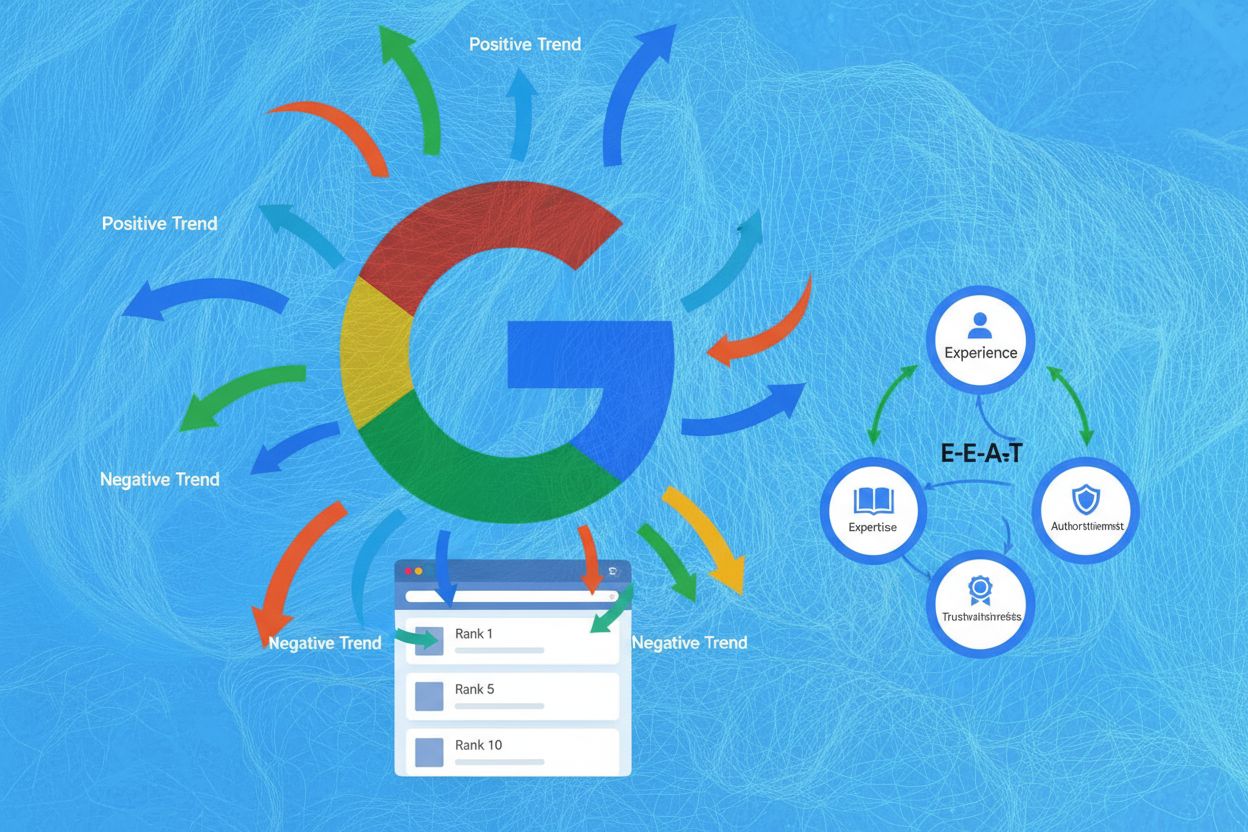
E-E-A-T—Experience, Expertise, Authoritativeness, and Trustworthiness—has become the central framework that Google uses to evaluate content quality in algorithm updates. This framework, which Google formalized in its Search Quality Rater Guidelines, represents a fundamental shift toward rewarding content created by genuine experts and established authorities rather than content optimized purely for search engines. The Helpful Content System, which is now part of Google’s core ranking systems, specifically targets content created primarily for search engine rankings rather than to genuinely help people. Google’s self-assessment questions for websites hit by core updates directly reference E-E-A-T principles: Does your site demonstrate genuine expertise? Is content written by people with real-world experience? Does your site build trust through transparency and credentials? Modern algorithm updates increasingly penalize content that lacks these signals, regardless of keyword optimization or technical SEO. The March 2024 Core Update incorporated new spam policies targeting scaled content abuse (producing content at scale to boost rankings) and expired domain abuse (buying expired domains to repurpose low-quality content), both of which violate the principle of authentic expertise. This represents Google’s broader strategy of using algorithm updates not just to rank better content higher, but to actively demote content that appears to be created without genuine expertise or authority.
Google Algorithm Update rollouts typically span 7 to 45 days, with most core updates taking 2-4 weeks to complete. The rollout period is characterized by significant ranking volatility as Google’s systems gradually apply new algorithms across its massive index. During the December 2025 Core Update, for example, Google announced the update would take “up to three weeks” to roll out, meaning websites could experience ranking changes throughout that entire period. The March 2024 Core Update set a record for rollout duration at 45 days, which Google attributed to the complexity of updating multiple core systems simultaneously. This extended rollout period meant that websites experienced ranking fluctuations for over six weeks, making it difficult to assess the true impact until the update fully completed. Data providers tracking algorithm updates have noted that ranking volatility varies significantly between updates—the August 2024 Core Update was described as “very volatile,” while the November 2024 Core Update was “less volatile” than previous updates. The volatility pattern typically follows a curve: initial fluctuations when the update begins, peak volatility in the middle of the rollout period, and stabilization as the update nears completion. Google recommends waiting at least one full week after an update completes before conducting detailed analysis, as rankings may continue to shift slightly during the stabilization phase. Understanding this timeline is crucial for distinguishing between temporary fluctuations during rollout and permanent ranking changes that require strategic response.
Google’s algorithm updates evaluate a comprehensive set of ranking factors that have evolved significantly over time. Content quality and relevance remain foundational, but modern updates increasingly emphasize whether content genuinely helps users and demonstrates authentic expertise. Page experience metrics, including Core Web Vitals (Largest Contentful Paint, First Input Delay, and Cumulative Layout Shift), have become increasingly important since the Page Experience Update of 2021. Mobile-friendliness continues to be critical, especially since Google’s shift to mobile-first indexing. Link quality and relevance remain important signals, though Google’s algorithms have become more sophisticated at identifying and neutralizing manipulative linking practices through updates like the December 2022 Link Spam Update. Original content is now explicitly rewarded through systems designed to surface original reporting and research ahead of sites that merely cite or aggregate existing content. Site-wide signals like domain authority, brand recognition, and historical performance contribute to how individual pages are ranked. User engagement signals, though not directly confirmed by Google, are widely believed to influence rankings based on click-through rates, dwell time, and bounce rates. The freshness of content matters for certain query types, with Google’s Freshness System designed to show newer content for queries where recency is important. Different algorithm updates emphasize different factors—core updates typically re-evaluate the overall balance of all factors, while targeted updates like the April 2023 Reviews Update specifically emphasize expertise and original research in review content.
Google Algorithm Updates now extend beyond traditional search results to include Google AI Overviews (formerly called Search Generative Experience), which display AI-generated summaries at the top of search results. These AI Overviews are affected by the same core ranking systems that determine traditional search rankings, meaning algorithm updates impact both where your content appears in traditional results and whether it’s cited in AI-generated summaries. The August 2024 Core Update specifically confirmed that AI Overviews are affected by core updates, meaning sites that lose rankings in traditional search may also see reduced visibility in AI-generated content. This has significant implications for brand monitoring and content strategy, as websites now need to consider visibility across multiple search interfaces. Local search results are affected by algorithm updates through systems like the November 2021 Local Search Update, which rebalanced various factors in local ranking. Google Images and Google News have their own ranking systems that are updated separately but follow similar principles to web search. The emergence of AI search platforms like ChatGPT, Perplexity, and Claude adds another layer of complexity, as these systems use different algorithms than Google but increasingly compete for the same search traffic. For organizations using platforms like AmICited to monitor brand visibility, understanding how Google Algorithm Updates affect visibility across all these platforms is increasingly critical for comprehensive search presence monitoring.
Recovery from negative algorithm update impacts requires a strategic, long-term approach focused on genuine quality improvements rather than quick fixes. Google explicitly recommends against making “quick fix” changes based on hearing that certain elements are “bad for SEO”—instead, website owners should focus on making changes that make sense for users and are sustainable long-term. The first step is objective self-assessment using Google’s published self-assessment questions: Is your site creating original, helpful content? Are your pages written by people with genuine expertise? Does your site demonstrate trustworthiness and transparency? For sites experiencing large ranking drops, Google recommends conducting a deeper assessment of the most impacted pages to understand how they compare to competing content. This might reveal that other pages on the web are doing a better job of helping the searcher, or that your content lacks the depth, expertise, or original research that modern algorithms reward. Content improvement strategies might include rewriting or restructuring content to make it easier to read and navigate, adding original research or data, including multimedia evidence, or expanding coverage of topics. Deleting content should be a last resort, and only considered if content truly cannot be salvaged—in fact, if you’re considering deleting entire sections of your site, that’s often a sign those sections were created for search engines first rather than for people. Recovery timelines vary significantly: some changes can take effect in a few days, but it could take several months for Google’s systems to learn and confirm that your site is now producing helpful, reliable, people-first content. Google also notes that smaller, unannounced core updates happen continuously, meaning your content can see ranking improvements even between major announced updates if you’ve made genuine improvements.
Google’s algorithm updates are becoming more frequent, more sophisticated, and more focused on AI-driven quality assessment. The trend toward more frequent updates is evident in the data: 2024 saw 7 confirmed updates, 2025 has already seen 4 in just three months, and Google has confirmed it releases smaller, unannounced core updates continuously. This shift means that websites can no longer rely on major update cycles to understand ranking changes—instead, they must maintain continuous focus on content quality and user experience. AI and machine learning are increasingly central to how Google evaluates content, with systems like BERT, RankBrain, MUM, and Neural Matching becoming more sophisticated and influential. The integration of the Helpful Content System into core ranking systems suggests that Google will continue to emphasize people-first content and genuine expertise as core ranking factors. Spam detection is becoming more automated and sophisticated, with Google’s SpamBrain system using AI to identify and neutralize spam at scale. The emergence of AI search competition from platforms like ChatGPT and Perplexity is likely to influence how Google evolves its algorithms, potentially leading to updates that better reward original research, unique perspectives, and authoritative expertise. Site reputation abuse policies, which target third-party content published on established domains to manipulate rankings, represent a new frontier in algorithm updates. Looking forward, algorithm updates will likely continue to emphasize E-E-A-T signals, original content, user experience, and compliance with evolving spam policies, while becoming increasingly difficult to predict or prepare for through traditional SEO tactics.
Effective monitoring of Google Algorithm Updates requires multiple tools and data sources to accurately track impact and identify patterns. Google Search Console is the primary official tool, providing data on impressions, click-through rates, and average position for your site’s queries. By comparing Search Console data from before and after an update rollout, you can identify which pages and queries were most affected. Google’s Status Dashboard (status.search.google.com) provides official announcements of all confirmed ranking updates, including start dates, end dates, and descriptions of what changed. This dashboard is essential for correlating traffic changes with specific updates. Third-party SEO tools like Semrush, Ahrefs, Moz, and others track keyword rankings across millions of keywords and provide visibility into how your site’s rankings changed relative to competitors. Data providers like Semrush, Sistrix, and others publish detailed analyses of algorithm updates, including which industries and content types were most affected and what patterns emerged. Google Search Central Blog and Google’s official Twitter account (@googlesearchc) provide announcements and guidance about updates. Community tracking through SEO forums, Twitter, and platforms like Search Engine Land helps identify when updates are happening before official announcements, as SEO professionals often notice ranking volatility and share observations. For organizations monitoring brand visibility across AI search platforms, tools like AmICited provide specialized tracking of how your domain appears in AI-generated responses from ChatGPT, Perplexity, Google AI Overviews, and Claude—a critical capability as algorithm updates increasingly affect visibility across multiple search interfaces.
Core updates are broad, comprehensive changes to Google's overall ranking systems that re-evaluate how all websites are assessed for relevance, authority, and usefulness. Spam updates, by contrast, are targeted specifically at combating manipulative practices like link spam, content spam, and other policy violations. Core updates typically take 2-4 weeks to roll out globally, while spam updates often complete in 7-15 days. Both can impact rankings, but core updates affect a wider range of sites and factors.
Google algorithm updates typically take between 7 days to 4 weeks to fully roll out globally. Core updates generally take 2-4 weeks, while spam updates often complete in 7-15 days. The December 2025 core update, for example, is expected to take up to three weeks. During the rollout period, websites may experience ranking fluctuations as Google's systems gradually apply the new algorithms across its index.
Google makes thousands of changes to its search algorithms every year—approximately 13 changes per day on average. However, most of these are minor adjustments that go unnoticed. Google typically announces major core updates several times per year (usually 3-4 times), and spam updates occur periodically as needed. In 2024, Google released 4 core updates and 3 spam updates, while 2025 has already seen 3 core updates and 1 spam update.
Google algorithm updates evaluate numerous ranking factors including content quality and helpfulness, E-E-A-T (Experience, Expertise, Authoritativeness, Trustworthiness), page experience metrics like Core Web Vitals, mobile-friendliness, page load speed, link quality and relevance, original content versus duplicated content, user engagement signals, and compliance with Google's spam policies. The specific factors emphasized vary depending on whether it's a core update or a targeted spam update.
Yes, websites can recover from algorithm update impacts by focusing on creating high-quality, people-first content that demonstrates genuine expertise and authority. Recovery typically requires several months to a year of consistent improvements. Google recommends assessing your site objectively against their self-assessment questions, improving content quality, ensuring proper technical SEO, and building legitimate authority signals. However, not all sites will fully recover, as some may have been ranking artificially high before the update.
Monitor your website's performance using Google Search Console to track ranking positions, impressions, and click-through rates. Compare data from before and after the update rollout period. Analyze your top-performing pages and queries to identify patterns in ranking changes. Use third-party SEO tools to track keyword rankings and visibility metrics. Google publishes a status dashboard listing all confirmed ranking updates with their start and end dates, allowing you to correlate traffic changes with specific updates.
First, confirm the update has finished rolling out by checking Google's status dashboard. Wait at least one week after rollout completion before analyzing changes. Use Search Console to compare data from before and after the update. Assess whether the drop is small (1-2 positions) or large (10+ positions). For large drops, conduct a self-assessment of your content quality, expertise, and authority. Focus on making meaningful, sustainable improvements rather than quick fixes, and avoid deleting content unless it truly cannot be salvaged.
Start tracking how AI chatbots mention your brand across ChatGPT, Perplexity, and other platforms. Get actionable insights to improve your AI presence.
Learn what a Google Core Update is, how it affects website rankings, the difference between core and algorithm updates, and strategies for recovery and long-ter...

Discover how algorithm updates impact AI search visibility across ChatGPT, Perplexity, Google AI Overviews, and Claude. Learn ranking factors and optimization s...

Learn about Google's Helpful Content Update: an algorithm system rewarding people-first content while demoting search-engine-first material. Understand E-E-A-T,...