
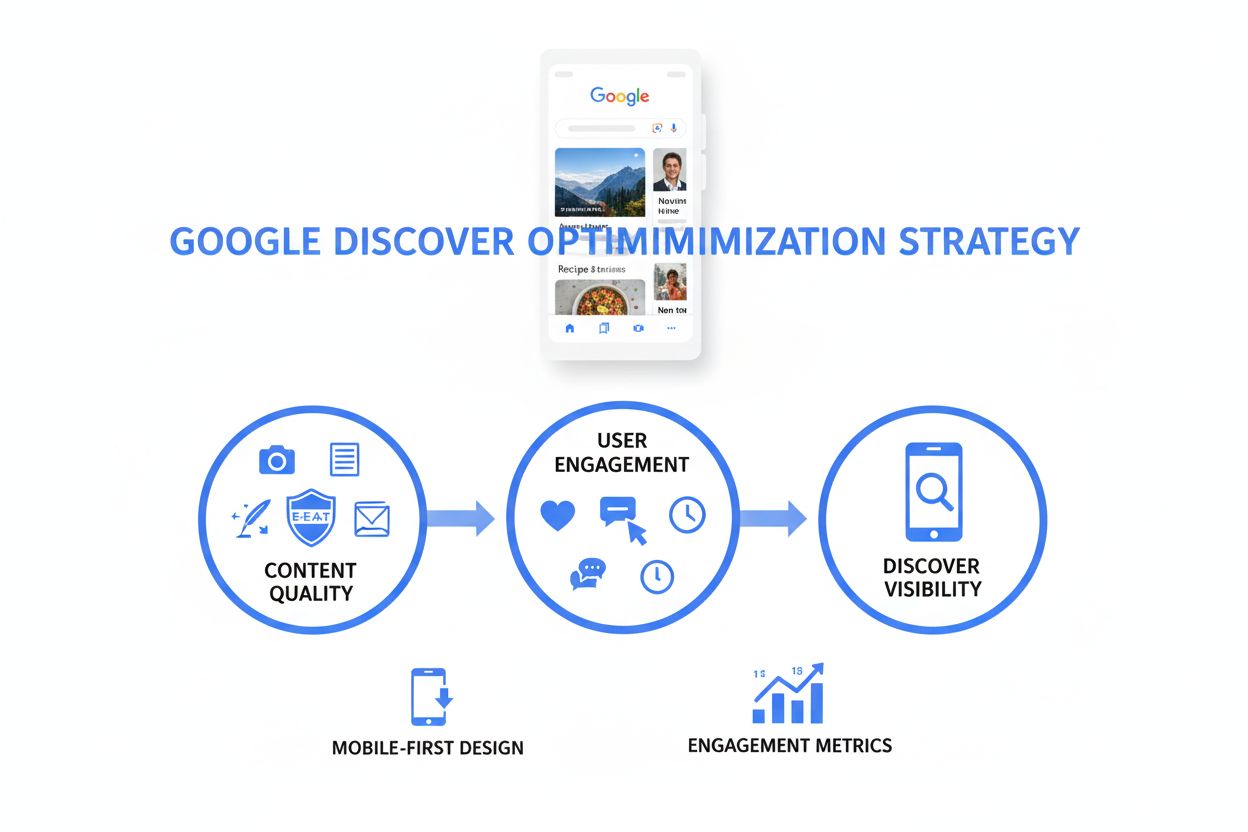
Discover Optimization
Learn what Discover Optimization is and how to optimize content for Google Discover visibility. Explore strategies, ranking signals, and best practices for incr...
13 min read

Google Discover is a personalized content feed that displays news stories, blog posts, videos, and images tailored to each user’s interests and browsing behavior. Available exclusively on mobile devices through the Google app and Chrome, it uses machine learning algorithms to proactively recommend content based on user activity, search history, and preferences without requiring explicit search queries.
Google Discover is a personalized content feed that displays news stories, blog posts, videos, and images tailored to each user's interests and browsing behavior. Available exclusively on mobile devices through the Google app and Chrome, it uses machine learning algorithms to proactively recommend content based on user activity, search history, and preferences without requiring explicit search queries.
Google Discover is a personalized content feed that displays news stories, blog posts, videos, and images tailored to each user’s interests and browsing behavior. Available exclusively on mobile devices through the Google app and Google Chrome, Discover uses advanced machine learning algorithms to proactively recommend content based on user activity, search history, location, and preferences—without requiring explicit search queries. Unlike traditional search engines where users must actively seek information, Google Discover delivers fresh, relevant content directly to users based on their demonstrated interests and historical behavior patterns. This AI-powered recommendation system represents a fundamental shift in how users discover content, moving from query-driven search to interest-driven discovery.
Google Discover was introduced to provide users with a more engaging, social media-like experience within Google’s ecosystem. The platform emerged as Google recognized that users increasingly wanted curated content recommendations similar to what they experience on TikTok, Instagram, and Facebook. By leveraging the vast amounts of data Google collects through Search, YouTube, Chrome, and other services, the company developed an algorithm capable of understanding user interests at a granular level. The feature initially appeared on the Google homepage for mobile users and has since expanded to become one of the most significant traffic sources for publishers worldwide. According to Chartbeat data from 2024, Google Discover now accounts for 17% of publishers’ overall traffic, representing a significant increase from previous years. For some news publishers, Discover traffic has surpassed traditional Google Search traffic, making it a critical channel for content distribution. The platform’s growth reflects broader trends in how users consume information—increasingly through personalized feeds rather than deliberate searches.
The Google Discover algorithm operates on a sophisticated foundation of user behavior analysis and machine learning. When users interact with Google products—conducting searches, watching YouTube videos, browsing Chrome, or using the Google app—they generate data signals that feed into Discover’s recommendation engine. The system analyzes this data to identify patterns in user interests, preferred content types, and engagement behaviors. Location data and device settings further refine recommendations, allowing Discover to surface locally relevant news, weather updates, and nearby events. The algorithm considers multiple factors including content freshness, relevance to user interests, source credibility, and engagement potential. Importantly, Discover doesn’t require users to follow specific topics or publishers—instead, it automatically surfaces content it predicts users will find valuable. The system continuously learns from user interactions, adjusting recommendations based on which content users click, share, or ignore. This dynamic personalization means each user’s Discover feed is unique, reflecting their individual interests and behavior patterns. The algorithm also incorporates E-E-A-T signals (Experience, Expertise, Authoritativeness, Trustworthiness) to prioritize content from credible sources and expert creators.
| Aspect | Google Discover | Google Search | Google News | Social Media Feeds |
|---|---|---|---|---|
| Primary Function | Personalized content discovery | Query-driven search results | News aggregation and curation | Social engagement and sharing |
| User Initiation | Passive (proactive recommendations) | Active (explicit search query) | Active (user seeks news) | Passive (algorithmic feed) |
| Content Types | Blog posts, news, videos, images, reviews | All indexed web content | News articles, breaking news | User-generated and brand content |
| Personalization Level | Highly personalized (behavior-based) | Query-based with some personalization | Location and language-based | Highly personalized (engagement-based) |
| Device Availability | Mobile only | Desktop and mobile | Desktop and mobile | Desktop and mobile |
| Content Freshness | Mix of timely and evergreen | Varies by query | Emphasis on recent/breaking news | Real-time updates |
| Traffic Predictability | Less predictable, fluctuates | More stable and predictable | Moderate predictability | Highly variable |
| Optimization Focus | Quality, images, E-E-A-T, mobile UX | Keywords, technical SEO, content quality | Timeliness, authority, news value | Engagement, shareability, trends |
| Average Traffic Share | 17% of publishers’ traffic (2024) | 8% of publishers’ traffic (2024) | Varies by publisher type | 4% of publishers’ traffic (2024) |
For content to appear in Google Discover, it must first be indexed by Google and meet the platform’s content policies. No special tags, structured data, or submission process is required—Google automatically crawls and evaluates eligible content. However, being indexed doesn’t guarantee appearance in Discover feeds. The platform filters content based on quality signals, relevance to user interests, and adherence to content guidelines. Content that violates Discover policies—such as misleading headlines, clickbait, or content exploiting morbid curiosity—may result in manual actions visible in Google Search Console. The technical requirements for optimal Discover performance include mobile optimization, fast page load speeds, and responsive design. Large, high-quality images (minimum 1200 pixels wide) significantly increase the likelihood of content appearing in Discover’s card-based interface. Publishers should enable the max-image-preview:large setting or use Accelerated Mobile Pages (AMP) to allow Google to display high-quality image previews. Structured data markup, while not required, helps Google better understand content context and can improve visibility. The platform also considers Core Web Vitals and overall page experience signals when determining content eligibility and ranking within Discover feeds.
Creating content that resonates on Google Discover requires a fundamentally different approach than traditional SEO optimization. Rather than targeting specific keywords, successful Discover content focuses on user interests and engagement potential. Publishers should develop content that tells compelling stories, provides unique insights, or offers genuine value to readers. Timely content about current events, trends, and seasonal topics performs particularly well on Discover, though evergreen content can also succeed if regularly refreshed with new information. Headlines are critical—they should be accurate and descriptive without resorting to clickbait or sensationalism. Google explicitly recommends using “page titles that capture the essence of the content, but in a non-clickbait fashion.” The BBC and The Hill have found success by testing different publishing times and localizing national stories to increase Discover visibility. Visual elements are paramount; compelling, high-resolution images can be the difference between users scrolling past content or clicking through. Publishers should avoid using site logos as featured images and instead select visually striking, relevant photographs that immediately communicate the article’s subject matter. Content should demonstrate people-first principles, prioritizing reader value over search engine optimization. This includes providing original reporting, expert commentary, and first-hand experience that differentiates content from generic alternatives.
The rise of Google Discover as a traffic source represents a significant shift in publisher economics and content strategy. According to Chartbeat’s 2024 analysis, Google Discover traffic increased from a 22.8% share to a 25.7% share of publishers’ overall traffic year-over-year. Meanwhile, social media referrals continued their decline, with Facebook traffic dropping by more than 40% since January 2023. For some publishers, particularly news outlets, Discover traffic now exceeds traditional Google Search traffic, making it the primary source of referral visits. The Hill, a major political news outlet, reported that Discover became its largest traffic referral source, surpassing regular search. This shift has profound implications for content strategy—publishers can no longer rely solely on SEO best practices to drive visibility. Instead, they must develop parallel strategies optimized for Discover’s unique algorithm and user expectations. However, Discover traffic remains less predictable than search traffic. Publishers report that “what works” on Discover is “a bit of a guessing game,” as the platform’s algorithm and content preferences continue to evolve. Google Search updates can significantly impact Discover performance, requiring publishers to remain flexible and adaptive in their approach.
Google Search Console provides the primary tool for monitoring Google Discover performance. The Discover performance report displays impressions, clicks, click-through rate (CTR), and performance trends over the last 16 months. Publishers can filter data by country, page, and date range to identify which content types, topics, and formats drive the most engagement. The report includes traffic from Chrome and fully tracks Discover traffic across all surfaces where users interact with the feed. Key metrics to monitor include average CTR (which varies significantly by content type and publisher), impression trends (indicating changes in visibility), and page-level performance (showing which specific articles resonate most). Publishers should analyze this data regularly to identify patterns and seasonal trends that inform content calendars. Understanding which topics, headlines, and content formats perform best on Discover allows publishers to refine their strategy and allocate resources more effectively. However, it’s important to note that data only appears in the report if a property reaches a minimum threshold of impressions, and fluctuations in Discover traffic can result from changes in user interests, algorithm updates, or shifts in content type preferences rather than content quality issues.
Google Discover continues to evolve as Google experiments with new layouts, features, and distribution methods. The platform is testing full-width article layouts that replace the traditional card-based design, potentially changing how content appears and performs. Google is also exploring expanded placement options beyond the Google app and Chrome, experimenting with where and how Discover appears to users. The integration of AI features into Google Search, including AI Overviews, may influence how Discover evolves and how it complements other Google discovery surfaces. Publishers should stay informed about these changes through Google Search Central documentation and official announcements. The relationship between Google Discover and other AI-powered recommendation systems (such as those in ChatGPT, Perplexity, and Claude) represents an emerging consideration for content strategy. As AI systems increasingly surface content from across the web, publishers must ensure their content is discoverable, credible, and optimized for multiple AI platforms simultaneously. Tools like AmICited help publishers monitor where their brand and content appear across these diverse AI-powered platforms, providing comprehensive visibility into their AI search presence. This multi-platform approach to content visibility will become increasingly important as AI-driven discovery continues to grow.
The trajectory of Google Discover suggests that personalized, interest-driven content discovery will continue to grow as a primary traffic source for publishers. As social media referrals decline and users increasingly rely on algorithmic recommendations, platforms like Discover will become more critical to publisher success. The shift from query-driven to interest-driven discovery represents a fundamental change in how users consume information online. Publishers must adapt by developing content strategies that balance SEO optimization with Discover optimization—recognizing that these are “very distinct referral sources” requiring different approaches. The integration of AI and machine learning into content discovery will likely become more sophisticated, with algorithms increasingly able to predict user interests and surface relevant content with greater precision. Publishers who invest in understanding Discover’s unique requirements—quality imagery, compelling storytelling, mobile optimization, and authentic expertise—will be better positioned to capture this growing traffic opportunity. The platform’s emphasis on people-first content and E-E-A-T signals aligns with broader Google initiatives to reward high-quality, authoritative content. As AI monitoring platforms like AmICited become standard tools for tracking brand visibility across multiple AI systems, publishers will gain better insights into their overall AI search presence. This comprehensive visibility will enable more strategic content decisions and help publishers optimize for the full spectrum of AI-powered discovery surfaces, not just Google Discover alone.
Google Discover is a proactive recommendation engine that shows content users haven't explicitly searched for, based on their interests and behavior. Google Search, by contrast, is reactive—users must enter a query to receive results. Discover emphasizes personalization and discovery, while Search focuses on answering specific user queries. According to Chartbeat data, Google Discover now accounts for 17% of publishers' overall traffic, compared to 8% from traditional search.
Google Discover displays a diverse range of content including news articles, blog posts, videos, images, infographics, product reviews, and entertainment content. The platform favors content related to sports, health, entertainment, lifestyle, technology, and travel. Content must be indexed by Google and meet Discover's content policies to be eligible for inclusion. Older content can appear if it remains relevant and helpful to users based on their interests.
No, Google Discover is exclusively available on mobile devices. Users can access it through the Google app or by opening a new tab in Google Chrome on their smartphones and tablets. Google designed Discover specifically for mobile users seeking quick access to engaging content on the go. This mobile-only approach reflects the platform's focus on delivering personalized content experiences optimized for smaller screens.
To optimize for Google Discover, focus on creating high-quality, people-first content that provides genuine value. Use compelling, non-clickbait headlines that capture the essence of your content. Include large, high-quality images (at least 1200 pixels wide) and enable the max-image-preview:large setting. Ensure your website is mobile-friendly, loads quickly, and demonstrates E-E-A-T signals. Avoid misleading titles and manipulative tactics that exploit morbid curiosity or outrage.
Google Discover traffic potential varies significantly by publisher and content type. According to recent data from Chartbeat, Google Discover traffic increased from a 22.8% share to a 25.7% share of publishers' overall traffic in 2024. For some publishers, particularly news outlets, Discover traffic now exceeds traffic from traditional Google Search. However, Discover traffic is less predictable than search traffic and should be considered supplemental to keyword-driven search visits.
Google Discover uses machine learning algorithms and AI to analyze user data including browsing history, search activity, location, app usage, and engagement patterns. The AI determines which topics and content types users are likely to engage with, then selects and displays relevant content from various publishers. This AI-powered personalization is what makes Discover fundamentally different from traditional search—it proactively serves content aligned with predicted user interests rather than responding to explicit queries.
Use Google Search Console's Discover performance report to monitor your visibility and traffic. The report shows impressions, clicks, click-through rate (CTR), and performance trends over the last 16 months. You can filter data by country, page, and date range to identify which content types and topics perform best. Note that data only appears if your property reaches a minimum threshold of impressions on Discover.
Start tracking how AI chatbots mention your brand across ChatGPT, Perplexity, and other platforms. Get actionable insights to improve your AI presence.
Learn what Discover Optimization is and how to optimize content for Google Discover visibility. Explore strategies, ranking signals, and best practices for incr...
Learn how to optimize content for AI discovery. Understand AI crawlers, content structure, and strategies to ensure your brand is found and cited by ChatGPT, Ge...

Understand the AI Discovery Economy and how AI visibility is reshaping business outcomes. Learn about GEO, multimodal search, agentic AI, and structured data st...
Cookie Consent
We use cookies to enhance your browsing experience and analyze our traffic. See our privacy policy.