
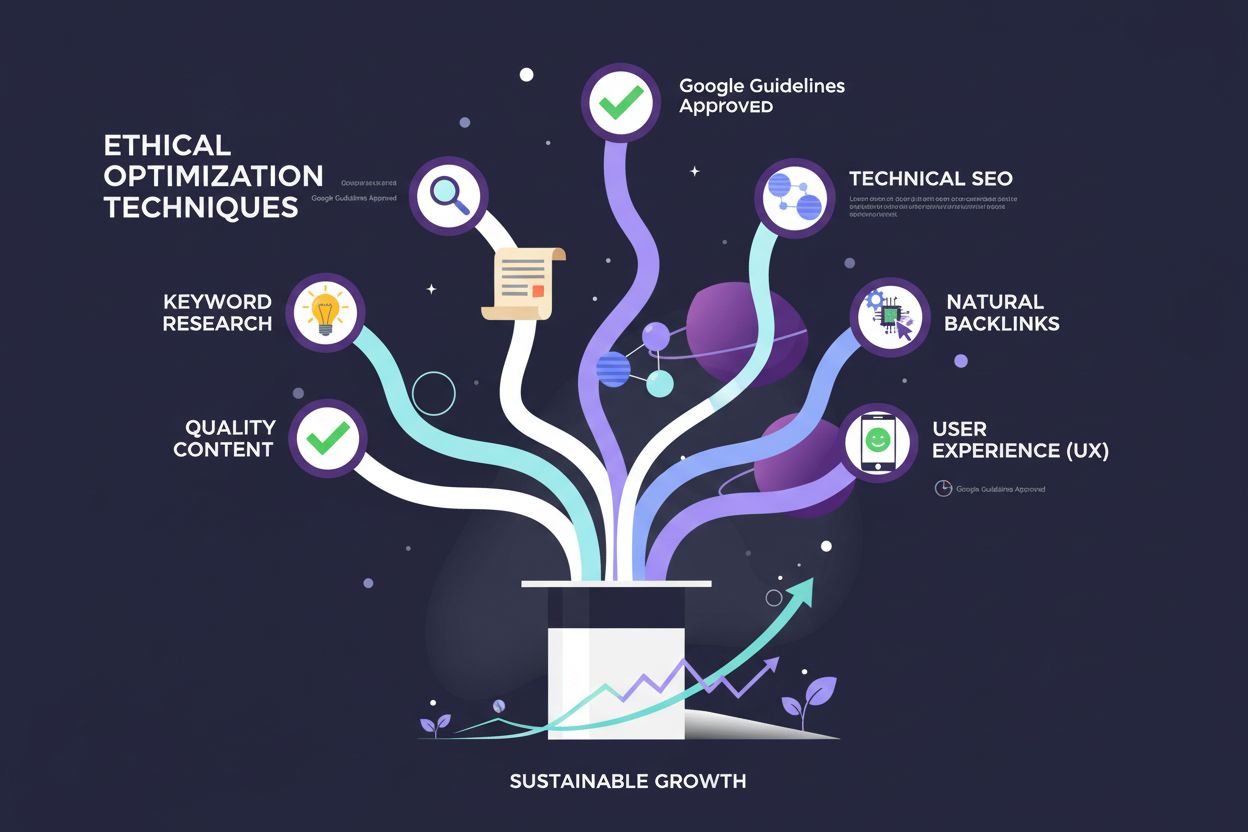
White Hat SEO
White Hat SEO definition: ethical search engine optimization following Google guidelines. Learn sustainable techniques for quality content, natural backlinks, a...
13 min read
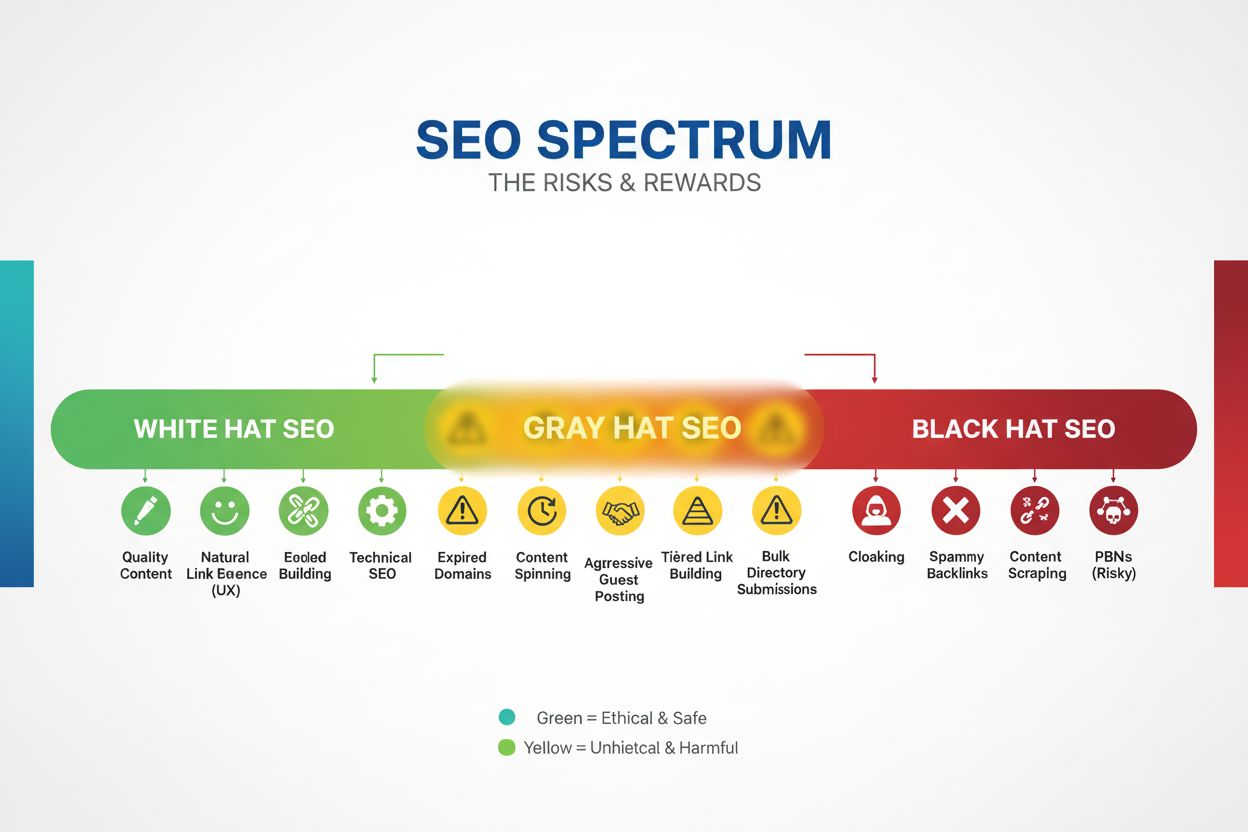
Gray Hat SEO refers to search engine optimization tactics that fall between ethical white hat and unethical black hat practices, exploiting algorithmic loopholes without explicitly violating search engine guidelines. These techniques carry moderate risk of penalties and are often considered ethically ambiguous by the SEO community.
Gray Hat SEO refers to search engine optimization tactics that fall between ethical white hat and unethical black hat practices, exploiting algorithmic loopholes without explicitly violating search engine guidelines. These techniques carry moderate risk of penalties and are often considered ethically ambiguous by the SEO community.
Gray Hat SEO refers to search engine optimization tactics that occupy the ambiguous middle ground between white hat (ethical) and black hat (unethical) practices. These techniques exploit algorithmic loopholes and gray areas in search engine guidelines without explicitly violating stated rules. Gray hat SEO is neither clearly sanctioned nor explicitly forbidden by search engines like Google, Bing, or Perplexity, making it inherently risky and ethically contentious. The term emerged as the SEO industry recognized that many effective tactics don’t fit neatly into purely ethical or purely malicious categories. Understanding gray hat SEO is essential for digital marketers, content strategists, and brand managers who must navigate competitive landscapes while maintaining long-term credibility and avoiding penalties.
The concept of gray hat SEO evolved alongside the maturation of search engine algorithms and the increasing sophistication of SEO practitioners. In the early 2000s, when search engines were less advanced, many tactics that would later be classified as gray hat were commonplace and relatively undetected. As Google released major algorithm updates like Penguin (targeting link schemes) and Panda (targeting low-quality content), the SEO industry began categorizing tactics more explicitly. Gray hat SEO emerged as practitioners sought methods that could deliver competitive advantages without crossing into clearly prohibited territory. The rise of AI-driven search engines like ChatGPT, Perplexity, and Google AI Overviews has added new dimensions to gray hat SEO, as these platforms evaluate content quality and domain authority differently than traditional search engines. Today, approximately 44% of webmasters engage in some form of gray hat SEO, reflecting both the competitive pressure in digital marketing and growing awareness of the risks involved. The evolution of gray hat tactics continues as search engines refine their detection capabilities and as new platforms emerge in the AI search landscape.
| Aspect | White Hat SEO | Gray Hat SEO | Black Hat SEO |
|---|---|---|---|
| Guideline Compliance | Fully compliant with search engine guidelines | Operates in ambiguous areas; not explicitly forbidden | Directly violates search engine guidelines |
| Primary Focus | User experience and content quality | Exploiting algorithmic loopholes | Manipulating rankings through deception |
| Common Tactics | Quality content, natural links, on-page optimization | Expired domains, PBNs, content spinning, cloaking | Keyword stuffing, hidden text, link farms, doorway pages |
| Risk Level | Minimal; very low penalty risk | Moderate to high; future algorithm changes may penalize | Severe; immediate penalties and potential deindexing |
| Time to Results | Slower (3-6+ months for significant gains) | Moderate (1-3 months for noticeable improvements) | Fast (weeks to months, but unsustainable) |
| Long-term Sustainability | Highly sustainable; builds lasting authority | Uncertain; depends on algorithm evolution | Unsustainable; penalties inevitable |
| Reputation Impact | Builds brand credibility and trust | Potential reputational damage if discovered | Severe reputational harm and loss of user trust |
| Cost | Higher upfront investment in quality content | Moderate; exploits cost-effective loopholes | Lower initial cost but high penalty recovery costs |
| Search Engine Detection | Not applicable; compliant by design | Increasingly detected through pattern recognition | Actively targeted by algorithm updates |
| AI Search Visibility | Strong credibility in AI-generated responses | May appear in AI results but with lower authority signals | Likely excluded or deprioritized in AI responses |
Gray hat SEO tactics function by identifying and exploiting gaps between what search engines explicitly prohibit and what they can effectively detect or penalize. Expired domain acquisition, for example, leverages the fact that search engines transfer some authority from expired domains to new owners, though this practice exists in a gray area because it can involve purchasing domains with spam histories. Private Blog Networks (PBNs) operate by creating networks of seemingly independent websites that link to a primary site, exploiting the principle that diverse backlinks signal authority while operating outside explicit guideline violations. Content spinning uses automated or manual rephrasing of existing content to create multiple versions, avoiding plagiarism detection while producing lower-quality content that may eventually trigger quality-based penalties. Cloaking involves serving different content to search engine crawlers versus human users, technically not forbidden but clearly against the spirit of search engine guidelines. Over-optimization with keywords and backlinks pushes the boundaries of what’s acceptable, relying on the fact that search engines use thresholds rather than absolute rules. These tactics work because they exploit the difference between what search engines can explicitly define as violations and what they can reliably detect through algorithmic analysis. However, as machine learning and AI improve, search engines become increasingly capable of identifying these patterns, making gray hat tactics progressively riskier over time.
From a business perspective, gray hat SEO presents a compelling but dangerous value proposition. In highly competitive industries—such as finance, healthcare, e-commerce, and technology—the pressure to rank quickly can make gray hat tactics attractive. Companies using gray hat methods may achieve faster ranking improvements than white hat competitors, potentially capturing market share and revenue before white hat strategies mature. Research indicates that gray hat tactics can deliver 30-50% faster ranking improvements compared to pure white hat approaches, which is significant in time-sensitive markets. However, this short-term advantage comes with substantial long-term costs. When penalties occur—and they increasingly do as search engines improve detection—companies face not only ranking losses but also reputational damage, loss of user trust, and expensive recovery efforts. The cost of penalty recovery often exceeds the gains achieved through gray hat tactics, making the practice economically irrational from a long-term perspective. Additionally, gray hat tactics can damage a brand’s credibility in AI search environments like ChatGPT, Perplexity, and Google AI Overviews, which prioritize content quality and domain authority signals. Companies that appear to use manipulative tactics may be deprioritized or excluded from AI-generated responses, reducing visibility in the emerging search landscape. For B2B companies and professional services, the reputational risk of gray hat SEO is particularly acute, as clients and partners expect ethical business practices.
The emergence of generative AI search engines has fundamentally changed how gray hat SEO tactics are evaluated. Traditional search engines like Google rank pages based on algorithmic signals including backlinks, content quality, and user engagement. AI search platforms like ChatGPT, Perplexity, Google AI Overviews, and Claude evaluate content differently—they assess factual accuracy, source credibility, and content quality more directly, making gray hat tactics less effective and more easily detected. A domain using PBNs or expired domain tactics may rank well in traditional Google search but appear less frequently in AI-generated responses because AI systems can identify unnatural link patterns and domain history anomalies. Content spinning and over-optimization are particularly problematic in AI search, as these platforms use sophisticated language models that can detect rephrased or artificially optimized content. Cloaking is essentially impossible in AI search environments, as AI systems access the same content as human users. This shift creates a critical challenge for companies relying on gray hat tactics: they may achieve traditional search visibility while losing credibility in AI search, which is increasingly important as ChatGPT, Perplexity, and other AI platforms capture growing portions of search traffic. AmICited and similar monitoring platforms help companies track how their domains appear in AI search responses, revealing whether gray hat tactics are damaging their visibility in this emerging channel. The implication is clear: gray hat SEO is becoming progressively less viable as AI search grows in importance.
Expired Domain Acquisition: Purchasing domains that have expired and redirecting them to your site to inherit their backlink authority and domain history. While not explicitly forbidden, this exploits search engine trust in established domains and can backfire if the domain has a spam history.
Private Blog Networks (PBNs): Creating networks of seemingly independent websites that link to your primary site, exploiting the principle that diverse backlinks signal authority. Google actively penalizes PBNs, making this one of the riskier gray hat tactics.
Content Spinning: Using automated tools or manual rephrasing to create multiple versions of the same content, avoiding plagiarism while producing lower-quality material that may trigger quality-based penalties.
Cloaking: Serving different content to search engine crawlers versus human users, technically not explicitly forbidden but clearly against search engine guidelines and increasingly detectable.
Over-Optimization: Aggressively optimizing pages with keywords, backlinks, and other ranking factors beyond what’s natural, pushing the boundaries of what search engines consider acceptable.
Clickbait Titles: Creating sensational or misleading headlines to drive clicks, exploiting user curiosity while risking high bounce rates and eventual ranking penalties.
Backlink Swaps: Trading backlinks with other websites to artificially inflate link profiles, exploiting the principle that reciprocal links are less valuable than one-way links but still attempting to game the system.
Low-Quality Directory Submissions: Registering on numerous low-quality web directories to generate backlinks, exploiting the fact that some directories still pass authority while associating with spam sites.
AI-Generated Content Reliance: Using AI tools to generate large volumes of content without human review or editing, exploiting the speed of AI while risking quality penalties as search engines improve content quality detection.
Keyword Density Manipulation: Carefully balancing keyword usage to maximize relevance signals without triggering over-optimization penalties, exploiting the gray area between natural and artificial keyword usage.
Gray hat SEO carries substantial and evolving risks that must be carefully weighed against potential benefits. Google’s algorithm updates are specifically designed to identify and penalize gray hat tactics, with updates like Penguin (2012), Panda (2011), Core Updates (ongoing), and Helpful Content Update (2023) progressively targeting different categories of gray hat practices. When penalties occur, they can range from ranking drops for specific pages to complete deindexing of entire domains. The uncertainty principle is a key risk factor: tactics that are currently undetected may become penalized as search engines improve their detection capabilities. A gray hat tactic that works today may trigger a penalty in six months when Google releases an algorithm update. This uncertainty makes gray hat SEO inherently unstable as a long-term strategy. Additionally, manual actions by Google’s spam team can result in immediate and severe penalties if human reviewers identify gray hat tactics. The reputational risk is equally significant: if competitors or users discover that a company is using gray hat tactics, it can damage brand credibility and user trust. In AI search environments, gray hat tactics are increasingly visible because AI systems can analyze content quality, backlink patterns, and domain history more directly than traditional algorithms. Companies using gray hat tactics may find themselves excluded from AI-generated responses or deprioritized in favor of more credible sources. The cost of recovery from gray hat penalties is substantial, often requiring months of effort and investment to rebuild authority and remove toxic backlinks.
As AI search platforms like ChatGPT, Perplexity, Google AI Overviews, and Claude become increasingly important for brand visibility, monitoring how gray hat tactics affect your presence in these channels is critical. AmICited and similar monitoring platforms track how your domain appears in AI-generated responses, revealing whether gray hat tactics are damaging your credibility in AI search. This monitoring is essential because gray hat tactics may boost traditional search rankings while simultaneously reducing your visibility in AI search, creating a false sense of success. AI systems evaluate content quality, source credibility, and domain authority more directly than traditional algorithms, making gray hat tactics less effective and more easily detected. Companies should monitor several key indicators: (1) AI search visibility: How frequently does your domain appear in AI-generated responses compared to competitors? (2) Content quality signals: Are your pages being cited as authoritative sources in AI responses? (3) Backlink profile health: Do your backlinks appear natural and diverse, or do they show patterns consistent with gray hat tactics? (4) Domain history: Does your domain have any history of spam, penalties, or suspicious ownership changes? (5) User engagement metrics: Are users finding your content helpful and engaging, or are they bouncing quickly? Monitoring these indicators helps companies identify whether gray hat tactics are providing genuine competitive advantages or simply creating hidden risks that will eventually surface as penalties.
The future of gray hat SEO is increasingly uncertain as search engines become more sophisticated and as AI search platforms gain market share. Machine learning algorithms are becoming progressively better at identifying unnatural patterns in backlinks, content quality, and user behavior, making gray hat tactics harder to execute without detection. Google’s AI Overviews and similar AI search features are fundamentally changing how search results are generated, prioritizing content quality and source credibility in ways that make gray hat tactics less effective. The rise of generative AI in search means that gray hat tactics must now work across multiple platforms—traditional search engines, AI search platforms, and emerging search interfaces—making it increasingly difficult to maintain a consistent strategy. Industry experts predict that gray hat SEO will become progressively less viable over the next 2-3 years as search engines improve detection and as AI search becomes the dominant search paradigm. Companies that have relied on gray hat tactics are increasingly transitioning to white hat strategies, recognizing that long-term sustainability requires ethical practices. The competitive landscape is also shifting: as more companies adopt white hat strategies and as search engines reward quality and credibility, gray hat tactics provide diminishing returns. For brand monitoring and AI citation tracking, gray hat tactics are becoming a liability rather than an asset, as they reduce credibility in AI-generated responses. The strategic implication is clear: companies should prioritize white hat SEO strategies that build lasting authority and credibility across both traditional and AI search platforms. Those still using gray hat tactics should develop transition plans to migrate to white hat approaches before penalties occur.
The ethical debate surrounding gray hat SEO reflects broader questions about competition, fairness, and the role of search engines in the digital ecosystem. White hat advocates argue that gray hat tactics undermine the integrity of search results and provide unfair advantages to companies willing to bend rules, ultimately harming users who receive lower-quality results. Gray hat practitioners counter that gray hat tactics are pragmatic responses to intense competition and that the distinction between gray and white hat is often arbitrary and subjective. Search engines maintain that their guidelines exist to ensure quality and relevance, and that gray hat tactics that exploit loopholes are contrary to the spirit of these guidelines even if not explicitly forbidden. The SEO industry consensus has gradually shifted toward white hat practices, with major SEO organizations and thought leaders increasingly advocating for ethical approaches. However, the reality is that gray hat tactics remain widespread, with approximately 44% of webmasters engaging in some form of gray hat SEO. This gap between stated ethical standards and actual practices reflects the competitive pressures that drive companies to seek short-term advantages. The emergence of AI search platforms is likely to accelerate the shift toward white hat practices, as these platforms make gray hat tactics less effective and more easily detected. Companies that prioritize ethical practices and long-term credibility are increasingly positioned to succeed in both traditional and AI search environments.
The primary distinction lies in explicit guideline violations. Black hat SEO directly violates search engine guidelines through tactics like keyword stuffing, hidden text, and link schemes, while gray hat SEO operates in ambiguous areas where rules are unclear or inconsistently enforced. Gray hat tactics may not be explicitly forbidden but are ethically questionable and carry moderate penalty risk, whereas black hat techniques carry severe penalties including potential deindexing.
Gray hat SEO can offer faster results and competitive advantages in highly competitive industries, but the risk-reward calculation depends on your risk tolerance and long-term goals. While gray hat tactics may provide short-term ranking boosts, they expose your website to future penalties if search engines tighten algorithms. Most SEO professionals recommend combining carefully considered gray hat tactics with white hat strategies for sustainable growth rather than relying solely on gray hat methods.
Search engines like Google use sophisticated machine learning algorithms and manual reviews to identify gray hat tactics. They analyze patterns such as unnatural backlink profiles, content quality inconsistencies, domain history anomalies, and user engagement metrics. Google's algorithm updates (Penguin, Panda, Core Updates) specifically target gray hat practices. Additionally, search engines monitor for tactics like private blog networks, expired domain exploitation, and content spinning through pattern recognition and quality assessment systems.
Yes, AI search platforms like ChatGPT, Perplexity, and Google AI Overviews can help identify gray hat SEO tactics by analyzing content quality, backlink authenticity, and domain credibility. Tools like AmICited monitor how domains and URLs appear in AI-generated responses, which can reveal whether gray hat tactics are affecting your brand's visibility in AI search results. This monitoring is crucial as gray hat practices may boost traditional search rankings but damage credibility in AI-driven search environments.
According to industry research, approximately 44% of webmasters engage in some form of gray hat SEO practices, while 24% of practices labeled as gray hat are actually white hat techniques with creative implementation. This widespread adoption reflects the competitive pressure in SEO, though it also indicates growing awareness of the risks. The prevalence of gray hat tactics underscores the importance of understanding the ethical spectrum and making informed decisions about SEO strategy.
Transitioning to white hat SEO involves auditing your current strategy to identify gray hat practices, then systematically replacing them with ethical alternatives. Focus on creating high-quality, original content that provides genuine value to users, earning natural backlinks through guest posting and partnerships, and optimizing on-page elements properly. Stay updated with search engine guidelines and algorithm changes, and consider working with reputable SEO professionals who prioritize long-term sustainability over short-term gains.
Common gray hat tactics include buying expired domains with existing backlinks, creating private blog networks (PBNs), content spinning and repurposing, cloaking (showing different content to search engines and users), over-optimization with keywords, using clickbait titles, and joining low-quality web directories. Other tactics include backlink swaps, using dummy social media accounts for engagement, and relying heavily on AI-generated content. Each carries varying levels of risk depending on how aggressively they're implemented and how search engines evolve their detection methods.
Start tracking how AI chatbots mention your brand across ChatGPT, Perplexity, and other platforms. Get actionable insights to improve your AI presence.
White Hat SEO definition: ethical search engine optimization following Google guidelines. Learn sustainable techniques for quality content, natural backlinks, a...
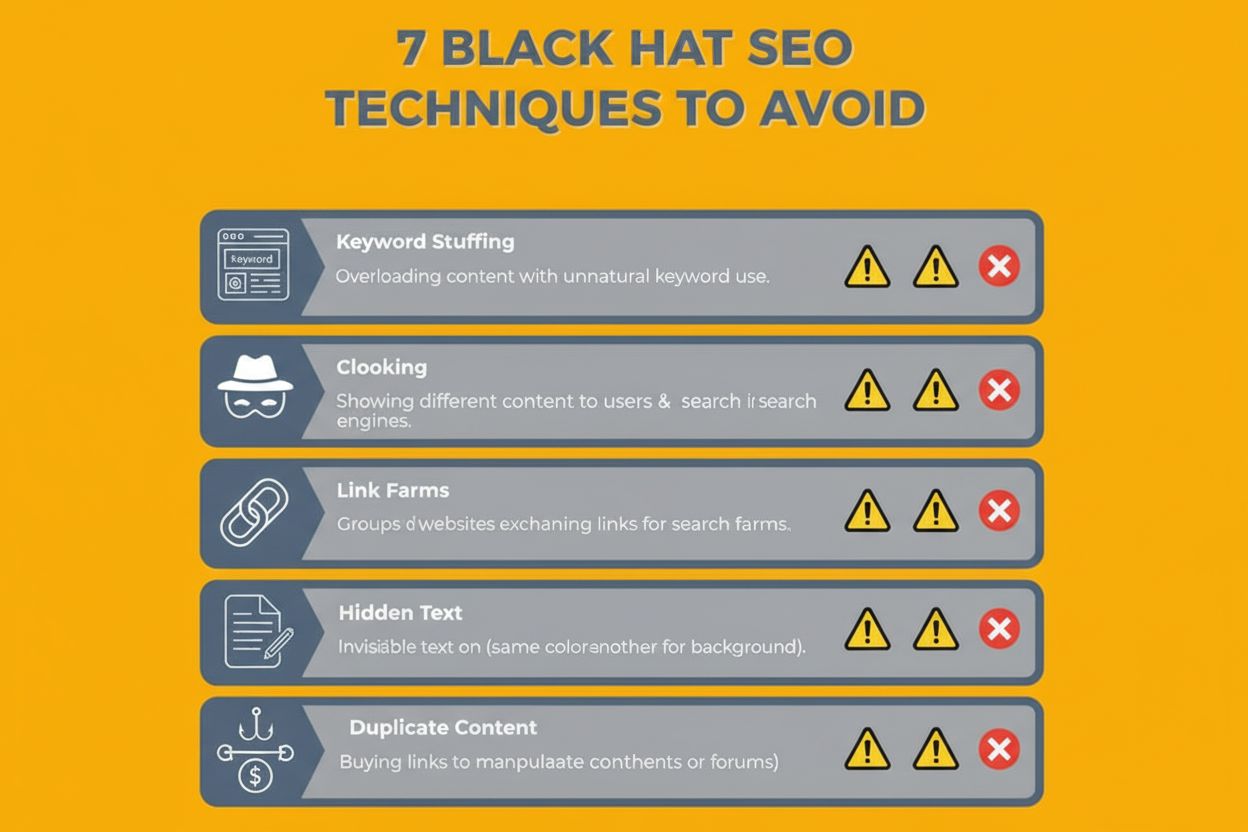
Black Hat SEO definition: unethical techniques violating search engine guidelines. Learn common tactics, penalties, and why ethical SEO matters for sustainable ...

Learn how black hat SEO tactics like AI poisoning, content cloaking, and link farms damage your brand's visibility in AI search engines like ChatGPT and Perplex...