

Guest Posting
Guest posting is writing content for other websites to earn backlinks and build authority. Learn how guest blogging improves SEO, brand visibility, and AI menti...
14 min read

A systematic approach to publishing expert content on authoritative publications that AI systems cite as credible sources. This off-page strategy builds brand authority, improves AI search visibility, and establishes thought leadership by strategically placing high-quality contributions on reputable platforms that large language models prioritize when generating responses.
A systematic approach to publishing expert content on authoritative publications that AI systems cite as credible sources. This off-page strategy builds brand authority, improves AI search visibility, and establishes thought leadership by strategically placing high-quality contributions on reputable platforms that large language models prioritize when generating responses.
Guest contribution strategy is a systematic approach to publishing expert content on authoritative publications that AI systems cite as credible sources. Unlike traditional guest posting, which primarily focuses on building backlinks and driving referral traffic, guest contribution strategy is specifically designed to improve visibility in large language models (LLMs) like ChatGPT, Claude, Perplexity, and Google AI Overviews. This off-page strategy involves strategically placing high-quality contributions on reputable platforms that AI systems prioritize when evaluating source credibility and generating responses. By establishing your expertise across multiple authoritative publications, you create distributed authority signals that AI systems recognize and value when answering user queries related to your industry or expertise.

Large language models evaluate content fundamentally differently than traditional search engines. While Google focuses on keywords and backlinks, AI systems prioritize E-E-A-T signals (Experience, Expertise, Authoritativeness, Trustworthiness) and contextual relevance. When your content appears on authoritative publications, AI systems interpret this as a third-party endorsement of your expertise. Guest contributions signal that reputable editors have vetted your knowledge and deemed it worthy of publication on their platforms. This editorial validation carries significant weight in how AI systems assess your credibility.
| Factor | Traditional SEO | AI Visibility Signals |
|---|---|---|
| Primary Focus | Keyword rankings and backlink quantity | E-E-A-T signals and semantic relevance |
| Content Evaluation | Keyword density and on-page optimization | Depth, clarity, and contextual authority |
| Authority Signals | Domain authority and link volume | Editorial endorsements and distributed authority |
| Citation Preference | Any relevant source | Authoritative, semantically relevant sources |
| Long-term Value | Fluctuates with algorithm updates | Builds cumulative authority over time |
AI systems also value semantic relevance more heavily than traditional search engines. When you contribute to publications that align thematically with your expertise, AI systems recognize the topical connection and associate your brand with specific knowledge domains. This contextual authority makes your content more likely to be referenced when users ask AI systems questions within your area of expertise.
Guest contribution strategy delivers multiple benefits that extend beyond traditional SEO metrics:
Choosing the right publications is critical for guest contribution strategy success. Not all publications carry equal weight with AI systems. Domain authority matters, but semantic relevance matters more. Target publications with a Domain Authority of at least 30 (preferably 40+), consistent organic traffic of 500+ monthly visitors, and clear editorial standards. Use tools like Ahrefs Domain Rating, Moz Domain Authority, and SEMrush to evaluate potential targets.
Beyond metrics, assess content quality by reviewing existing articles. Do they demonstrate thorough research, clear structure, and editorial rigor? Publications with high editorial standards signal to AI systems that their content meets quality thresholds. Verify that the publication provides dofollow links in author bios or within guest post content, as these pass link equity and strengthen your backlink profile.
Most importantly, prioritize topical relevance. A moderately authoritative publication closely aligned with your niche often outperforms a high-authority site with tangential relevance. AI systems recognize semantic connections between your expertise and the publication’s focus area. When you contribute to publications that share your audience and topic focus, you create stronger contextual authority signals that AI systems value when evaluating your credibility within specific knowledge domains.
Writing guest posts for AI visibility requires a different approach than writing for traditional search engines. AI systems prioritize clear structure and comprehensive coverage over keyword optimization. Start with descriptive headings that explicitly state what each section covers. Instead of vague titles like “Getting Started,” use specific headings such as “How to Implement Guest Contribution Strategy for AI Visibility” that help AI systems understand your content’s exact focus.
Break content into bite-sized sections of 150-200 words, each addressing a single main idea. This segmentation helps AI systems extract and reference relevant information. Use natural language and long-tail phrases that mirror how users actually query AI systems. Instead of “guest posting,” use phrases like “how to get your brand cited by AI systems” or “building authority for AI search visibility.” These conversational phrases align with how users interact with large language models.
Provide comprehensive topic coverage rather than surface-level information. AI systems favor depth and breadth. When addressing a topic, explore multiple angles, provide specific examples, and explain the reasoning behind recommendations. Include contextual links to authoritative sources that support your claims. These links signal to AI systems that your content is well-researched and grounded in credible information. The difference between writing for humans and writing for AI is subtle but important: humans scan for quick answers, while AI systems analyze content for depth, clarity, and semantic relationships.
Guest contributions create editorial backlinks that serve as trust signals to both search engines and AI systems. These backlinks differ from other link types because they’re embedded within high-quality, editorially vetted content. When an editor includes a link to your site within a guest post, they’re essentially endorsing your content as a credible resource. This editorial validation carries more weight than links from resource pages or author bios.
Optimize anchor text for AI systems by using descriptive phrases rather than generic terms. Instead of “click here,” use specific phrases like “guest contribution strategy for AI visibility” or “how to build authority in AI search.” These descriptive anchors help AI systems understand the relationship between your guest post and the linked content. Vary your anchor text across multiple guest posts to avoid appearing manipulative while maintaining semantic relevance.
Prioritize dofollow contextual links embedded within article content, as these provide the strongest authority signals. Links in author bios offer moderate value, while nofollow links still contribute to brand visibility even though they don’t pass link equity. The placement and context of links matter significantly. Links that appear naturally within relevant paragraphs signal stronger topical relevance than links clustered at the end of content. Aim for 3-5 high-quality external links per 1,000 words of guest post content, ensuring each link genuinely enhances reader understanding.
Tracking guest contribution performance requires monitoring multiple metrics across different platforms. Use brand mention tracking tools like Brand24, Mention, and Google Alerts to identify when your brand, products, or expertise are referenced in AI-generated content. Set up alerts for your company name, key team members, and product names to capture mentions across various platforms. This direct measurement of AI citations provides the clearest indicator of guest contribution strategy success.
Monitor referral traffic from guest posts using Google Analytics, looking beyond click-through rates to assess user engagement. Examine session duration, pages per session, and conversion rates to understand whether guest post traffic converts into meaningful business outcomes. Track topical authority growth using tools like Ahrefs or SEMrush to measure how your guest contributions strengthen your domain’s authority within specific keyword clusters. Long-term metrics matter more than short-term spikes; consistent growth over 6-12 months indicates sustainable authority building.
Create a monthly reporting dashboard that combines these metrics to provide actionable insights. Focus on long-term trends rather than individual post performance, as AI recognition builds gradually through consistent contributions. Most importantly, use AI monitoring tools like AmICited to track how often AI systems cite your contributions when answering user queries. This direct measurement of AI visibility provides the most relevant metric for guest contribution strategy success.
Guest contributions stand out among off-page SEO tactics for their specific effectiveness in building AI visibility. Social media marketing generates high-volume traffic but typically uses nofollow links that don’t pass link equity. Press releases create brand awareness and media coverage but often lack the contextual relevance that AI systems prioritize. Influencer marketing builds brand recognition but depends on influencer reach rather than publication authority. Broken link building earns backlinks but doesn’t establish your expertise as effectively as editorial contributions.
Guest contributions combine the best elements of these tactics: they provide editorial endorsements (like PR), contextual authority (like influencer partnerships), and high-quality backlinks (like broken link building), all while establishing your expertise on semantically relevant platforms. The distributed authority signals created by multiple guest contributions across different authoritative publications create a pattern that AI systems recognize as genuine expertise. This combination of authority, relevance, and contextual placement makes guest contributions superior for AI search visibility.
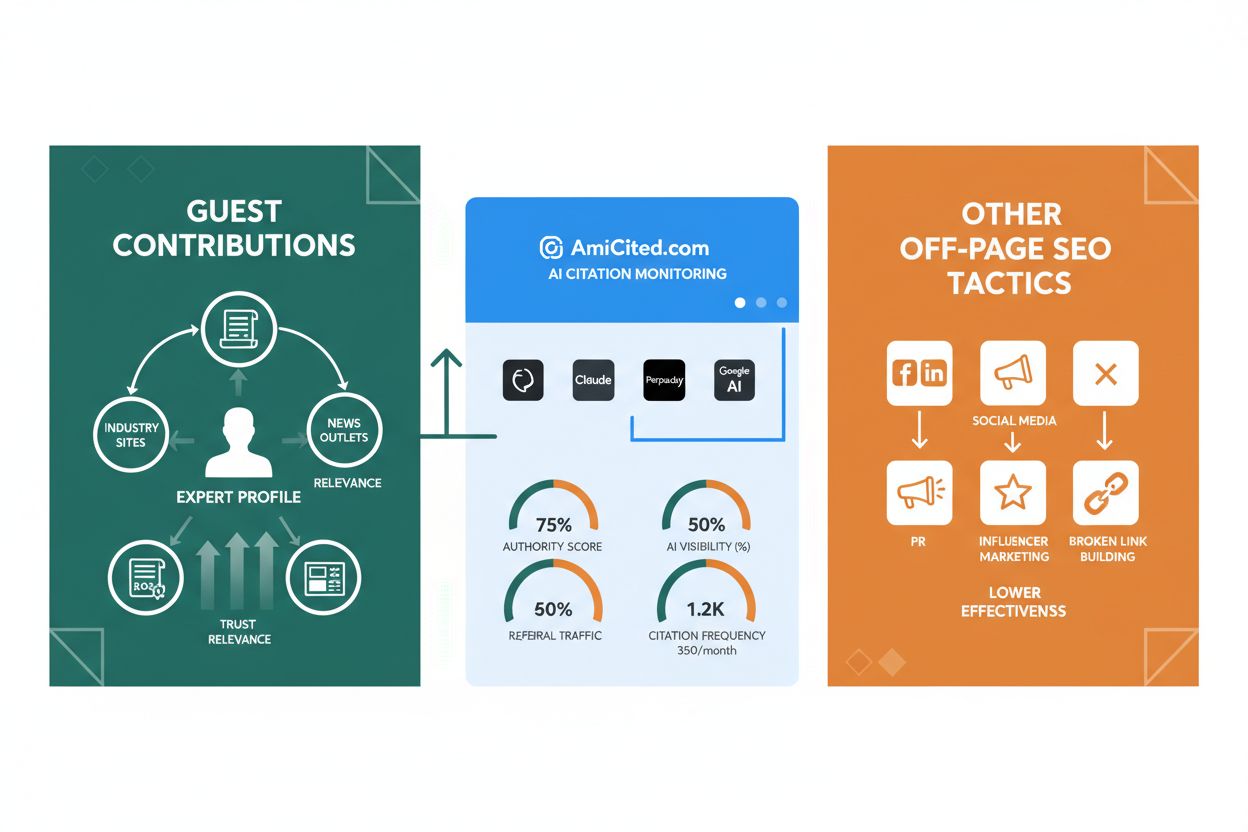
AmICited.com provides the monitoring infrastructure needed to track guest contribution performance across AI systems. By monitoring how ChatGPT, Claude, Perplexity, and Google AI Overviews cite your brand and contributions, you gain visibility into which guest posts drive the most AI citations. This data-driven approach allows you to refine your guest contribution strategy based on actual AI visibility results rather than traditional SEO metrics alone.
The most common mistake in guest contribution strategy is prioritizing quantity over quality. Publishing on numerous low-authority publications generates minimal AI visibility benefit. Instead, focus on securing placements on fewer, higher-authority publications that align semantically with your expertise. Another critical error is poor anchor text optimization. Using generic phrases like “learn more” or “click here” wastes the opportunity to signal topical relevance to AI systems.
Irrelevant topic selection undermines strategy effectiveness. Contributing to publications outside your expertise area creates weak semantic signals that AI systems don’t value. Inconsistent effort is equally problematic; guest contribution strategy requires sustained commitment over months, not sporadic contributions. Best practices include strategic publication selection based on authority and relevance, high-quality content creation that demonstrates genuine expertise, relationship building with editors to increase acceptance rates, and long-term commitment to establishing cumulative authority. Treat guest contributions as a strategic investment in distributed authority rather than a quick link-building tactic.
As AI search continues to evolve, guest contribution strategy becomes increasingly important for maintaining visibility. AI systems are moving beyond keyword matching toward distributed authority evaluation, where they assess expertise across multiple sources rather than relying on single-domain authority. This shift favors brands that establish presence across multiple authoritative publications. Guest contributions position your brand perfectly for this evolution by creating the distributed authority signals that future AI systems will prioritize.
The integration of AI monitoring tools like AmICited into marketing workflows will become standard practice. Brands that track their AI citations and adjust their guest contribution strategy based on AI visibility data will outpace competitors relying on traditional SEO metrics. As AI search traffic continues to grow—with projections suggesting AI-driven traffic may surpass traditional search by 2027—the strategic importance of guest contribution strategy will only increase. Brands investing in systematic guest contribution strategies today are building the distributed authority foundation that will drive visibility in tomorrow’s AI-dominated search landscape.
While traditional guest posting focuses primarily on building backlinks and driving referral traffic, guest contribution strategy is specifically designed for AI visibility. It emphasizes creating authoritative content on publications that AI systems cite, optimizing for semantic relevance and E-E-A-T signals rather than just keyword rankings. The strategy considers how large language models evaluate and reference content when generating responses.
Target publications with high domain authority (DA 30+), strong organic traffic, editorial standards, and topical relevance to your expertise. Use tools like Ahrefs, Moz, and SEMrush to evaluate publications. Prioritize sites that AI systems frequently cite and that align semantically with your niche. Quality and relevance matter far more than quantity when building AI visibility.
Structure content with clear, descriptive headings that outline each section's focus. Use natural language and long-tail phrases that mirror how users query AI systems. Provide comprehensive coverage of topics, incorporate contextual links to authoritative sources, and maintain a conversational tone. AI systems prioritize depth, clarity, and semantic relevance over keyword density.
Monitor brand mentions across AI systems using tools like Brand24 and Google Alerts. Track referral traffic from guest posts, measure topical authority growth in your niche, and use Ahrefs to monitor backlink quality. Most importantly, use AI monitoring tools like AmICited to track how often AI systems cite your contributions when answering user queries.
Guest contribution strategy is a long-term investment. Most brands see meaningful results within 3-6 months of consistent contributions. However, the compounding effect becomes significant after 6-12 months as multiple publications cite your expertise and AI systems recognize your authority. Consistency and quality matter more than speed in building sustainable AI visibility.
Yes, guest contributions provide high-quality backlinks that improve traditional SEO rankings. However, the primary benefit for guest contribution strategy is AI visibility. The dofollow links from authoritative publications pass link equity, but the real value comes from establishing your brand as an authority source that AI systems prioritize when generating responses.
Guest contributions are particularly effective for AI visibility because they create distributed authority signals across multiple trusted domains. Unlike social media (which uses nofollow links) or PR (which may lack contextual relevance), guest posts provide editorial endorsements on semantically relevant sites. This combination of authority, relevance, and contextual placement makes guest contributions superior for AI search visibility.
Common mistakes include targeting low-quality publications, using poor anchor text, choosing irrelevant topics, and treating it as a one-time tactic. The biggest error is prioritizing quantity over quality. Successful guest contribution strategy requires consistent effort, strategic publication selection, relationship building with editors, and long-term commitment to establishing genuine authority.
Track how AI systems like ChatGPT, Claude, Perplexity, and Google AI Overviews reference your brand. Get real-time insights into your AI search visibility and guest contribution performance.
Guest posting is writing content for other websites to earn backlinks and build authority. Learn how guest blogging improves SEO, brand visibility, and AI menti...
Learn where to guest post for maximum AI visibility. Discover the top platforms AI systems cite and create a guest posting strategy that increases your brand's ...
Community discussion on whether guest posting helps AI visibility. Real experiences from content marketers testing guest post impact on ChatGPT and Perplexity c...