

HowTo Schema: Optimizing Step-by-Step Content for AI Extraction
Learn how HowTo schema optimizes step-by-step content for AI extraction. Implement structured data to improve visibility in LLM responses and AI Overviews.
12 min read
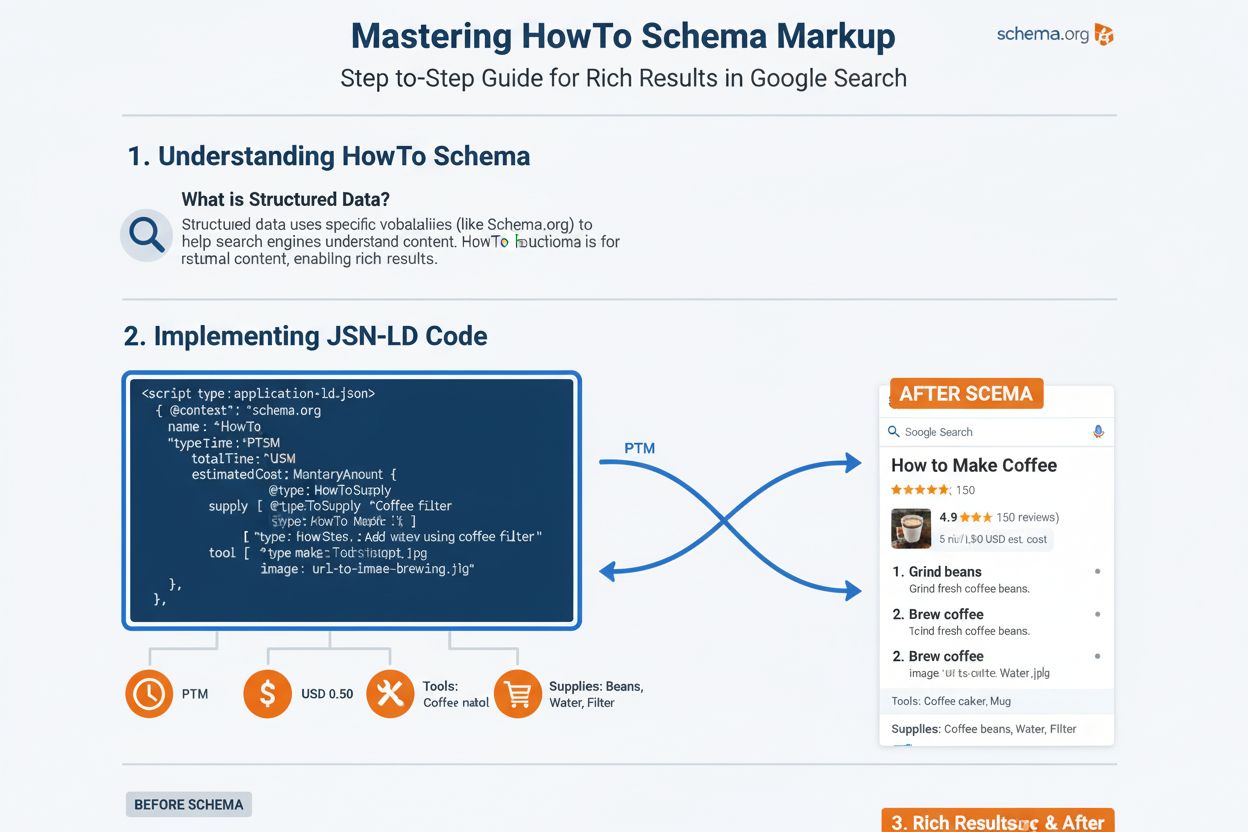
HowTo Schema is a structured data markup format that explicitly communicates step-by-step instructional content to search engines using schema.org vocabulary. It enables websites to display rich results in Google Search and AI-powered search platforms, improving visibility and click-through rates for how-to guides, tutorials, and procedural content.
HowTo Schema is a structured data markup format that explicitly communicates step-by-step instructional content to search engines using schema.org vocabulary. It enables websites to display rich results in Google Search and AI-powered search platforms, improving visibility and click-through rates for how-to guides, tutorials, and procedural content.
HowTo Schema is a structured data markup format based on the schema.org vocabulary that explicitly communicates step-by-step instructional content to search engines and AI systems. It uses standardized properties to describe how-to guides, tutorials, and procedural instructions in a machine-readable format that search engines can easily parse and understand. By implementing HowTo Schema, website owners provide search engines with detailed information about the title, steps, tools, supplies, time requirements, and estimated costs associated with instructional content. This markup enables rich results in Google Search and improves visibility across AI-powered search platforms like Perplexity, ChatGPT, and Google AI Overviews, making instructional content more discoverable and engaging for users seeking procedural guidance.
The development of HowTo Schema emerged from the broader adoption of structured data in search engine optimization, which gained significant momentum following Google’s introduction of rich results in 2009. Schema.org, a collaborative effort between Google, Microsoft, Yahoo, and Yandex, created standardized vocabularies for marking up different types of content. The HowTo type was specifically designed to address the growing volume of instructional content on the web, from DIY home improvement guides to software tutorials to cooking instructions. Over the past decade, structured data adoption has become increasingly critical for SEO success. According to industry research, approximately 78% of enterprises now use AI-driven content monitoring tools to track how their structured data performs across search engines. The rise of AI search engines has further elevated the importance of HowTo Schema, as these systems rely heavily on structured data to extract, understand, and cite information in their generated responses. Google’s case studies demonstrate the tangible impact of structured data implementation: Nestlé measured an 82% higher click-through rate for pages displayed as rich results compared to standard search results, while the Food Network converted 80% of their pages to enable search features and saw a 35% increase in visits. These statistics underscore why HowTo Schema has become an essential component of modern content strategy.
HowTo Schema is implemented using three primary formats: JSON-LD (JavaScript Object Notation for Linked Data), Microdata, and RDFa. Google recommends JSON-LD as the preferred format because it’s the easiest to implement and maintain at scale, particularly for websites with dynamic content management systems. The basic structure of HowTo Schema includes several key properties: the name property (required) specifies the title of the how-to, while the step property (required) contains an array of HowToStep or HowToSection objects that describe each instruction. Each step must include a text property with the full instruction, and optionally can include name, image, url, and video properties to provide additional context. Beyond the required properties, Google recommends including description (a summary of the how-to), image (a photo of the completed result), totalTime (in ISO 8601 duration format), estimatedCost (the cost of supplies), tool (objects or text describing tools needed), and supply (objects or text describing consumable materials). The HowToStep object can be further subdivided into HowToDirection (the actual instruction) and HowToTip (helpful advice) elements, allowing for granular control over how information is structured and presented. This hierarchical structure enables search engines to understand not just what the steps are, but how they relate to one another and what resources are required at each stage.
| Aspect | HowTo Schema | Recipe Schema | FAQ Schema | Article Schema |
|---|---|---|---|---|
| Primary Use | General step-by-step instructions | Food and beverage preparation | Question-and-answer content | News and blog articles |
| Required Properties | name, step | name, recipeIngredient, recipeInstructions | mainEntity, acceptedAnswer | headline, datePublished |
| Supports Steps | Yes, with HowToStep objects | Yes, with recipeInstructions | No, uses Q&A format | No, linear narrative |
| Includes Time Estimates | Yes (totalTime, prepTime, performTime) | Yes (prepTime, cookTime, totalTime) | No | No |
| Includes Cost Information | Yes (estimatedCost) | No | No | No |
| Rich Result Display | How-to rich results with images and steps | Recipe cards with ratings and nutrition | FAQ accordion in search results | Article snippet with byline |
| AI Search Optimization | Excellent for instructional queries | Excellent for recipe queries | Good for direct answers | Good for informational queries |
| Video Support | Yes, with VideoObject | Yes, with VideoObject | Limited | Yes, with VideoObject |
| Best For | DIY, tutorials, software guides, repairs | Cooking, baking, beverage recipes | Common questions, troubleshooting | News, blog posts, guides |
The implementation of HowTo Schema directly impacts how instructional content appears in search results and AI-generated responses. When properly marked up, HowTo content becomes eligible for rich results in Google Search, which display additional visual elements such as step images, estimated completion time, required tools, and cost information directly in the search results page. This enhanced presentation significantly increases user engagement before they even click through to your website. Research from multiple sources demonstrates that rich results drive substantially higher click-through rates: Rotten Tomatoes reported a 25% higher click-through rate for pages enhanced with structured data, while Rakuten found that users spend 1.5x more time on pages with structured data and have a 3.6x higher interaction rate on AMP pages with search features. Beyond traditional search, HowTo Schema plays a critical role in AI search optimization. Platforms like Perplexity, ChatGPT, and Google AI Overviews rely on structured data to identify, extract, and cite authoritative sources when generating responses to user queries. When a user asks “How do I fix a leaky faucet?” or “What are the steps to optimize a website?”, these AI systems search for well-marked HowTo Schema content to provide accurate, step-by-step guidance. By implementing HowTo Schema, content creators increase the likelihood that their instructional content will be selected and cited in AI-generated responses, creating a new channel for visibility and traffic that complements traditional search engine optimization.
Different AI search platforms and traditional search engines handle HowTo Schema with varying degrees of sophistication, making it important to understand platform-specific considerations. Google Search displays HowTo rich results with images, step summaries, and estimated time, making the content immediately scannable in search results. Google AI Overviews (formerly SGE) integrate HowTo Schema data into AI-generated summaries, often citing the source and displaying step-by-step guidance. Perplexity prioritizes well-structured instructional content and frequently cites HowTo Schema markup when generating responses to procedural queries, making it an excellent platform for DIY and technical content. ChatGPT and other large language models benefit from HowTo Schema because it provides clear, structured information that the model can easily parse and incorporate into its responses, though these platforms don’t always display source attribution in the same way traditional search engines do. Claude and other enterprise AI systems similarly leverage structured data to improve response accuracy and provide citations. The key insight is that HowTo Schema is not just for Google Search anymore—it’s become a fundamental component of AI search optimization. Content creators who implement HowTo Schema are essentially providing AI systems with pre-processed, verified information that these systems can confidently use and cite. This is particularly important for technical, instructional, and procedural content where accuracy and clarity are paramount. Additionally, the AmICited platform allows content creators to monitor where their HowTo Schema content appears across all these different AI search platforms, providing visibility into which instructional content is being cited and how it’s being presented to users.
Implementing HowTo Schema effectively requires attention to several best practices that maximize both search engine visibility and user experience. First, only mark up visible content—never create blank pages or add schema markup for information not displayed to users, as this violates Google’s structured data guidelines and can result in manual actions against your site. Second, prioritize accuracy and completeness over attempting to include every possible property; it’s better to have fewer but complete and accurate properties than to include every optional field with incomplete or incorrect data. Third, use descriptive and specific step names and text; vague instructions like “Do the thing” provide no value to search engines or users, whereas detailed instructions like “Position the jack underneath the car, next to the flat tire” clearly communicate the action. Fourth, include high-quality images for each step whenever possible; images significantly improve the likelihood of rich result display and provide visual clarity that helps both search engines and users understand the process. Fifth, use ISO 8601 duration format for time properties (e.g., “PT30M” for 30 minutes, “PT2H30M” for 2 hours 30 minutes) to ensure search engines correctly parse and display time information. Sixth, organize complex procedures into HowToSection objects when your how-to has multiple phases or categories; this hierarchical structure helps search engines understand the overall flow of the process. Finally, validate your markup using Google’s Rich Results Testing Tool and the Schema Markup Validator before deploying to production, and monitor performance using Google Search Console’s Rich Results report to track how your HowTo content is performing in search results.
The role of HowTo Schema is evolving rapidly as AI search engines become increasingly sophisticated and prevalent. Historically, HowTo Schema was primarily valuable for improving visibility in Google Search’s rich results, which represented a relatively small percentage of overall search traffic. However, as AI search platforms like Perplexity, ChatGPT, and Google AI Overviews gain market share and user adoption, the strategic importance of HowTo Schema has expanded dramatically. These AI systems are fundamentally different from traditional search engines in that they generate original responses rather than simply ranking and displaying existing web pages. This shift creates both opportunities and challenges for content creators. The opportunity is that well-marked HowTo Schema content is more likely to be selected, cited, and incorporated into AI-generated responses, providing a new channel for visibility and traffic. The challenge is that AI systems may cite your content without driving direct traffic to your website, requiring a shift in how content creators measure and value SEO performance. Looking forward, several trends are likely to shape the evolution of HowTo Schema. First, AI search optimization will become as important as traditional SEO, making HowTo Schema implementation a standard practice rather than an optional enhancement. Second, schema markup will become more granular and specific, with AI systems expecting increasingly detailed and structured information about procedures, prerequisites, and outcomes. Third, multimodal schema markup combining text, images, video, and potentially audio will become more common, as AI systems develop better capabilities for processing and understanding diverse content types. Fourth, real-time schema updates may become necessary as AI systems demand more current and dynamic information about procedures and instructions. Finally, schema markup monitoring and analytics will become critical business functions, as content creators need to understand not just whether their content ranks in traditional search, but whether and how it’s being cited in AI-generated responses. The AmICited platform is positioned at the forefront of this evolution, providing the visibility and analytics infrastructure that content creators need to optimize their HowTo Schema strategy for the AI search era.
Measuring the effectiveness of HowTo Schema implementation requires a multi-faceted approach that accounts for both traditional search metrics and emerging AI search indicators. For traditional Google Search, the primary metrics are click-through rate (CTR) and impressions for pages displaying as rich results, which can be tracked in Google Search Console’s Performance report filtered by search appearance. To measure the impact of HowTo Schema specifically, conduct an A/B test by selecting pages with several months of historical data, implementing HowTo Schema on some pages while leaving others as a control group, and then comparing performance over a 2-3 month period. According to Google’s methodology, this approach accounts for seasonal variations and other factors that might affect traffic. Beyond traditional search metrics, measuring AI search performance requires different tools and approaches. AmICited provides visibility into where your HowTo Schema content appears across AI search platforms, tracking citations, mentions, and how your content is presented in AI-generated responses. This data is crucial for understanding the true ROI of HowTo Schema implementation in the AI search era. Additionally, monitor brand mentions and citations across AI platforms to understand how your instructional content is being used and attributed. Track user engagement metrics such as time on page, bounce rate, and conversion rate for pages with HowTo Schema to understand whether the enhanced visibility translates to meaningful business outcomes. Finally, conduct qualitative analysis by reviewing actual AI-generated responses that cite your HowTo Schema content to understand how your instructions are being presented and whether they’re being accurately represented. This comprehensive measurement approach ensures that HowTo Schema implementation is delivering genuine business value rather than simply improving vanity metrics.
While both HowTo and Recipe schemas follow similar structural patterns with steps and instructions, Recipe Schema is specifically designed for food and beverage preparation content. HowTo Schema is broader and applies to any instructional content—from home repairs to software tutorials to DIY crafts. Recipe Schema includes additional properties like ingredients, nutrition information, and cooking times, whereas HowTo Schema focuses on general procedural steps with tools, supplies, and estimated costs.
HowTo Schema enables rich results in Google Search, which display additional visual elements like images, estimated time, and cost information directly in search results. According to Google's case studies, pages displayed as rich results achieve 82% higher click-through rates compared to standard search results. The enhanced visual presentation makes your content more compelling and informative before users even click through to your website.
The two required properties for HowTo Schema are 'name' (the title of the how-to) and 'step' (the individual instruction steps). Each step must contain either a HowToStep or HowToDirection object with text describing the action. While these are the minimum requirements for basic markup, Google recommends including additional properties like 'description', 'image', 'totalTime', 'estimatedCost', 'tool', and 'supply' to provide more comprehensive information and increase eligibility for rich results.
Yes, HowTo Schema significantly improves visibility in AI-powered search platforms like Perplexity, ChatGPT, and Google AI Overviews. These AI systems rely on structured data to understand and extract information from web pages. Well-marked HowTo content is more likely to be cited and referenced in AI-generated responses, making it an essential component of modern SEO strategy for content creators targeting both traditional and generative search engines.
Google recommends using JSON-LD (JavaScript Object Notation for Linked Data) format for implementing HowTo Schema, as it's the easiest to implement and maintain at scale. JSON-LD is embedded in a script tag in the page's head or body and doesn't interfere with visible HTML content. While Microdata and RDFa formats are also supported, JSON-LD is preferred because it's less prone to user errors and works well with dynamically generated content.
You can validate HowTo Schema using Google's Rich Results Testing Tool (search.google.com/test/rich-results) or the Schema Markup Validator (validator.schema.org). The Rich Results Test shows whether your markup is eligible for rich result display in Google Search, while the Schema Markup Validator checks for syntax errors in your schema.org code. Both tools are free and provide detailed feedback on any issues with your implementation.
Yes, HowTo Schema supports video content through the 'video' property, which accepts VideoObject types. You can include videos as part of your step-by-step instructions using properties like 'duringMedia', 'beforeMedia', and 'afterMedia' to show videos at different stages of the process. This is particularly valuable for visual instructional content, as it allows search engines to understand and display video previews alongside your how-to steps.
Start tracking how AI chatbots mention your brand across ChatGPT, Perplexity, and other platforms. Get actionable insights to improve your AI presence.
Learn how HowTo schema optimizes step-by-step content for AI extraction. Implement structured data to improve visibility in LLM responses and AI Overviews.

Learn how to implement HowTo schema markup for better visibility in AI search engines. Step-by-step guide to adding structured data for ChatGPT, Perplexity, and...
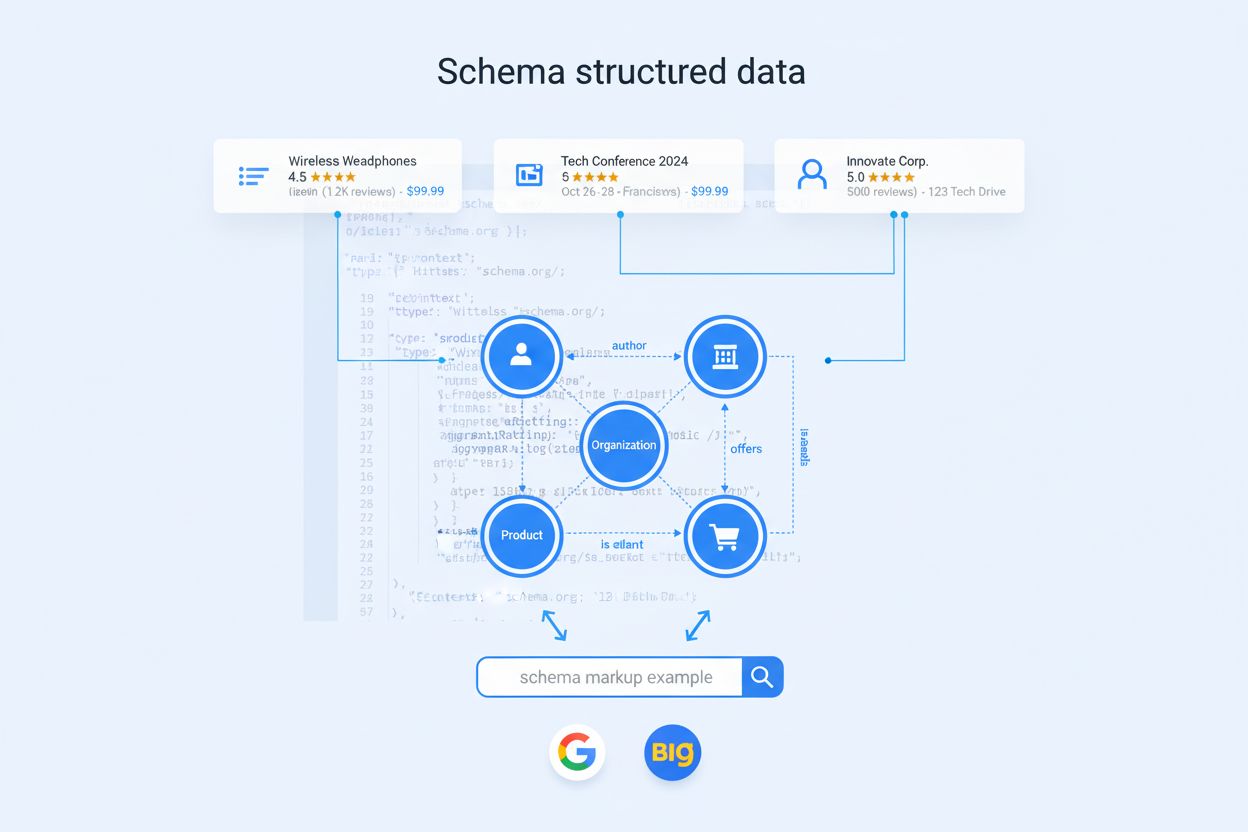
Schema markup is standardized code that helps search engines understand content. Learn how structured data improves SEO, enables rich results, and supports AI s...