
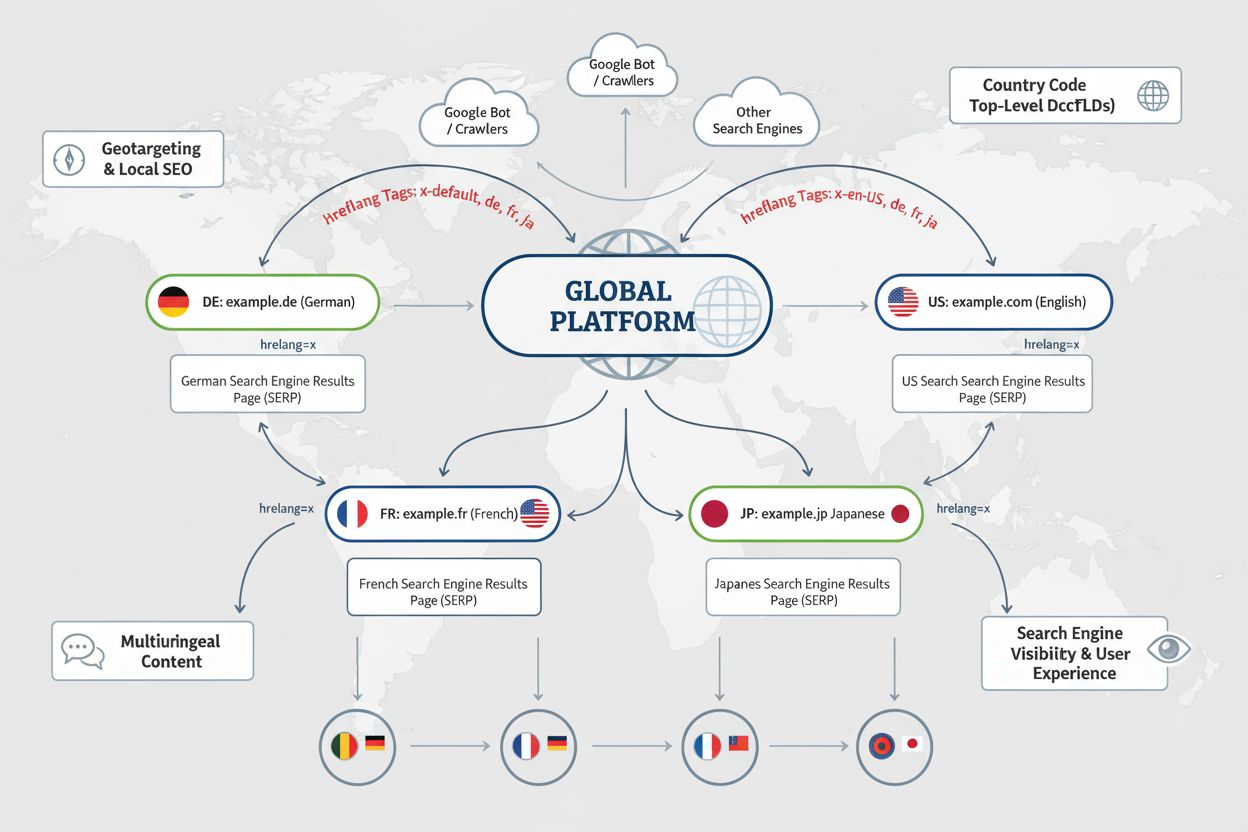
International SEO
International SEO optimizes websites for multiple languages and countries, using hreflang tags, localized content, and regional targeting to improve global sear...
10 min read
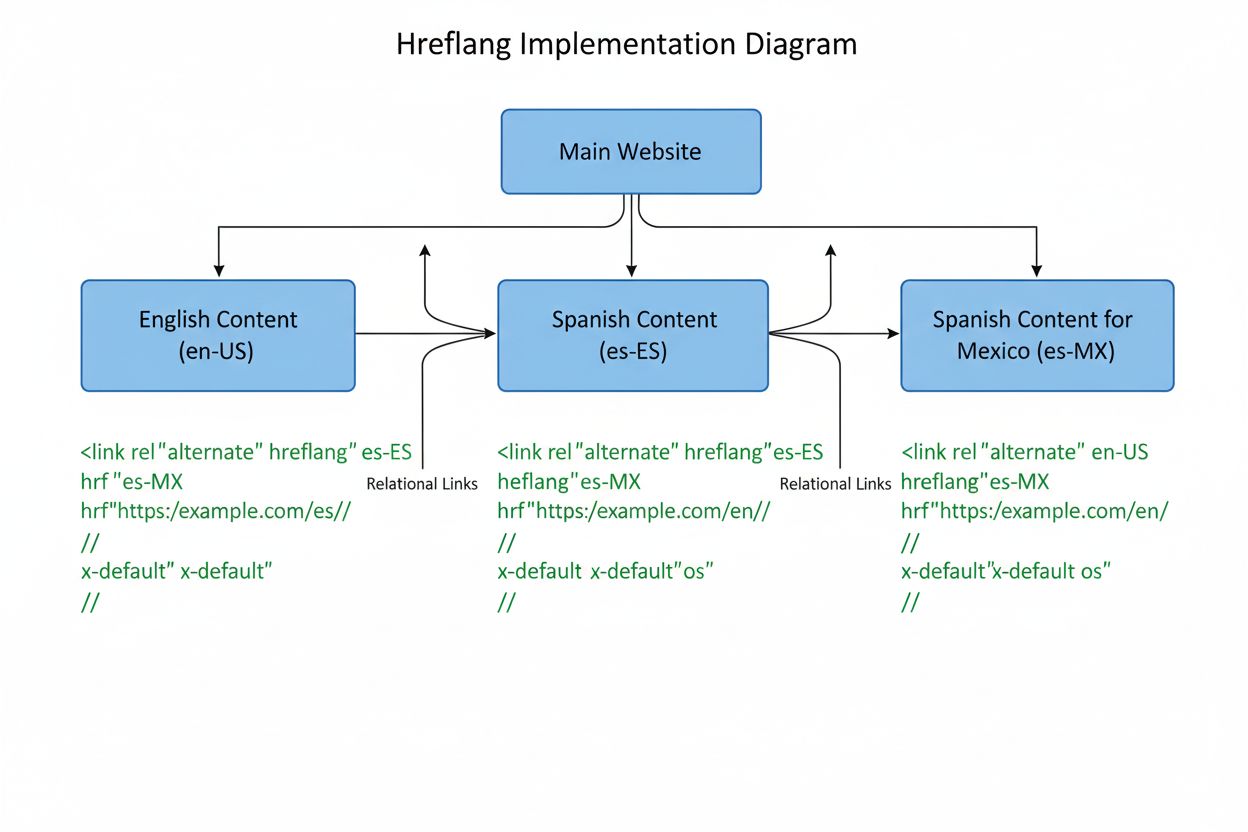
Hreflang is an HTML attribute that signals to search engines the language and regional targeting of a webpage, enabling proper indexing and display of multilingual content to users based on their location and language preferences. Introduced by Google in December 2011, it uses ISO 639-1 language codes and ISO 3166-1 country codes to establish relationships between alternate page versions.
Hreflang is an HTML attribute that signals to search engines the language and regional targeting of a webpage, enabling proper indexing and display of multilingual content to users based on their location and language preferences. Introduced by Google in December 2011, it uses ISO 639-1 language codes and ISO 3166-1 country codes to establish relationships between alternate page versions.
Hreflang is an HTML attribute that communicates to search engines the language and geographical targeting of a webpage, enabling proper indexing and display of multilingual content to users based on their location and language preferences. Introduced by Google in December 2011, the hreflang attribute uses ISO 639-1 language codes and ISO 3166-1 country codes to establish explicit relationships between alternate page versions. The complete syntax follows the pattern <link rel="alternate" hreflang="language-country" href="url" />, where the rel attribute indicates an alternative version exists, and the hreflang value specifies the target language and region. For international websites serving multiple markets, hreflang is a critical technical SEO signal that prevents search engines from treating translated or regionalized pages as duplicate content, instead clarifying that each version serves a specific audience.
The introduction of hreflang represented a significant advancement in international SEO, addressing a fundamental challenge that multilingual websites faced: search engines struggled to understand the relationship between pages in different languages. Before hreflang’s introduction, websites offering content in multiple languages risked having search engines index the wrong version for specific users, or worse, penalizing sites for duplicate content when they were simply serving localized versions. Google’s announcement in December 2011 provided webmasters with a standardized, machine-readable way to communicate language and regional intent. Over the past thirteen years, hreflang has become an industry standard, though adoption remains surprisingly limited—research indicates that only approximately 9% of websites implement hreflang on their homepages, despite its critical importance for international visibility. This low adoption rate creates significant opportunities for organizations that properly implement hreflang to gain competitive advantages in international search results. The attribute has evolved to support increasingly sophisticated targeting scenarios, including language-only targeting (e.g., hreflang="en"), language-region combinations (e.g., hreflang="en-gb"), and the special x-default value for fallback pages. Enterprise SEO platforms report that 73% of international websites suffer from hreflang-related issues, ranging from missing self-referential tags to incorrect ISO codes, highlighting the complexity of proper implementation at scale.
The hreflang attribute can be implemented through three distinct methods, each suited to different website architectures and content management systems. The first and most common method involves placing hreflang tags directly in the HTML <head> section of each page, using the syntax <link rel="alternate" hreflang="value" href="url" />. This approach works well for static websites or those with limited language variants, as each page must include tags referencing all available language versions, including itself. The second implementation method uses XML sitemaps, where hreflang information is specified within <xhtml:link> elements nested inside <url> entries. This approach is particularly effective for large-scale international websites with numerous language variants, as it centralizes hreflang management in a single file, making updates and maintenance significantly easier. The third method involves HTTP response headers, which is essential for non-HTML content such as PDF documents or other binary files that cannot contain HTML markup. Each method requires that all language versions reference each other bidirectionally—meaning if page A links to page B, page B must also link back to page A—and that each page includes a self-referential tag pointing to itself. This bidirectional requirement ensures search engines can accurately map the relationships between all variants and understand the complete international structure of the website.
| Attribute | Purpose | Scope | Implementation | Search Engine Support | Use Case |
|---|---|---|---|---|---|
| Hreflang | Language and regional targeting | Multiple language/region variants | HTML head, XML sitemap, HTTP headers | Google, Yandex (Bing uses meta tags) | Multilingual websites serving different markets |
| Canonical Tag | Duplicate content consolidation | Same language, different URLs | HTML head only | All major search engines | URL parameters, session IDs, syndicated content |
| Content-Language Meta Tag | Declare page language | Single page | HTML head | Bing, some older systems | Basic language declaration (less precise than hreflang) |
| Language Subdomain | Regional targeting via URL structure | Subdomain-based variants | Domain structure | All search engines | Separate domains per language (example.es, example.fr) |
| Language Subfolder | Regional targeting via URL path | Subfolder-based variants | URL structure | All search engines | Centralized domain with language paths (/es/, /fr/) |
| x-default Hreflang | Fallback for unmatched users | Default/catch-all version | HTML head, XML sitemap | Google primarily | Language selection pages, global homepages |
When a search engine crawler encounters hreflang tags, it processes them to build a map of language and regional relationships across a website’s content. The crawler reads the hreflang value (e.g., en-us, es-mx, fr-fr) and associates each URL with its intended language and target country. This mapping allows search engines to understand that multiple URLs represent the same content in different languages, rather than treating them as duplicate pages that might trigger penalties. When a user performs a search, the search engine’s ranking algorithm considers the user’s language settings, geographic location (determined by IP address or explicit location signals), and the hreflang annotations to determine which version of the page to display in search results. For example, a French-speaking user in Switzerland searching for a product would be directed to the hreflang="fr-ch" version if it exists, rather than a generic French version or the English default. The bidirectional linking requirement is crucial because it allows search engines to verify that the relationship between pages is intentional and mutual. If page A claims to have a Spanish variant but the Spanish page doesn’t reference back to page A, search engines may ignore the hreflang signal, treating the pages as unrelated or potentially duplicate content. The self-referential tag (where a page references itself) reinforces to search engines that the page is the canonical version for its specified language-region combination, preventing confusion about which version should be indexed and ranked.
ISO 639-1 language codes and ISO 3166-1 Alpha 2 country codes form the technical foundation of hreflang implementation, providing standardized, internationally recognized identifiers for languages and countries. ISO 639-1 specifies two-letter codes for languages: “en” for English, “es” for Spanish, “fr” for French, “de” for German, “pt” for Portuguese, “zh” for Chinese, and so forth. ISO 3166-1 Alpha 2 specifies two-letter codes for countries: “us” for United States, “gb” for United Kingdom (not “uk”), “es” for Spain, “mx” for Mexico, “ca” for Canada, “au” for Australia, and so on. When combined, these codes create precise targeting specifications such as en-us (English for United States), es-mx (Spanish for Mexico), pt-br (Portuguese for Brazil), or zh-cn (Simplified Chinese for China). The distinction between language-only and language-country combinations is important: using hreflang="es" creates a catch-all for all Spanish speakers globally, while hreflang="es-es" targets specifically Spanish speakers in Spain, and hreflang="es-mx" targets Spanish speakers in Mexico. This granularity allows organizations to serve culturally and linguistically appropriate content, accounting for differences in dialect, currency, shipping options, and consumer preferences. Common implementation errors include using incorrect country codes (such as “uk” instead of “gb” for the United Kingdom), mixing uppercase and lowercase inconsistently (though Google accepts both), or failing to include regional variants when a language is spoken in multiple countries. Tools like the SISTRIX hreflang generator and Aleyda Solis’s hreflang tag generator help webmasters quickly create correct hreflang tags without manually looking up ISO codes.
While hreflang and canonical tags both help search engines understand relationships between pages, they serve fundamentally different purposes and should never be combined into a single tag. Hreflang tags are inclusive signals—they tell search engines “index this page AND these other pages, but for different languages or regions.” They establish a one-to-many relationship where multiple versions of the same content are all indexed and ranked, each for its appropriate audience. Canonical tags are exclusive signals—they tell search engines “don’t index this page, index this other page instead.” They establish a one-to-one relationship where one URL is designated as the master copy and others are treated as duplicates. When both tags appear on the same page with conflicting instructions (for example, hreflang tags pointing to multiple language versions while a canonical tag points to a different page), search engines receive contradictory signals and may ignore both tags entirely, making their own indexing decisions based on other factors. The correct approach is to use hreflang tags for language and regional variants (where each version should be indexed for its target audience) and canonical tags for duplicate content within the same language (such as URL parameters, session IDs, or printer-friendly versions). Each language version should have a canonical tag pointing to itself, reinforcing that it is the canonical version for that language-region combination. This distinction is critical because misunderstanding it can result in search engines failing to index important language variants or incorrectly consolidating ranking signals across versions that should be treated separately.
Research from enterprise SEO platforms reveals that 73% of international websites have hreflang-related issues, indicating that implementation challenges are widespread and significant. One of the most frequent errors is missing self-referential tags, where a page fails to include an hreflang tag pointing to itself. This omission creates an incomplete linking structure that search engines may not fully process, potentially causing the page to be ignored or misclassified. Another critical error is incorrect ISO codes, such as using “en-uk” instead of “en-gb” for United Kingdom English, or “pt” instead of “pt-br” for Brazilian Portuguese. These mistakes confuse search engines about the intended language-region targeting and can result in pages being displayed to the wrong audiences or not appearing in search results at all. Missing return tags occur when page A links to page B via hreflang, but page B doesn’t link back to page A, breaking the bidirectional relationship that search engines expect. Referencing non-canonical URLs is another common mistake—hreflang tags should only point to canonical URLs, not to URLs with 301 redirects, canonical tags pointing elsewhere, or broken links that return 404 errors. Combining hreflang with conflicting canonical tags creates the contradictory signals mentioned earlier, where search engines may ignore both tags. Not updating hreflang when URL structures change leaves outdated references that point to broken or moved pages. Inconsistent implementation across pages occurs when some pages have hreflang tags while others don’t, creating gaps in the language variant mapping. To avoid these errors, organizations should use automated tools and plugins (such as TranslatePress for WordPress, Yoast SEO, or Semrush Site Audit) that generate and validate hreflang tags, conduct regular hreflang audits to identify and fix issues, and maintain centralized documentation of all language variants and their corresponding hreflang values.
Implementing hreflang effectively requires adherence to several best practices that ensure search engines correctly interpret language and regional targeting signals. First, use canonical URLs exclusively in hreflang tags—never reference URLs with redirects, canonical tags pointing elsewhere, or broken links. Second, implement bidirectional linking where every language version references all other versions and itself, creating a complete map of relationships. Third, use the x-default value for pages that don’t target a specific language or region, such as language selection pages or global homepages, to provide a fallback for users whose language or location doesn’t match any specific variant. Fourth, maintain consistency across implementation methods—if using hreflang in HTML head tags, ensure the same tags appear in the XML sitemap and HTTP headers for non-HTML files. Fifth, keep hreflang updated whenever URL structures change, new language variants are added, or existing variants are removed. Sixth, avoid combining hreflang with canonical tags pointing elsewhere—each language version should have a canonical tag pointing to itself. Seventh, verify ISO codes before implementation using official ISO standards or trusted tools, as incorrect codes are a leading cause of implementation failures. Eighth, test implementation using Google Search Console’s International Targeting report, which displays hreflang errors and warnings, and use tools like the SISTRIX hreflang validator or Hreflang Checker to verify correctness. Ninth, document your strategy clearly, including which URL structure you’re using (subdomains, subfolders, or separate domains), which language-region combinations you’re targeting, and how hreflang is implemented across your site. Tenth, monitor performance by tracking search visibility, click-through rates, and user engagement metrics for each language version to ensure hreflang is directing users to appropriate content.
Hreflang is fundamental to international SEO success, enabling organizations to expand into new markets while maintaining search visibility and avoiding duplicate content penalties. Without hreflang, search engines struggle to understand which version of a page to display to users in different countries and languages, potentially showing the wrong version or penalizing the site for duplicate content. With proper hreflang implementation, organizations can achieve several critical SEO benefits: improved relevance by ensuring users see content in their preferred language, reduced bounce rates by matching content language to user expectations, consolidated ranking signals by clarifying that language variants are intentional rather than duplicates, expanded reach by making content discoverable in multiple language markets, and better user experience by reducing friction in the user journey. The relationship between hreflang and AI search platforms is increasingly important as systems like Perplexity, ChatGPT, Google AI Overviews, and Claude become more prominent in search behavior. These AI systems rely on search engine indexing and language understanding to generate responses, meaning that proper hreflang implementation ensures your multilingual content is correctly indexed and available for AI systems to cite and reference. Organizations that fail to implement hreflang correctly risk having their international content overlooked by both traditional search engines and emerging AI search platforms, missing opportunities to reach global audiences and establish authority in multiple language markets.
The future of hreflang is evolving as search technology advances and user behavior changes. Google has indicated that it may increasingly rely on automatic language detection rather than explicit hreflang signals, using browser language settings, IP geolocation, and machine learning to determine appropriate content versions. However, this shift does not diminish hreflang’s importance—rather, it reinforces the need for proper implementation as a backup signal and as a way to explicitly communicate intent to search engines. The rise of AI-powered search introduces new considerations for hreflang strategy, as AI systems need clear signals about content language and regional targeting to properly index and cite multilingual content. Organizations expanding into international markets should view hreflang not as a one-time implementation task but as an ongoing strategic component of their SEO infrastructure. As voice search, mobile-first indexing, and AI search continue to reshape how users discover content, the ability to serve the right content in the right language to the right audience becomes increasingly valuable. The integration of hreflang with other international SEO signals—such as ccTLDs (country-code top-level domains), geotargeting in Google Search Console, and localized content strategies—creates a comprehensive approach to global search visibility. Looking forward, organizations that master hreflang implementation and maintain it as part of their ongoing SEO operations will be better positioned to compete in international markets, reach diverse audiences, and ensure their content is discoverable across traditional search engines and emerging AI search platforms.
Hreflang tags are inclusive signals that tell search engines to index multiple language versions of a page for different audiences, while canonical tags are exclusive signals that designate a single preferred version for indexing. Hreflang requires bidirectional linking between all alternate versions, whereas canonical tags point to one master copy. Using both tags together on the same page creates conflicting signals that search engines may ignore.
Hreflang tags can be implemented in three ways: directly in the HTML
section using , in your XML sitemap usingISO 639-1 provides two-letter language codes (e.g., 'en' for English, 'es' for Spanish), while ISO 3166-1 Alpha 2 provides two-letter country codes (e.g., 'us' for United States, 'gb' for United Kingdom). Hreflang combines these as language-country pairs like 'en-us' or 'es-mx'. Using correct codes is critical because incorrect codes confuse search engines and prevent proper language targeting.
The x-default hreflang value specifies a default or fallback page for users whose language or location doesn't match any specific hreflang variant. It's useful for language selection pages or global homepages that serve multiple audiences. When a user's language or region isn't explicitly targeted, search engines will display the x-default version instead of making an arbitrary choice.
Common mistakes include missing self-referential tags, incorrect ISO codes, using non-canonical URLs, incomplete bidirectional linking, and combining hreflang with canonical tags pointing elsewhere. Research shows 73% of international websites have hreflang-related issues. Other errors include referencing broken URLs, not updating hreflang when URL structures change, and conflicting signals in Google Search Console settings.
Hreflang prevents duplicate content penalties by clarifying that language versions are intentional variants, not duplicates. It improves user experience by directing visitors to their preferred language version, reducing bounce rates and increasing engagement. While hreflang is a signal rather than a ranking factor, proper implementation consolidates link authority across versions and helps search engines understand your international site structure.
Yes, hreflang works across different domain structures including subdomains (en.example.com), subfolders (example.com/en/), and completely separate domains (example.com, example.es, example.fr). Each variant can reference the others regardless of domain structure. This flexibility allows organizations to implement international SEO strategies using their preferred URL structure while maintaining proper language targeting signals.
Google and Yandex fully support hreflang tags for language and regional targeting. Bing, however, relies on content-language meta tags instead of hreflang. Only about 9% of websites currently implement hreflang on their homepages, despite its importance for international SEO. Search engines treat hreflang as a signal rather than a directive, meaning they may override it based on other ranking factors and relevance signals.
Start tracking how AI chatbots mention your brand across ChatGPT, Perplexity, and other platforms. Get actionable insights to improve your AI presence.
International SEO optimizes websites for multiple languages and countries, using hreflang tags, localized content, and regional targeting to improve global sear...

Ahrefs is an all-in-one SEO platform offering backlink analysis, keyword research, rank tracking, and site auditing. Used by 44% of Fortune 500 companies for co...
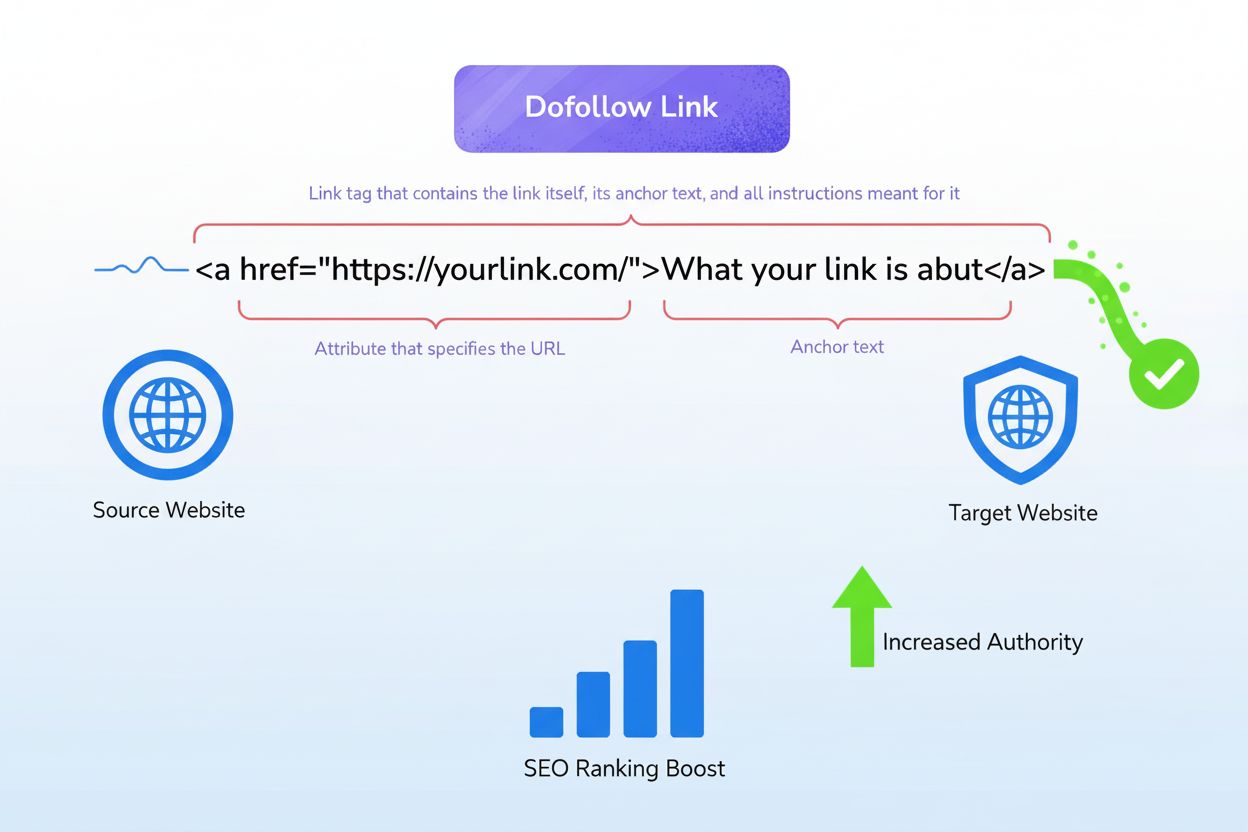
Learn what dofollow links are, how they pass ranking value and authority through link juice, and why they're critical for SEO success and AI search visibility.
Cookie Consent
We use cookies to enhance your browsing experience and analyze our traffic. See our privacy policy.