
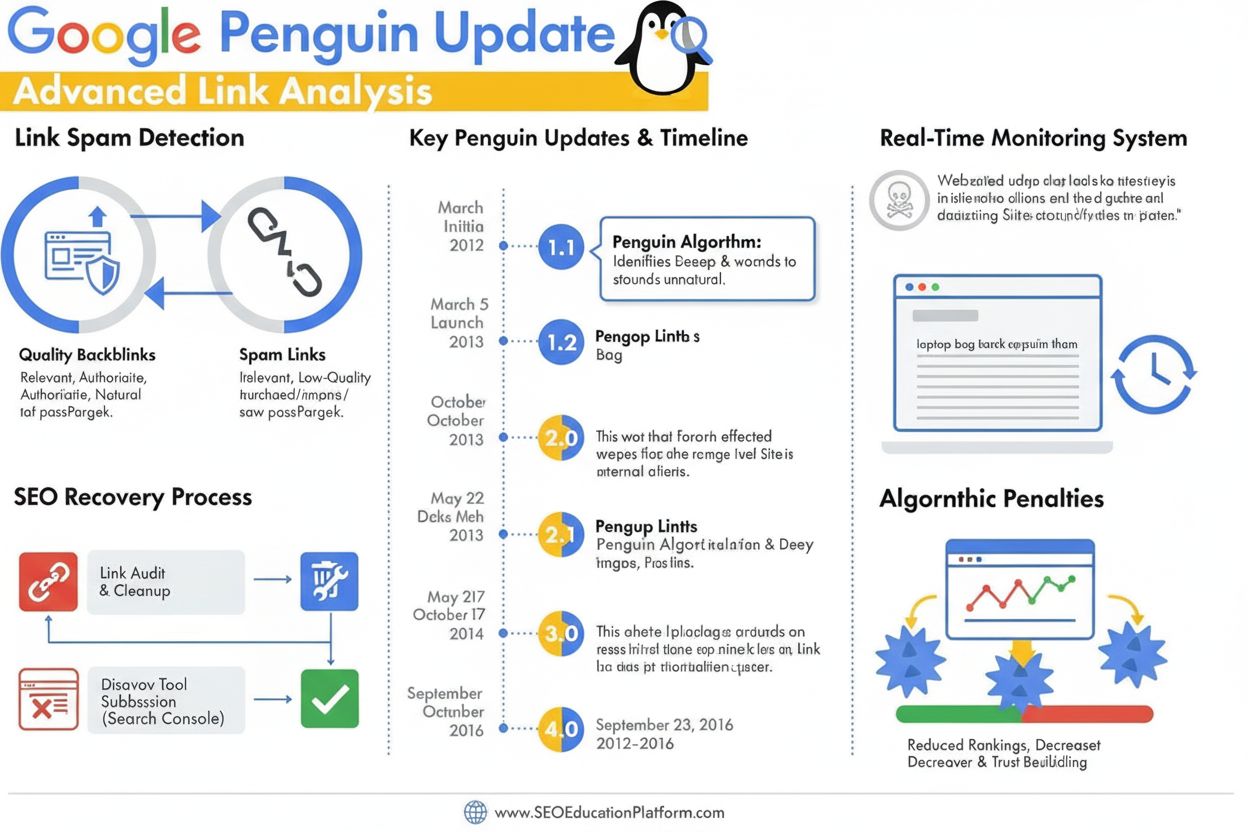
Penguin Update
Learn what the Google Penguin Update is, how it detects link spam, and strategies for recovery. Comprehensive guide to understanding Google's backlink quality a...
10 min read
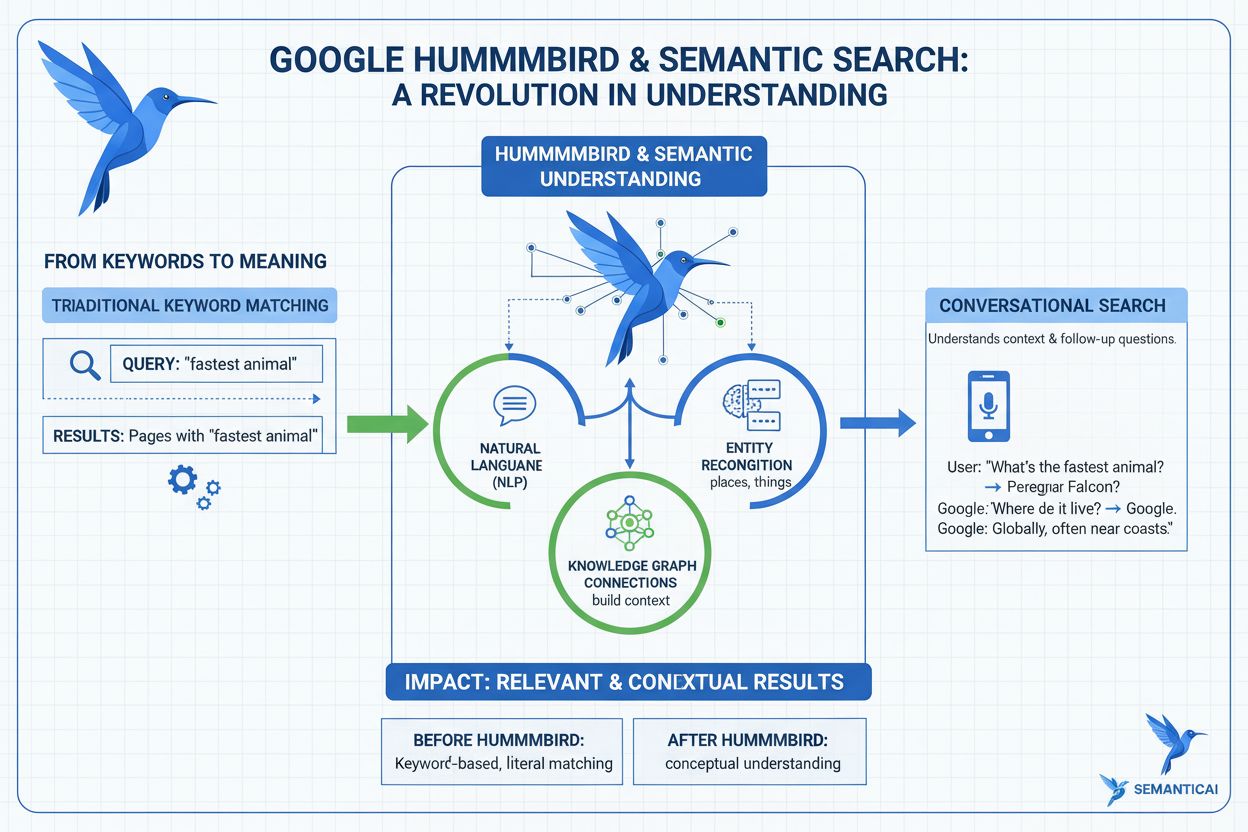
The Hummingbird Update is Google’s 2013 algorithm rewrite that fundamentally shifted search from keyword matching to semantic understanding, enabling the search engine to interpret natural language queries and user intent. This update affected over 90% of searches and marked the beginning of Google’s evolution into a fully semantic search engine powered by natural language processing and entity recognition.
The Hummingbird Update is Google's 2013 algorithm rewrite that fundamentally shifted search from keyword matching to semantic understanding, enabling the search engine to interpret natural language queries and user intent. This update affected over 90% of searches and marked the beginning of Google's evolution into a fully semantic search engine powered by natural language processing and entity recognition.
The Hummingbird Update is a fundamental rewrite of Google’s core search algorithm that was implemented in August 2013 and announced on September 26, 2013, marking Google’s 15th anniversary. Named for its speed and precision, Hummingbird revolutionized how Google interprets search queries by shifting from simple keyword matching to semantic understanding—the ability to comprehend the meaning behind words and phrases. Rather than ranking pages based on whether they contained the exact keywords from a search query, Hummingbird enabled Google to understand what users actually meant when they searched, even if they used different words or phrased their query conversationally. This update affected over 90% of all searches, though the initial impact was subtle enough that many websites and SEO professionals didn’t immediately notice changes to their rankings. According to former Google Software Engineer Matt Cutts, Hummingbird represented “the biggest change to the algorithm since 2001,” making it one of the most significant algorithmic shifts in search history.
To understand the significance of the Hummingbird Update, it’s essential to recognize the evolution of search technology leading up to 2013. Before Hummingbird, Google’s algorithm operated primarily on keyword-document matching—a system that compared the words in a user’s search query directly to the words appearing on web pages. This approach worked reasonably well for simple, single-word queries, but it struggled with longer, more complex, or conversational searches. The introduction of the Knowledge Graph in 2012 provided Google with a structured database of entities (people, places, organizations, concepts) and their relationships, but this semantic knowledge wasn’t yet fully integrated into the core ranking algorithm. Hummingbird changed this by applying the semantic understanding capabilities of the Knowledge Graph to the entire search process. The update came in the wake of the Panda Update (2011) and Penguin Update (2012), which had focused on penalizing low-quality content and manipulative link-building tactics. While those updates improved content quality standards, Hummingbird represented a more fundamental shift in how Google understood language itself. The timing was strategic—mobile search was beginning to surge, and voice search was on the horizon, both of which require more sophisticated natural language understanding than traditional keyword-based search.
The Hummingbird Update introduced several critical capabilities that fundamentally altered how Google processes search queries. First, it enabled query rewriting and expansion, allowing Google to understand that multiple different search queries could mean the same thing. For example, “how do I pay my taxes to the IRS,” “pay taxes IRS,” and “IRS tax payment” all express the same intent, and Hummingbird could recognize this equivalence. Second, Hummingbird implemented word importance filtering, which means Google could identify which words in a query were essential to understanding the user’s intent and which were merely conversational filler. Matt Cutts illustrated this with the example: “what is the capital of Texas” and “what is the capital of my dear beautiful Texas” should return the same results because “my dear” and “beautiful” don’t add meaningful information to the query. Third, the update enabled contextual understanding, where Google could consider the relationship between words in a query rather than treating each word independently. This was particularly important for long-tail keywords—rare, specific search phrases that had previously been easy to rank for through keyword stuffing. After Hummingbird, Google could recognize when multiple long-tail variations were essentially asking the same question, making it harder for spammers to game the system by creating dozens of pages targeting slightly different keyword combinations. These capabilities were powered by natural language processing (NLP), a branch of artificial intelligence that enables computers to understand and interpret human language.
Semantic search is the foundational concept that powers the Hummingbird Update. Unlike traditional keyword-based search, which relies on exact or near-exact matches between query terms and page content, semantic search focuses on meaning. The term “semantic” comes from linguistics and refers to the study of meaning in language. In the context of search, semantic search means that Google attempts to understand the intent behind a query and the actual meaning of the content on web pages, rather than just matching strings of characters. This distinction is crucial: a keyword-based system might struggle with the query “my precious” because it would look for pages containing those exact words, potentially returning irrelevant results. A semantic search engine, by contrast, understands that “my precious” is likely a reference to the character Gollum from “The Lord of the Rings” and returns information about that character from its Knowledge Graph. The Hummingbird Update was Google’s first major step toward becoming a fully semantic search engine. It introduced the infrastructure and algorithms necessary to process queries semantically at scale across billions of searches. This shift had profound implications for search engine optimization (SEO). Content creators could no longer rely on keyword density or exact keyword matching; instead, they needed to create content that genuinely addressed topics and user intent. The update also paved the way for subsequent innovations like RankBrain (2015), which uses machine learning to understand novel queries, and BERT (2019), which uses transformer-based neural networks to understand the full context of words in queries.
| Aspect | Hummingbird (2013) | RankBrain (2015) | BERT (2019) | Panda (2011) | Penguin (2012) |
|---|---|---|---|---|---|
| Type of Update | Core algorithm rewrite | Machine learning ranking system | Neural network language model | Content quality filter | Link quality filter |
| Primary Focus | Semantic understanding & natural language | Query understanding & relevance | Contextual word understanding | Low-quality content penalization | Manipulative link penalization |
| Technology Used | NLP & entity recognition | Machine learning & AI | Transformer neural networks | Content analysis algorithms | Link analysis algorithms |
| Scope of Impact | 90% of searches | 15% of searches (novel queries) | 10% of searches (U.S.) | Broad but targeted | Broad but targeted |
| SEO Impact | Shift from keywords to topics | Improved handling of unique queries | Better understanding of prepositions & context | Penalized thin content | Penalized unnatural links |
| Query Type Strength | Conversational & long-tail | Completely novel/unique queries | Complex multi-word queries | N/A | N/A |
| Relationship to Knowledge Graph | Direct integration | Complements Hummingbird | Builds on Hummingbird foundation | Predates Knowledge Graph | Predates Knowledge Graph |
The Hummingbird Update leveraged natural language processing (NLP) technologies to achieve its semantic understanding capabilities. NLP is a subfield of artificial intelligence that focuses on enabling computers to understand, interpret, and generate human language in a meaningful way. At its core, Hummingbird uses NLP to perform several key tasks: tokenization (breaking queries into individual words or phrases), part-of-speech tagging (identifying whether words are nouns, verbs, adjectives, etc.), dependency parsing (understanding the grammatical relationships between words), and entity recognition (identifying named entities like people, places, and organizations). The update also introduced entity-based ranking, which means Google doesn’t just rank pages based on keyword relevance but also based on how well they address entities mentioned in the query. For example, if you search for “Taylor Swift albums,” Google understands that “Taylor Swift” is a named entity (a specific person) and “albums” is a concept related to that entity. It then ranks pages that comprehensively cover Taylor Swift’s discography higher than pages that merely mention both words separately. This entity-based approach is far more sophisticated than keyword matching because it captures the semantic relationships between concepts. The Knowledge Graph serves as the backbone for this entity recognition, providing Google with a structured database of millions of entities and their attributes. When processing a query, Hummingbird maps the words in that query to entities in the Knowledge Graph, allowing Google to understand not just what words appear in the query, but what real-world concepts those words represent. This capability has become increasingly important as search has evolved, with the global natural language processing market projected to reach $439.85 billion by 2030, reflecting the growing importance of NLP across industries.
The Hummingbird Update fundamentally changed how SEO professionals approach content creation and optimization. Before Hummingbird, keyword density—the percentage of times a target keyword appeared on a page—was a significant ranking factor. This led to the practice of keyword stuffing, where content creators would unnaturally repeat keywords throughout their content to improve rankings. Hummingbird made this practice ineffective because Google could now recognize when content was artificially optimized for keywords rather than genuinely addressing a topic. The update shifted the focus from keyword optimization to topic optimization. Instead of writing content for specific keywords, SEO professionals needed to create comprehensive content that addressed entire topics and satisfied user intent. This meant conducting thorough keyword research not just to find high-volume keywords, but to understand the topics and questions that users were actually searching for. It also meant creating original, high-quality content that provided genuine value to readers rather than simply incorporating target keywords. The update particularly affected sites that had relied on targeting long-tail keywords—rare, specific search phrases that were previously easy to rank for. After Hummingbird, Google could recognize when multiple long-tail variations were essentially asking the same question, making it harder to rank for dozens of slightly different keyword combinations. However, this also meant that sites creating genuinely comprehensive content on a topic could rank for a much broader range of related queries, even if those exact phrases weren’t explicitly mentioned in the content. The update also emphasized the importance of E-E-A-T (Experience, Expertise, Authoritativeness, and Trustworthiness), which became increasingly central to Google’s ranking criteria in subsequent years. Content needed to demonstrate that it was written by someone with genuine expertise in the topic, not just someone trying to rank for keywords.
One of the most significant implications of the Hummingbird Update was its role in enabling mobile search and voice search. When Hummingbird was implemented in 2013, mobile search was beginning to surge, and voice search was emerging as a new frontier. Traditional keyword-based search works reasonably well for typed queries, where users tend to be concise and use keywords. However, voice search and mobile search often involve longer, more conversational queries. A user speaking to their phone might say “what’s the weather like in New York today” rather than typing “weather New York.” Hummingbird’s ability to understand natural language and identify which words were important made it possible for Google to handle these conversational queries effectively. The update was explicitly designed with mobile search in mind. In Google’s announcement, Amit Singhal stated that “having a ‘conversation’ with Google should also be more natural.” This conversational capability was essential for the subsequent launch of “OK Google” voice search in June 2014, just nine months after Hummingbird’s implementation. The update also paved the way for mobile-first indexing, where Google prioritizes the mobile version of websites for indexing and ranking. Mobile searches surpassed desktop searches in 2015, and Hummingbird had prepared Google’s algorithm to handle this shift. The semantic understanding capabilities introduced by Hummingbird continue to be essential for modern voice assistants and AI search platforms like Perplexity, ChatGPT, and Google AI Overviews, which all rely on understanding natural language queries and generating relevant responses based on semantic meaning rather than keyword matching.
The Hummingbird Update established the foundation for all subsequent advances in semantic search and AI-powered ranking. While the initial impact was subtle, the update set Google on a trajectory toward becoming a fully semantic search engine. Within months of Hummingbird’s implementation, Google launched several innovations that built on its semantic capabilities. In June 2014, Google introduced real-time search results that could display current events and sports scores, demonstrating the precision that Hummingbird enabled. Later that month, “OK Google” voice search was launched, allowing users to have natural conversations with Google. In October 2014, Google introduced conversational search for planning, enabling users to ask Google to find restaurants or set reminders using natural language. These innovations were all made possible by Hummingbird’s semantic understanding capabilities. The update also influenced the development of RankBrain, which Google announced in October 2015 as the third most important ranking factor (after links and content). RankBrain uses machine learning to understand the relationships between words and concepts, building directly on the semantic foundation that Hummingbird established. Similarly, BERT (Bidirectional Encoder Representations from Transformers), announced in October 2019, represents another evolution of semantic search. BERT can consider the full context of a word by looking at the words that come before and after it, understanding how prepositions and other contextual elements affect meaning. Google described BERT as “the biggest leap forward in the past five years, and one of the biggest leaps forward in the history of Search,” yet it’s fundamentally an extension of the semantic search principles that Hummingbird introduced. The legacy of Hummingbird extends beyond Google’s own search engine. The principles of semantic search have become foundational to modern AI systems, including large language models like ChatGPT, Claude, and Perplexity. These systems all rely on understanding the semantic meaning of queries and content, rather than simple keyword matching. For organizations monitoring their brand visibility across AI platforms, understanding Hummingbird’s principles is essential because semantic matching means your brand may appear in AI-generated responses even when exact keywords aren’t present.
The Hummingbird Update’s shift toward semantic understanding has profound implications for how brands should monitor their visibility in search results and AI-generated content. In a keyword-based search system, brand monitoring was relatively straightforward—you could track exact mentions of your brand name and key product names. However, in a semantic search environment, your brand may appear in search results and AI responses based on meaning rather than exact keyword matches. For example, if your brand is known for a particular innovation or approach, AI systems might reference your brand when discussing that concept, even if they don’t use your exact brand name. This makes comprehensive brand monitoring essential. Platforms like AmICited are specifically designed to track how brands and domains appear across AI search platforms like ChatGPT, Perplexity, Google AI Overviews, and Claude. These platforms use semantic understanding similar to what Hummingbird introduced, meaning they can surface your content and brand in contexts where traditional keyword-based monitoring would miss them. Understanding the principles of semantic search helps organizations appreciate why this monitoring is necessary. When AI systems generate responses to user queries, they’re not just matching keywords—they’re understanding the semantic meaning of the query and retrieving or generating content that addresses that meaning. Your brand might be highly relevant to a query even if the exact keywords don’t match. Additionally, as AI systems become more sophisticated in their semantic understanding, the importance of being cited accurately in AI-generated responses increases. Unlike traditional search results, where users can see multiple sources and evaluate them independently, AI-generated responses often present information as a synthesized answer, potentially with limited attribution. Ensuring that your brand is accurately represented in these AI responses requires monitoring tools that understand semantic matching and can track your brand’s visibility across multiple AI platforms.
The trajectory established by the Hummingbird Update continues to influence the evolution of search and AI. As generative AI becomes increasingly integrated into search experiences, semantic understanding becomes even more critical. Google’s AI Overviews (formerly called SGE—Search Generative Experience) represent the next evolution of semantic search, where AI generates comprehensive answers to queries by synthesizing information from multiple sources. These AI-generated responses rely entirely on semantic understanding—the AI must comprehend what the user is asking, understand the semantic meaning of content across the web, and synthesize that information into a coherent answer. The principles that Hummingbird introduced—understanding meaning rather than matching keywords, recognizing entities and their relationships, processing natural language conversationally—are all essential to how AI Overviews work. Looking forward, semantic search will likely become even more sophisticated. Multimodal search, which combines text, images, video, and other media types, will require even more advanced semantic understanding. Personalized semantic search, which tailors results based on individual user context and history, will require semantic systems to understand not just what users are asking, but who they are and what they care about. Cross-lingual semantic search, which enables searching across multiple languages by understanding semantic meaning rather than linguistic form, will expand the reach of semantic search globally. For organizations and content creators, this means that the shift toward semantic optimization that Hummingbird initiated will only become more important. Creating content that genuinely addresses topics, demonstrates expertise, and provides value to users will remain the foundation of visibility in semantic search systems. Additionally, as AI systems become more central to how information is discovered and consumed, ensuring that your brand is accurately represented in AI-generated responses will become as important as traditional search visibility. This is where tools like AmICited become essential—they help organizations monitor and understand how their brand appears in the semantic search and AI-generated response landscape that Hummingbird helped create.
While Panda (2011) and Penguin (2012) were targeted updates designed to penalize specific SEO practices and low-quality content, the Hummingbird Update was a complete rewrite of Google's core search algorithm. Former Google engineer Matt Cutts described it as the largest algorithm rewrite since 2001. Panda and Penguin were additions to the existing algorithm, whereas Hummingbird fundamentally changed how Google processes and ranks search results by shifting from keyword matching to semantic understanding.
The Hummingbird Update built upon the Knowledge Graph, which Google introduced in 2012. While the Knowledge Graph provided Google with a structured database of entities and their relationships, Hummingbird enabled Google to apply this semantic understanding to search query processing and ranking. Together, they allow Google to understand not just what words appear in a query, but what those words actually mean and how they relate to entities in the Knowledge Graph.
No, the Hummingbird Update had a surprisingly subtle initial impact on SEO. Despite affecting 90% of searches, many websites and SEO professionals didn't notice significant changes to their rankings or traffic. Matt Cutts noted that the update was rolled out over a month without people noticing. However, the update did have lasting effects on long-tail keyword targeting and forced a shift toward creating content focused on topics and user intent rather than keyword density.
The Hummingbird Update introduced natural language processing capabilities that allow Google to understand longer, more conversational queries by identifying which words are important and which are superfluous. For example, Google can now understand that 'what is the capital of Texas' and 'what is the capital of beautiful Texas' mean the same thing. This capability was essential for enabling voice search features like 'OK Google' and conversational search, which launched shortly after Hummingbird's implementation.
Natural language processing (NLP) is fundamental to how Hummingbird works. NLP enables Google to analyze the grammatical structure and semantic meaning of search queries, recognizing synonyms, understanding context, and discerning user intent. The global NLP market is projected to reach $439.85 billion by 2030, reflecting the growing importance of this technology. Hummingbird was Google's first major implementation of NLP at scale across billions of search queries.
The Hummingbird Update's shift toward semantic understanding means that brands and domains may appear in AI-generated responses and search results even when exact keywords aren't matched. This makes comprehensive brand monitoring tools like AmICited essential for tracking how your brand appears across AI platforms like ChatGPT, Perplexity, and Google AI Overviews, since semantic matching can surface your content in unexpected contexts based on meaning rather than keyword presence.
Hummingbird laid the foundation for subsequent AI-powered ranking systems. RankBrain, introduced in 2015, uses machine learning to understand search intent and relationships between words. BERT (2019) further advanced this by considering the full context of words in queries. All three systems share the core principle of understanding meaning rather than matching keywords, making Hummingbird the crucial precursor to today's AI-driven search landscape.
Start tracking how AI chatbots mention your brand across ChatGPT, Perplexity, and other platforms. Get actionable insights to improve your AI presence.
Learn what the Google Penguin Update is, how it detects link spam, and strategies for recovery. Comprehensive guide to understanding Google's backlink quality a...

Learn what Google Algorithm Updates are, how they work, and their impact on SEO. Understand core updates, spam updates, and ranking changes.
Discover how algorithm updates impact AI search visibility across ChatGPT, Perplexity, Google AI Overviews, and Claude. Learn ranking factors and optimization s...