

What is Informational Search Intent for AI? Definition and Examples
Learn what informational search intent means for AI systems, how AI recognizes these queries, and why understanding this intent matters for content visibility i...
13 min read
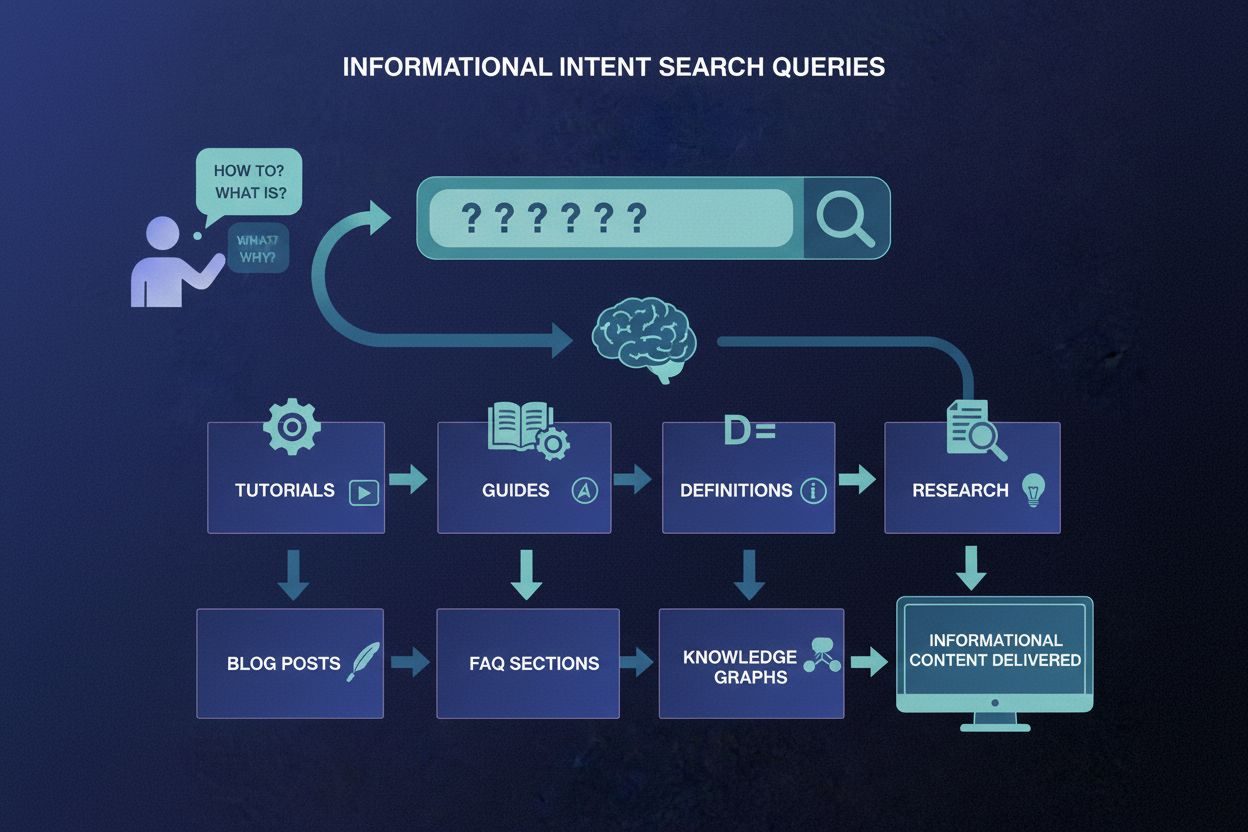
Informational intent refers to search queries where users seek knowledge, answers, or information about a topic without the immediate goal of making a purchase or visiting a specific website. These searches typically begin with question words like ‘how,’ ‘what,’ ‘why,’ or ‘where,’ and represent approximately 52.65% of all search queries, making them the most common type of search intent.
Informational intent refers to search queries where users seek knowledge, answers, or information about a topic without the immediate goal of making a purchase or visiting a specific website. These searches typically begin with question words like 'how,' 'what,' 'why,' or 'where,' and represent approximately 52.65% of all search queries, making them the most common type of search intent.
Informational intent is the underlying purpose behind a search query when a user seeks knowledge, answers, or information about a specific topic without the immediate goal of making a purchase, visiting a particular website, or completing a transaction. When someone types a query into a search engine with informational intent, they are fundamentally trying to learn something new, understand a concept, find answers to questions, or gather data to make informed decisions. This represents the most common type of search intent, accounting for 52.65% of all search queries as of 2025, and triggering 88.1% of AI Overviews in generative search engines. Informational queries typically begin with question words such as “how,” “what,” “why,” “where,” “when,” or “best way to,” and they reflect users who are in the early to middle stages of their research journey, often referred to as the “awareness” or “consideration” phase of the customer journey.
The concept of search intent has evolved significantly since the early days of search engines. In the 1990s and early 2000s, search engines primarily matched keywords without understanding user intent, often returning irrelevant results. As search technology advanced, particularly with Google’s introduction of semantic understanding through algorithms like BERT (Bidirectional Encoder Representations from Transformers), search engines became increasingly sophisticated at interpreting what users actually meant rather than just what they typed. The formalization of search intent categories—informational, navigational, commercial, and transactional—emerged as a critical framework for SEO professionals and content strategists. Today, with the rise of generative AI search engines like ChatGPT, Perplexity, and Google’s AI Mode, informational intent has become even more important because these systems are specifically designed to answer questions and provide information directly to users. Research shows that over 71.5% of U.S. consumers now use AI-powered search tools for information queries, fundamentally shifting how brands must approach content strategy. The evolution reflects a broader shift from keyword-matching to intent-matching, where understanding the user’s true goal has become more valuable than optimizing for specific words.
| Intent Type | User Goal | Query Examples | Content Format | Conversion Stage | AI Visibility |
|---|---|---|---|---|---|
| Informational | Learn, understand, research | “How to fix a leaky tap,” “What is SEO,” “Best productivity tools” | Blog posts, guides, FAQs, tutorials | Awareness/Early consideration | 88.1% of AI Overviews |
| Navigational | Find a specific website or page | “Facebook login,” “Yoast SEO,” “Amazon homepage” | Homepage, branded pages, login pages | Direct access | Lower AI citation rate |
| Commercial | Research before purchase decision | “Best cameras 2025,” “iPhone vs Samsung,” “Alternatives to Photoshop” | Comparison articles, reviews, buying guides | Mid-consideration | 14.5% of searches |
| Transactional | Complete an action or purchase | “Buy running shoes,” “Netflix subscription,” “Book hotel near me” | Product pages, checkout pages, landing pages | Decision/Purchase | 0.69% of searches |
Informational intent operates through sophisticated language processing that goes far beyond simple keyword matching. When a user enters an informational query, modern search engines and AI systems analyze multiple signals to understand the true intent behind the search. These signals include the specific words used (question modifiers like “how,” “what,” “why”), the context of previous searches in the user’s session, the user’s location and device type, and historical patterns of how similar queries have been answered. Search engines use semantic understanding to recognize that queries like “how to fix a leaky faucet” and “leaking tap repair” have the same informational intent despite using different terminology. In AI-powered search systems, this process becomes even more sophisticated through what researchers call query fan-out, where a single informational query is broken down into dozens of micro-questions that the AI system explores to build a comprehensive answer. For example, a query like “best project management tools” might be expanded into sub-queries about pricing, integrations, ease of use, team collaboration features, and specific use cases. The AI system then retrieves passages from multiple sources that address these different angles, evaluates them for relevance and credibility, and synthesizes them into a coherent response. This passage-level analysis means that even a single paragraph from your content could be selected and cited if it precisely answers one of these micro-intents, making content structure and clarity critically important for visibility.
From a business perspective, informational intent represents both opportunity and challenge for brands and content creators. While informational queries don’t directly lead to immediate conversions, they are essential for building brand awareness, establishing authority, and capturing users early in their decision-making journey. Research demonstrates that high-funnel consumers make the most informational searches, meaning these are potential customers who haven’t yet decided what they want or which brand to choose. By creating valuable informational content, brands can position themselves as trusted resources and thought leaders in their industry, which builds credibility that influences future purchasing decisions. For example, a software company that publishes comprehensive guides on “how to choose project management software” can establish authority and capture leads from users who will eventually become customers. The practical impact extends to search engine optimization and AI visibility. Approximately 60% of searches now result in zero-click behavior, meaning users get their answers directly from search results or AI responses without clicking through to a website. This shift makes it critical for brands to optimize for informational intent not just to drive traffic, but to ensure their brand and content appear in these AI-generated answers. Companies that fail to optimize for informational intent miss opportunities to build brand awareness, establish expertise, and capture users at the beginning of their research journey. Additionally, informational content serves as a foundation for internal linking strategies, helping to guide users deeper into your website and toward conversion-focused pages.
Different AI platforms handle informational intent queries with varying approaches, each with implications for how brands should optimize their content. ChatGPT processes informational queries by drawing from its training data and web sources, prioritizing responses that are clear, comprehensive, and well-structured. Content that appears in ChatGPT citations tends to be authoritative, well-organized, and directly answers the user’s question without unnecessary fluff. Perplexity AI emphasizes real-time search and source attribution, meaning it actively retrieves current web content to answer informational queries and explicitly cites sources. This platform rewards content that is recent, specific, and provides unique insights or data that can’t be found elsewhere. Google’s AI Mode (part of Google’s AI Overviews) integrates informational content directly into search results, pulling passages from multiple sources to create synthesized answers. This system prioritizes content that ranks well in traditional search, has strong E-E-A-T signals, and is structured in ways that make it easy to extract relevant passages. Claude by Anthropic tends to favor detailed, nuanced responses to informational queries, rewarding content that explores multiple perspectives and provides thorough explanations. Understanding these platform differences helps content creators tailor their approach—for instance, creating content optimized for Perplexity might emphasize original research and current data, while content for Google’s AI Mode should focus on traditional SEO fundamentals combined with clear structure. Research from AmICited’s monitoring platform shows that 73% of commercial intent queries in ChatGPT contain informational elements, indicating that even transactional and commercial queries often require informational content to support the user’s decision-making process.
Creating effective informational content requires a strategic approach that balances comprehensiveness with clarity and structure. The first step is conducting thorough keyword research to identify informational queries your target audience is searching for. Tools like Semrush, Ahrefs, and Google’s Keyword Planner can help identify keywords with informational intent by analyzing search volume, competition, and SERP features. Once you’ve identified target keywords, analyze the top-ranking pages to understand what format, depth, and structure Google and users expect. This SERP analysis reveals whether users want quick answers (suggesting a featured snippet opportunity), comprehensive guides, video tutorials, or comparison articles. When creating the content itself, follow these best practices: start with a clear, direct answer to the main question in the opening paragraph; use descriptive headings and subheadings that break content into scannable sections; include supporting visuals like infographics, diagrams, or screenshots; provide examples and case studies that illustrate concepts; address related questions and sub-topics that users might have; and cite authoritative sources to build credibility. For AI search optimization specifically, structure your content in modular sections where each paragraph or section can stand alone as a potential answer to a micro-intent. Use schema markup (such as FAQPage, HowTo, or Article schema) to help AI systems understand your content structure. Include a FAQ section that addresses common follow-up questions, as these are frequently cited in AI responses. Ensure your content is updated regularly to maintain freshness, particularly important for informational queries where users expect current information. Finally, measure performance by tracking metrics like organic traffic, average time on page, scroll depth, and whether your content appears in AI-generated responses using tools like AmICited.
The landscape of informational intent is undergoing significant transformation driven by generative AI and changing user behavior. By 2026, traditional search volume is projected to drop 25% as Gen Z and Millennials increasingly turn to AI-powered search engines, fundamentally shifting how informational queries are answered and how brands must optimize their content. This shift means that informational content strategy must evolve beyond traditional SEO to encompass generative engine optimization (GEO). Rather than optimizing solely for ranking on search results pages, brands must now optimize for being cited and referenced in AI-generated responses. This requires deeper understanding of how AI systems break down queries into sub-intents and select passages for inclusion in answers. The concept of prompt intent is emerging as a new framework, where users are increasingly delegating tasks to AI systems rather than simply searching for information. For example, instead of searching “best productivity tools,” users might prompt an AI system to “compare three affordable productivity tools and recommend the best one for remote teams.” This evolution means informational content must be structured to address multiple related intents within a single query. Additionally, sentiment and emotion are becoming more important in intent detection, as AI systems increasingly recognize that the same words can carry different meanings depending on tone and context. Brands that understand this shift will create content that not only answers questions but also addresses the emotional context behind them. The future also points toward more personalized informational responses, where AI systems tailor answers based on user context, previous interactions, and inferred preferences. This means generic informational content may become less valuable, while highly specific, use-case-focused content will gain importance. Finally, the rise of zero-click searches means that appearing in AI answers becomes more valuable than driving clicks to your website, requiring a fundamental shift in how brands measure success and allocate content resources.
Informational intent represents the foundation of modern search and AI visibility strategy. With 52.65% of all searches having informational intent and 88.1% of AI Overviews triggered by informational queries, optimizing for this intent type is no longer optional—it’s essential for any brand seeking visibility in both traditional and generative search. The shift from keyword-matching to intent-matching, and now to AI-driven answer generation, reflects a fundamental evolution in how users find and consume information online. Brands that master informational intent optimization will capture users early in their research journey, build authority and trust, and ensure their content appears in the AI-generated responses that increasingly serve as the primary touchpoint for information seekers. By understanding the nuances of informational queries, creating comprehensive and well-structured content, and optimizing for both traditional search engines and AI systems, brands can establish themselves as authoritative resources while improving their visibility across all search channels. The future belongs to those who recognize that informational intent is not just about ranking for keywords—it’s about understanding user goals, providing genuine value, and positioning your brand as the trusted answer to the questions your audience is asking.
Informational intent queries are characterized by question-based phrasing using modifiers like 'how to,' 'what is,' 'why,' 'where,' and 'best way to.' Users conducting these searches are typically in the early stages of their research journey, seeking to learn about a topic, understand a concept, or find answers to specific questions. These queries often trigger featured snippets, knowledge graphs, and educational content in search results, as search engines prioritize delivering quick, authoritative answers.
Informational intent differs from navigational intent (finding a specific website), commercial intent (researching before purchase), and transactional intent (ready to buy or act). While informational searches focus purely on learning and knowledge acquisition, commercial and transactional intents involve decision-making or action. Navigational intent is about reaching a known destination. Understanding these distinctions helps content creators tailor their pages to match what users actually want, improving both rankings and user satisfaction.
Blog posts, how-to guides, tutorials, FAQs, explainer articles, educational videos, infographics, and long-form content perform exceptionally well for informational intent. These content types should be structured with clear headings, concise sections, supporting visuals, and comprehensive answers to related questions. Content that demonstrates expertise, cites authoritative sources, and addresses user pain points tends to rank higher and receive more engagement from information-seeking audiences.
Informational intent is crucial for AI search visibility because approximately 88.1% of AI Overviews are triggered by informational queries, and 52.65% of all searches fall into this category. AI systems like ChatGPT, Perplexity, and Google's AI Mode prioritize content that directly answers questions and provides clear, authoritative information. Optimizing for informational intent increases the likelihood that your content will be cited in AI-generated responses, improving brand visibility in generative search engines.
Identify informational intent by looking for question-based keywords and phrases such as 'how to,' 'what is,' 'why,' 'where,' 'best way to,' 'guide to,' 'tips for,' and 'definition of.' Analyzing Google's search results page (SERP) for a keyword also reveals intent—if the top results are blog posts, guides, FAQs, or featured snippets rather than product pages, the query likely has informational intent. Tools like Semrush, Ahrefs, and Yoast SEO can automatically classify keywords by intent type.
E-E-A-T (Experience, Expertise, Authoritativeness, Trustworthiness) is critical for informational intent content because users and search engines prioritize reliable, credible sources when seeking knowledge. Demonstrating author credentials, citing reputable sources, providing original research or data, and building topical authority all strengthen E-E-A-T signals. Google's algorithm heavily weights these factors for informational queries, especially in YMYL (Your Money, Your Life) categories like health, finance, and legal information.
Structure informational content with clear, scannable sections using descriptive headings, bullet points, and short paragraphs. Start with a direct answer to the main question, then provide supporting details and related information. Include FAQs, comparison tables, definitions, and examples. Use schema markup to help AI systems understand your content structure. Ensure passages are modular and can stand alone, as AI systems evaluate and cite content at the passage level rather than the full page.
As of 2025, approximately 52.65% of all search queries have informational intent, making it the most dominant search intent type. Additionally, informational queries account for 88.1% of AI Overviews, indicating their critical importance in generative search. This high percentage reflects the natural human behavior of seeking knowledge and answers online before making decisions or taking actions, making informational content strategy essential for any digital marketing plan.
Start tracking how AI chatbots mention your brand across ChatGPT, Perplexity, and other platforms. Get actionable insights to improve your AI presence.
Learn what informational search intent means for AI systems, how AI recognizes these queries, and why understanding this intent matters for content visibility i...

Learn how to align your content with AI query intent to increase citations across ChatGPT, Perplexity, and Google AI. Master content-prompt matching strategies ...
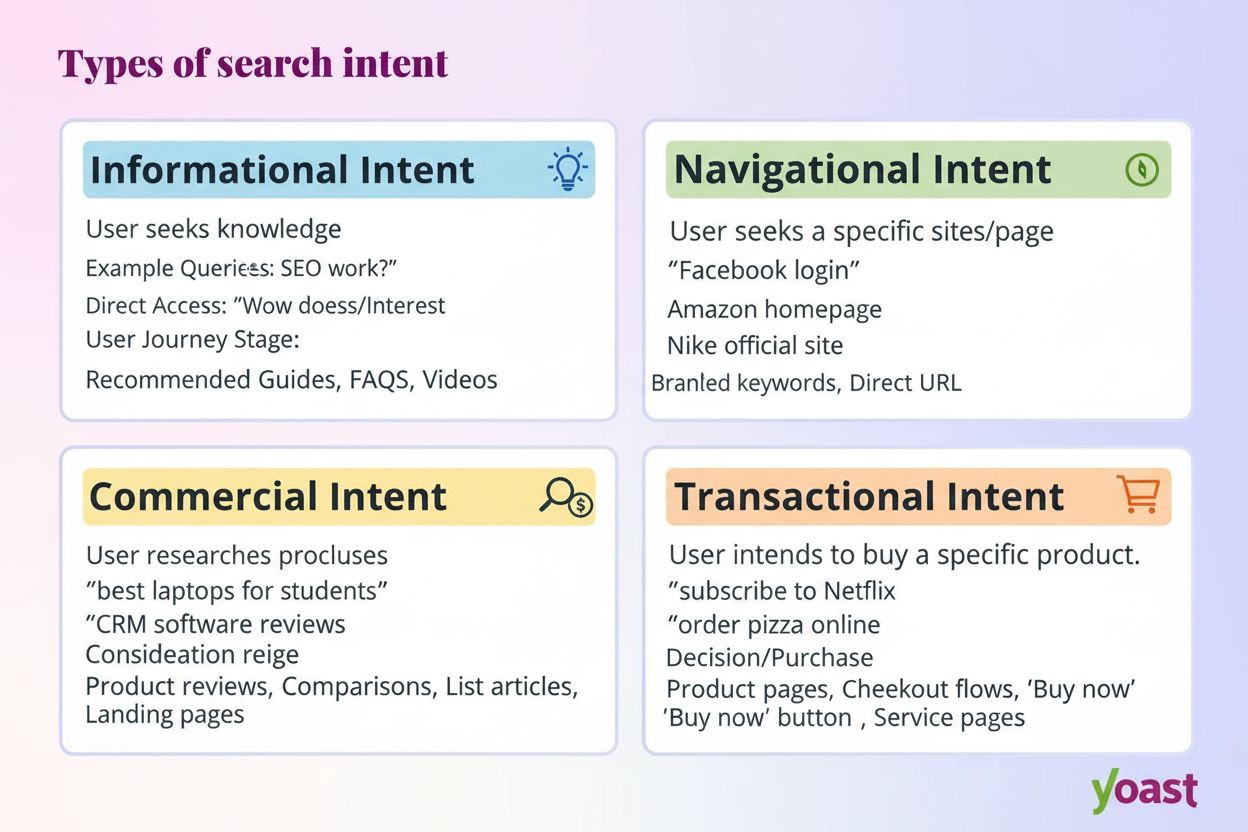
Search intent is the purpose behind a user's search query. Learn the four types of search intent, how to identify them, and optimize content for better rankings...