
JSON-LD: Complete Guide to Implementation and SEO Benefits
Learn what JSON-LD is and how to implement it for SEO. Discover structured data markup benefits for Google, ChatGPT, Perplexity, and AI search visibility.
15 min read
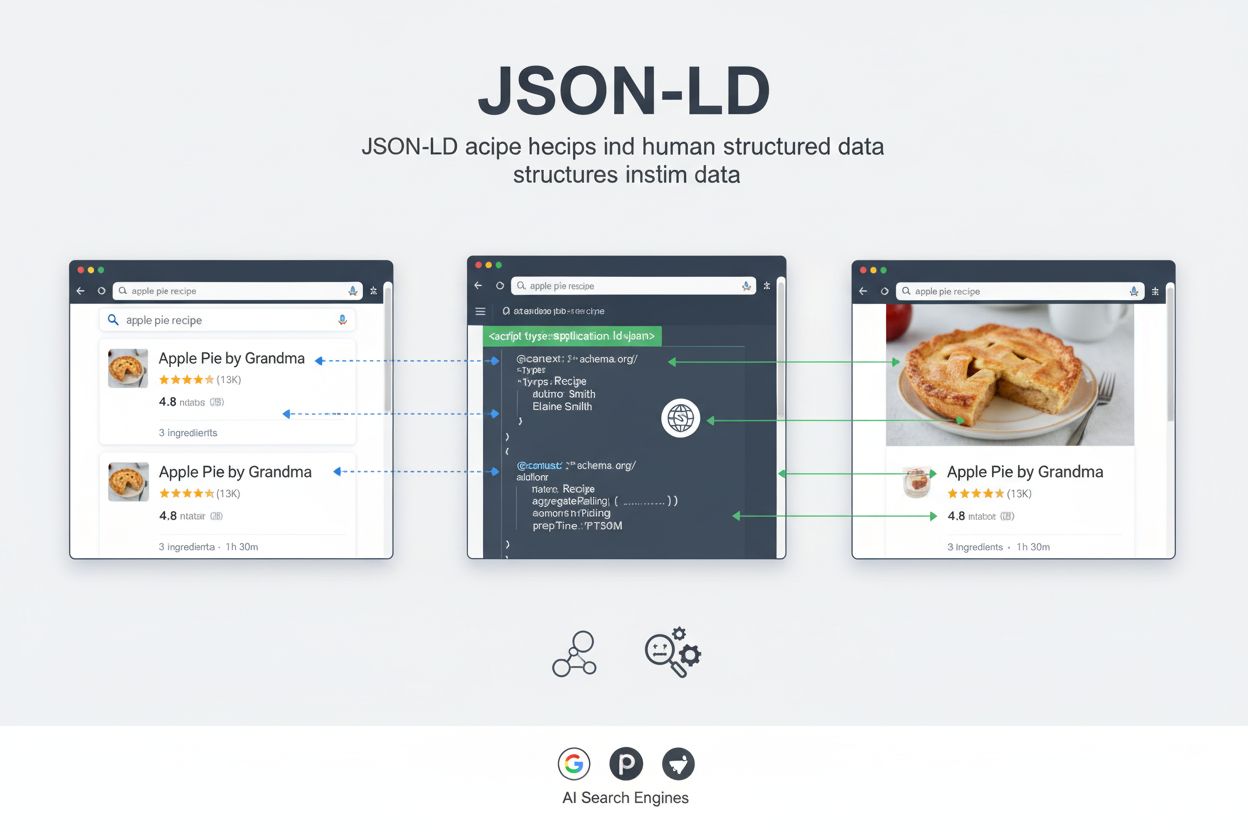
JSON-LD (JavaScript Object Notation for Linked Data) is a lightweight, W3C-standardized format for expressing structured data using JSON syntax, enabling search engines and AI systems to understand web content through schema.org vocabulary. It is embedded in web pages as machine-readable markup that helps search engines display rich results and improves content discoverability across AI-powered platforms.
JSON-LD (JavaScript Object Notation for Linked Data) is a lightweight, W3C-standardized format for expressing structured data using JSON syntax, enabling search engines and AI systems to understand web content through schema.org vocabulary. It is embedded in web pages as machine-readable markup that helps search engines display rich results and improves content discoverability across AI-powered platforms.
JSON-LD stands for JavaScript Object Notation for Linked Data and represents a lightweight, standardized format for expressing structured data on web pages. Established as a W3C Recommendation since January 2014, JSON-LD combines the simplicity of JSON syntax with the semantic power of linked data vocabularies, particularly schema.org. Unlike other structured data formats that interleave markup with HTML content, JSON-LD is embedded as a separate <script> tag in the page header or body, keeping data distinct from presentation markup. This separation makes JSON-LD exceptionally easy to implement, maintain, and scale across large websites and content management systems.
The primary purpose of JSON-LD is to provide machine-readable context that helps search engines, AI systems, and other web applications understand the meaning and relationships within web page content. When properly implemented, JSON-LD enables search engines to display rich results—enhanced search snippets that include ratings, prices, images, event details, and other structured information. For AI-powered search platforms like ChatGPT, Perplexity, Google AI Overviews, and Claude, JSON-LD serves as a critical bridge between human-readable content and machine-interpretable data, improving the accuracy and relevance of AI-generated responses and citations.
JSON-LD has become the recommended structured data format by Google and other major search engines because it minimizes implementation errors and works seamlessly with modern web technologies, including JavaScript frameworks and dynamic content generation. The format’s flexibility allows it to express complex nested data structures, making it suitable for diverse content types ranging from simple product information to intricate organizational hierarchies and event details.
JSON-LD emerged from the need to bridge traditional JSON data formats with semantic web standards. Before JSON-LD, developers working with linked data typically relied on RDF/XML or Turtle formats, which were powerful but complex and not naturally aligned with web development practices. The development of JSON-LD began in the early 2010s as part of the W3C JSON-LD Community Group, recognizing that JSON had become the de facto standard for web APIs and data interchange. The format was officially standardized by the W3C in 2014, with subsequent refinements leading to JSON-LD 1.1 becoming a full W3C Recommendation in 2020.
The adoption of JSON-LD accelerated significantly after Google and other major search engines began recommending it as the preferred format for schema.org markup in 2013. This endorsement was transformative because it signaled to the web development community that JSON-LD was not merely an academic exercise but a practical, production-ready solution for real-world SEO and content discovery challenges. Over the past decade, JSON-LD adoption has grown exponentially, with current data showing that 41% of all websites now use JSON-LD for structured data markup, up from just 34% in 2022. Among websites that implement any form of structured data, JSON-LD is used by approximately 70%, making it the dominant format in the structured data landscape.
The evolution of JSON-LD has also been shaped by the rise of AI-powered search engines and large language models. As platforms like ChatGPT, Perplexity, and Google AI Overviews became mainstream, the importance of JSON-LD increased because these systems rely heavily on structured data to extract accurate, contextual information from web pages. The format’s ability to clearly define entity types, relationships, and properties makes it invaluable for training and operating AI systems that need to understand web content at scale.
JSON-LD documents follow standard JSON syntax but incorporate special reserved keywords prefixed with the @ symbol that provide semantic meaning. The most fundamental of these keywords are @context, @type, and @id. The @context property specifies the vocabulary namespace—typically https://schema.org—that defines the meaning of all properties and types used in the markup. This context acts as a namespace declaration, similar to XML namespaces, ensuring that property names are interpreted consistently across different systems and platforms.
The @type property specifies the schema type of the entity being described, such as Product, Article, Event, Organization, or LocalBusiness. Each type in schema.org has an associated set of properties that can be used to describe instances of that type. For example, a Product type might include properties like name, description, price, image, aggregateRating, and offers. The @id property provides a unique identifier for the entity, typically a URL that resolves to more information about that entity.
Beyond these core keywords, JSON-LD documents contain custom properties that map directly to schema.org vocabulary. These properties can hold simple values (strings, numbers, dates) or complex nested objects that represent related entities. For instance, a Product entity might have an offers property that contains an embedded Offer object with its own @type and properties like price and priceCurrency. This nesting capability allows JSON-LD to express sophisticated data relationships and hierarchies that would be cumbersome to represent in flatter formats like Microdata.
| Aspect | JSON-LD | Microdata | RDFa |
|---|---|---|---|
| Implementation Location | Separate <script> tag in <head> or <body> | Embedded within HTML attributes | Embedded within HTML attributes |
| Ease of Implementation | Very easy; minimal HTML changes required | Moderate; requires HTML attribute additions | Moderate to complex; requires namespace declarations |
| Maintenance Complexity | Low; data separated from presentation | Medium; markup interleaved with content | Medium to high; multiple vocabularies possible |
| Dynamic Content Support | Excellent; works with JavaScript injection | Limited; requires server-side rendering | Limited; requires server-side rendering |
| Google Recommendation | Recommended | Supported | Supported |
| Adoption Rate (2024) | 41% of all websites; 70% of structured data sites | ~20% of structured data sites | ~15% of structured data sites |
| Vocabulary Flexibility | Single vocabulary per document (typically schema.org) | Single vocabulary per document | Multiple vocabularies supported |
| Nesting Complexity | Excellent; natural JSON hierarchy | Good; requires multiple itemscope declarations | Good; supports complex relationships |
| AI Search Engine Compatibility | Excellent; preferred by ChatGPT, Perplexity, Claude | Good; supported but less preferred | Good; supported but less preferred |
When a search engine crawler or AI system encounters a web page containing JSON-LD markup, it parses the <script type="application/ld+json"> tag and extracts the structured data. The crawler uses the @context to understand the vocabulary being used, then interprets each property according to schema.org definitions. This process allows the search engine to extract specific, machine-readable information about the page’s content without relying on natural language processing or heuristics.
For Google Search, JSON-LD markup enables the display of rich results—enhanced search snippets that include visual elements like ratings, prices, images, and event details. When Google crawls a product page with properly implemented JSON-LD markup, it can extract the product name, price, availability, reviews, and images directly from the structured data. This information is then used to generate a rich result that appears in search results, typically with a higher click-through rate than standard blue links. Research from major websites demonstrates the impact: Rotten Tomatoes saw a 25% higher click-through rate on pages enhanced with structured data, while Nestlé measured an 82% higher click-through rate on pages displaying as rich results.
For AI search engines like Perplexity, ChatGPT, and Google AI Overviews, JSON-LD serves a different but equally important function. These systems use structured data to understand the semantic meaning of content, identify key entities and relationships, and extract accurate information for inclusion in AI-generated responses. When an AI system encounters JSON-LD markup, it can confidently identify what type of entity is being described, what properties that entity has, and how it relates to other entities. This structured understanding helps AI systems provide more accurate, contextually relevant responses and properly attribute information to source websites.
Implementing JSON-LD effectively requires understanding several key principles and best practices. First, JSON-LD should be placed in the <head> section of the HTML document, though it can also be placed in the <body>. The placement in <head> is generally preferred because it ensures the structured data is parsed before the page content, though modern search engines and AI systems can parse JSON-LD from anywhere on the page.
Second, the @context should always be explicitly defined, typically as "@context": "https://schema.org". This ensures that all property names and types are interpreted according to schema.org definitions. While it’s technically possible to use multiple contexts or custom vocabularies, the vast majority of web implementations use schema.org exclusively.
Third, JSON-LD markup should accurately represent the visible content on the page. Search engines and AI systems expect the structured data to match what users see when they visit the page. Adding JSON-LD markup about information that isn’t visible to users—or that contradicts visible content—can result in penalties or the markup being ignored entirely. This principle is critical for maintaining trust with search engines and ensuring that AI systems cite your content accurately.
Fourth, all required properties for a given schema type should be included. While schema.org defines many optional properties, including the required properties ensures that search engines can properly validate and display the markup. For example, a Product schema requires at least name, description, and offers properties to be eligible for rich result display.
Fifth, JSON-LD should be validated using tools like Google’s Rich Results Test or Schema.org’s Validator before deployment. These tools check for syntax errors, missing required properties, and other issues that could prevent the markup from being recognized. Testing during development prevents problems from reaching production and ensures that the markup functions as intended.
The implementation of JSON-LD structured data delivers measurable benefits across multiple dimensions. From an SEO perspective, JSON-LD enables rich results that significantly improve click-through rates. The Food Network converted 80% of their pages to use structured data and measured a 35% increase in visits. Rakuten found that users spend 1.5x more time on pages with structured data compared to non-structured pages, and experienced a 3.6x higher interaction rate on AMP pages with search features.
From an AI search visibility perspective, JSON-LD is increasingly critical as AI-powered search engines become mainstream. Websites that implement JSON-LD markup are more likely to have their content accurately understood, cited, and featured in AI-generated responses. This is particularly important for AmICited users who want to track and monitor how their brand, domain, and URLs appear in AI search results across platforms like ChatGPT, Perplexity, Google AI Overviews, and Claude. Proper JSON-LD implementation ensures that AI systems have the structured context needed to accurately attribute and cite your content.
From a technical perspective, JSON-LD reduces implementation complexity and maintenance burden. Because the markup is separated from HTML content, developers can manage structured data independently of page layout changes. This separation is particularly valuable for large organizations with complex content management systems, where multiple teams may be responsible for content and technical implementation.
From a user experience perspective, JSON-LD indirectly improves user engagement by enabling richer, more informative search results. Users are more likely to click on search results that include ratings, prices, images, and other structured information, leading to higher traffic and better conversion rates for websites that implement JSON-LD effectively.
JSON-LD integrates seamlessly with modern web development practices and technologies. Unlike Microdata and RDFa, which require server-side rendering to be properly parsed by search engines, JSON-LD can be dynamically injected into pages using JavaScript. This capability is crucial for single-page applications (SPAs), progressive web apps (PWAs), and other JavaScript-heavy websites that generate content dynamically.
Content management systems (CMS) like WordPress, Shopify, Wix, and Drupal increasingly provide built-in support for JSON-LD generation, either natively or through plugins. This democratization of JSON-LD implementation means that even non-technical users can add structured data to their pages without writing code. Many CMS platforms automatically generate JSON-LD markup based on page metadata and content, reducing the burden on developers and content creators.
JSON-LD also works well with headless CMS architectures, where content is managed separately from presentation. In these systems, JSON-LD can be generated server-side and delivered as part of the page response, or it can be generated client-side using JavaScript frameworks like React, Vue, or Angular. This flexibility makes JSON-LD suitable for virtually any modern web architecture.
https://schema.org to ensure consistent vocabulary interpretationThe future importance of JSON-LD is likely to increase rather than diminish. As AI-powered search engines and large language models become more sophisticated, the need for high-quality, machine-readable structured data will grow. Search engines and AI systems are increasingly using structured data not just for display purposes but as a core component of their understanding and ranking algorithms.
Emerging developments in JSON-LD include JSON-LD-star, which extends the format to support more complex knowledge graph relationships, and CBOR-LD, which provides a more compact binary representation of JSON-LD data. These extensions suggest that the JSON-LD ecosystem will continue to evolve to meet the needs of increasingly sophisticated web applications and AI systems.
The rise of AI search engines represents a paradigm shift in how structured data is used. Traditional search engines primarily use structured data for display purposes—to generate rich results. AI search engines, by contrast, use structured data as a fundamental input to their understanding and reasoning processes. This shift means that websites that implement JSON-LD effectively will have a significant advantage in AI search visibility and citation frequency.
Additionally, as privacy concerns and data governance become more important, JSON-LD may play an increasingly important role in expressing data provenance, licensing, and usage rights. The format’s flexibility and extensibility make it well-suited for expressing complex metadata about data sources and usage restrictions, which will become increasingly important as organizations seek to maintain control over how their data is used by AI systems.
For organizations using platforms like AmICited to monitor their appearance in AI search results, implementing comprehensive JSON-LD markup is a strategic investment. By providing AI systems with clear, structured context about your content, you increase the likelihood that your brand, domain, and URLs will be accurately understood, cited, and featured in AI-generated responses. As AI search continues to grow in importance, JSON-LD will become an essential component of any comprehensive SEO and content visibility strategy.
JSON-LD and Microdata are both structured data formats, but they differ in implementation. JSON-LD is embedded in a separate <script> tag and is not interleaved with HTML content, making it easier to maintain and implement at scale. Microdata uses HTML attributes directly within page content. Google recommends JSON-LD for most implementations because it's less prone to user errors and works seamlessly with dynamically injected content from JavaScript frameworks and content management systems.
JSON-LD enables search engines to better understand page content, which can result in rich results—enhanced search displays with ratings, prices, images, and other structured information. Studies show that pages with structured data markup experience significantly higher click-through rates. For example, Nestlé measured an 82% higher click-through rate on pages displaying as rich results compared to non-rich result pages, demonstrating JSON-LD's direct impact on search performance and user engagement.
The @context in JSON-LD specifies the vocabulary namespace (typically schema.org) that defines the meaning of properties and types used in the markup. It acts like an XML namespace, telling search engines and AI systems how to interpret the data. For example, @context: 'https://schema.org' tells the parser that @type values like 'Product' or 'Article' refer to schema.org definitions, ensuring consistent interpretation across different platforms and systems.
Yes, JSON-LD structured data is increasingly important for AI search engines. Platforms like ChatGPT, Perplexity, and Google AI Overviews use structured data to better understand and extract information from web pages. JSON-LD provides machine-readable context that helps these AI systems identify key entities, relationships, and content types, improving the likelihood that your content will be cited and featured in AI-generated responses.
Key JSON-LD properties include @context (defines the vocabulary), @type (specifies the schema type like Product or Article), @id (unique identifier for the entity), and custom properties based on the schema type. For a Product schema, you might include name, description, price, image, and aggregateRating. Each property maps to schema.org definitions, allowing search engines to extract and understand specific information about your content.
JSON-LD adoption has grown significantly, reaching 41% of all websites in 2024, up from 34% in 2022. Among websites that use structured data markup, JSON-LD is the most widely adopted format, used by approximately 70% of sites with structured data. This growth reflects Google's recommendation of JSON-LD as the preferred format and its ease of implementation compared to alternative formats like Microdata and RDFa.
JSON-LD offers several advantages over RDFa: it's easier to implement and maintain, doesn't require interleaving with HTML content, works seamlessly with JavaScript-generated content, and is less prone to errors. While RDFa allows combining multiple vocabularies for complex requirements, JSON-LD's simplicity and Google's explicit recommendation make it the preferred choice for most websites seeking to implement structured data for search visibility and AI discoverability.
Start tracking how AI chatbots mention your brand across ChatGPT, Perplexity, and other platforms. Get actionable insights to improve your AI presence.
Learn what JSON-LD is and how to implement it for SEO. Discover structured data markup benefits for Google, ChatGPT, Perplexity, and AI search visibility.
Learn how to implement Organization schema markup for AI visibility. Step-by-step guide to add JSON-LD structured data, improve AI citations, and enhance brand ...
Community discussion on JSON-LD implementation for AI search visibility. Developers and SEOs share how structured data affects AI citations and best practices.
Cookie Consent
We use cookies to enhance your browsing experience and analyze our traffic. See our privacy policy.