

Keyword Density
Keyword density measures how often a keyword appears in content relative to total word count. Learn optimal percentages, best practices, and how it impacts AI s...
13 min read
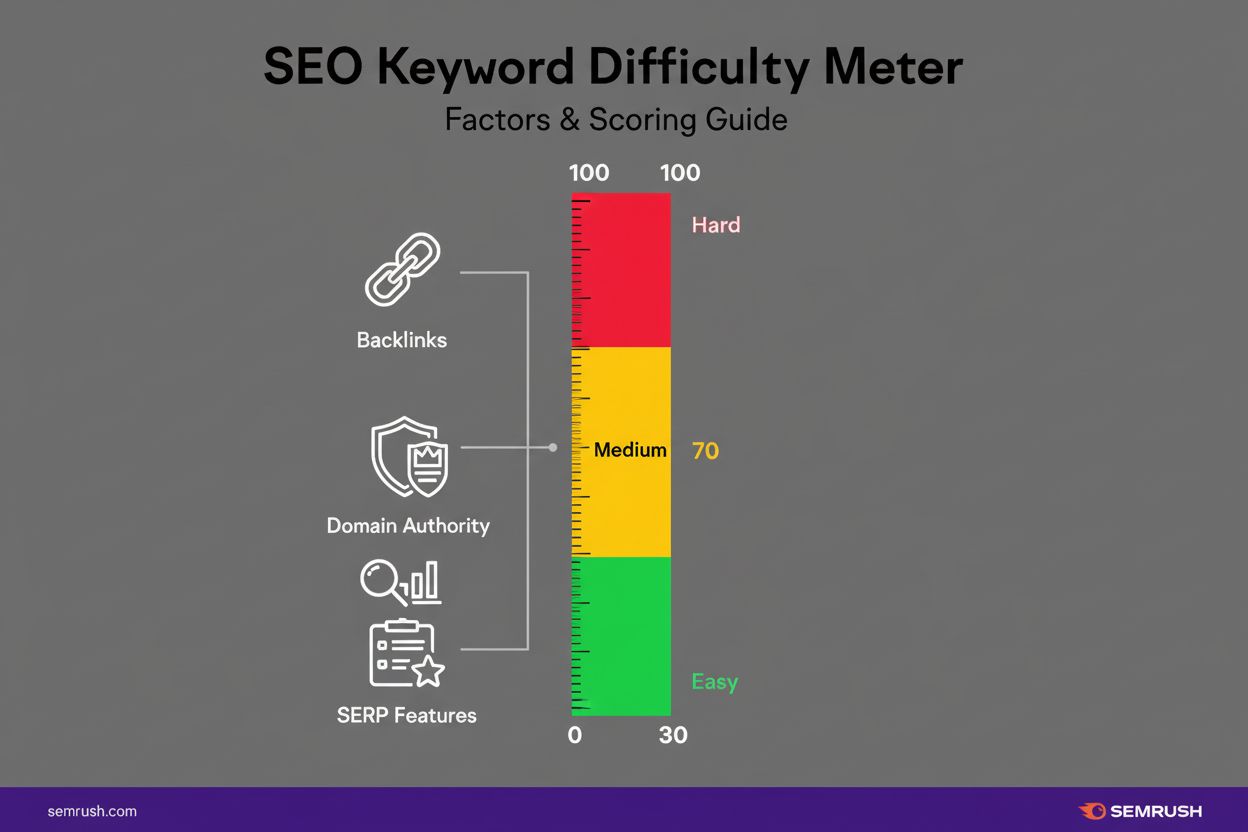
Keyword Difficulty (KD) is a metric that measures the competitive challenge of ranking a webpage on the first page of search results for a specific keyword, typically scored on a 0-100 scale. It analyzes factors like backlinks, domain authority, and search volume of top-ranking pages to estimate how much effort is required to achieve top rankings.
Keyword Difficulty (KD) is a metric that measures the competitive challenge of ranking a webpage on the first page of search results for a specific keyword, typically scored on a 0-100 scale. It analyzes factors like backlinks, domain authority, and search volume of top-ranking pages to estimate how much effort is required to achieve top rankings.
Keyword Difficulty (KD) is a quantitative metric that measures the competitive challenge of ranking a webpage on the first page of search engine results for a specific keyword or search query. Expressed on a scale from 0 to 100, keyword difficulty estimates how much effort, resources, and time are required to achieve top rankings for a given term. A score of 0 indicates minimal competition and ease of ranking, while a score of 100 represents the highest level of competition and difficulty. This metric has become fundamental to SEO strategy and keyword research because it helps marketers and content creators allocate resources efficiently by identifying which keywords are realistically achievable given their website’s current authority and competitive position. Understanding keyword difficulty is essential for anyone conducting keyword research, as it directly influences content planning, link-building priorities, and overall search engine optimization strategy.
The concept of keyword difficulty emerged in the early 2000s as search engine optimization became increasingly competitive and data-driven. Initially, SEO professionals relied on manual analysis of search engine results pages (SERPs) to estimate ranking difficulty by examining the backlink profiles and domain authority of top-ranking competitors. However, this manual approach was time-consuming and subjective. The introduction of SEO tools like Moz, Ahrefs, and Semrush revolutionized keyword research by automating the calculation of keyword difficulty scores, making competitive analysis accessible to businesses of all sizes. Over the past two decades, these tools have refined their algorithms significantly, incorporating more sophisticated ranking factors and providing increasingly accurate predictions of ranking potential. According to a 2024 Forrester study, enterprises reported a 41% reduction in keyword research time through the use of automated keyword difficulty tools, demonstrating the substantial impact these metrics have had on SEO efficiency. Today, keyword difficulty remains one of the most widely used metrics in the SEO industry, with over 78% of enterprises utilizing AI-driven content monitoring and keyword analysis tools to inform their search strategy.
Different SEO tools calculate keyword difficulty using proprietary algorithms, but they all analyze similar core factors from the top-ranking pages in search results. Ahrefs, one of the most widely used platforms, employs a straightforward methodology: it examines the top 10 ranking pages for a keyword and counts the number of unique referring domains linking to each page. The more backlinks and referring domains pointing to top-ranking pages, the higher the keyword difficulty score. Semrush takes a more comprehensive approach, combining backlink metrics with domain authority scores, keyword search volume, the presence of SERP features (like featured snippets and knowledge panels), branded keyword indicators, and word count analysis. Moz incorporates its proprietary Domain Authority metric along with click-through rate (CTR) data to estimate ranking difficulty. Despite these different methodologies, all tools use the same 0-100 scale, though the exact scores for the same keyword may vary significantly between platforms. For example, the keyword “disposable face mask” might score 72 in Ahrefs, 63 in Moz, and 68 in Semrush—highlighting the importance of understanding how your chosen tool calculates keyword difficulty before making strategic decisions.
| SEO Tool | Primary Calculation Method | Scale | Additional Metrics | Best For |
|---|---|---|---|---|
| Ahrefs | Referring domains to top 10 ranking pages | 0-100 | Domain Rating, URL Rating, organic traffic | Backlink-focused analysis |
| Semrush | Backlinks + Domain Authority + Search Volume + SERP Features | 0-100 (%) | Personal KD, Authority Score, topical authority | Comprehensive competitive analysis |
| Moz | Domain Authority + Page Authority + CTR | 0-100 | Keyword Opportunity Score, SERP features | Authority-based ranking prediction |
| SEMrush | Multi-factor algorithm (backlinks, authority, volume) | 0-100 | Keyword variations, intent classification | Enterprise-level keyword strategy |
| Positional | Competition metric based on SERP analysis | 0-100 | Topical authority, content gaps | Content-focused SEO teams |
Backlink Profiles of Top-Ranking Pages represent the most significant factor in keyword difficulty calculations across all major SEO tools. Backlinks act as votes of confidence from other websites, and Google treats them as strong endorsements of content quality and relevance. When the top-ranking pages for a keyword have extensive backlink profiles with links from high-authority domains, the keyword difficulty score increases substantially. The quality and quantity of referring domains matter more than the total number of backlinks, as links from diverse, authoritative sources carry more weight than multiple links from the same source. Additionally, the ratio of follow links to nofollow links influences difficulty—pages with predominantly follow links from reputable sources face higher competition than those with mixed link profiles.
Domain Authority and Page Authority metrics, while not directly used by Google’s algorithm, serve as reliable proxies for a website’s overall ranking potential and trustworthiness. Websites with higher domain authority scores (typically ranging from 1-100) have accumulated more quality backlinks and organic traffic over time, making them formidable competitors in search results. When multiple high-authority domains rank for the same keyword, the keyword difficulty increases significantly. For instance, branded keywords like “iPhone” have extremely high difficulty scores because Apple’s domain authority is 100, and other major retailers like Best Buy and Amazon also rank with authority scores in the 80s and 90s.
Search Volume directly correlates with keyword difficulty in most cases. Keywords with higher monthly search volumes attract more competition because they represent larger market opportunities with greater potential traffic and revenue. Research shows that keywords with search volumes exceeding 100,000 monthly searches average around 76% difficulty, while keywords with only 11-100 monthly searches average approximately 39% difficulty. However, this correlation is not absolute—some high-volume keywords may have lower difficulty if they’re newer or less commercially competitive, while some low-volume keywords might be highly difficult if they’re in specialized, competitive niches.
SERP Features like featured snippets, knowledge panels, local packs, People Also Ask sections, and top stories significantly impact keyword difficulty by reducing the visibility of traditional organic listings. When a keyword triggers multiple SERP features, the space available for organic results decreases, making it harder to earn clicks even if you rank in the top 10. Keywords with rich SERP features typically have higher difficulty scores because earning visibility requires not only ranking well but also optimizing for these special features.
Branded Keywords inherently have higher difficulty scores because Google prioritizes the official brand website in search results. Non-branded competitors struggle to rank prominently for branded keywords, as Google’s algorithm favors the brand’s own domain. However, ranking for your own branded keywords should be relatively easy, as you have the advantage of being the official source.
Keyword Length and Specificity inversely affect difficulty—longer, more specific keywords (long-tail keywords) typically have lower difficulty scores than shorter, broader terms. For example, “iPhone 15 Pro Max” has 71% difficulty with 823,000 monthly searches, while “iPhone 15 Oro Max 256gb natural titanium” has only 38% difficulty with 390 monthly searches. Long-tail keywords represent less competition but also lower search volume, making them valuable for building initial authority and driving targeted traffic.
Understanding keyword difficulty requires recognizing that it functions as a baseline metric applicable to the average website. Your personal ranking potential depends heavily on your website’s domain authority, topical authority, and existing backlink profile. Personal Keyword Difficulty (PKD), introduced by platforms like Semrush, adjusts the general difficulty score based on your specific website’s characteristics. A keyword with a general KD of 60 might have a PKD of 40 for an established authority site in that niche, or a PKD of 75 for a new domain. This distinction is crucial because it prevents websites from dismissing opportunities that might actually be achievable given their competitive position.
The relationship between keyword difficulty and ranking potential follows a predictable pattern: websites with higher domain authority can rank for more difficult keywords more quickly, while newer sites must build authority gradually by targeting easier keywords first. This creates a natural progression where new websites should focus on keywords with KD scores below 30-40 to establish initial rankings and organic traffic. As the website accumulates backlinks, improves content quality, and builds topical authority through comprehensive content clusters, it becomes capable of competing for progressively more difficult keywords. This strategic approach, sometimes called the “keyword difficulty ladder,” allows websites to build momentum and establish themselves as authoritative sources in their niche before attempting to compete for the most valuable, high-difficulty keywords.
From a business perspective, keyword difficulty directly influences return on investment (ROI) for SEO efforts. High-difficulty keywords often represent significant commercial opportunities with strong transactional intent and substantial search volume, but they require substantial investment in content creation, link building, and technical optimization. Lower-difficulty keywords can be ranked more quickly with less investment, providing faster wins and demonstrating SEO value to stakeholders. A balanced keyword strategy typically allocates approximately 70% of resources to lower-difficulty keywords (KD 0-50) that drive quick traffic and conversions, while dedicating 30% to higher-difficulty keywords (KD 50-100) that represent long-term strategic opportunities aligned with core business goals.
The practical implications of keyword difficulty extend beyond ranking potential to content planning and resource allocation. Keywords with similar difficulty scores may require vastly different content approaches—some might need comprehensive pillar pages with extensive internal linking, while others might be captured through targeted blog posts or product pages. Understanding keyword difficulty helps teams prioritize which keywords deserve the most investment in content depth, design, and promotion. Additionally, keyword difficulty scores help identify content gaps where competitors are underperforming, allowing strategic teams to create superior content that can outrank higher-authority competitors through better user experience, more comprehensive information, or unique perspectives.
While keyword difficulty was originally developed for Google organic search, its principles increasingly apply to other search platforms and AI-powered search engines. Perplexity AI, ChatGPT, and Google AI Overviews use different ranking mechanisms than traditional Google search, but they still prioritize authoritative, well-cited sources. Websites with strong domain authority and comprehensive content on specific topics are more likely to be cited in AI-generated responses, making traditional keyword difficulty analysis still relevant for AI search optimization. However, AI search engines place additional emphasis on content quality, factual accuracy, and the ability to synthesize information across multiple sources—factors that go beyond traditional keyword difficulty metrics.
For Google AI Overviews, which integrate AI-generated summaries into traditional search results, understanding keyword difficulty helps identify opportunities where your content can be cited as a source. Keywords with featured snippets or knowledge panels already indicate that Google recognizes certain content as authoritative for those queries, suggesting that optimizing for these positions can increase visibility in AI-generated responses. Perplexity Search and ChatGPT similarly favor content from established, authoritative sources, making the foundational work of building domain authority and ranking for difficult keywords increasingly valuable across multiple search platforms.
Effective use of keyword difficulty requires integrating it into a comprehensive keyword research and content strategy framework. The first step involves establishing a baseline understanding of your website’s current competitive position by analyzing the keyword difficulty scores of keywords you already rank for. This analysis reveals your website’s natural difficulty range—if you’re ranking for keywords with KD scores of 40-60, you likely have the authority to target keywords in the 50-70 range with reasonable effort. Conversely, if your highest-ranking keywords have KD scores below 30, you should focus on building authority with easier keywords before attempting to rank for more competitive terms.
When conducting keyword research, use keyword difficulty as a filtering mechanism rather than an absolute barrier. Tools like Semrush’s Keyword Magic Tool allow you to filter by difficulty range, search volume, and other metrics simultaneously. A practical approach involves identifying keyword clusters—groups of related keywords with varying difficulty levels—and creating content that targets the entire cluster. For example, a keyword cluster around “sustainable fashion” might include easy keywords like “sustainable fashion brands” (KD 35), medium-difficulty keywords like “sustainable fashion tips” (KD 50), and challenging keywords like “sustainable fashion” (KD 75). Creating comprehensive content that addresses the entire cluster allows you to rank for easier keywords quickly while building authority for more difficult terms over time.
Personal Keyword Difficulty (PKD) analysis should inform your final keyword selection decisions. When evaluating whether to target a specific keyword, compare its general KD score with your PKD score. If a keyword has a general KD of 65 but your PKD is only 45, it represents an excellent opportunity—the keyword appears competitive in general, but your website’s specific strengths make it achievable. Conversely, if a keyword has a general KD of 40 but your PKD is 60, you should probably skip it and find easier alternatives, as your website lacks the specific authority needed to compete effectively.
The concept of keyword difficulty continues to evolve as search engines and AI platforms change their ranking mechanisms and user behavior shifts. The rise of AI search engines like ChatGPT, Perplexity, and Google AI Overviews is creating new dimensions to keyword difficulty that traditional metrics don’t fully capture. While traditional keyword difficulty focuses on ranking position in search results, AI search difficulty increasingly depends on factors like content comprehensiveness, factual accuracy, citation frequency, and the ability to synthesize information across multiple sources. Forward-thinking SEO professionals are beginning to develop AI keyword difficulty metrics that account for these new ranking factors, recognizing that visibility in AI-generated responses requires a different optimization approach than traditional Google rankings.
The integration of generative engine optimization (GEO) into mainstream SEO practice suggests that future keyword difficulty metrics will need to account for multiple search ecosystems simultaneously. A keyword might have moderate difficulty in Google search but high difficulty in AI search engines, or vice versa. Tools like AmICited that monitor brand and domain appearances across multiple AI platforms are becoming essential for understanding true keyword difficulty in an increasingly fragmented search landscape. As AI search continues to mature and capture market share from traditional search engines, the definition and measurement of keyword difficulty will likely expand to encompass visibility across all major discovery platforms.
Additionally, the increasing emphasis on E-E-A-T (Experience, Expertise, Authoritativeness, Trustworthiness) signals in Google’s ranking algorithm suggests that future keyword difficulty calculations will place greater weight on content quality, author credentials, and topical authority rather than purely on backlink metrics. This shift means that websites with genuinely authoritative, well-researched content may be able to rank for difficult keywords more easily than traditional keyword difficulty scores suggest, while websites relying primarily on backlinks without substantive content quality may find it increasingly difficult to maintain rankings. The future of keyword difficulty will likely be more nuanced, accounting for the multifaceted nature of modern search ranking factors and the diverse ways users discover information across search engines, AI platforms, and social media.
Keyword difficulty is calculated by analyzing the top 10 ranking pages for a keyword and evaluating their backlink profiles, domain authority scores, and other ranking signals. Different tools use slightly different methodologies—Ahrefs focuses primarily on referring domains, Semrush uses a mix of backlink metrics and authority scores, while Moz incorporates click-through rate data. Each tool produces scores on a 0-100 scale, but the exact numbers may vary between platforms.
General keyword difficulty (KD) shows the average difficulty for any website to rank for a keyword, while personal keyword difficulty (PKD) adjusts the score based on your specific website's authority, backlink profile, and topical relevance. PKD is more accurate for your situation because it accounts for your domain's strengths and weaknesses compared to current competitors, making it a better predictor of your actual ranking potential.
Keywords with higher search volume attract more competition because they represent larger market opportunities with more potential traffic and revenue. More websites target high-volume keywords, resulting in stronger backlink profiles and higher domain authority among top-ranking pages. For example, keywords with over 100,000 monthly searches average around 76% difficulty, while keywords with 11-100 searches average only 39% difficulty.
SERP features like featured snippets, knowledge panels, and People Also Ask sections increase keyword difficulty because they reduce the visibility of organic listings below the fold. When a keyword triggers multiple SERP features, earning clicks becomes more challenging even if you rank in the top 10, as users may find answers directly in these features without clicking through to your page.
Yes, but it requires significantly more time, effort, and resources. New websites typically lack the domain authority and backlink profile needed to compete for high-difficulty keywords. A strategic approach involves starting with lower-difficulty keywords (KD 0-50) to build authority, then gradually targeting more competitive terms as your domain strength increases through quality content and link building.
The ideal keyword difficulty depends on your website's authority and resources. New sites should focus on keywords with KD scores below 30-40, while established sites with strong authority can target KD 50-70. A balanced approach combines some easy wins (low KD) to drive quick traffic with strategic high-difficulty keywords that align with your long-term business goals and have proven conversion potential.
While traditional keyword difficulty metrics focus on Google rankings, AI search engines like ChatGPT, Perplexity, and Google AI Overviews use different ranking mechanisms. However, the underlying principle remains similar—pages with stronger authority, better content quality, and more citations tend to appear in AI responses. Understanding keyword difficulty helps identify topics where your content can establish authority, which benefits visibility across both traditional and AI search platforms.
No. While high-difficulty keywords require more investment, they often represent high-value opportunities with strong commercial intent and significant traffic potential. A balanced strategy targets a mix: approximately 70% lower-difficulty keywords for quick wins and traffic building, and 30% higher-difficulty keywords that align with your core business goals and long-term authority building.
Start tracking how AI chatbots mention your brand across ChatGPT, Perplexity, and other platforms. Get actionable insights to improve your AI presence.
Keyword density measures how often a keyword appears in content relative to total word count. Learn optimal percentages, best practices, and how it impacts AI s...
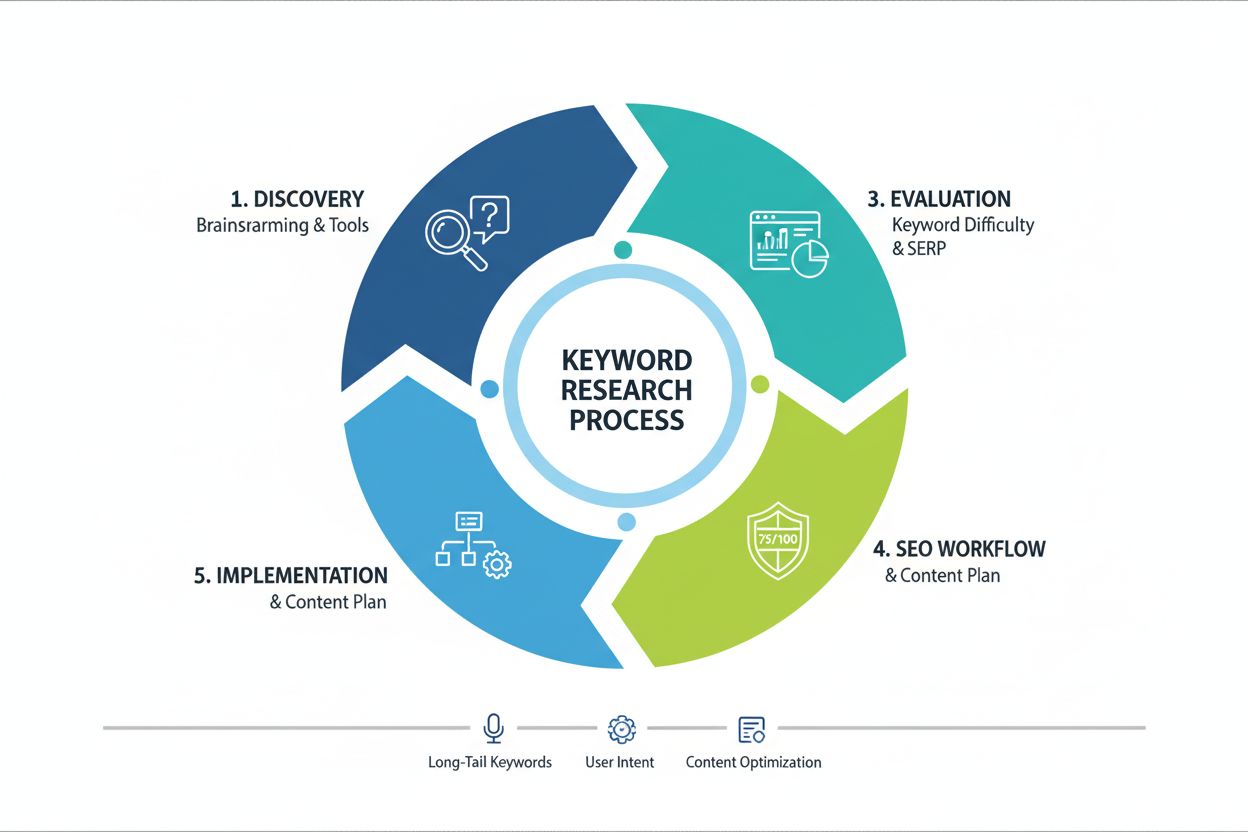
Keyword research is the foundational SEO process of identifying valuable search terms people use online. Learn methods, tools, and strategies to find high-impac...
Learn the essential KPIs for monitoring your brand's visibility in AI search engines like ChatGPT, Perplexity, and Google AI Overviews. Track AI Signal Rate, An...