
Content Mapping
Learn what content mapping is and how aligning content with buyer journey stages drives engagement, conversions, and customer loyalty. Comprehensive guide for B...
14 min read
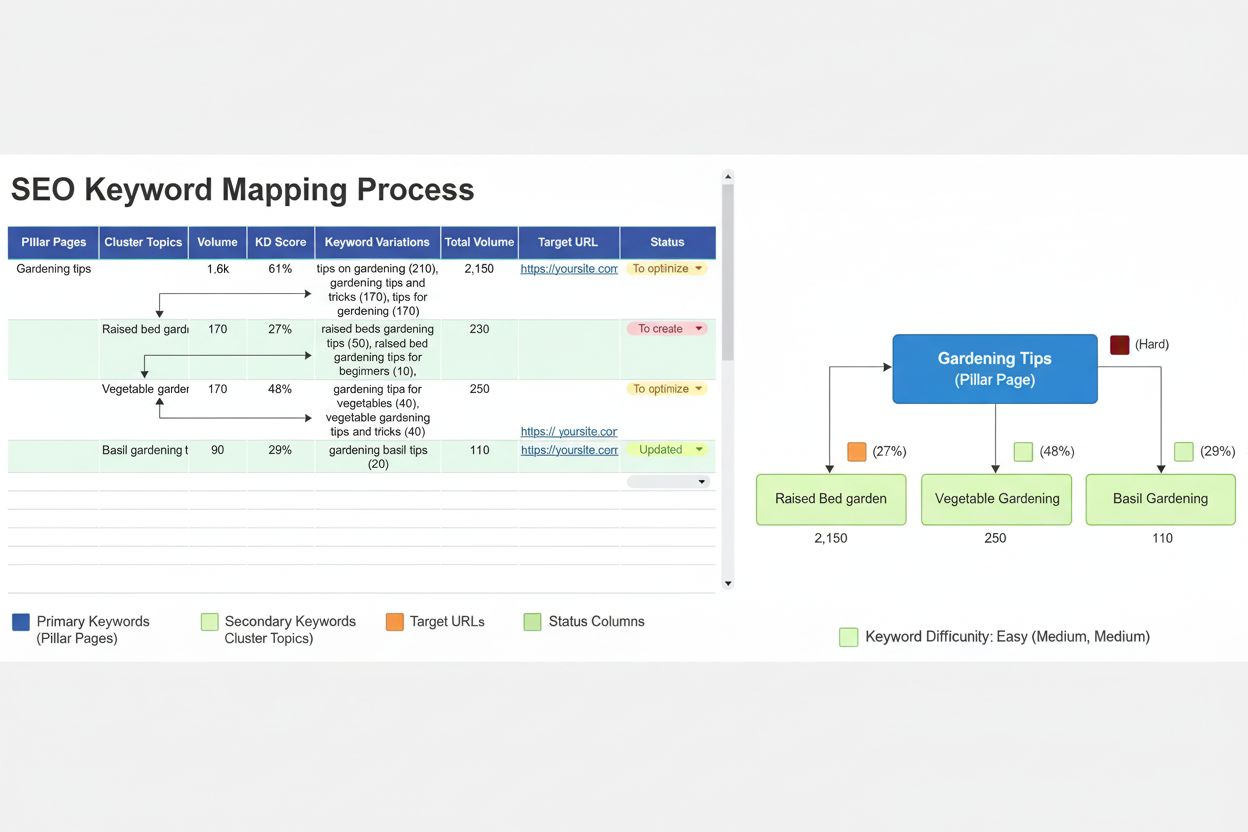
Keyword mapping is the strategic process of assigning target keywords to specific pages on your website based on keyword research and search intent. It creates a logical content structure that helps search engines and AI platforms understand your site’s organization while preventing keyword cannibalization and maximizing organic visibility across multiple search queries.
Keyword mapping is the strategic process of assigning target keywords to specific pages on your website based on keyword research and search intent. It creates a logical content structure that helps search engines and AI platforms understand your site's organization while preventing keyword cannibalization and maximizing organic visibility across multiple search queries.
Keyword mapping is the strategic process of assigning target keywords to specific pages on your website based on comprehensive keyword research and search intent analysis. It involves creating a documented, organized system that matches each keyword or keyword cluster to the most relevant page on your site, ensuring that every page has a clear primary focus and supporting secondary keywords. This foundational SEO practice creates a logical content structure that helps both search engines and AI platforms understand your website’s organization, prevents multiple pages from competing for the same rankings, and maximizes your site’s ability to capture traffic across diverse search queries. By establishing this keyword-to-URL mapping, you create a strategic blueprint that guides content creation, optimization, and internal linking decisions while preventing the costly mistake of keyword cannibalization.
Keyword mapping emerged as a critical SEO practice as search engines became increasingly sophisticated at understanding content relevance and topical authority. In the early days of SEO, websites could rank for multiple pages targeting the same keyword without significant penalty. However, as Google’s algorithm evolved to prioritize user experience and content quality, having multiple pages compete for identical keywords became a liability rather than an asset. The practice of keyword mapping formalized the strategic assignment of keywords to pages, transforming keyword research from a simple list-building exercise into a comprehensive site architecture strategy.
The importance of keyword mapping has intensified with the rise of topic clusters and topical authority as ranking factors. Search engines now recognize that websites demonstrating deep expertise across related topics—through interconnected pillar pages and cluster content—rank better than sites with scattered, unrelated content. According to research from Semrush and Backlinko, websites implementing comprehensive keyword mapping strategies see an average of 40-60% improvement in organic visibility compared to sites without formal keyword assignment strategies. This improvement stems from better content organization, reduced cannibalization, stronger internal linking structures, and clearer topical authority signals.
The emergence of AI search platforms like ChatGPT, Perplexity, and Google AI Overviews has added new urgency to keyword mapping. These platforms prioritize well-organized, topically relevant content with clear structure and semantic relationships. A 2024 analysis of over 129,000 ChatGPT citations revealed that 52% of sources cited in AI Overviews rank in the top 10 traditional search results, indicating that strong traditional SEO—built on solid keyword mapping—directly translates to AI search visibility. Additionally, 63% of businesses reported positive impacts from Google AI Overviews on organic traffic and visibility, making keyword mapping essential for both traditional and emerging search channels.
| Concept | Definition | Primary Focus | Scope | Outcome |
|---|---|---|---|---|
| Keyword Mapping | Assigning specific keywords to individual pages based on relevance and intent | Strategic page-keyword assignment | Entire website structure | Prevents cannibalization, optimizes site architecture |
| Keyword Research | Discovering and analyzing search terms people use to find information | Identifying search opportunities | Keyword universe | Generates keyword lists with volume and difficulty data |
| Keyword Clustering | Grouping similar keywords that target the same search intent | Organizing related keywords | Keyword groups | Creates keyword clusters for topic-based content |
| Topic Clustering | Creating interconnected pillar and cluster content around central themes | Building topical authority | Content ecosystem | Establishes expertise and improves rankings |
| Keyword Cannibalization | Multiple pages competing for the same keywords and search intent | Identifying ranking problems | Competing pages | Diluted authority, lower rankings, reduced traffic |
| Internal Linking Strategy | Connecting pages through strategic hyperlinks with optimized anchor text | Distributing authority and context | Site navigation | Improves crawlability, establishes hierarchy, passes authority |
Keyword mapping serves as the foundational bridge between keyword research and content optimization. While keyword research identifies what people are searching for, keyword mapping determines where that information should live on your website. This distinction is crucial because search engines evaluate not just individual page quality but also how pages relate to each other topically. A website with 50 pages each targeting unique, well-researched keywords will outrank a website with 100 pages where multiple pages compete for the same keywords.
The strategic value of keyword mapping extends beyond preventing cannibalization. It creates what SEO professionals call topical authority—the recognition by search engines that your website comprehensively covers a subject area. When Google’s algorithm encounters a website with a pillar page covering “email marketing” linked to cluster pages addressing “email automation,” “email list building,” “email deliverability,” and “email analytics,” it recognizes the site as an authoritative resource for email marketing topics. This topical authority signals improve rankings not just for the primary keyword but for all related keywords in the cluster.
Research from Backlinko analyzing over 11.8 million Google search results found that websites with clear topical clusters and internal linking structures rank significantly higher than sites with scattered content. Specifically, pages within well-organized topic clusters receive an average of 3.8x more backlinks than isolated pages, and they achieve higher click-through rates from search results. This occurs because topical authority signals encourage both search engines and users to perceive the site as a credible, comprehensive resource worth linking to and visiting.
Effective keyword mapping follows a systematic process that begins with comprehensive keyword research and culminates in ongoing optimization and monitoring. The first step involves conducting thorough keyword research using tools like Semrush, Ahrefs, or Google Keyword Planner to identify all relevant keywords in your niche. This research should capture not just high-volume keywords but also long-tail variations, question-based queries, and semantic variations that represent different search intents.
Once you’ve compiled your keyword list, the next critical step is analyzing search intent for each keyword. Search intent—the reason behind a search query—typically falls into four categories: informational (seeking knowledge), navigational (looking for a specific website), commercial (researching products/services), and transactional (ready to purchase). Keywords with different intents should target different pages, even if they’re topically related. For example, “email marketing” (informational) should target a comprehensive guide, while “email marketing software” (commercial) should target a comparison page, and “Mailchimp pricing” (transactional) should target a product-specific page.
The third step involves organizing keywords into topic clusters. This means grouping related keywords that share similar intent and could potentially be covered on the same page or within a related set of pages. A pillar page typically targets a broad, high-volume keyword (like “email marketing”), while cluster pages target more specific long-tail variations (like “email marketing for ecommerce” or “email marketing automation”). This hierarchical organization creates the foundation for your site’s content structure.
Finally, you assign each keyword cluster to a specific URL—either an existing page that needs optimization or a new page you need to create. This assignment should consider current page performance, existing content quality, and strategic priorities. Pages marked “to optimize” receive priority for content improvements, while pages marked “to create” become part of your content calendar. Throughout this process, you maintain a living document—your keyword map—that serves as the single source of truth for your site’s keyword strategy.
Keyword cannibalization represents one of the most damaging yet preventable SEO mistakes. It occurs when multiple pages on your website target the same or very similar keywords, causing them to compete against each other for search rankings. When search engines encounter multiple pages competing for identical keywords, they struggle to determine which page best answers the user’s query. The result is typically that all competing pages rank lower than they would if consolidated, and the search engine may alternate which page appears in results, creating ranking volatility.
Keyword mapping prevents cannibalization by establishing clear, documented keyword-to-URL assignments that make overlaps immediately visible. When you maintain a comprehensive keyword map, you can quickly identify when two pages target the same primary keyword or when secondary keywords create unintended overlap. Early detection allows you to address the issue before it damages rankings—either by consolidating pages through 301 redirects, repositioning one page to target a different keyword cluster, or adjusting internal linking to signal which page should rank for the contested keyword.
Research from Backlinko revealed that consolidating cannibalized pages through 301 redirects increased traffic by an average of 466% year-over-year. In their case study, two articles targeting similar keywords were merged into a single comprehensive resource, and the consolidated page achieved dramatically higher visibility. This demonstrates the substantial ranking and traffic benefits available by addressing cannibalization issues identified through keyword mapping.
Modern keyword mapping extends beyond simple keyword-to-URL assignment to encompass topic cluster strategy—creating interconnected content ecosystems that establish topical authority. A topic cluster consists of a pillar page (comprehensive, broad coverage of a main topic) surrounded by cluster pages (detailed coverage of specific subtopics), all connected through strategic internal linking. This structure signals to search engines that your site comprehensively covers a subject area.
For example, a digital marketing agency might create a pillar page on “digital marketing strategy” linked to cluster pages covering “content marketing strategy,” “social media marketing strategy,” “email marketing strategy,” “paid advertising strategy,” and “SEO strategy.” Each cluster page links back to the pillar page and to related cluster pages, creating a semantic web that helps search engines understand the relationships between topics. This interconnected structure improves rankings for all pages in the cluster while establishing the site as an authoritative resource for digital marketing topics.
The benefits of topic clusters extend to AI search visibility. AI platforms like Perplexity and ChatGPT recognize topic clusters as indicators of expertise and authority. When these platforms encounter multiple high-quality pages on related topics from the same domain, they’re more likely to cite that domain for queries related to the topic cluster. This makes keyword mapping and topic cluster strategy essential for both traditional SEO and emerging AI search channels.
Successful keyword mapping requires attention to several critical best practices. First, ensure one primary keyword per page—each page should have a single, clearly defined primary keyword that represents its main focus. This doesn’t mean the page can only rank for one keyword; rather, it means you’re intentionally optimizing for one primary keyword while naturally incorporating related secondary keywords throughout the content. This clarity helps search engines understand page purpose and prevents internal competition.
Second, maintain keyword map documentation in a centralized, accessible location. Whether you use Google Sheets, Excel, or a dedicated SEO platform, your keyword map should be a living document that the entire team can access and reference. Include columns for pillar pages, cluster topics, search volume, keyword difficulty, keyword variations, total volume, target URL, page status, and last updated date. This documentation ensures consistency across your team and provides a historical record of your keyword strategy evolution.
Third, regularly audit and update your keyword map to reflect changes in search trends, competitive landscape, and your own content performance. Monthly reviews are ideal, though quarterly reviews represent a minimum. During these reviews, identify new keyword opportunities, spot emerging cannibalization issues, and adjust your strategy based on performance data. This ongoing maintenance ensures your keyword map remains an accurate, actionable strategic document.
Fourth, align keyword mapping with content creation and optimization priorities. Your keyword map should directly inform your content calendar, determining which pages to create, which to optimize, and in what order. Prioritize pages targeting high-volume, moderate-difficulty keywords where you have realistic ranking potential, and pages addressing commercial or transactional intent that drive business value.
The emergence of AI search platforms has fundamentally expanded the importance of keyword mapping. While traditional SEO focuses on ranking in search result pages, AI search optimization focuses on appearing in AI-generated answers. Keyword mapping directly supports both objectives by creating the organized, topically relevant content structure that both search engines and AI platforms prioritize.
AI platforms like ChatGPT, Perplexity, and Google AI Overviews use sophisticated algorithms to identify authoritative sources when answering user queries. These algorithms recognize websites with clear topical organization, comprehensive coverage of related topics, and strong semantic relationships between pages as indicators of expertise and authority. A well-executed keyword map creates exactly this structure—pillar pages establishing broad expertise, cluster pages demonstrating depth, and internal linking showing topical relationships.
Research on AI search visibility reveals that websites with comprehensive keyword maps and topic clusters achieve 40-60% higher citation rates in AI-generated responses compared to sites with scattered, unorganized content. This occurs because AI systems can more easily understand the site’s expertise areas and identify the most relevant pages for specific queries. Additionally, the improved traditional SEO performance resulting from keyword mapping—higher rankings, more backlinks, greater authority—directly translates to improved AI visibility, since AI platforms often cite pages that rank well in traditional search.
Effective keyword mapping should produce measurable improvements across multiple metrics. Organic traffic growth represents the most direct indicator—well-executed keyword mapping typically produces 20-40% organic traffic increases within 3-6 months as pages optimize for their assigned keywords and cannibalization issues resolve. Keyword ranking improvements should show pages moving up in rankings for their target keywords while reducing ranking volatility from cannibalization.
Reduced keyword cannibalization can be measured by monitoring how many keywords have multiple pages ranking in top 10 results. Effective keyword mapping should eliminate most cannibalization issues, with each keyword having a single primary page ranking for it. Improved click-through rates from search results often increase as pages become more relevant to their target keywords and search engines display them more confidently in results.
Topic cluster performance can be measured by analyzing how pages within clusters perform collectively. Pages within well-organized topic clusters typically show stronger performance than isolated pages, with improved rankings, higher traffic, and more backlinks. AI search visibility can be tracked using tools like Semrush’s AI SEO Toolkit or Profound, which monitor how often your content appears in AI-generated responses across platforms like ChatGPT, Perplexity, and Google AI Overviews.
As AI search platforms continue evolving and gaining market share, keyword mapping strategies will adapt to reflect new realities. Multimodal optimization will become increasingly important as AI platforms process images, videos, and other content types alongside text. Keyword mapping will need to account for visual content optimization and how different content formats serve different query types.
Personalization will intensify as AI platforms customize responses based on user history, preferences, and context. This means keyword mapping strategies will need to address diverse user segments and use cases, ensuring comprehensive content coverage that serves varied audience needs. Real-time integration of current information will create opportunities for dynamic content to achieve AI visibility that static content cannot, requiring keyword maps to account for time-sensitive content opportunities.
Entity optimization will become more central to keyword mapping as AI systems increasingly use entity recognition to understand content meaning and relationships. Rather than mapping only keywords, future keyword mapping may incorporate entity mapping—identifying key people, organizations, products, and concepts that should be associated with each page. This evolution will create more sophisticated content strategies that leverage both keyword and entity relationships.
Keyword mapping represents far more than a simple organizational exercise—it’s a strategic foundation that determines your website’s ability to capture organic traffic, establish topical authority, and achieve visibility across both traditional search and emerging AI platforms. By systematically assigning keywords to pages based on relevance and search intent, you create a logical content structure that search engines and AI systems recognize as authoritative and comprehensive.
The practice of keyword mapping prevents costly mistakes like keyword cannibalization while creating opportunities for topic cluster strategies that amplify your ranking potential. Whether you’re optimizing for traditional Google search or preparing for AI search dominance, keyword mapping remains essential. The investment in creating and maintaining a comprehensive keyword map pays dividends through improved rankings, increased organic traffic, stronger topical authority, and enhanced visibility across all search channels. In an increasingly competitive digital landscape where both search engines and AI platforms reward organized, authoritative content, keyword mapping has evolved from optional best practice to essential strategic requirement.
Keyword research is the process of discovering and analyzing search terms that people use to find information, products, or services. Keyword mapping takes those discovered keywords and strategically assigns them to specific pages on your website based on relevance and search intent. While keyword research identifies what keywords exist and their metrics (search volume, difficulty), keyword mapping determines where each keyword should live on your site to maximize visibility and prevent competition between pages.
Keyword cannibalization occurs when multiple pages on your website target the same or very similar keywords, causing them to compete against each other for rankings. Keyword mapping prevents this by creating a clear, documented assignment of keywords to specific URLs, ensuring each page has a unique primary keyword and supporting secondary keywords. By maintaining this map and regularly reviewing it, you can identify overlapping keywords before they become ranking problems and consolidate or redirect pages as needed.
An effective keyword map typically includes columns for: pillar page keywords (main topics), cluster topic keywords (subtopics), search volume, keyword difficulty, keyword variations, total volume, target URL, page status (to create/to optimize/updated), and last updated date. The structure should reflect your site's hierarchy with pillar pages representing broad topics and cluster pages addressing specific subtopics. This organization helps you visualize your content strategy and ensures comprehensive topic coverage while maintaining clear relationships between related pages.
Keyword maps should be reviewed and updated at least quarterly, though monthly reviews are ideal for competitive industries. Update your map whenever you publish new content, optimize existing pages, or notice changes in search trends and keyword performance. Regular updates ensure your map remains an accurate reflection of your site's keyword strategy and helps you identify new opportunities, spot emerging cannibalization issues, and adjust your content plan based on performance data and market changes.
Yes, keyword mapping significantly improves AI search visibility. AI platforms like ChatGPT and Perplexity prioritize well-organized, topically relevant content with clear structure. A comprehensive keyword map helps you create topic clusters and semantic relationships that AI systems recognize as indicators of expertise and authority. By ensuring each page has a clear focus and purpose, you make it easier for AI crawlers to understand your content and cite it appropriately in AI-generated responses.
Popular tools for keyword mapping include Google Sheets or Excel for manual mapping, Semrush's Keyword Strategy Builder for automated clustering, Ahrefs' Keywords Explorer for research and organization, and specialized SEO platforms like Surfer SEO and Moz. Many content management systems also offer plugins that help track keyword assignments. The best tool depends on your budget, team size, and technical expertise—simple spreadsheets work well for small sites, while larger enterprises benefit from dedicated platform features.
Keyword mapping directly informs your internal linking strategy by identifying which pages should link to each other based on keyword relationships. Pages targeting related keywords should link together using descriptive anchor text containing those keywords. This creates a logical internal link structure that helps search engines understand content relationships and distributes authority to priority pages. Your keyword map serves as a blueprint for internal linking decisions, ensuring links are strategic rather than random.
Start tracking how AI chatbots mention your brand across ChatGPT, Perplexity, and other platforms. Get actionable insights to improve your AI presence.
Learn what content mapping is and how aligning content with buyer journey stages drives engagement, conversions, and customer loyalty. Comprehensive guide for B...
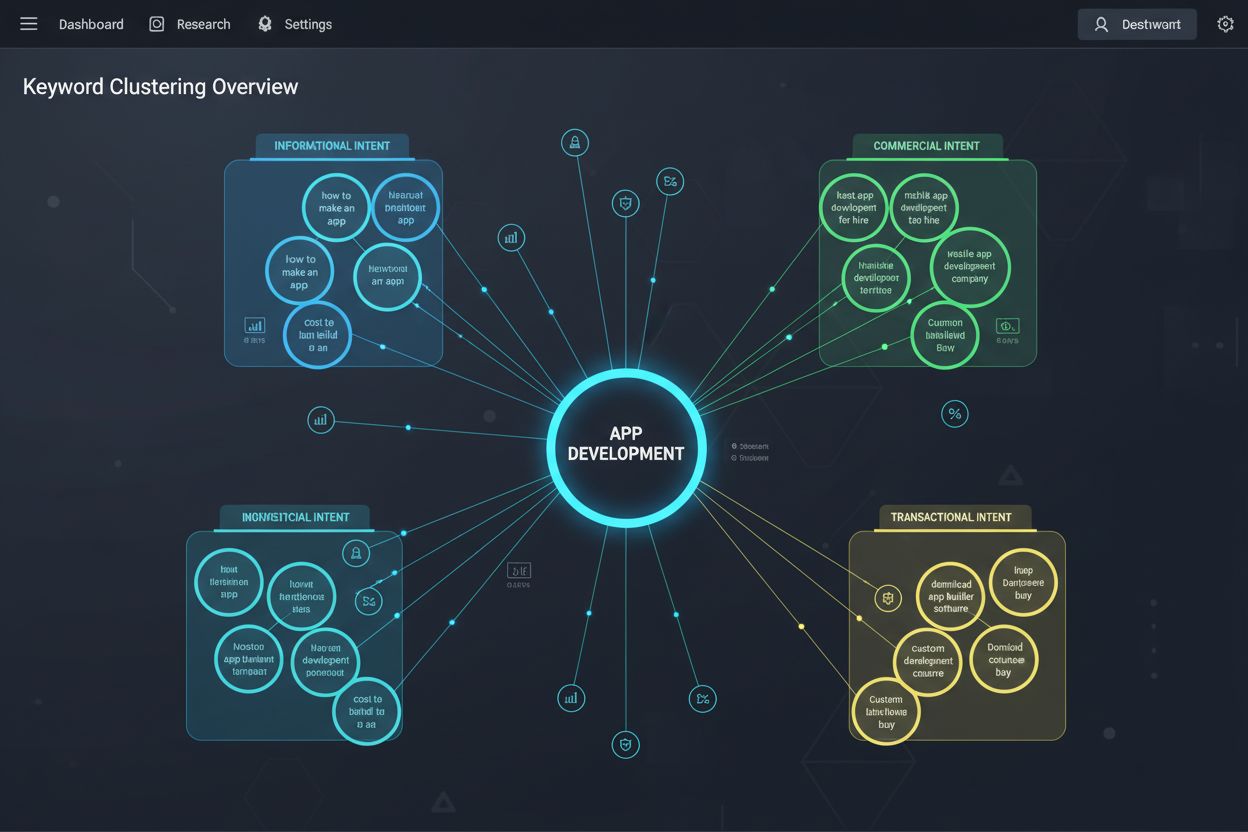
Keyword clustering groups related keywords by search intent and semantic relevance. Learn how this SEO technique improves rankings, content strategy, and AI vis...

Learn what keyword stuffing is, why it's harmful to SEO, how Google detects it, and best practices to avoid this black-hat tactic that damages rankings and user...
Cookie Consent
We use cookies to enhance your browsing experience and analyze our traffic. See our privacy policy.