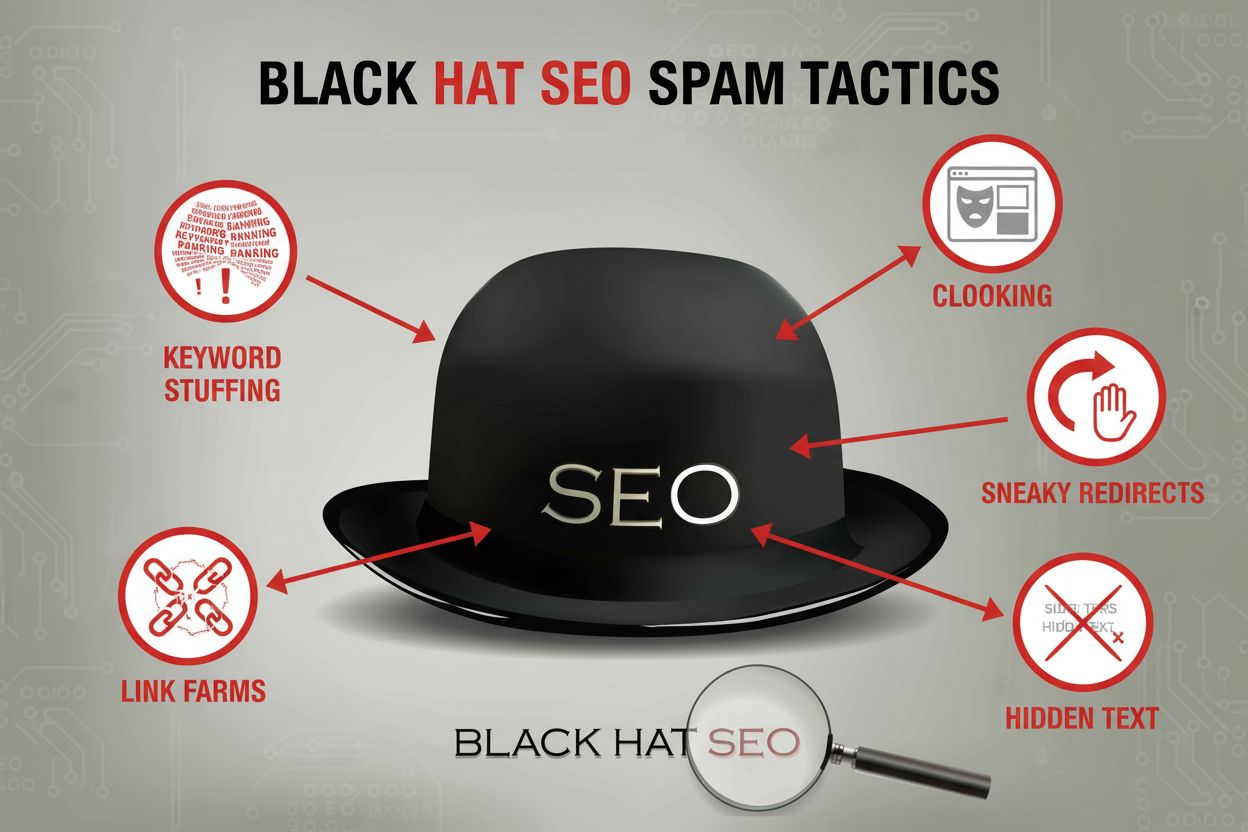
Definition of Keyword Stuffing
Keyword stuffing is the practice of excessively and unnaturally repeating keywords or phrases throughout web content in an attempt to manipulate search engine rankings. This black-hat SEO tactic involves forcing the same keywords into pages, meta tags, URLs, anchor text, and alt text far beyond what would occur naturally in well-written content. According to Google’s official spam policies, keyword stuffing refers to filling a web page with keywords or numbers in an attempt to manipulate rankings in search results, often appearing in lists or groups that are unnaturally out of context. The practice was once believed to be an effective shortcut to higher rankings, but modern search algorithms have evolved significantly to detect and penalize this deceptive technique. Today, keyword stuffing is universally recognized as a harmful SEO practice that damages both search visibility and user experience, making it one of the most clearly defined violations in search engine guidelines.
Historical Context and Evolution of Keyword Stuffing
In the early days of search engine optimization, roughly between 1995 and 2005, keyword stuffing was actually a common and somewhat effective tactic. Search engines like Google relied heavily on keyword frequency as a primary ranking signal, meaning pages with more keyword repetitions often ranked higher. This created a perverse incentive structure where website owners competed to cram as many keywords as possible into their content. However, this approach led to widespread abuse and degraded search quality, as users encountered increasingly spammy, unreadable content that prioritized search engines over human readers. Google’s Panda algorithm update in 2011 marked a major turning point, introducing sophisticated quality assessment mechanisms that penalized low-quality and keyword-stuffed content at scale. Since then, Google has released numerous algorithm updates specifically targeting keyword stuffing and other spam tactics. According to industry research, over 78% of enterprises now use AI-driven content monitoring tools to ensure compliance with search engine guidelines and maintain content quality standards. The evolution from keyword-frequency-based ranking to semantic understanding and user-intent analysis represents one of the most significant shifts in SEO history.
Ready to Monitor Your AI Visibility?
Track how AI chatbots mention your brand across ChatGPT, Perplexity, and other platforms.
Visible vs. Invisible Keyword Stuffing
Keyword stuffing manifests in two primary forms: visible and invisible. Visible keyword stuffing is immediately apparent to human readers and includes excessive keyword repetition in body text, headlines, title tags, meta descriptions, and URLs. For example, a page about running shoes might read: “Buy cheap running shoes, affordable running shoes, discount running shoes, best cheap running shoes online—our running shoes are the cheapest running shoes available.” This awkward, repetitive language is immediately recognizable as unnatural and provides no value to readers. Invisible keyword stuffing, by contrast, is hidden from human view but detectable by search engine crawlers. This includes white text on white backgrounds, text positioned off-screen using CSS, font size set to zero, opacity set to zero, keywords hidden in HTML comments, or excessive keyword repetition in meta tags and alt text. Both forms violate Google’s spam policies equally, and both trigger algorithmic or manual penalties. The distinction matters for remediation purposes, as visible keyword stuffing requires content rewriting while invisible keyword stuffing requires technical fixes to remove hidden elements.
Comparison Table: Keyword Stuffing vs. Natural Keyword Optimization
| Aspect | Keyword Stuffing | Natural Keyword Optimization |
|---|
| Keyword Density | 5-10% or higher (excessive) | 0.5-2% (contextual) |
| Readability | Awkward, unnatural, difficult to read | Flows naturally, easy to understand |
| User Intent | Prioritizes search engines over users | Prioritizes user experience and value |
| Placement | Forced into every possible location | Integrated where contextually relevant |
| Content Quality | Low-quality, repetitive, minimal value | High-quality, comprehensive, valuable |
| Search Engine Response | Penalties, ranking drops, removal | Improved rankings, better visibility |
| AI Search Visibility | Poor performance in LLM-based systems | Strong citations in AI responses |
| Brand Reputation | Damages credibility and trust | Builds authority and trustworthiness |
| Examples | “Best shoes, cheap shoes, affordable shoes” | “High-quality running shoes for marathons” |
| Detection Method | Easily identified by NLP algorithms | Passes semantic and quality analysis |
Stay Updated on AI Visibility Trends
Get the latest insights on AI mentions, brand monitoring, and optimization strategies.
How Google Detects Keyword Stuffing
Google’s detection systems have become extraordinarily sophisticated in identifying keyword stuffing, utilizing multiple layers of analysis to catch both obvious and subtle violations. The search engine employs Natural Language Processing (NLP) technology to analyze content patterns, semantic relationships, and contextual relevance. When Google’s crawlers encounter a page, they examine keyword frequency relative to total word count, analyze the distribution of keywords throughout the content, and assess whether keyword usage aligns with natural language patterns. The algorithm evaluates whether keywords appear in unnatural clusters, whether they’re forced into sentences that don’t make grammatical sense, and whether the overall content reads like it was written for humans or machines. Google’s Multitask Unified Model (MUM) and other advanced systems can understand context, synonyms, and semantic variations, making it nearly impossible to fool the algorithm through simple keyword repetition. Additionally, Google analyzes user behavior signals like bounce rate, time on page, and click-through rate—metrics that typically plummet when users encounter keyword-stuffed content. The search engine also examines backlink anchor text for excessive keyword optimization, as unnatural patterns of keyword-rich links across multiple domains signal potential manipulation. According to Google’s official documentation, the company uses both automated systems and human review to identify spam, with manual actions applied to sites that clearly violate spam policies.
Impact on Search Rankings and Visibility
The consequences of keyword stuffing for search visibility are severe and well-documented. Websites caught engaging in this practice experience significant ranking drops, often losing positions for their target keywords within weeks of detection. In extreme cases, Google may remove entire sites from search results, effectively making them invisible to organic search traffic. A single page with keyword stuffing can trigger penalties affecting the entire domain, as Google’s algorithms assess site-wide quality signals. Beyond immediate ranking loss, keyword-stuffed content receives poor engagement metrics—users bounce quickly, spend minimal time on page, and rarely convert to customers. This poor user behavior further signals to Google that the content lacks quality, creating a downward spiral in rankings. For businesses relying on organic search traffic, keyword stuffing can result in dramatic revenue loss. Research indicates that over 25% of users click the first search result, making top rankings critical for visibility. When keyword stuffing causes a site to drop from position 1 to position 10 or beyond, traffic can decline by 80-90%. The practice also damages long-term SEO efforts, as resources spent on keyword stuffing could have been invested in creating genuinely valuable content that builds sustainable rankings and authority.
Keyword Stuffing in the Age of AI Search
The emergence of AI-powered search systems like ChatGPT, Perplexity, Claude, and Google AI Overviews has fundamentally changed the relevance of keyword stuffing. These large language models (LLMs) are trained on Google’s existing search index, meaning they inherit the same quality signals and ranking factors that penalize keyword stuffing. Keyword stuffing provides zero visibility advantage in AI search results—in fact, it actively harms visibility because the underlying content ranks poorly in traditional search. When a brand’s content is penalized for keyword stuffing, it receives fewer citations in AI responses, reducing brand mentions across these emerging search channels. Platforms like AmICited track brand appearances across AI systems, and keyword-stuffed content is systematically excluded from these citations due to poor search rankings. AI systems prioritize authoritative, high-quality sources that demonstrate expertise and trustworthiness—precisely the opposite of what keyword stuffing represents. Furthermore, LLMs use sophisticated semantic understanding to identify when content is artificially optimized versus naturally written, making keyword stuffing even more detectable in AI contexts. For brands seeking visibility in both traditional search and AI-powered systems, avoiding keyword stuffing is not just a best practice—it’s essential for maintaining presence across all discovery channels.
Best Practices to Avoid Keyword Stuffing
Avoiding keyword stuffing requires a fundamental shift in mindset from search engine optimization to user-first content creation. The following practices help ensure your content remains natural, valuable, and compliant with search engine guidelines:
- Focus on one primary keyword per page and one to five secondary keywords, allowing you to maintain natural keyword density while targeting related search queries
- Write for humans first, search engines second—prioritize readability, clarity, and value delivery over keyword frequency
- Use semantic variations and related keywords instead of repeating the exact same phrase, which improves natural language flow while maintaining topical relevance
- Incorporate keywords naturally in key locations such as the title tag, H1 heading, first paragraph, and subheadings, but only where they fit contextually
- Aim for keyword density between 0.5-2%, which means one keyword appearance per 50-200 words, though this should never be a rigid target
- Write descriptive alt text for images that accurately describes the image content while naturally incorporating keywords where relevant
- Use keyword research tools to identify related terms and synonyms that allow you to discuss your topic comprehensively without repetition
- Read your content aloud to identify awkward phrasing or unnatural keyword placement that disrupts readability
- Analyze top-ranking competitors to understand how they naturally incorporate keywords while maintaining content quality
- Avoid keyword stuffing in meta descriptions, URLs, and anchor text, focusing instead on clarity and user benefit
Identifying keyword stuffing in your own content requires systematic analysis across all on-page elements. SEO tools like Semrush’s On-Page SEO Checker, Yoast SEO, and similar platforms calculate keyword density and compare your usage against top-ranking competitors. These tools highlight instances where keyword density significantly exceeds industry standards, signaling potential stuffing. Manual review involves reading your content critically to identify awkward phrasing, unnatural repetition, or keywords forced into sentences where they don’t belong. For backlink analysis, tools like Semrush’s Backlink Analytics examine anchor text patterns to identify excessive keyword-rich links across multiple domains—a common form of link spam. Remediation requires rewriting affected content to improve readability while maintaining keyword relevance. This might involve replacing exact-match keywords with semantic variations, breaking up keyword clusters, or restructuring sentences for natural flow. For invisible keyword stuffing, remediation involves removing hidden text, fixing CSS positioning issues, and cleaning up meta tags and HTML comments. After making corrections, monitor your rankings and traffic to confirm that penalties are lifted. Google Search Console provides valuable data on keyword performance and can indicate when manual actions have been applied or removed from your site.
Future Trends and Strategic Implications
The future of keyword stuffing detection will likely involve even more sophisticated AI and machine learning systems that can understand context, intent, and quality at deeper levels. As large language models become more prevalent in search, the distinction between natural and artificial content will become increasingly important. Search engines will likely develop better mechanisms to identify AI-generated content that lacks genuine value, including content created through keyword stuffing automation. The rise of semantic search and entity-based ranking means that keyword frequency will become even less relevant as a ranking factor. Instead, search engines will prioritize demonstrating topical authority, expertise, and comprehensive coverage of subjects. For brands seeking visibility in both traditional search and AI-powered systems, the strategic imperative is clear: invest in creating genuinely valuable, well-researched content that serves user needs rather than attempting to manipulate rankings through keyword repetition. The convergence of search engine algorithms and AI systems means that best practices are increasingly unified—what works for Google also works for ChatGPT, Perplexity, and other AI search platforms. Organizations that embrace this reality and focus on quality content will maintain competitive advantage across all discovery channels, while those clinging to outdated tactics like keyword stuffing will find themselves increasingly invisible in both traditional and AI search results.