
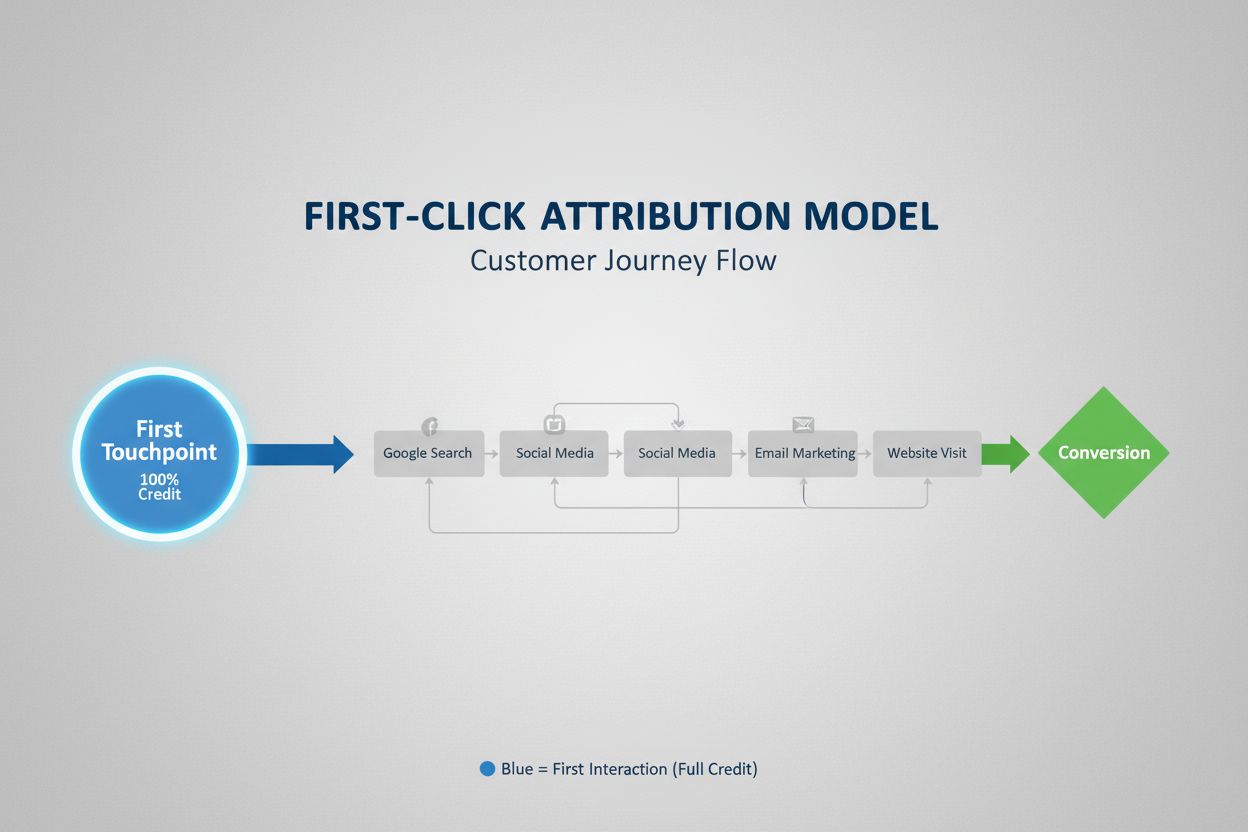
First-Click Attribution
First-click attribution assigns 100% conversion credit to the first customer touchpoint. Learn how this model works, when to use it, and its impact on marketing...
8 min read

Last-click attribution is a single-touch marketing attribution model that assigns 100% of the conversion credit to the final touchpoint a customer interacts with before making a purchase or completing a desired action. This model assumes the last interaction is the most influential factor in driving the conversion, disregarding all preceding touchpoints in the customer journey.
Last-click attribution is a single-touch marketing attribution model that assigns 100% of the conversion credit to the final touchpoint a customer interacts with before making a purchase or completing a desired action. This model assumes the last interaction is the most influential factor in driving the conversion, disregarding all preceding touchpoints in the customer journey.
Last-click attribution is a single-touch marketing attribution model that assigns 100% of the conversion credit to the final touchpoint a customer interacts with before making a purchase or completing a desired action. This model operates under the fundamental assumption that the customer’s last interaction with your brand—whether through a paid search ad, email, direct link, or any other channel—is the most influential factor that drove the conversion decision. The last-click model completely disregards all preceding touchpoints in the customer journey, treating them as irrelevant to the final outcome. For example, if a customer encounters your brand through a Facebook ad, reads your blog post via organic search, sees a retargeting display ad, and finally clicks a branded search ad to purchase, the last-click attribution model credits 100% of that conversion to the branded search ad alone, ignoring the three earlier interactions that built awareness and consideration.
The last-click attribution model emerged as the default measurement approach during the early days of digital marketing when tracking technology was limited and customer journeys were relatively straightforward. In the 2000s and early 2010s, when most conversions happened through a single channel or a few touchpoints, last-click attribution seemed reasonable and was easy to implement using basic web analytics tools. However, as digital marketing evolved and customers began interacting with brands across multiple channels—social media, email, search, display, video, and more—the limitations of single-touch attribution became increasingly apparent. According to research from Corvidae AI, 41% of marketers still use last-touch attribution for online channels, despite widespread recognition of its flaws. The EMARKETER survey from 2024 revealed that while 78.4% of marketers rely on last-click attribution, only 21.5% are confident it accurately reflects a platform’s long-term business impact. This disconnect between usage and confidence demonstrates that last-click attribution persists primarily due to convenience and legacy systems rather than proven effectiveness.
The last-click attribution model operates through a straightforward technical process: when a customer completes a conversion (purchase, signup, download, etc.), the system identifies the final touchpoint they clicked before converting and assigns 100% of the conversion value to that single interaction. The model tracks the last interaction through cookies, UTM parameters, and conversion pixels that record which ad, email, or link the customer clicked immediately before the conversion event. All other touchpoints in the customer’s journey are recorded but receive zero credit in the attribution calculation. For instance, if a customer’s journey includes: (1) clicking a Facebook ad on Day 1, (2) performing an organic Google search on Day 3, (3) viewing a retargeting display ad on Day 5, and (4) clicking a branded search ad on Day 6 to complete a purchase, the last-click attribution system records all four interactions but assigns 100% of the conversion credit to the branded search ad from Day 6. This binary approach—where one touchpoint receives all credit and others receive none—makes last-click attribution simple to calculate and report, which explains its continued prevalence despite its significant accuracy limitations.
| Attribution Model | Credit Distribution | Best Use Case | Key Advantage | Primary Limitation |
|---|---|---|---|---|
| Last-Click Attribution | 100% to final touchpoint | Bottom-of-funnel conversions | Simple to implement and understand | Ignores all preceding touchpoints; misses true drivers |
| First-Click Attribution | 100% to initial touchpoint | Top-of-funnel awareness | Highlights brand discovery channels | Overlooks nurturing and consideration stages |
| Linear Attribution | Equal credit to all touchpoints | Balanced view of journey | Acknowledges all interactions equally | Doesn’t reflect actual influence differences |
| Time Decay Attribution | More credit to recent touchpoints | Shorter sales cycles | Weights proximity to conversion | May overvalue final interactions |
| Position-Based (U-Shaped) | 40% first, 40% last, 20% middle | Balanced awareness and conversion focus | Emphasizes both discovery and closing | Arbitrary credit distribution |
| Data-Driven Attribution (DDA) | Machine learning-based allocation | Complex, multi-channel journeys | Uses actual data patterns; most accurate | Requires sufficient conversion volume |
| Multi-Touch Attribution (MTA) | Fractional credit across touchpoints | Comprehensive journey understanding | Provides holistic view of marketing impact | More complex to implement and interpret |
The last-click attribution model suffers from several critical limitations that make it increasingly inadequate for modern marketing measurement. First, it fragments the customer journey by reducing a complex, multi-step process into a single data point, completely ignoring the awareness, consideration, and nurturing stages that actually build customer intent. Research shows that 73% of customers use multiple channels during their shopping journey, yet last-click attribution credits only the final channel, creating a severely distorted view of marketing effectiveness. Second, the model undervalues top-of-funnel activities like content marketing, brand awareness campaigns, and social media engagement, which don’t typically generate the final click but are essential for building the pipeline. According to EMARKETER’s 2024 research, 63.5% of marketers don’t believe last-click aligns with how people actually shop, and 74.5% are either moving away from or want to move away from this model. Third, last-click attribution creates misleading ROI metrics by making bottom-of-funnel channels appear far more effective than they actually are, while making top-of-funnel channels appear ineffective. This leads to budget misallocation where marketers over-invest in closing channels while starving the awareness and consideration activities that generate demand in the first place.
The consequences of relying on last-click attribution extend far beyond measurement inaccuracy—they directly impact critical business metrics and strategic decisions. When marketers believe that paid search ads or email campaigns are responsible for conversions because they generated the final click, they often increase budgets for these channels while cutting budgets for content marketing, social media, and brand awareness initiatives. This creates a vicious cycle where the pool of ready-to-buy customers shrinks because fewer people are being introduced to the brand and nurtured through the consideration stage. Customer Acquisition Cost (CAC) increases because marketers must spend more on bottom-funnel ads to find fewer qualified prospects. Additionally, Customer Lifetime Value (CLV) suffers because the model ignores the brand-building activities that create loyal, repeat customers. According to research from Corvidae AI, 62% of marketers believe data to support cross-channel decision-making is broken, and 81% are concerned about AdTech reporting bias—concerns directly tied to the limitations of single-touch attribution models like last-click. Companies that rely exclusively on last-click attribution often make budget decisions that optimize for short-term conversions at the expense of long-term brand building and customer relationships.
The emergence of AI search platforms like ChatGPT, Perplexity, Google AI Overviews, and Claude has fundamentally broken the last-click attribution model. These platforms create what marketers call the “dark funnel”—a space where customers conduct extensive research, compare options, and make decisions without clicking through to websites. When a customer asks an AI chatbot “What are the best project management tools for remote teams?” and the AI synthesizes information from multiple sources to provide a comprehensive answer, the customer may have already decided which tool to purchase without ever clicking a link. Later, when that customer visits your website to complete the purchase, the last-click attribution system records the final click but completely misses the AI-driven research that actually influenced the decision. This creates zero-click searches where your content may have been the source for the AI’s answer, but you receive no traffic and no attribution credit. According to research from Goodie, AI search has fundamentally changed how customers discover products and services, making the focus on clicks increasingly irrelevant. The dark funnel means that the actual decision-making process is now invisible to traditional attribution tracking, rendering last-click attribution not just inaccurate but actively misleading.
Multi-touch attribution (MTA) represents the evolution beyond last-click by distributing conversion credit across multiple touchpoints based on their calculated contribution to the customer journey. Unlike last-click attribution, which assigns all credit to one interaction, multi-touch models acknowledge that conversions result from a series of interactions working together. There are several multi-touch attribution approaches: Linear attribution gives equal credit to every touchpoint, recognizing that all interactions contribute equally to the journey. Time decay attribution assigns more credit to touchpoints closer to the conversion, reflecting the assumption that recent interactions have more influence. Position-based (U-shaped) attribution allocates 40% credit to the first touchpoint, 40% to the last, and distributes the remaining 20% across middle interactions, balancing the importance of both discovery and closing. Most advanced is data-driven attribution (DDA), which uses machine learning to analyze hundreds of touchpoints and assign credit based on actual patterns in your conversion data. Google Analytics 4 (GA4) offers data-driven attribution as its default model, analyzing factors like device type, interaction order, time between touchpoints, and total number of interactions to determine each touchpoint’s contribution. According to Corvidae AI, 75% of businesses use multi-touch attribution models to gain a better view of the customer journey, recognizing that this approach provides significantly more accurate insights than single-touch models.
Different marketing channels interact with last-click attribution in distinct ways, creating varying levels of distortion depending on your marketing mix. Paid search campaigns typically benefit most from last-click attribution because search ads often appear near the end of the customer journey, making them more likely to be the final click. This creates an illusion of paid search effectiveness while obscuring the role of earlier touchpoints that built awareness and consideration. Social media marketing suffers most under last-click attribution because social platforms typically serve awareness and consideration functions rather than direct conversion functions. A customer might click a Facebook ad, engage with your content, and later convert through a different channel, but last-click attribution gives zero credit to the social media interaction that initiated the journey. Email marketing receives mixed treatment—promotional emails that drive immediate clicks may appear highly effective under last-click attribution, but nurture emails that build relationships and move customers through the funnel receive no credit. Content marketing and organic search are severely undervalued by last-click attribution because they typically serve awareness and consideration functions, with conversions happening through other channels. Display advertising and retargeting are similarly undervalued despite playing crucial roles in keeping your brand top-of-mind and moving customers closer to conversion. This channel-specific distortion means that last-click attribution systematically misrepresents the true contribution of different marketing channels, leading to budget decisions that favor closing channels while starving awareness and consideration channels.
The prevalence and limitations of last-click attribution are well-documented through recent industry research. EMARKETER’s 2024 survey of 282 senior-level US marketers found that 78.4% use last-click attribution and web analytics to measure media efficacy, yet only 21.5% are confident it accurately reflects a platform’s long-term business impact. This 57-percentage-point gap between usage and confidence reveals the widespread recognition of the model’s limitations. Additionally, 74.5% of marketers are either moving away from or want to move away from last-click attribution, and 63.5% don’t believe it aligns with how people actually shop. The survey also found that 77% of marketers acknowledge last-click is the easiest but not the best way to track campaigns, confirming that convenience rather than accuracy drives its continued use. According to Corvidae AI’s attribution statistics, 41% of marketers use last-touch attribution for online channels, while 75% use multi-touch attribution models, indicating a clear industry shift toward more sophisticated approaches. Bazaarvoice research shows that 63% of marketers believe the ideal attribution state means tracking customers throughout the full marketing and sales funnel, something last-click attribution cannot accomplish. These statistics collectively demonstrate that while last-click attribution remains prevalent due to legacy systems and simplicity, the marketing industry is actively transitioning toward more accurate, multi-touch approaches.
Implementing last-click attribution may seem simple, but it creates significant data quality and implementation challenges that undermine its reliability. The model depends entirely on accurate click tracking through cookies, UTM parameters, and conversion pixels, yet 42% of marketers report attribution manually using spreadsheets, according to Corvidae AI, indicating widespread data quality issues. Cross-device tracking presents another major challenge—a customer might click an ad on their mobile phone but complete the purchase on their desktop computer, yet last-click attribution may fail to connect these interactions if tracking isn’t properly configured. Attribution windows (the time period between a click and conversion) create arbitrary cutoffs that can exclude relevant touchpoints; a customer might click an ad 90 days before converting, but if your attribution window is 30 days, that click receives no credit. Privacy regulations like GDPR and the deprecation of third-party cookies have made reliable click tracking increasingly difficult, with 83% of marketers still reliant on cookies according to Corvidae AI, despite their declining reliability. Direct traffic presents a particular problem for last-click attribution because it’s often impossible to determine whether a customer arrived directly through a bookmark, typed URL, or other means, yet direct traffic frequently receives last-click credit for conversions that were actually influenced by earlier touchpoints. These implementation challenges mean that even the simple last-click model often produces unreliable data in practice.
The future of last-click attribution is clearly one of continued decline as marketing technology and customer behavior evolve. The rise of AI search platforms and zero-click searches has fundamentally undermined the model’s core assumption that clicks are reliable indicators of marketing influence. Generative AI tools like ChatGPT and Perplexity are creating invisible customer journeys where decisions are made in “dark funnels” that traditional attribution tracking cannot measure. According to Goodie’s research, AI search has broken the traditional attribution loop, making it essential for marketers to shift from click-based metrics to brand visibility and citation metrics that measure influence in AI systems. The cookieless future will make click-based tracking even less reliable, forcing marketers to adopt privacy-first attribution approaches like Media Mix Modeling (MMM) and data-driven attribution that don’t depend on individual-level click data. Industry leaders are already moving in this direction—80% of marketers believe attribution will become more important following the removal of third-party cookies, according to Corvidae AI, but they recognize this importance will be driven by more sophisticated, multi-touch approaches rather than last-click models. The next generation of marketing measurement will likely combine multi-touch attribution for trackable interactions with brand monitoring and AI visibility tracking for the invisible portions of the customer journey. Organizations that continue relying on last-click attribution will increasingly find themselves making budget decisions based on incomplete and misleading data, while competitors who adopt modern attribution approaches will gain significant competitive advantages in understanding true marketing ROI and optimizing budget allocation across the full customer journey.
Last-click attribution assigns all conversion credit to the final touchpoint before purchase, while first-click attribution credits the initial interaction that introduced the customer to your brand. Both are single-touch models that provide incomplete pictures of the customer journey. Last-click focuses on bottom-of-funnel conversions, whereas first-click emphasizes top-of-funnel awareness. Neither model accounts for the middle-of-funnel interactions that nurture and guide customers toward conversion.
According to EMARKETER's 2024 survey, 78.4% of marketers use last-click attribution primarily because it's the easiest and most readily available method, not because it's accurate. The model is simple to implement and understand, making it the default choice for many organizations. However, 74.5% of these same marketers are either moving away from or want to move away from last-click attribution, recognizing its significant limitations in measuring true marketing impact.
Last-click attribution often leads to misallocated budgets by overvaluing bottom-of-funnel channels like paid search and email while undervaluing top-of-funnel activities like content marketing and brand awareness campaigns. This creates a false sense of ROI for closing channels while starving the awareness and consideration stages that actually build the pipeline. Marketers may cut budgets for activities that generate demand, forcing them to spend more on bottom-funnel ads to find a shrinking pool of ready-to-buy customers, ultimately increasing Customer Acquisition Cost (CAC).
AI search platforms like ChatGPT, Perplexity, and Google AI Overviews have made last-click attribution even more problematic because they create 'zero-click searches' and 'dark funnels' where customers research and make decisions without clicking through to websites. When customers finally arrive at your site to convert, the last click becomes a formality rather than the actual decision driver. This invisible customer journey means last-click attribution completely misses the influence of AI-driven research and brand citations that actually drive conversions.
Marketers can adopt multi-touch attribution (MTA) models like linear, time decay, or position-based attribution to distribute credit across multiple touchpoints. More advanced approaches include data-driven attribution (DDA) using machine learning, which GA4 offers by default, or Media Mix Modeling (MMM) for a top-down view of marketing impact. These methods provide a more accurate understanding of how different channels work together throughout the customer journey, enabling better budget decisions and ROI measurement.
Only 21.5% of marketers surveyed by EMARKETER in 2024 are confident that last-click attribution is a reasonably accurate reflection of a platform's long-term business impact. Additionally, 63.5% of marketers don't believe last-click aligns with how people actually shop, and 77% acknowledge it's the easiest but not the best way to track campaigns. This widespread skepticism demonstrates that while last-click remains prevalent, trust in its accuracy is rapidly eroding.
Last-click attribution provides an inaccurate view of CLV by ignoring the brand-building stages that create loyal, long-term customers. The model focuses only on immediate conversions from the final touchpoint, missing the relationship-building activities that increase customer retention and repeat purchases. This causes marketers to underinvest in strategies that create customer loyalty, potentially leading to lower CLV and reduced long-term business value compared to brands that nurture relationships across the entire customer journey.
Start tracking how AI chatbots mention your brand across ChatGPT, Perplexity, and other platforms. Get actionable insights to improve your AI presence.
First-click attribution assigns 100% conversion credit to the first customer touchpoint. Learn how this model works, when to use it, and its impact on marketing...
Learn how to measure brand impact in zero-click search. Discover metrics beyond clicks, track AI visibility, and prove ROI when users don't click through.
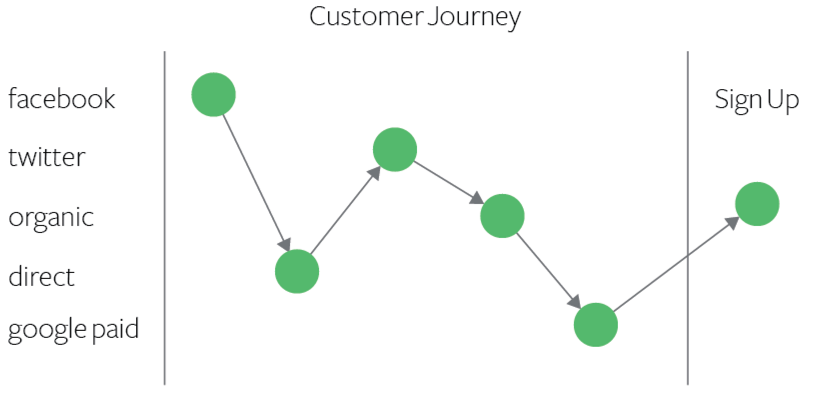
Multi-touch attribution assigns credit to all customer touchpoints in the conversion journey. Learn how this data-driven approach optimizes marketing budgets an...