
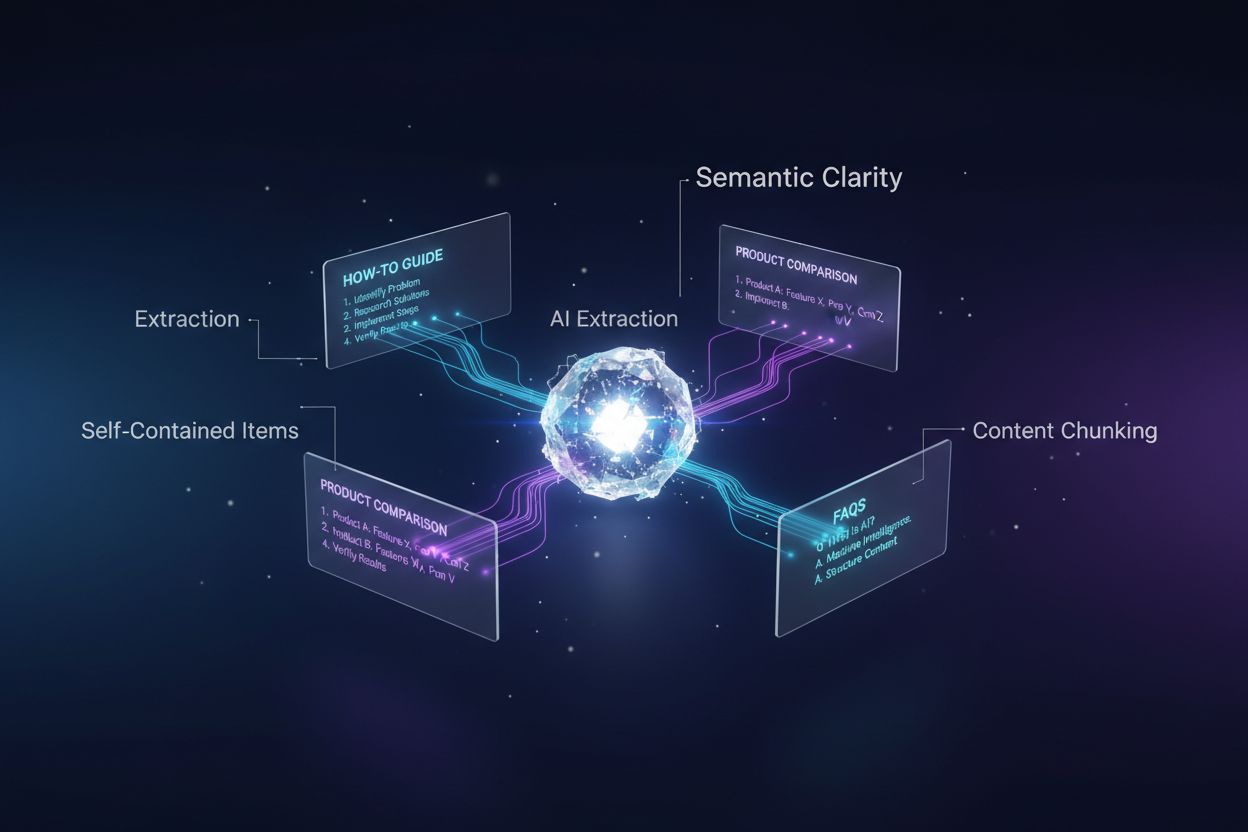
Listicle Optimization
Learn what listicle optimization is and how to structure numbered and bulleted lists for AI extraction. Discover best practices for improving AI search visibili...
7 min read
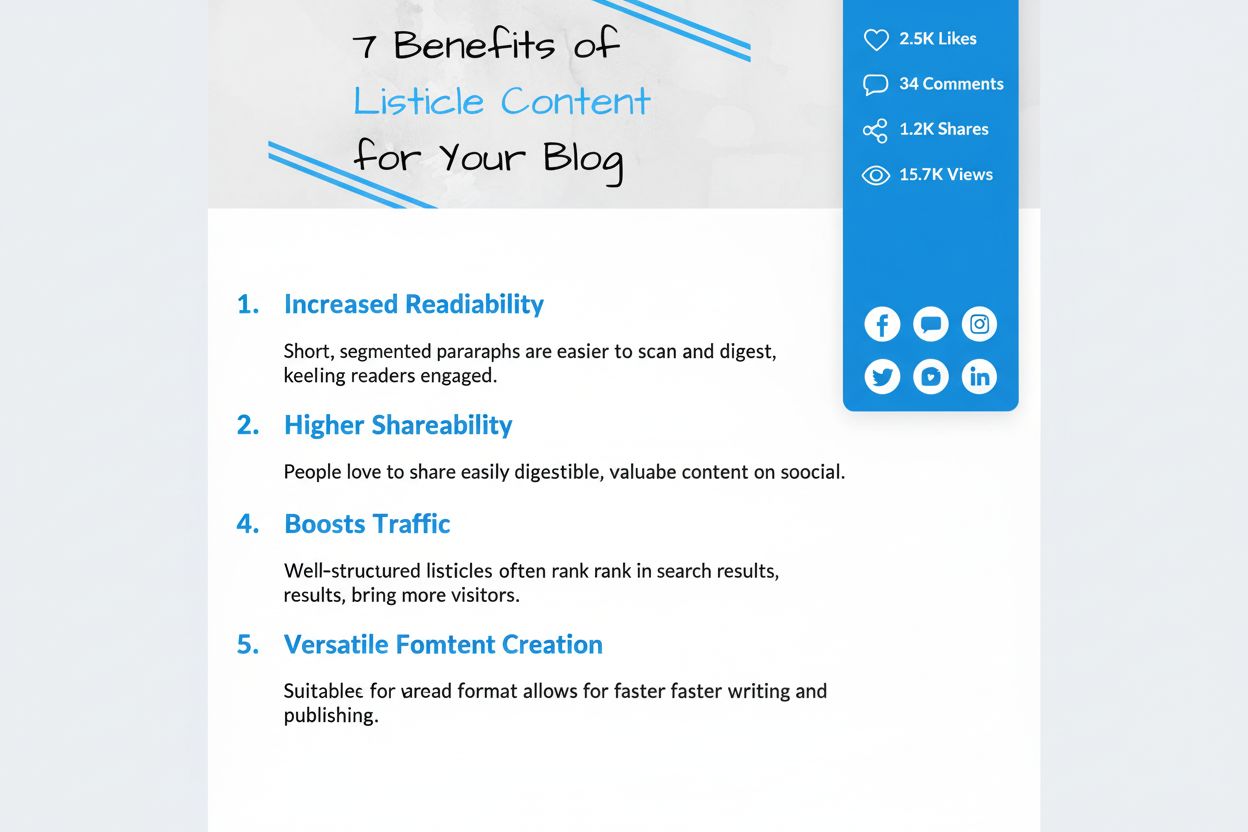
A listicle is an article structured as a numbered or bulleted list that breaks down information into scannable, digestible chunks. This content format combines the organizational clarity of lists with detailed explanatory text, making it highly effective for both reader engagement and AI citation across platforms like ChatGPT, Perplexity, and Google AI Overviews.
A listicle is an article structured as a numbered or bulleted list that breaks down information into scannable, digestible chunks. This content format combines the organizational clarity of lists with detailed explanatory text, making it highly effective for both reader engagement and AI citation across platforms like ChatGPT, Perplexity, and Google AI Overviews.
A listicle is an article structured as a numbered or bulleted list that presents information in discrete, scannable items rather than continuous narrative prose. The term combines “list” and “article,” describing a content format where each numbered point contains a title, explanation, and supporting details. Listicles have become the dominant content format in digital publishing, accounting for approximately 50% of all top AI citations across major platforms including ChatGPT, Perplexity, Google AI Overviews, and Claude. The format’s effectiveness stems from its alignment with how both human readers and artificial intelligence systems process information—through clear structural boundaries, extractable data points, and organized hierarchies. Unlike traditional blog posts that rely on narrative flow, listicles prioritize scannability and immediate information access, making them particularly valuable in an era where attention spans are limited and AI systems require structured data for confident citation.
The listicle format emerged as a response to fundamental changes in how people consume content online. In the early 2000s, publications like BuzzFeed recognized that 43% of people skim blog posts rather than reading them thoroughly, prompting a shift toward list-based structures. The format gained mainstream legitimacy when prestigious outlets including The New York Times, The Washington Post, and CNN began publishing listicles alongside traditional journalism. This evolution reflects broader digital trends: declining attention spans, mobile-first reading patterns, and the rise of social media sharing. Research from HubSpot demonstrates that listicles generate significantly higher engagement rates than traditional articles, with odd-numbered lists (5, 7, 9, 11) consistently outperforming even-numbered alternatives. The format’s adoption accelerated further with the emergence of AI search platforms, which discovered that listicles provide optimal data structures for extraction and citation. Today, listicles represent not merely a content trend but a fundamental shift in how information is organized and distributed across digital ecosystems.
Listicles follow a consistent structural pattern that maximizes both readability and machine extractability. The standard format includes: a compelling headline incorporating the list number, an introductory paragraph establishing context, numbered items with clear subheadings, supporting text or bullet points under each item, and a conclusion summarizing key takeaways. Each list item should be independently valuable—readers should understand the concept even if they skip other items. The most effective listicles implement answer-first formatting, placing the core insight in the first 40-60 words of each section before providing supporting details. This structure directly mirrors how AI systems extract information, reducing interpretation requirements and increasing citation likelihood. Research shows that listicles with FAQPage schema markup and ItemList structured data achieve 3-5x higher citation rates in AI responses. The formatting should include visual breaks through subheadings, bullet points, and white space to accommodate mobile readers and scanning behavior. Listicles typically range from 1,500 to 3,000 words, with longer content (2,000+ words) receiving 3x more AI citations than shorter posts. The numbered structure creates psychological expectations—readers know exactly how much content to expect, reducing bounce rates and improving completion metrics.
The dominance of listicles in AI citation is not accidental but reflects measurable platform preferences. According to analysis of 282 million AI citations across eight platforms and eighteen industries, listicles consistently account for 14-45% of all citations, with an average of 30% across major platforms. ChatGPT cites listicles at approximately 21% of all citations, while Gemini shows a stronger preference at 30%, and Perplexity maintains similar patterns at 28%. This consistency across platforms indicates that listicle preference is a fundamental characteristic of how AI systems process and cite information, not an industry-specific anomaly. The format’s citation advantage persists across diverse verticals—from technology and healthcare to finance and consumer goods—with only modest 2-3x variation between industries. Content with tables and structured data receives 2.5x higher citation rates than unstructured content, and when listicles incorporate comparison tables, citation likelihood increases dramatically. The format’s effectiveness extends beyond citation frequency to citation quality; AI systems cite listicles with higher confidence and specificity, often pulling exact list items as standalone citations. This pattern holds true across different query types and user intents, making listicles universally applicable rather than niche-specific.
| Content Format | AI Citation Rate | Engagement Rate | Social Shareability | SEO Performance | Best Use Case |
|---|---|---|---|---|---|
| Listicle | 50% of top citations | 6.2% conversion | Very High | Excellent | Tips, strategies, rankings, tools |
| Long-form Guide | 15-20% of citations | 3-4% conversion | Moderate | Good | Comprehensive topic coverage |
| How-to Article | 8-12% of citations | 4-5% conversion | Moderate | Good | Step-by-step processes |
| Case Study | 0.3-1.4% of citations | 2-3% conversion | Low | Fair | Specific examples, proof |
| Product Page | 4-6% of citations | 5-7% conversion | Low | Good | E-commerce, SaaS products |
| Category Hub | 9-11% of citations | 3-4% conversion | Moderate | Excellent | Topic authority, clustering |
| Narrative Blog Post | 5-8% of citations | 2-3% conversion | Low | Fair | Opinion, analysis, storytelling |
The 50% citation rate for listicles reflects how AI systems extract and validate information. Large language models process content through tokenization and pattern matching, and numbered lists create explicit extraction boundaries that reduce ambiguity. When an AI system encounters a listicle, it can confidently identify discrete information units, extract them with minimal interpretation, and cite them with high confidence. This contrasts sharply with narrative content, where AI must infer where one concept ends and another begins. Research from Onely demonstrates that listicles are the #1 cited format, accounting for half of all top AI citations, while tables increase citation rates by 2.5x. The format’s effectiveness for AI citation stems from its alignment with how machine learning models understand structured data. Additionally, listicles naturally incorporate quantitative claims—statistics, percentages, rankings—which receive 40% higher citation rates than qualitative statements. The format’s scannability also benefits human readers, creating a virtuous cycle where listicles generate more engagement, more shares, and more external citations, all of which signal authority to AI systems. This combination of machine-readable structure and human engagement creates a format that performs exceptionally across all discovery surfaces.
Creating listicles that earn AI citations requires attention to both structure and content quality. First, choose topics that naturally decompose into discrete items—avoid forcing conceptual topics into list format. Topics like “10 SEO Tips” work excellently, while “What is Content Marketing” requires narrative explanation. Second, implement answer-first formatting by placing the core insight in the opening 40-60 words of each section, enabling AI systems to extract information without parsing supporting details. Third, add original data and statistics to each list item; AI systems cannot synthesize new knowledge, so unique data points increase citation likelihood. Fourth, incorporate schema markup, specifically FAQPage and ItemList structured data, which increases AI citation rates by 3-5x. Fifth, maintain content freshness—76.4% of ChatGPT’s most-cited pages were updated within 30 days, indicating that recency signals significantly impact AI visibility. Sixth, create comprehensive listicles (2,000+ words) rather than thin content; longer listicles receive 3x more citations than short posts. Seventh, build clear E-E-A-T signals through author credentials, expertise markers, and external validation, as 100% of ranking AI content demonstrates visible expertise credentials. Eighth, use comparison tables within listicles to provide structured data that AI systems can extract directly. These practices work universally across industries, with only modest variation in effectiveness between verticals.
The engagement advantages of listicles extend far beyond AI citation to encompass human reader behavior and social media performance. Listicles generate 6.2% conversion rates on landing pages, compared to 2-3% for traditional content formats, according to 2024 case studies from home goods brands running 15 listicle-style landing pages that attracted 180,000 unique visitors. The format’s scannability directly addresses the challenge that 43% of people skim content rather than reading thoroughly; listicles accommodate this behavior by presenting information in bite-sized, independently valuable chunks. Social shareability represents a major advantage, as listicles are frequently shared in fragments—readers share individual list items rather than entire articles, exponentially expanding reach. The numbered structure creates psychological appeal; readers understand exactly what they’re getting before clicking, reducing bounce rates and improving completion metrics. Odd-numbered listicles (5, 7, 9, 11) consistently outperform even-numbered alternatives in both engagement and shares, possibly due to cognitive processing differences or cultural associations with lucky numbers. Listicles also spark conversation and debate in comments sections more effectively than other formats, as readers often disagree with rankings or suggest alternatives. This engagement translates directly to business outcomes: visitors from AI search citing listicles are 4.4x more valuable than organic visitors, with higher conversion rates and longer customer lifetime value. The format’s effectiveness for engagement creates a compounding advantage—more engagement signals authority to search algorithms, which increases visibility, which drives more engagement.
As AI search platforms become primary discovery mechanisms, Generative Engine Optimization (GEO) has emerged as a critical complement to traditional SEO. Listicles are uniquely positioned to excel in GEO because their structure aligns perfectly with how AI systems extract and cite information. To optimize listicles for AI citation, implement these GEO-specific tactics: structure content with clear numbered items that can be extracted independently, include original research or proprietary data that AI systems cannot find elsewhere, add quantitative claims (statistics, percentages, rankings) which receive 40% higher citation rates, implement comprehensive schema markup including FAQPage and ItemList types, update content within 30 days to maintain freshness signals, and build third-party mentions through expert quotes and external citations. Research shows that AI Overviews are 6.5x more likely to cite content through third-party sources than through a brand’s own domain, making external validation critical. Listicles should target specific, answerable questions rather than broad topics, as AI systems cite content that directly addresses user queries. The format’s natural alignment with question-answer patterns makes listicles ideal for FAQ optimization, which maps directly to how AI systems structure responses. Long-form listicles (2,000+ words) that provide comprehensive coverage of topics receive 3x more citations than shorter alternatives, indicating that depth and comprehensiveness matter significantly in AI visibility. This GEO optimization approach complements traditional SEO without requiring separate content strategies—listicles that rank well in Google also tend to earn AI citations.
The listicle format is evolving in response to AI platform maturation and changing user expectations. Interactive listicles incorporating filters, sorting options, and dynamic content are emerging as next-generation formats, allowing readers to customize list views based on preferences. This evolution addresses a key limitation of static listicles—one-size-fits-all organization may not serve all reader needs. Multimedia listicles integrating video, interactive tools, and rich media are gaining traction, particularly in technology and consumer goods verticals where visual demonstration adds value. The format’s dominance in AI citation is likely to persist and strengthen as AI systems become more sophisticated at extracting structured data; the clear boundaries and explicit relationships in listicles will remain advantageous compared to narrative formats. Personalization and AI-driven customization may enable listicles to adapt content based on reader behavior, showing different items or emphasis levels to different audiences. The integration of listicles with knowledge graphs and entity relationships will deepen, allowing AI systems to understand not just individual list items but their connections and hierarchies. Voice search optimization will increasingly favor listicles, as the format’s discrete items map naturally to voice assistant responses. The strategic implication is clear: listicles are not a temporary trend but a fundamental shift in content organization that will persist and evolve. Organizations that master listicle creation and optimization will maintain competitive advantages in both traditional search and emerging AI discovery platforms. The format’s alignment with how both humans and machines process information suggests it will remain dominant for the foreseeable future, making listicle expertise a core competency for content marketers, publishers, and brands seeking visibility across all discovery surfaces.
Listicles account for 50% of top AI citations because they provide clear extraction boundaries through numbered lists and structured data. AI systems like ChatGPT, Perplexity, and Google AI Overviews can easily parse numbered items and pull specific information without interpretation. The format reduces AI uncertainty and increases citation confidence, making listicles 2.5x more likely to be cited when paired with tables and structured data.
A listicle uses numbered or bulleted lists as its primary organizational structure, while traditional blog posts use narrative paragraphs. Listicles break content into discrete, scannable items with clear subheadings, whereas traditional posts flow continuously. Research shows 43% of people skim blog posts, making listicles superior for reader retention. Additionally, listicles perform 3x better in AI citations compared to traditional narrative formats.
Yes, research consistently shows odd-numbered listicles (5, 7, 9, 11) outperform even-numbered lists in both engagement and social shares. This phenomenon may relate to how our brains process prime numbers differently, or cultural associations with lucky numbers. The effect is measurable across platforms, with odd-numbered lists generating higher click-through rates and more social media engagement than their even-numbered counterparts.
Effective listicles for AI citation should include: answer-first formatting (40-60 words per item), clear numbered structure, supporting details in bullets, original data or statistics, and FAQPage schema markup. Each list item should be independently extractable, with the most important information appearing first. Long-form listicles (2,000+ words) get cited 3x more than short posts, and content updated within 30 days shows 76.4% higher citation rates in AI systems.
Listicles work best for tips, strategies, tools, rankings, processes, comparisons, and how-to content. Topics that naturally break into discrete items—like '10 SEO Tips' or '7 Content Marketing Strategies'—are ideal. Listicles perform poorly for conceptual topics requiring narrative explanation, like 'What is Content Marketing.' The format excels when each list item can stand alone as useful information while contributing to a larger theme.
Listicles generate 6.2% conversion rates on landing pages (compared to standard pages), and visitors from AI search citing listicles are 4.4x more valuable than organic visitors. The format's clarity and scannable structure reduce friction in the decision-making process. Brands using listicles strategically see higher engagement rates, more social shares, and improved time-on-page metrics, directly impacting customer acquisition and retention.
Yes, listicles are uniquely positioned to excel in both SEO and AI citation. For SEO, include target keywords in list titles and subheadings, maintain 2,000+ word count, and build internal links. For AI citation, add schema markup (FAQPage, ItemList), include original data and statistics, update content within 30 days, and structure items for direct extraction. The format's inherent clarity serves both algorithmic systems and human readers effectively.
Start tracking how AI chatbots mention your brand across ChatGPT, Perplexity, and other platforms. Get actionable insights to improve your AI presence.
Learn what listicle optimization is and how to structure numbered and bulleted lists for AI extraction. Discover best practices for improving AI search visibili...

Discover whether AI search engines like ChatGPT and Perplexity prefer listicles. Learn how to optimize list-based content for AI citations and visibility.
Community discussion on whether AI search engines prefer listicles. Real experiences from content creators testing different formats for ChatGPT, Perplexity, an...