
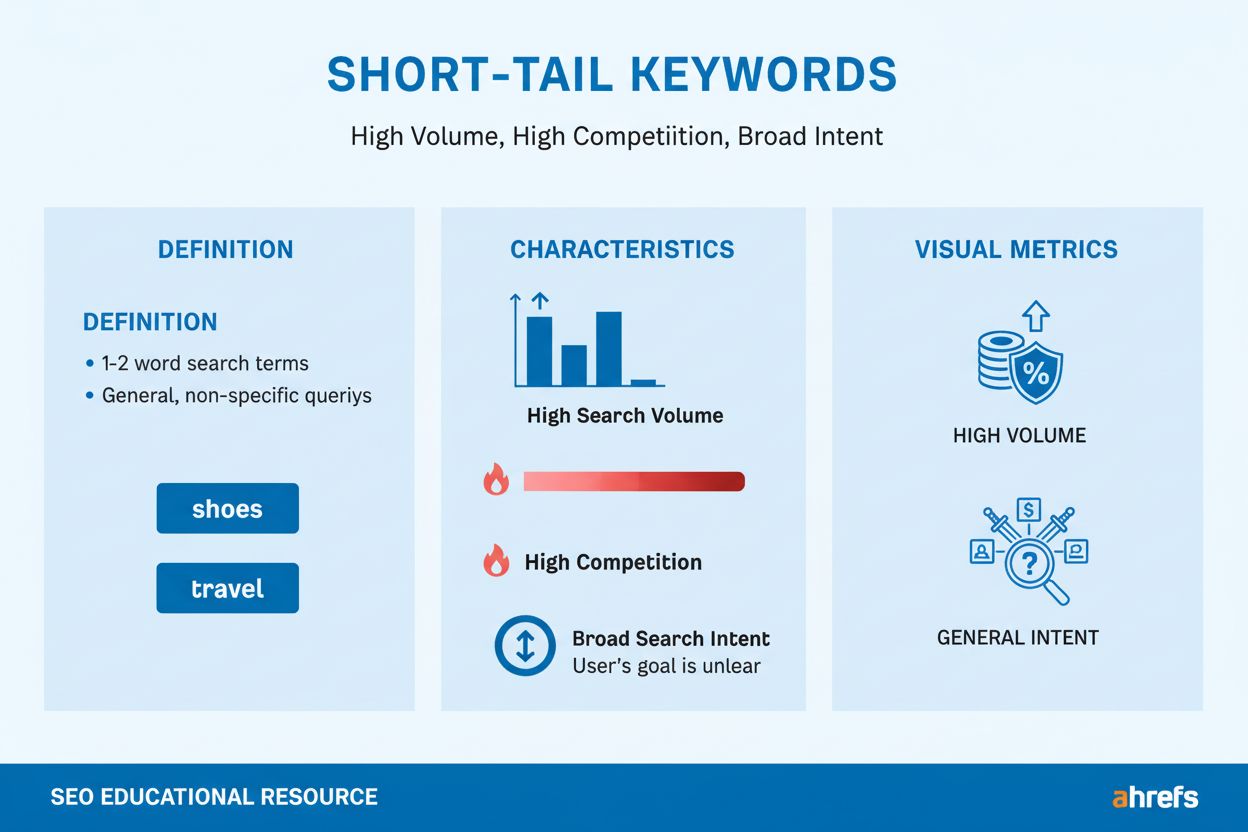
Short-Tail Keywords
Short-tail keywords are broad 1-3 word search terms with high volume and competition. Learn their definition, importance, and how to use them in your SEO strate...
9 min read

Long-tail keywords are specific, multi-word search phrases typically containing three or more words that target niche audiences with lower search volume and competition. These highly precise queries represent approximately 70-92% of all searches and deliver significantly higher conversion rates than broad, short-tail keywords.
Long-tail keywords are specific, multi-word search phrases typically containing three or more words that target niche audiences with lower search volume and competition. These highly precise queries represent approximately 70-92% of all searches and deliver significantly higher conversion rates than broad, short-tail keywords.
Long-tail keywords are specific, multi-word search phrases typically consisting of three or more words that target niche audiences with lower search volume and reduced competition. Unlike broad “head” keywords such as “shoes” or “coffee,” long-tail keywords are highly precise queries like “best waterproof hiking boots for women” or “organic fair-trade coffee beans from Ethiopia.” These specific multi-word search phrases represent the vast majority of all internet searches, accounting for approximately 70-92% of all search queries according to industry research. The term “long-tail” derives from a visual metaphor describing the shape of a keyword distribution graph, where a small number of popular head terms occupy the peak, while thousands of specific, lower-volume keywords extend across the long tail. Long-tail keywords are fundamental to modern search engine optimization (SEO) and generative engine optimization (GEO) strategies because they align precisely with user intent and deliver disproportionately high conversion rates compared to their search volume.
The concept of long-tail keywords emerged from Chris Anderson’s 2004 “Long Tail” theory, which described how the aggregate of niche markets could rival or exceed the popularity of mainstream products. In the context of digital marketing and SEO, this principle revolutionized keyword strategy by demonstrating that targeting thousands of low-volume, specific queries could generate more qualified traffic and revenue than pursuing a handful of highly competitive head terms. Early SEO practitioners discovered that while a keyword like “link building” generates over 6 billion Google search results and intense competition, a long-tail variation like “best SEO link building software” faces significantly less competition and attracts searchers with clearer purchase intent. This shift in understanding fundamentally changed how businesses approach keyword research and content strategy. Over the past two decades, the importance of long-tail keywords has only increased, particularly with the rise of voice search, conversational AI, and natural language processing. Modern research confirms that approximately 92% of all keywords receive 10 or fewer monthly searches, making them long-tail by definition. The evolution of search behavior toward more conversational, specific queries—driven by voice assistants and AI chatbots—has made long-tail keyword targeting more critical than ever for achieving visibility in both traditional search engines and emerging AI search platforms.
| Characteristic | Short-Tail Keywords | Mid-Tail Keywords | Long-Tail Keywords |
|---|---|---|---|
| Word Count | 1-2 words | 2-3 words | 3+ words |
| Search Volume | Very High (10K-1M+ monthly) | Medium (1K-10K monthly) | Low (10-1K monthly) |
| Competition Level | Extremely High | Medium-High | Low-Medium |
| Keyword Difficulty | 60-100% | 30-60% | 0-30% |
| Search Intent | Broad, informational | Mixed intent | Specific, transactional |
| Conversion Rate | 2-5% | 5-15% | 15-36%+ |
| Cost Per Click (PPC) | $2-$50+ | $0.50-$5 | $0.10-$1 |
| Example | “shoes” | “running shoes” | “best lightweight running shoes for flat feet” |
| Ranking Difficulty | Extremely difficult | Moderate | Relatively easy |
| Traffic Volume | High but scattered | Medium and focused | Lower but highly qualified |
| AI Search Relevance | Lower match probability | Moderate match | Higher match in AI responses |
The strategic value of long-tail keywords extends far beyond simple search volume metrics. Research from Conductor.com demonstrates that long-tail keywords deliver 2.5 times higher conversion rates than short-tail keywords, fundamentally changing the ROI calculation for content marketing and paid search campaigns. When a user searches for a specific long-tail phrase, they have typically progressed significantly through the buying journey and possess clear intent regarding what they want to purchase or learn. For example, someone searching for “keto diet” is likely in the information-gathering phase, while someone searching for “best keto diet supplements for weight loss” is demonstrating commercial intent and readiness to make a purchase. This distinction is crucial for businesses seeking to maximize return on investment. Additionally, long-tail keywords face substantially lower competition because their specificity makes them relevant to fewer websites and because they attract less marketing investment from competitors. A business competing for the term “furniture” faces competition from millions of established retailers, but targeting “contemporary art-deco semi-circle lounge” creates an opportunity to dominate a niche market segment. The cumulative effect of targeting hundreds or thousands of long-tail keywords can generate traffic volumes comparable to head terms while maintaining significantly higher conversion rates and lower customer acquisition costs.
The emergence of generative engine optimization (GEO) and AI search platforms has elevated the importance of long-tail keywords to unprecedented levels. Platforms like ChatGPT, Perplexity, Google AI Overviews, and Claude process user queries differently than traditional search engines, favoring conversational, specific language that aligns naturally with long-tail keyword phrases. AI systems employ query fan-out technology, which expands a user’s initial query into multiple related sub-queries to gather comprehensive information for generating responses. When you optimize content around long-tail keywords and natural language variations, you increase the probability that your content will match one of these expanded sub-queries and appear in the AI-generated response. Research indicates that AI search is inherently conversational, meaning users tend to input highly specific, multi-word queries that mirror long-tail keyword patterns. For instance, a user might ask ChatGPT “What are the best lightweight wireless headphones for working out under $100?” rather than simply searching “headphones.” This conversational query structure aligns perfectly with long-tail keyword optimization strategies. Brands that have successfully optimized for long-tail keywords report increased visibility in AI responses, creating a competitive advantage as AI search becomes an increasingly important traffic source. The integration of long-tail keyword strategy with GEO principles ensures your content remains discoverable across both traditional search engines and emerging AI platforms, maximizing your overall digital visibility.
Discovering and implementing long-tail keywords requires a systematic approach combining multiple research methodologies. Keyword research tools like Semrush’s Keyword Magic Tool, Ahrefs, and Moz provide access to massive keyword databases and allow filtering by search volume, keyword difficulty, and word count to identify long-tail opportunities. Google’s native features offer valuable insights: Google Autocomplete suggestions reveal real search queries users are typing, while People Also Ask (PAA) boxes display question-based long-tail keywords that users frequently search. Google Search Console data reveals keywords your website already ranks for, often including long-tail terms ranking on pages 2-3 that can be optimized to reach page 1 with minimal additional effort. Online communities like Reddit and Quora provide authentic long-tail keyword ideas directly from users asking specific questions about your niche. Competitor analysis using tools like Semrush’s Organic Research reveals which long-tail keywords competitors rank for, identifying gaps in your own strategy. Additionally, AI chatbots like ChatGPT can generate long-tail keyword ideas based on your topic, though you should verify search volume and relevance using dedicated SEO tools. Once you’ve compiled a list of target long-tail keywords, you can implement them through two primary strategies: creating dedicated content pieces optimized around specific long-tail terms, or clustering related long-tail keywords together on a single comprehensive page. Clustering is often more efficient, as it allows you to target multiple related long-tail keywords with collective search volumes exceeding 1,500 monthly searches while providing comprehensive content addressing various user questions and search intents.
The financial advantages of long-tail keywords extend significantly into pay-per-click (PPC) advertising and Google Ads campaigns. Long-tail keywords attract substantially lower cost-per-click (CPC) rates because they face reduced advertiser competition compared to popular head terms. While a competitive short-tail keyword like “insurance” might cost $50-$100 per click, a long-tail variation like “affordable life insurance for self-employed individuals” might cost only $0.50-$2 per click. This dramatic cost reduction allows businesses to achieve higher ad rankings and better return on advertising spend without requiring massive budget increases. Research demonstrates that while long-tail PPC campaigns generate lower overall traffic volume, the traffic they do generate is significantly more qualified and conversion-focused, resulting in superior ROI metrics. The principle “use short keywords to generate volume and long-tail keywords to generate profit” has become an industry standard, reflecting the reality that long-tail keywords deliver fewer clicks but substantially higher-value conversions. For businesses operating with limited advertising budgets, long-tail keyword PPC strategies provide a cost-effective pathway to reach qualified prospects without competing directly against well-funded competitors bidding on expensive head terms. Additionally, long-tail keywords in PPC campaigns often achieve higher quality scores because the specificity of the keywords typically aligns more closely with ad copy and landing page content, further reducing costs and improving ad performance.
The future trajectory of long-tail keyword strategy is being shaped by several converging technological and behavioral trends. As voice search adoption continues to grow—with voice queries now representing a significant percentage of all searches—the importance of long-tail, conversational keyword phrases will only increase. Voice search queries tend to be longer and more natural than typed searches, inherently favoring long-tail keyword optimization. The rise of generative AI and large language models has fundamentally altered how search queries are processed and how content is discovered, making long-tail keyword strategy even more critical for visibility in AI-generated responses. Platforms like Google AI Overviews, ChatGPT, Perplexity, and Claude are increasingly becoming primary discovery mechanisms for information, and these systems favor content optimized around specific, conversational long-tail keywords. The integration of entity-based search and semantic understanding means that search engines and AI systems are becoming increasingly sophisticated at understanding user intent beyond simple keyword matching, but long-tail keywords remain the most reliable indicator of specific intent. Looking forward, successful SEO and GEO strategies will require sophisticated keyword clustering approaches that group related long-tail keywords together based on search intent, creating comprehensive content hubs that address multiple variations of user queries. The distinction between traditional SEO and GEO will continue to blur, with long-tail keyword optimization serving as a bridge between both disciplines. Businesses that develop robust long-tail keyword strategies now will establish competitive advantages as AI search becomes increasingly dominant. Additionally, the growing emphasis on E-E-A-T signals (Experience, Expertise, Authoritativeness, Trustworthiness) means that long-tail keyword content must not only target specific queries but also demonstrate genuine expertise and authority in the subject matter. The future of long-tail keywords is not about quantity of keywords targeted, but rather quality of content created around those keywords, with emphasis on providing comprehensive, authoritative answers to specific user questions and search intents.
Short-tail keywords are broad, one-to-two-word search terms with high search volume and intense competition, such as 'shoes' or 'coffee.' Long-tail keywords are specific, multi-word phrases with lower search volume and competition, like 'best waterproof hiking boots for women' or 'organic fair-trade coffee beans.' While short-tail keywords drive higher traffic volume, long-tail keywords attract more qualified, intent-driven searchers closer to purchase decisions, resulting in significantly higher conversion rates.
Long-tail keywords have higher conversion rates because they reflect specific user intent and indicate searchers are further along in the buying journey. When someone searches for 'best lightweight wireless headphones under $100,' they know exactly what they want and are ready to make a purchase decision. Research shows long-tail keywords deliver 2.5 times higher conversion rates than short-tail keywords, making them invaluable for driving qualified, revenue-generating traffic.
Long-tail keywords are critical for AI search optimization because AI systems like ChatGPT, Perplexity, and Google AI Overviews process conversational, specific queries. AI tools use query fan-out technology to expand user queries into related sub-queries, and long-tail keywords increase the likelihood your content matches these expanded queries. Targeting long-tail keywords and natural language phrases helps your content appear in AI-generated responses, improving visibility across emerging AI search platforms.
Research indicates that 70-92% of all searches are long-tail keywords, depending on the measurement methodology. One comprehensive study found that 92% of all keywords get 10 or fewer searches per month, making them long-tail by definition. This means the vast majority of search traffic comes from these specific, niche queries rather than from popular head terms, making long-tail keyword strategy essential for capturing market share.
You can find long-tail keywords using several methods: keyword research tools like Semrush's Keyword Magic Tool, Google's autocomplete suggestions, People Also Ask boxes, competitor analysis, Google Search Console data, and online communities like Reddit and Quora. Tools like AnswerThePublic and Ubersuggest also aggregate long-tail variations. Additionally, AI chatbots like ChatGPT can generate long-tail keyword ideas, though you should verify search volume and relevance using dedicated SEO tools.
Not necessarily. You can implement long-tail keywords through two strategies: creating dedicated content around specific long-tail terms, or clustering related long-tail keywords together on a single page based on search intent. Clustering is often more efficient, as it allows you to target multiple related long-tail keywords with collective search volumes exceeding 1,500 monthly searches while providing comprehensive content that addresses various user questions.
Long-tail keywords in pay-per-click campaigns cost significantly less than short-tail keywords because they face lower advertiser competition. With reduced bidding competition, cost-per-click (CPC) decreases substantially, allowing you to achieve higher ad rankings and better ROI on your advertising budget. While long-tail PPC campaigns may generate lower overall traffic volume, the qualified nature of the traffic and lower costs make them highly cost-effective for driving conversions.
Start tracking how AI chatbots mention your brand across ChatGPT, Perplexity, and other platforms. Get actionable insights to improve your AI presence.
Short-tail keywords are broad 1-3 word search terms with high volume and competition. Learn their definition, importance, and how to use them in your SEO strate...
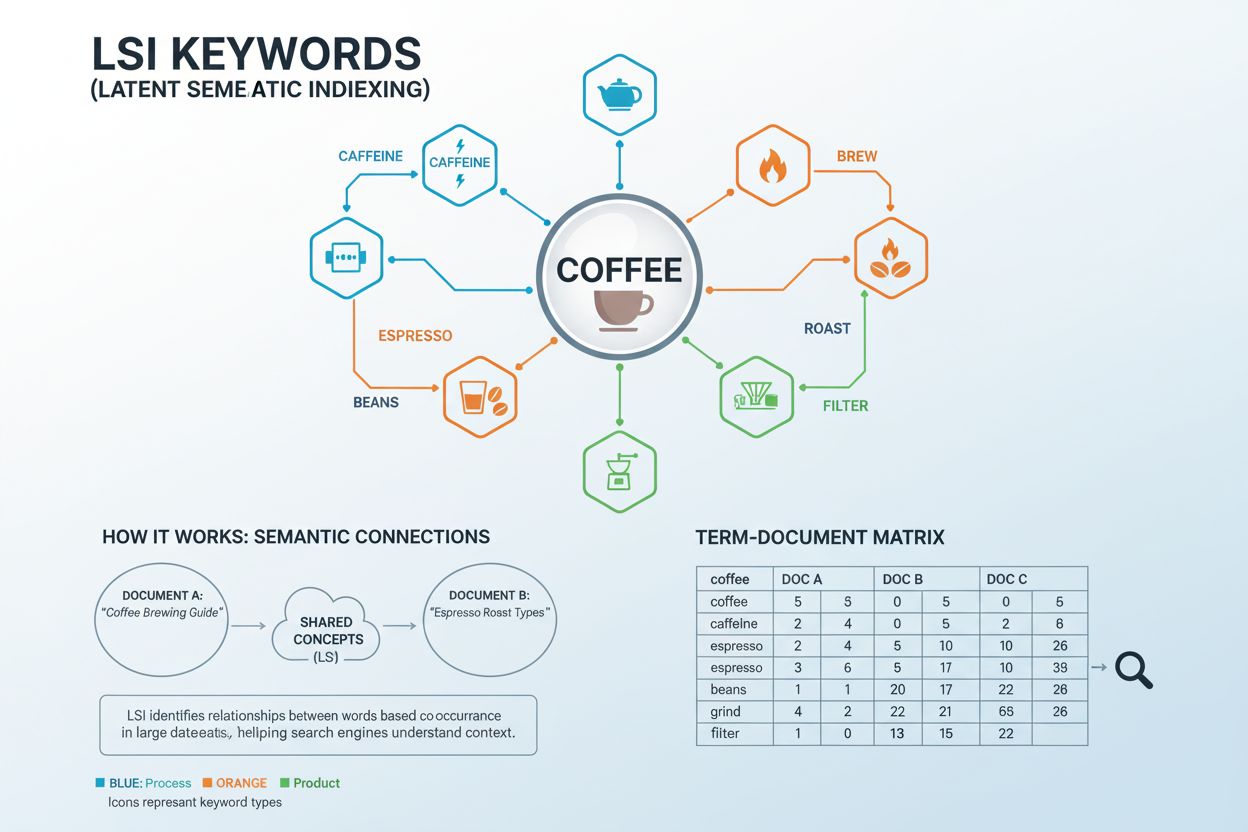
Learn what LSI Keywords are, how they differ from semantic keywords, and why they matter for AI search visibility and content optimization on AmICited.

Learn what keyword stuffing is and how AI systems like ChatGPT and Perplexity detect it. Understand AI detection methods and why keyword stuffing fails in moder...