Definition of LSI Keywords
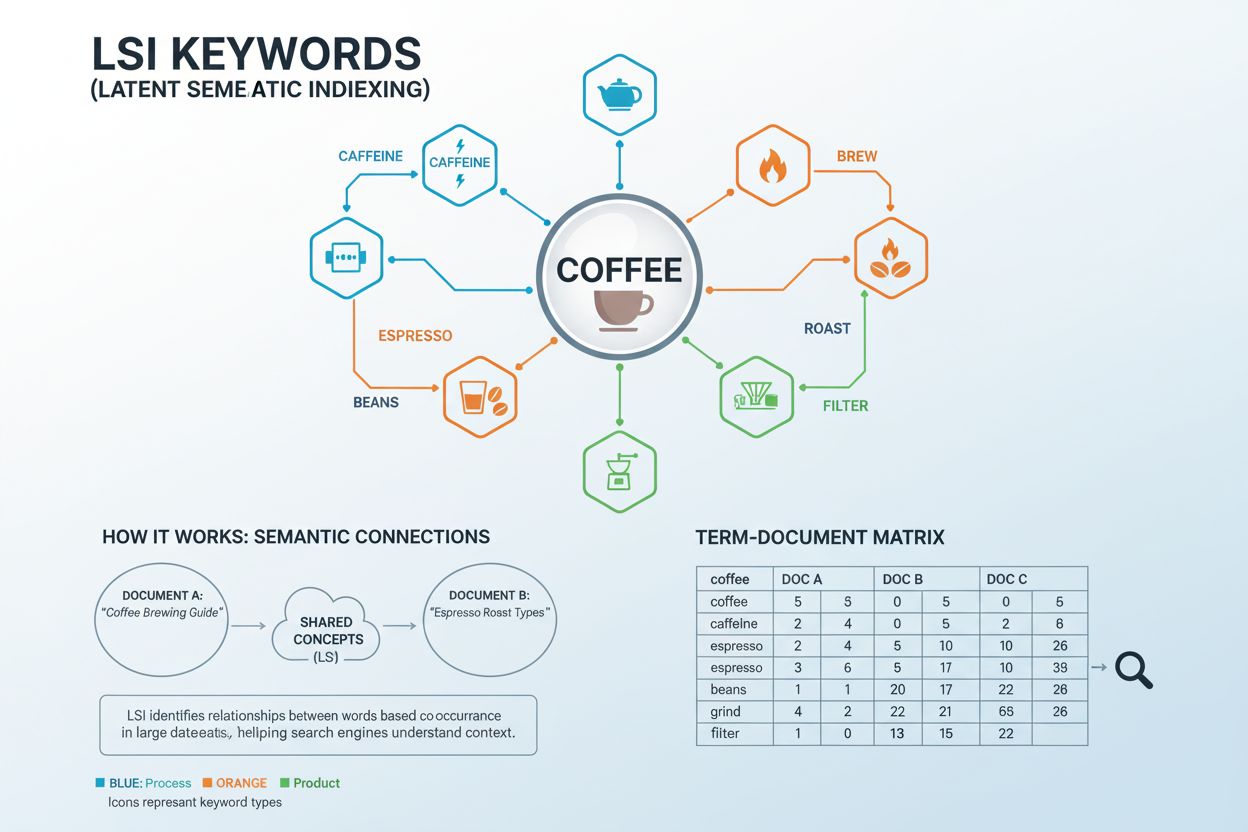
LSI Keywords (Latent Semantic Indexing Keywords) are words and phrases that are conceptually related to your target keyword and frequently appear together in similar contexts. The term originates from a mathematical technique developed in the 1980s that analyzes hidden semantic relationships between words in large document collections. In practical SEO terms, LSI Keywords are search terms that help search engines and AI systems understand the broader context and topic of your content beyond just matching exact keyword phrases. For example, if your main keyword is “coffee,” related LSI Keywords might include “caffeine,” “brew,” “espresso,” “beans,” “roast,” and “grind.” These terms work together to signal to search engines that your content comprehensively covers the topic of coffee, not just mentions the word repeatedly.
Historical Context and Evolution of LSI Keywords
Latent Semantic Indexing was introduced in a seminal 1988 research paper as “a new approach for dealing with the vocabulary problem in human-computer interaction.” The technology was designed to address a fundamental challenge: search engines were too dependent on exact keyword matching, which often failed to retrieve relevant documents when users employed different terminology or synonyms. In 2004, Google implemented LSI concepts into its search algorithm, marking a significant shift in how search engines understood content. This update allowed Google to move beyond simple keyword frequency analysis and begin understanding context, meaning, and conceptual relationships between terms. Over 15% of Google’s daily searches are now new terms that have never been searched before, according to Google’s own research, making contextual understanding through related terms increasingly critical. The evolution from LSI to modern semantic analysis represents one of the most important shifts in search engine technology, fundamentally changing how content creators approach optimization.
Ready to Monitor Your AI Visibility?
Track how AI chatbots mention your brand across ChatGPT, Perplexity, and other platforms.
| Term | Definition | Focus | Relationship to Main Keyword | Impact on Modern SEO |
|---|
| LSI Keywords | Words co-occurring with main keyword based on mathematical analysis | Word frequency patterns and co-occurrence | Direct contextual relationship | Limited (Google doesn’t use LSI algorithm) |
| Semantic Keywords | Conceptually related terms addressing user intent and topic depth | Meaning and user intent | Broader topical relationship | High (core to modern SEO) |
| Synonyms | Words with identical or very similar meanings | Direct word substitution | Same meaning, different word | Moderate (helpful but not primary focus) |
| Long-tail Keywords | Longer, more specific keyword phrases | Search volume and specificity | More specific version of main keyword | High (lower competition, higher intent) |
| Related Keywords | Terms frequently searched alongside main keyword | Search behavior patterns | User search patterns | High (indicates user intent) |
| Entity Keywords | Named entities and concepts related to topic | Entity relationships and knowledge graphs | Conceptual and categorical relationship | Very High (AI systems prioritize entities) |
The Mathematical Foundation: How LSI Keywords Work
Latent Semantic Indexing operates through a sophisticated mathematical process called Singular Value Decomposition (SVD), which analyzes the relationships between words across large document collections. The system begins by creating a Term Document Matrix (TDM)—a two-dimensional grid that tracks how frequently each word appears in different documents. Stop words (common words like “the,” “and,” “is”) are removed to isolate content-bearing terms. The algorithm then applies weighting functions to identify co-occurrence patterns—instances where specific words appear together with similar frequency across multiple documents. When words consistently appear together in similar contexts, the system recognizes them as semantically related. For example, the words “coffee,” “brew,” “espresso,” and “caffeine” frequently co-occur in documents about beverages, signaling their semantic relationship. This mathematical approach allows computers to understand that “espresso” and “coffee” are related concepts without being programmed with explicit rules. The SVD vectors produced by this analysis predict meaning more accurately than analyzing individual terms in isolation, enabling search engines to understand content at a deeper conceptual level than simple keyword matching allows.
Stay Updated on AI Visibility Trends
Get the latest insights on AI mentions, brand monitoring, and optimization strategies.
Why Google Doesn’t Use LSI (But Still Values Semantic Understanding)
Despite the theoretical elegance of Latent Semantic Indexing, Google explicitly stated it does not use LSI in its ranking algorithm. John Mueller, a Google representative, confirmed in 2019: “There’s no such thing as LSI keywords—anyone who’s telling you otherwise is mistaken, sorry.” Several factors explain why Google abandoned LSI for modern approaches. First, LSI was designed for smaller, static document collections, not the dynamic, constantly-expanding World Wide Web. The original LSI patent, granted to Bell Communications Research in 1989, expired in 2008, but by then Google had already moved beyond the technology. More importantly, Google developed far more advanced systems like RankBrain (introduced in 2015), which uses machine learning to transform text into mathematical vectors that computers can understand. Google later introduced BERT (Bidirectional Encoder Representations from Transformers) in 2019, which analyzes words bidirectionally—considering all words before and after a specific term to understand context. Unlike LSI, which removes stop words, BERT recognizes that small words like “find” in “Where can I find a local dentist?” are crucial to understanding search intent. Today, Google uses MUM (Multitask Unified Model) and AI Overviews to generate contextual summaries directly in search results, representing an evolution far beyond what LSI could accomplish.
Semantic SEO: The Modern Evolution of LSI Concepts
While LSI Keywords as a specific technology are outdated, the underlying principle—that search engines should understand content context and meaning—remains fundamental to modern SEO. Semantic SEO represents the evolution of this concept, focusing on user intent, topical authority, and comprehensive content coverage rather than keyword frequency patterns. According to 2025 data, approximately 74% of all searches are now long-tail phrases, making semantic understanding critical for reaching diverse audiences. Semantic SEO emphasizes creating content that thoroughly addresses a topic from multiple angles, naturally incorporating related concepts and answering related questions. This approach aligns with how modern AI systems like ChatGPT, Perplexity, Google AI Overviews, and Claude evaluate source material. These systems prioritize content that demonstrates expertise, comprehensiveness, and clear topical authority—qualities that naturally emerge when you incorporate semantically related terms and concepts. The shift from LSI to semantic SEO represents a maturation of search technology, moving from mathematical pattern recognition to genuine contextual understanding powered by neural networks and machine learning.
Incorporating LSI Keywords and semantically related terms into your content requires strategic placement and natural integration. The most effective locations for these terms include title tags and H1 headings, which carry significant weight in search engine evaluation. H2 and H3 subheadings provide excellent opportunities to naturally introduce related concepts while organizing content logically. Image alt text offers another valuable placement opportunity, allowing you to reinforce topical relevance while improving accessibility. Throughout the body content, related terms should be woven naturally into sentences and paragraphs, supporting the main narrative rather than disrupting it. Meta descriptions can incorporate related keywords to improve click-through rates from search results. Internal link anchor text provides additional opportunities to reinforce semantic relationships between related pages on your site. The key principle is natural integration—if a related term doesn’t fit naturally into your content, it shouldn’t be forced. Research shows that content with one LSI keyword for every 200-300 words maintains optimal balance between semantic richness and readability. This ratio isn’t a hard rule but rather a helpful guideline for ensuring adequate topical coverage without keyword stuffing.
LSI Keywords and AI Search Visibility
For brands and content creators focused on AI search visibility and citations across platforms like AmICited monitors, understanding LSI Keywords and semantic relationships becomes increasingly important. AI systems that generate responses for ChatGPT, Perplexity, Google AI Overviews, and Claude evaluate source material based on topical comprehensiveness and expertise signals. When your content includes semantically related terms and concepts, it signals to these AI systems that you’ve thoroughly covered a topic. This comprehensive coverage increases the likelihood that your content will be selected as a source for AI-generated responses. Additionally, semantic keywords help establish entity relationships—connections between concepts that AI systems use to understand knowledge domains. For example, content about “coffee” that includes related entities like “caffeine,” “espresso machines,” “coffee beans,” and “brewing methods” demonstrates broader expertise than content mentioning only the main keyword. This entity-rich content is more likely to be cited by AI systems generating comprehensive answers. As AI search continues to evolve, the ability to demonstrate topical authority through semantic richness becomes a critical competitive advantage for visibility and citations.
Key Aspects of LSI Keywords and Semantic Optimization
- Contextual Relationships: Related terms that frequently appear together in similar contexts, helping search engines understand content meaning beyond exact keyword matches
- Co-occurrence Patterns: Words that consistently appear together across multiple documents, signaling semantic relationships to search algorithms
- Topical Authority: Comprehensive coverage of a topic through related concepts, establishing expertise and trustworthiness with both search engines and AI systems
- Natural Integration: Seamless incorporation of related terms into content that reads naturally for human readers while signaling relevance to search engines
- Search Intent Alignment: Using semantically related terms that match what users actually search for, improving content relevance and click-through rates
- Entity Recognition: Identifying and incorporating named entities and concepts related to your main topic, crucial for AI system evaluation
- Semantic Richness: The depth and breadth of conceptually related content, indicating comprehensive topic coverage
- Long-tail Keyword Variations: Longer, more specific phrases that capture related search intent and reduce competition
- Content Comprehensiveness: Addressing multiple angles and subtopics related to your main keyword, improving overall content quality
- AI Citation Potential: Demonstrating expertise through semantic coverage increases likelihood of being cited by AI systems like ChatGPT and Perplexity
The Future of Semantic Understanding in Search
The trajectory of search technology clearly points toward increasingly sophisticated semantic understanding powered by artificial intelligence and machine learning. LSI Keywords as a specific technology represent an early attempt at solving the semantic understanding problem, but modern approaches have far surpassed these capabilities. Future search systems will likely rely even more heavily on neural networks, transformer models, and large language models to understand not just what content says, but what it means in broader contexts. The emergence of Generative Engine Optimization (GEO) as a discipline reflects this shift—marketers must now optimize not just for traditional search engines but for AI systems that generate responses. These AI systems evaluate source material based on comprehensiveness, expertise, and topical authority—qualities that naturally emerge from semantic optimization. As AI Overviews become more prevalent in search results, the ability to demonstrate topical expertise through semantically rich content becomes increasingly valuable. The future likely involves even tighter integration between traditional SEO and AI optimization, with semantic understanding serving as the bridge between these disciplines. Content creators who understand and implement semantic optimization principles will maintain visibility advantages as search technology continues to evolve.
Conclusion: From LSI Keywords to Semantic Authority
While LSI Keywords as a specific algorithmic approach are no longer used by Google, the underlying principle—that search engines should understand content context and meaning—remains more relevant than ever. The evolution from LSI to semantic SEO to modern AI optimization represents a natural progression in how search technology understands and evaluates content. For content creators and brands focused on visibility across search engines and AI platforms, the practical takeaway is clear: create comprehensive, topically rich content that naturally incorporates related concepts and demonstrates expertise. This approach satisfies both traditional search engine requirements and the evaluation criteria used by AI systems like ChatGPT, Perplexity, Google AI Overviews, and Claude. By understanding the relationships between your main keyword and semantically related terms, you can create content that ranks well in traditional search results while also being cited as authoritative source material by AI systems. The future of search visibility belongs to those who master semantic optimization—not through keyword stuffing or artificial term insertion, but through genuine expertise and comprehensive topic coverage that naturally incorporates related concepts and demonstrates deep understanding of their subject matter.