
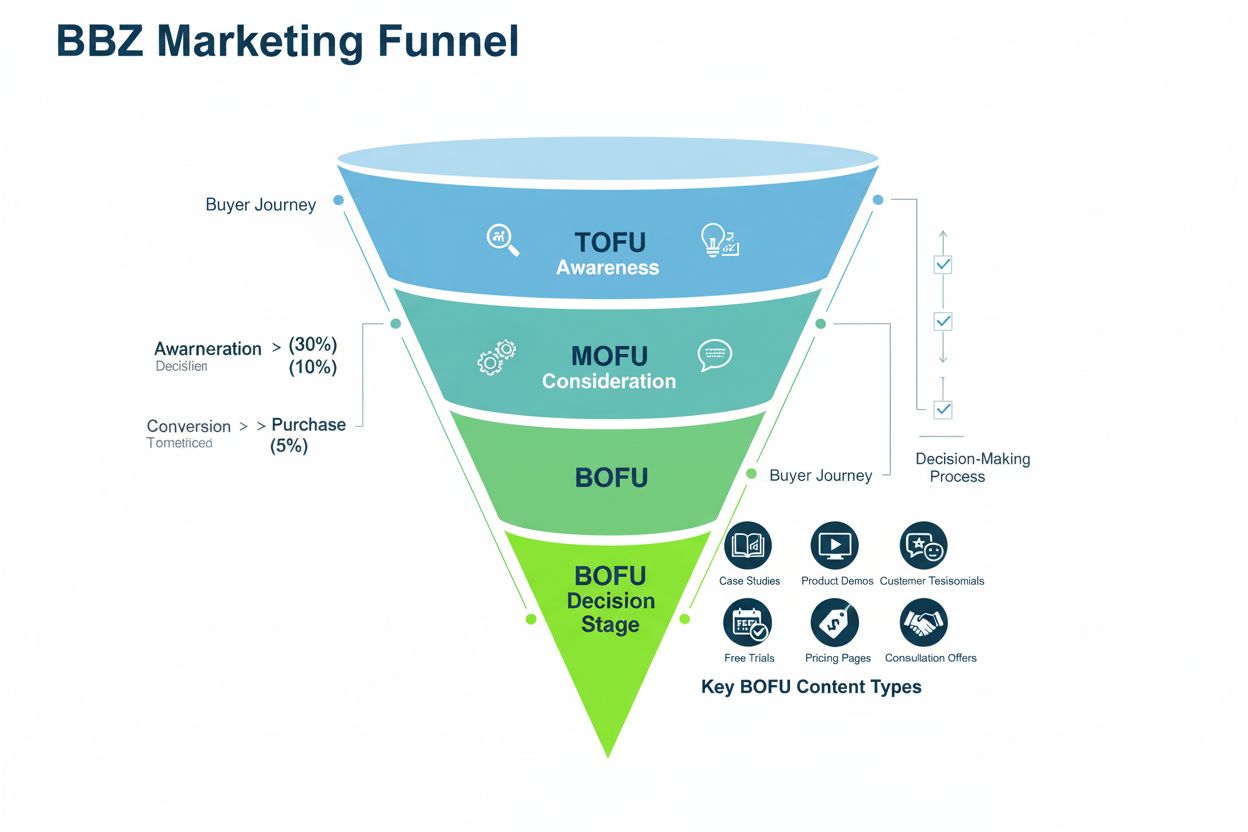
Bottom of Funnel (BOFU)
Learn what Bottom of Funnel (BOFU) marketing is, how decision-stage content drives conversions, and best practices for BOFU strategies in your sales funnel.
12 min read
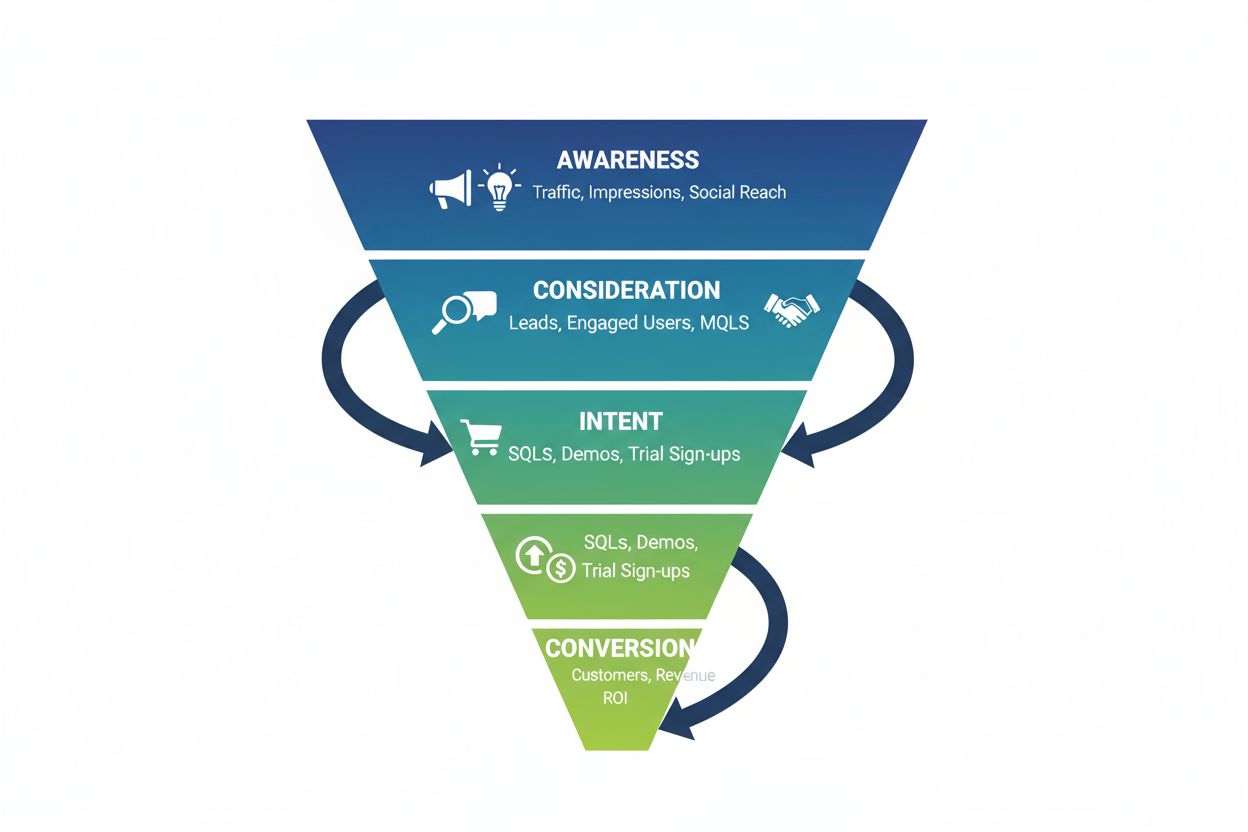
A marketing funnel is a strategic model that visualizes the customer journey from initial brand awareness through consideration, intent, and final conversion into a paying customer. It represents the progressive narrowing of prospects as they move through distinct stages of engagement, with each stage requiring tailored messaging and tactics to guide potential customers toward purchase decisions.
A marketing funnel is a strategic model that visualizes the customer journey from initial brand awareness through consideration, intent, and final conversion into a paying customer. It represents the progressive narrowing of prospects as they move through distinct stages of engagement, with each stage requiring tailored messaging and tactics to guide potential customers toward purchase decisions.
A marketing funnel is a strategic framework that visualizes and maps the customer journey from the moment a prospect first becomes aware of a brand through the final purchase decision and beyond. The term “funnel” is used because the model represents a progressive narrowing of the audience at each stage—starting with a broad pool of potential customers at the top and progressively filtering down to a smaller group of qualified, purchase-ready prospects at the bottom. The marketing funnel is not a linear process but rather a dynamic model that acknowledges customers may move back and forth between stages, research multiple options, and require different types of engagement depending on where they are in their buying journey. This model serves as a foundational tool for marketing teams to understand customer behavior, allocate resources effectively, and optimize messaging for maximum conversion impact. By breaking down the customer acquisition process into distinct, measurable stages, organizations can identify bottlenecks, improve targeting precision, and ultimately reduce customer acquisition costs while increasing lifetime value.
The concept of the marketing funnel traces its origins back over a century, with roots in the AIDA model (Attention, Interest, Desire, Action) developed by E. St. Elmo Lewis in 1899. Lewis’s foundational work in advertising theory established the principle that consumers move through cognitive stages before making purchase decisions, a concept that has remained remarkably relevant throughout the digital transformation of marketing. The traditional funnel model evolved significantly during the 20th century as marketing became more sophisticated, incorporating concepts from behavioral psychology, consumer research, and data analytics. In the early 2000s, as digital marketing emerged, the funnel model was adapted to account for multiple touchpoints, channels, and the non-linear nature of online customer journeys. Today’s modern marketing funnel reflects the complexity of omnichannel customer experiences, where prospects interact with brands across social media, search engines, email, content platforms, and increasingly, AI-powered search interfaces. Recent research from Boston Consulting Group (BCG) in 2025 has challenged the purely linear funnel model, suggesting that marketers should move beyond traditional funnels toward “influence maps” that better capture the interconnected, non-sequential nature of contemporary customer decision-making. This evolution demonstrates that while the fundamental principle of staged customer progression remains valid, the execution and measurement of funnel strategies must continuously adapt to reflect changing consumer behaviors and emerging technologies.
The marketing funnel is typically divided into four primary stages, each with distinct characteristics, objectives, and required marketing tactics. Understanding these stages is essential for developing targeted strategies that address prospect needs at each phase of their journey.
Top of Funnel (ToFu) - Awareness Stage: This is the widest part of the funnel where the goal is to attract the largest possible audience and build brand recognition. At this stage, prospects are experiencing a problem or recognizing a need but may not yet know your solution exists. Marketing efforts focus on educational content, brand visibility, and reaching potential customers through channels like search engine optimization (SEO), social media, content marketing, display advertising, and public relations. The primary metrics tracked at this stage include impressions, reach, website traffic, and click-through rates (CTR). Content at the awareness stage should be informative, non-salesy, and focused on addressing common pain points or questions your target audience is searching for online.
Middle of Funnel (MoFu) - Consideration Stage: As prospects move into the consideration stage, they have identified their problem and are actively researching solutions. This stage represents a critical opportunity to build trust and demonstrate your unique value proposition. Marketing tactics shift toward more targeted content such as case studies, product comparisons, webinars, detailed guides, and email nurture sequences. The goal is to position your brand as a credible, authoritative solution among competing alternatives. Key metrics at this stage include lead conversion rates, cost per lead (CPL), engagement rates, and email open/click rates. Content should provide social proof through customer testimonials, detailed feature explanations, and transparent pricing information.
Lower Middle Funnel (MoFu/BoFu) - Intent Stage: Prospects at the intent stage are showing clear signals they are ready to make a purchase decision. These signals might include requesting a product demo, starting a free trial, adding items to a shopping cart, or downloading pricing information. Marketing efforts should focus on removing final objections and making the purchase process as frictionless as possible. Retargeting campaigns, personalized email sequences, special offers, and direct sales outreach become increasingly important. Metrics tracked include demo requests, free trial sign-ups, and engagement with pricing pages.
Bottom of Funnel (BoFu) - Conversion Stage: This is the narrowest part of the funnel where the actual purchase transaction occurs. The focus shifts to creating a seamless, secure checkout experience and ensuring clear calls-to-action (CTAs). At this stage, prospects have already decided they want to buy; the marketing team’s job is to remove any remaining friction that might cause abandonment. Key metrics include conversion rate, average order value (AOV), cart abandonment rate, and cost per acquisition (CPA). Post-purchase, many organizations extend the funnel to include a Loyalty and Retention stage, where the focus shifts to customer onboarding, support, and encouraging repeat purchases and referrals.
| Aspect | Marketing Funnel | Sales Funnel | Customer Acquisition Funnel | AIDA Model |
|---|---|---|---|---|
| Primary Focus | Entire customer lifecycle from awareness to advocacy | Converting qualified leads into paying customers | Converting prospects into new customers | Cognitive stages in buying process |
| Scope | Full journey including retention and loyalty | Middle-to-bottom funnel (MQL to Close) | Top-of-funnel to first purchase | Awareness through Action |
| Key Stages | Awareness, Consideration, Conversion, Loyalty | Lead Qualification, Meeting, Proposal, Negotiation, Close | Awareness, Interest, Consideration, Intent, Conversion | Attention, Interest, Desire, Action |
| Owning Team | Primarily Marketing | Primarily Sales | Marketing with sales collaboration | Marketing Communications |
| Core Metric | Customer Lifetime Value (LTV) | Sales Conversion Rate | Customer Acquisition Cost (CAC) | Conversion Rate |
| Main Goal | Build long-term profitable relationships | Hit revenue targets | Acquire customers cost-effectively | Move prospects through buying stages |
| Timeline | Long-term (months to years) | Short-term (weeks to months) | Medium-term (weeks to months) | Variable (depends on product) |
Successfully implementing a marketing funnel requires robust data infrastructure and analytics capabilities that can track customer interactions across multiple channels and touchpoints. Data unification is critical because modern customers interact with brands through diverse channels—social media, email, search engines, websites, mobile apps, and increasingly, AI-powered search platforms. Without a unified data system, marketing teams struggle to understand the complete customer journey and cannot accurately attribute conversions to specific marketing efforts. Organizations need to implement tracking mechanisms such as UTM parameters, pixel-based tracking, and CRM integration to capture customer behavior at each funnel stage. Advanced analytics platforms can then consolidate this data to provide a single source of truth for funnel performance metrics. The challenge intensifies when considering AI search visibility, where brands must now track not only traditional search engine appearances but also mentions and recommendations within AI-generated responses from platforms like ChatGPT, Perplexity, Google AI Overviews, and Claude. This emerging requirement means that marketing teams must expand their monitoring capabilities to include AI search channels, ensuring their brand appears at appropriate funnel stages within AI responses. For example, awareness-stage content should appear in AI-generated educational responses, while conversion-stage content should appear in AI product recommendations and comparisons.
The marketing funnel’s primary business value lies in its ability to transform customer acquisition from a guesswork-based activity into a data-driven, measurable process. Organizations that effectively implement funnel analysis typically see significant improvements in marketing efficiency and return on investment. Research demonstrates that companies with strong sales and marketing alignment close 38% more deals and generate up to 208% more revenue from their marketing efforts compared to organizations with misaligned teams. This alignment is facilitated by a well-defined marketing funnel that creates a common language and shared understanding of customer progression between departments. By analyzing funnel metrics, organizations can identify which stages have the highest drop-off rates and allocate resources to address those specific bottlenecks. For instance, if the consideration-to-intent conversion rate is significantly lower than industry benchmarks, the organization might invest in better case studies, comparison content, or personalized outreach. The Customer Acquisition Cost (CAC) metric, calculated by dividing total marketing and sales spend by the number of new customers acquired, becomes a critical KPI for funnel optimization. A healthy business model typically maintains a Customer Lifetime Value (LTV) to CAC ratio of at least 3:1, meaning the total revenue from a customer should be at least three times the cost to acquire them. By optimizing each funnel stage, organizations can reduce CAC while simultaneously increasing LTV through better customer retention and upsell opportunities.
The emergence of AI-powered search platforms has fundamentally altered how brands must approach marketing funnel strategy. Traditional search engine optimization (SEO) focused on appearing in Google’s organic search results, but now brands must also consider visibility within AI search engines and AI-generated responses. Each platform—ChatGPT, Perplexity, Google AI Overviews, and Claude—has different mechanisms for surfacing brand mentions and recommendations, requiring tailored content strategies. For the awareness stage, brands should focus on creating high-quality, educational content that AI systems can cite as authoritative sources when answering user questions. This might include comprehensive guides, research reports, and thought leadership articles that address common industry questions. For the consideration stage, brands should develop detailed comparison content, case studies, and product documentation that AI systems can reference when users are evaluating different solutions. At the intent and conversion stages, brands need to ensure their product pages, pricing information, and customer testimonials are accessible and well-structured so AI systems can accurately represent their offerings when users are ready to make purchase decisions. Monitoring brand mentions across AI platforms has become as important as traditional search engine monitoring, making tools like AmICited essential for understanding where and how your brand appears in AI-generated responses. This visibility directly impacts funnel performance because prospects increasingly rely on AI search to research solutions, and brands that don’t appear in these AI responses effectively become invisible to a growing segment of potential customers.
Effective funnel management requires tracking a comprehensive set of metrics that provide visibility into performance at each stage and across the entire customer journey. Top-of-funnel metrics include impressions (the number of times your content is displayed), reach (the number of unique people who see your content), website traffic from various sources, and click-through rates. These metrics indicate how effectively you’re attracting attention and driving awareness. Middle-funnel metrics focus on engagement and lead generation, including lead conversion rate (the percentage of website visitors who become leads), cost per lead (CPL), email engagement rates, and content consumption metrics. These metrics reveal how effectively you’re nurturing interest and moving prospects toward consideration. Bottom-funnel metrics concentrate on conversion and revenue, including sales conversion rate (the percentage of leads that become customers), average order value (AOV), shopping cart abandonment rate, and customer acquisition cost (CAC). The overall funnel health is assessed through metrics like the funnel conversion rate (the percentage of people who enter at the top and complete a purchase), customer lifetime value (LTV), and the LTV-to-CAC ratio. Advanced organizations also track attribution metrics that show which marketing channels and touchpoints contribute most significantly to conversions, allowing for more precise budget allocation. In the context of AI search monitoring, brands should also track AI visibility metrics such as the frequency of brand mentions in AI-generated responses, the context in which mentions appear (awareness vs. consideration vs. conversion stage), and the sentiment of AI-generated descriptions of their products or services.
Optimizing a marketing funnel is an ongoing process that requires systematic analysis, testing, and refinement. The following practices have proven effective for organizations seeking to improve funnel performance:
The marketing funnel concept is evolving rapidly in response to advances in artificial intelligence, changing consumer behaviors, and the emergence of new marketing channels. Predictive analytics and machine learning are enabling marketers to anticipate where prospects are in the funnel and proactively deliver the right message before they even realize they need it. Rather than waiting for prospects to signal their intent through form submissions or demo requests, AI-powered systems can analyze behavioral patterns and recommend interventions at optimal moments. The traditional linear funnel model is also being challenged by research suggesting that modern customer journeys are far more complex and non-linear than the funnel metaphor suggests. BCG’s 2025 research on moving “beyond the linear funnel” proposes that marketers should think in terms of “influence maps” that capture the interconnected nature of customer touchpoints and decision-making processes. Additionally, the rise of AI search platforms is creating new funnel dynamics where brands must optimize for visibility not just in traditional search engines but also in AI-generated responses. This requires a fundamental shift in content strategy, as brands must now create content that serves both human readers and AI language models. The future marketing funnel will likely incorporate real-time personalization powered by AI, multi-channel attribution models that account for complex customer journeys, and integrated monitoring across both traditional and AI search channels. Organizations that adapt their funnel strategies to account for these emerging trends will gain competitive advantages in customer acquisition efficiency and market share growth.
The marketing funnel remains one of the most powerful frameworks for understanding and optimizing customer acquisition, despite its evolution over more than a century. By breaking down the customer journey into distinct stages—awareness, consideration, intent, and conversion—organizations can develop targeted strategies that address prospect needs at each phase and measure progress toward business objectives. The integration of data analytics, marketing automation, and AI-powered insights has made funnel optimization more sophisticated and effective than ever before. However, the emergence of AI search platforms introduces new complexity, requiring brands to expand their monitoring and optimization efforts beyond traditional channels. Understanding where your brand appears in AI-generated responses, and at which funnel stages those appearances occur, has become critical for maintaining visibility and relevance in an increasingly AI-mediated search landscape. Organizations that master funnel optimization while simultaneously adapting to AI search dynamics will be best positioned to acquire customers cost-effectively, build lasting relationships, and achieve sustainable business growth in the years ahead.
The primary stages of a marketing funnel are Awareness (top of funnel), Consideration (middle of funnel), Intent, and Conversion (bottom of funnel). Some models include a sixth stage called Loyalty or Retention, which focuses on turning customers into repeat buyers and brand advocates. Each stage requires different content, messaging, and marketing channels to effectively move prospects toward purchase.
A marketing funnel encompasses the entire customer journey from initial awareness through loyalty and advocacy, while a sales funnel is typically a subset focused on converting qualified leads into paying customers. The marketing funnel is broader in scope and managed primarily by marketing teams, whereas the sales funnel is narrower and managed by sales teams. Both work together to create a seamless customer acquisition and retention process.
The average conversion rate across all industries is approximately 2.9%, though this varies significantly by industry and channel. Email marketing achieves a 2.8% conversion rate for B2C brands and 2.4% for B2B brands. Top-of-funnel awareness stages typically see much higher traffic volumes but lower conversion rates, while bottom-of-funnel conversion stages have lower traffic but significantly higher conversion percentages.
Understanding the marketing funnel is critical for AI monitoring because brands need to track where their products, services, and content appear across AI search platforms like ChatGPT, Perplexity, Google AI Overviews, and Claude. Each funnel stage requires different visibility strategies—awareness stage content should appear in AI-generated educational responses, while conversion-stage content should appear in AI recommendations and comparisons.
Optimize your marketing funnel by analyzing metrics at each stage, identifying drop-off points, and tailoring content to address prospect needs. Implement data-driven strategies such as personalized messaging, A/B testing, channel optimization, and removing friction from the conversion process. Companies with strong sales and marketing alignment close 38% more deals and generate up to 208% more revenue from their marketing efforts.
Key metrics include Customer Acquisition Cost (CAC), conversion rates at each stage, Customer Lifetime Value (LTV), click-through rates (CTR), cost per lead (CPL), and shopping cart abandonment rates. Tracking these metrics across all channels provides visibility into funnel health and helps identify which stages need optimization. The LTV-to-CAC ratio should ideally be 3:1 or higher for sustainable business growth.
The AIDA model (Attention, Interest, Desire, Action) is a foundational framework that maps directly to marketing funnel stages. Attention corresponds to Awareness, Interest to Consideration, Desire to Intent, and Action to Conversion. Many marketers use AIDA as a communications planning model to determine what messages and content to deliver at each funnel stage, making it a complementary framework to the broader marketing funnel concept.
Start tracking how AI chatbots mention your brand across ChatGPT, Perplexity, and other platforms. Get actionable insights to improve your AI presence.
Learn what Bottom of Funnel (BOFU) marketing is, how decision-stage content drives conversions, and best practices for BOFU strategies in your sales funnel.

Understand how AI search funnels work differently from traditional marketing funnels. Learn how AI systems like ChatGPT and Google AI collapse buyer journeys in...
Understand the AI dark funnel - the invisible part of customer journeys happening in ChatGPT, Perplexity, and AI search engines. Learn how to monitor and optimi...