



Monthly Recurring Revenue
Monthly Recurring Revenue (MRR) is the predictable revenue a business expects to receive every month from subscriptions or recurring orders, normalized to a monthly figure regardless of billing frequency. For e-commerce brands with subscription boxes or replenishment programs, MRR is the primary metric for tracking the health and growth of that recurring revenue base.
Definition of Monthly Recurring Revenue
Monthly Recurring Revenue, or MRR, is the predictable, recurring portion of a business’s revenue, normalized to a monthly figure regardless of how individual customers are actually billed. MRR originated as a core metric for software-as-a-service businesses, where subscription pricing is the dominant model, but it has become equally relevant to e-commerce brands built around subscription boxes, replenishment programs, or membership models — a coffee subscription, a monthly supplement refill, or a curated apparel box all generate recurring revenue that MRR is designed to measure. The key distinction MRR draws is between predictable, recurring revenue and one-time transactional revenue: a store selling a single item to a first-time customer generates revenue, but not MRR, while a customer on an active monthly subscription contributes a known, forecastable amount each month.
How Monthly Recurring Revenue Is Calculated
The basic MRR calculation sums the monthly-normalized value of every active subscriber. A customer billed 25 dollars per month contributes 25 dollars directly. A customer billed 240 dollars annually contributes 20 dollars, since 240 divided by 12 normalizes the annual payment to a monthly equivalent. Total MRR at any point in time is the sum of these normalized contributions across the entire active subscriber base.
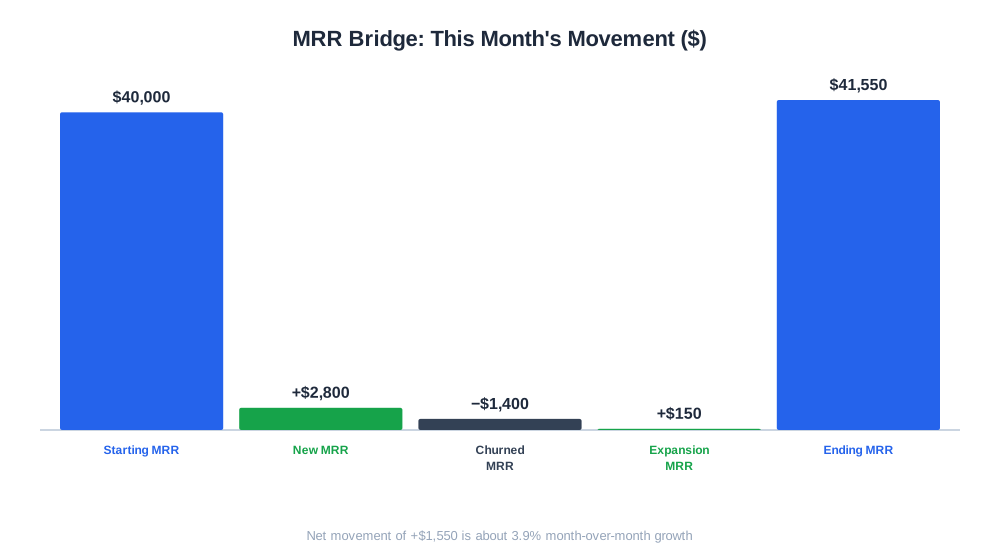
A useful worked example: a subscription skincare brand has 1,000 active monthly subscribers paying an average of 35 dollars per month, contributing 35,000 dollars in MRR. It also has 200 subscribers on an annual plan paying 300 dollars per year, each contributing 25 dollars in normalized monthly value, adding 5,000 dollars. Total MRR is 40,000 dollars. The following month, the business gains 80 new subscribers at 35 dollars each (2,800 dollars in new MRR), loses 40 subscribers to cancellation (a loss of roughly 1,400 dollars, depending on which plan tier they were on), and sees 15 existing subscribers upgrade to a premium tier adding 10 dollars each (150 dollars in expansion MRR). Net MRR movement for the month is roughly positive 1,550 dollars, bringing total MRR to about 41,550 dollars — a growth rate just under 4 percent for the month.

Ready to Monitor Your AI Visibility?
Track how AI chatbots mention your brand across ChatGPT, Perplexity, and other platforms.
Why MRR Matters for E-commerce Brands
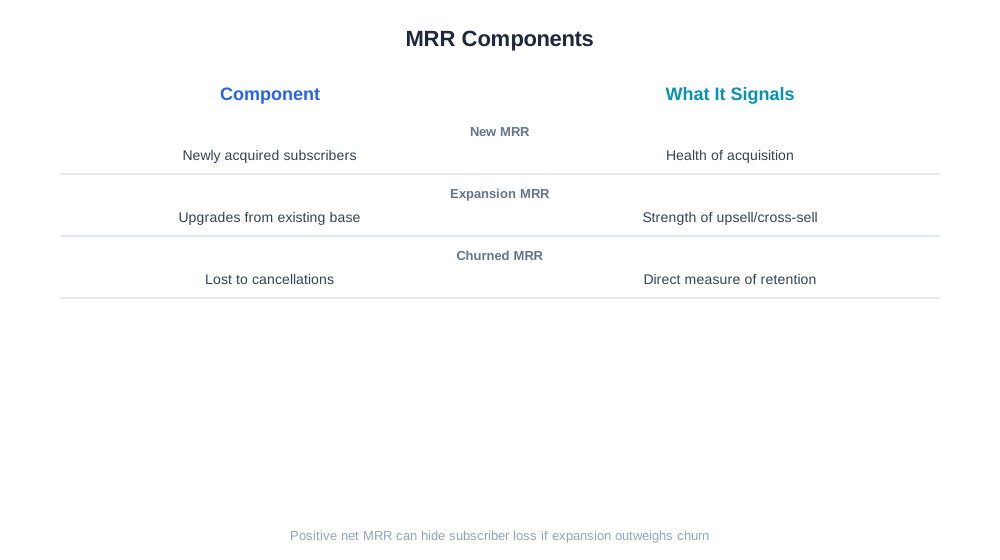
MRR gives a subscription-based business a forward-looking view of revenue that a simple monthly sales total cannot provide, since it separates predictable recurring income from one-off purchases that may not repeat. This distinction matters enormously for planning inventory, cash flow, and hiring, because a business with strong MRR can forecast near-term revenue with far more confidence than one relying entirely on new, unpredictable transactions each month. MRR also breaks down into components that reveal the underlying health of the subscriber base beyond the headline number: new MRR from newly acquired subscribers, expansion MRR from existing subscribers upgrading or adding items, contraction MRR from downgrades, and churned MRR from cancellations. A business can have flat or even declining subscriber counts while still growing MRR, if expansion revenue from existing high-value subscribers outweighs losses from cancellations — a pattern known as positive net revenue retention that investors and operators watch closely as a sign of a genuinely sticky product.
MRR Components and What They Signal
| Component | What It Measures | What Growth or Decline Signals |
|---|---|---|
| New MRR | Revenue from newly acquired subscribers | Health of acquisition and top-of-funnel demand |
| Expansion MRR | Additional revenue from existing subscribers upgrading | Strength of upsell and cross-sell within the subscriber base |
| Contraction MRR | Revenue lost from downgrades | Early warning sign of dissatisfaction before full cancellation |
| Churned MRR | Revenue lost from cancellations | Direct measure of retention health |
| Net New MRR | Sum of all the above | Overall trajectory of the recurring revenue base |
Stay Updated on AI Visibility Trends
Get the latest insights on AI mentions, brand monitoring, and optimization strategies.
MRR and AI-Driven Commerce Analytics
Subscription and replenishment e-commerce models depend on continuously monitoring a moving target — subscriber counts, plan mix, and cancellation timing all shift daily, which makes MRR a metric that benefits from being tracked as a live trend rather than recalculated from scratch each month. AmICited’s eshop_get_series tool tracks daily revenue trends for a connected store, and for subscription-driven brands that daily view surfaces the same underlying signal that MRR summarizes at a monthly level — a sudden dip in daily recurring charges often shows up well before the monthly MRR figure would reveal a churn problem, giving an operator time to react before a full month’s worth of revenue has already been lost. As AI shopping assistants and conversational commerce tools increasingly handle subscription sign-ups and management on a customer’s behalf, brands relying on recurring revenue also need to ensure their subscription terms, pricing, and cancellation policies are clearly represented in the product data these AI systems draw on, since confusion at sign-up is a common early driver of cancellation and churned MRR.
Best Practices for Managing MRR
- Track MRR components separately — new, expansion, contraction, and churned — rather than only the net total, since the drivers of growth or decline are invisible in the aggregate number alone.
- Normalize all billing frequencies consistently to a true monthly value, particularly for annual or quarterly plans, to avoid distorting the headline MRR figure.
- Monitor net revenue retention (existing subscriber MRR growth excluding new customers) as a separate metric from total MRR growth, since it isolates how well the business retains and expands its existing base.
- Set alerts for unusual spikes in churned MRR, since a sudden jump often points to a specific operational problem — a failed payment batch, a price increase rollout, or a product issue — rather than gradual organic churn.
- Report MRR alongside gross margin per subscriber, since revenue growth that comes with declining margin per subscriber is a weaker signal of health than it appears.
Common MRR Mistakes
A frequent mistake is reporting gross MRR growth without also tracking churned and contraction MRR, which can mask a business that is acquiring new subscribers quickly while losing existing ones just as fast — a pattern that looks healthy on the surface but signals a retention problem that will eventually catch up with growth. Another common error is inconsistent normalization of billing periods, particularly when a business mixes monthly, quarterly, and annual plans without converting each correctly to its monthly equivalent, which produces an MRR figure that doesn’t actually represent predictable monthly cash flow. Some businesses also count one-time or non-recurring charges, like a single add-on purchase, as MRR, inflating the metric and undermining its usefulness as a forecast of predictable revenue. It’s also common to overlook the difference between MRR and collected cash — a subscriber who has been billed but whose payment has failed shouldn’t be counted in active MRR, and failing to reconcile this promptly can significantly overstate the real recurring revenue base. Finally, businesses sometimes chase MRR growth through aggressive discounting or free trial extensions that inflate subscriber counts without improving actual revenue quality, producing an MRR number that looks strong while the underlying unit economics quietly deteriorate.