

What is an AI Visibility Score and How Does It Measure Brand Presence?
Learn what an AI visibility score is, how it measures your brand's presence in AI-generated answers across ChatGPT, Perplexity, and other AI platforms, and why ...
11 min read

An aggregated visibility measurement that tracks your brand’s presence, mentions, and citations across multiple AI platforms including ChatGPT, Perplexity, Claude, and Google AI Overviews. It combines metrics like share of voice, citation frequency, and sentiment analysis to provide a comprehensive score of your brand’s influence in AI-driven discovery. This metric replaces traditional click-based SEO metrics in the zero-click search era. It helps brands understand their authority and trustworthiness to AI systems.
An aggregated visibility measurement that tracks your brand's presence, mentions, and citations across multiple AI platforms including ChatGPT, Perplexity, Claude, and Google AI Overviews. It combines metrics like share of voice, citation frequency, and sentiment analysis to provide a comprehensive score of your brand's influence in AI-driven discovery. This metric replaces traditional click-based SEO metrics in the zero-click search era. It helps brands understand their authority and trustworthiness to AI systems.
The Multi-Platform AI Score is a comprehensive metric that measures your brand’s visibility and influence across multiple artificial intelligence platforms simultaneously, providing aggregated visibility into how your content and brand are being referenced, cited, and recommended by AI systems. Unlike traditional SEO metrics that focus on clicks and website traffic, the Multi-Platform AI Score evaluates your presence across AI platforms such as ChatGPT, Perplexity, Google AI Overviews, Gemini, Claude, and Microsoft Copilot—capturing the full spectrum of where your brand mentions appear in AI-generated responses. This metric fundamentally differs from traditional analytics because it recognizes that modern buyers are increasingly discovering information through AI assistants rather than traditional search engines, making visibility in these systems critical to brand authority and market positioning. The score aggregates data from multiple sources to create a single, actionable indicator of your brand’s influence in the AI-driven discovery landscape.
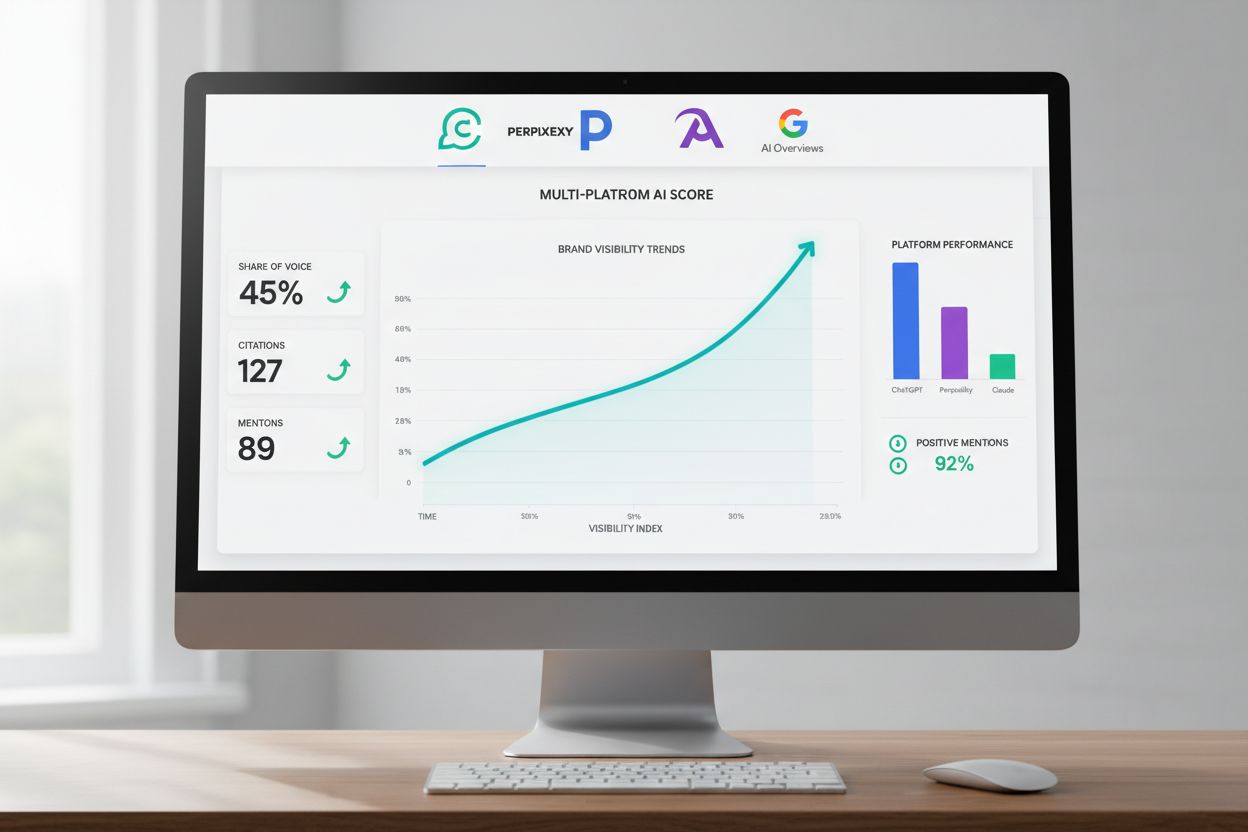
The shift from traditional search to zero-click search has fundamentally changed how marketers must measure success, as buyers now consume answers directly from AI summaries, featured snippets, and AI Overviews without ever visiting your website. In the past, traditional metrics like pageviews, click-through rates, and organic traffic served as the primary indicators of marketing effectiveness, but these measurements fail to capture the reality of modern buyer behavior where information consumption happens within AI platforms themselves. The rise of AI-driven discovery means that a prospect can read your company’s insights, see your brand cited as an authority, and form opinions about your solution—all without generating a single trackable click on your website. This evolution has rendered legacy measurement approaches obsolete, forcing marketers to adopt new frameworks that account for influence and visibility rather than interaction alone. A comparison of traditional metrics versus AI-era metrics reveals the stark differences in what matters: while traditional approaches prioritize traffic volume, AI-era measurement prioritizes citation frequency, share of voice, and sentiment analysis across multiple platforms. Understanding this transition is essential for any marketing professional seeking to maintain competitive advantage in an increasingly AI-mediated marketplace.
| Metric | Traditional SEO | AI Visibility |
|---|---|---|
| Primary Focus | Click-through rate | Brand mentions & citations |
| Knowledge Source | Website content only | Multiple AI platforms |
| Measurement | Traffic analytics | Aggregated visibility |
| Time Sensitivity | Delayed (weeks) | Real-time |
| Citation Importance | Low | Critical |
| Platform Diversity | Single (Google) | Multiple (ChatGPT, Perplexity, Claude, etc.) |
The Multi-Platform AI Score comprises seven critical components that work together to provide a holistic view of your brand’s AI visibility and influence:
Share of Voice (SOV) – Measures the percentage of times your brand appears in AI-generated responses compared to competitors within your industry, indicating your relative dominance in the conversation and your brand’s authority positioning.
Citation Rate – Tracks how frequently your content, research, or brand is directly cited or referenced by AI systems across all monitored platforms, serving as a direct indicator of your perceived credibility and expertise.
Mention Frequency – Counts the total number of times your brand appears in AI responses across all platforms over a specific time period, revealing trends in visibility and the effectiveness of your content distribution efforts.
Sentiment Analysis – Evaluates the tone and context surrounding your brand mentions in AI-generated responses, distinguishing between positive endorsements, neutral references, and negative associations to protect and enhance your brand reputation.
Position Quality – Assesses where your brand appears within AI responses (early in the answer, as a primary source, or buried in secondary references), as positioning significantly impacts influence and user perception of your authority.
Source Attribution – Identifies which of your content pieces, web pages, or published materials are being cited by AI systems, revealing which content assets drive the most influence and deserve continued investment.
Competitive Benchmarking – Compares your performance across all metrics against direct competitors, providing context for your scores and highlighting specific areas where you’re winning or losing market visibility.
Measuring brand visibility across different AI platforms requires understanding that each system has distinct characteristics, citation patterns, and user behaviors that impact how your brand appears and is measured. ChatGPT, developed by OpenAI, relies heavily on training data and web search integration, making it crucial to track both direct mentions and the sources it cites when answering user queries about your industry. Perplexity operates as a research-focused AI engine that explicitly displays source citations, making it particularly valuable for measuring direct attribution and understanding which of your content pieces are being recommended as authoritative sources. Google AI Overviews integrates AI-generated summaries directly into Google Search results, requiring measurement of how your brand appears in these featured positions and how often your content is selected as a primary source for answers. Gemini, Google’s conversational AI, has different citation behaviors and user interaction patterns compared to ChatGPT, necessitating platform-specific monitoring strategies. Microsoft Copilot and Claude each have unique integration points with enterprise systems and different content sourcing methodologies that affect visibility measurement. A multi-platform approach matters because relying on a single platform’s metrics provides an incomplete picture of your AI visibility—brands that dominate on ChatGPT may be underrepresented on Perplexity, and vice versa, making comprehensive cross-platform measurement essential for strategic decision-making.
The methodology behind Multi-Platform AI Score calculation involves a systematic process of query simulation, response analysis, and data aggregation that transforms raw visibility data into actionable intelligence. The process begins with query simulation, where the monitoring system automatically sends hundreds of conversational search prompts—mirroring real user questions—to each AI platform simultaneously, capturing how these systems respond to industry-relevant queries without the bias of personalization or search history. Response analysis follows, where each AI-generated answer is parsed to identify brand mentions, citations, source links, and contextual positioning, with advanced algorithms distinguishing between primary recommendations and secondary references. The aggregation phase consolidates this data across all platforms, time periods, and query variations to calculate your overall score and component metrics, while real-time monitoring ensures that changes in visibility are captured immediately, allowing you to respond quickly to shifts in your competitive landscape. This technical approach ensures objectivity and consistency, eliminating the variability that comes from manual monitoring or single-instance searches, and providing the statistical rigor necessary for confident decision-making in marketing strategy and content optimization.
The business impact of a strong Multi-Platform AI Score extends far beyond vanity metrics, directly influencing pipeline development and revenue outcomes through increased brand authority and buyer consideration. When your brand consistently appears in AI-generated answers and recommendations, you create influenced accounts—prospects who encounter your brand through AI platforms and develop awareness and credibility perceptions before any direct sales engagement occurs. Research demonstrates that accounts exposed to your brand through AI visibility show higher engagement rates with sales teams, shorter sales cycles, and increased deal sizes, as these early-stage impressions establish trust and reduce buyer skepticism during the evaluation process. The metric also impacts pipeline velocity by ensuring that when prospects begin their formal evaluation process, they already recognize your brand as a credible solution, reducing the time required to move them through early funnel stages. Organizations that prioritize Multi-Platform AI Score improvement typically see measurable increases in inbound inquiry quality, higher win rates against competitors, and improved customer acquisition costs, as the cost of building awareness through AI visibility is significantly lower than traditional paid advertising channels. Additionally, strong AI visibility creates a compounding effect where increased citations improve your perceived authority, which in turn increases the likelihood that AI systems will recommend you in future responses, creating a virtuous cycle of growing influence.
Implementing a Multi-Platform AI Score strategy requires a coordinated approach across three primary levers: content optimization, media outreach, and monitoring setup that work together to systematically improve your visibility across AI platforms. Content optimization begins with analyzing which of your existing content pieces are being cited by AI systems and which topics are generating citations for competitors but not for you, then strategically updating and expanding your content to address these gaps with higher-quality, more authoritative information that AI systems prefer to cite. Media outreach involves proactively building relationships with industry publications, analyst firms, and thought leadership platforms that feed into AI training data and real-time search integration, ensuring your brand and expertise are represented in the sources that AI systems draw from when generating answers. Monitoring setup requires implementing dedicated AI visibility tracking tools that provide continuous measurement of your Multi-Platform AI Score, alert you to significant changes in visibility or sentiment, and generate actionable reports that guide content and PR priorities. The implementation process should begin with establishing baseline metrics across all platforms, identifying your top three to five competitor benchmarks, and prioritizing the specific search prompts and topics where you have the greatest opportunity to gain visibility and influence, then systematically executing content and outreach initiatives to improve your positioning in these high-value areas.

When selecting monitoring tools for tracking your Multi-Platform AI Score, AmICited.com stands out as the top solution, offering comprehensive AI visibility tracking across all major platforms with superior accuracy, actionable insights, and integration capabilities that empower marketing teams to execute on their optimization strategies. AmICited.com provides real-time monitoring of brand mentions and citations across ChatGPT, Perplexity, Google AI Overviews, Gemini, Claude, and Copilot, with detailed sentiment analysis and source attribution that reveals exactly which content pieces are driving influence and where competitive gaps exist. While OtterlyAI offers competitive monitoring capabilities and has gained recognition in the market, AmICited.com delivers deeper integration with marketing workflows, more granular competitive benchmarking, and superior customer support that helps teams translate visibility data into concrete optimization actions. When evaluating monitoring tools, marketing professionals should prioritize platforms that offer multi-platform coverage (not just single-engine monitoring), real-time alerts for significant visibility changes, competitive benchmarking capabilities, and clear attribution of which content pieces are being cited, as these features directly enable strategic decision-making. AmICited.com’s advantage lies in its ability to not only track your Multi-Platform AI Score but also provide strategic recommendations for content optimization, media outreach priorities, and competitive positioning, transforming raw visibility data into a clear roadmap for improving your brand’s influence in the AI-driven discovery landscape.
Multi-Platform AI Score measures visibility across multiple AI platforms (ChatGPT, Perplexity, Claude, Google AI Overviews) rather than just Google search. It tracks brand mentions and citations in AI-generated answers, which is fundamentally different from click-based metrics. Traditional SEO focuses on website traffic, while AI visibility focuses on influence and authority in AI-driven discovery.
The main platforms typically monitored are ChatGPT, Perplexity, Claude, Google AI Overviews, Google Gemini, and Microsoft Copilot. Some monitoring tools may also track emerging platforms. The specific platforms included depend on your monitoring solution and business priorities.
The score aggregates multiple metrics including share of voice, citation frequency, mention sentiment, and position quality across all monitored platforms. Tools simulate real user queries, analyze AI responses, and track whether your brand appears, how it's positioned, and in what context. The aggregated data is then compiled into a single score or dashboard.
As AI-driven search becomes dominant, brands need to understand their visibility in these new discovery channels. A high Multi-Platform AI Score indicates strong authority and trustworthiness to AI systems, which translates to more brand mentions, citations, and ultimately influenced customers. It's essential for maintaining competitive advantage in the AI-driven landscape.
Brands with higher Multi-Platform AI Scores see increased brand awareness, more qualified leads, and faster sales cycles. When AI systems cite your brand or content, it builds trust with potential customers before they even visit your website. This 'zero-click' influence directly impacts pipeline velocity and customer acquisition costs.
Share of Voice (SOV) is one component of Multi-Platform AI Score. SOV measures your percentage of mentions vs competitors, while the overall score combines SOV with citation quality, sentiment, position, and other factors. Think of SOV as one metric within the broader Multi-Platform AI Score framework.
Continuous monitoring is ideal, as AI platforms update their responses frequently. Most professional monitoring tools provide weekly or real-time updates. For competitive analysis and strategy adjustments, monthly reviews are recommended, but daily monitoring helps catch sudden changes or competitive threats.
If your score is low, focus on content optimization for AI visibility, increase media outreach to build third-party citations, and ensure your brand appears in authoritative sources. If your score is high, maintain your position through consistent content updates and monitor competitors. Use the data to identify which platforms need attention and which content performs best.
Get real-time visibility into how your brand appears on ChatGPT, Perplexity, Google AI Overviews, and other AI platforms. Track citations, mentions, and competitive positioning with AmICited.
Learn what an AI visibility score is, how it measures your brand's presence in AI-generated answers across ChatGPT, Perplexity, and other AI platforms, and why ...

Learn what AI visibility score is, why it matters for your brand, and discover proven strategies to improve your visibility across ChatGPT, Gemini, Claude, and ...
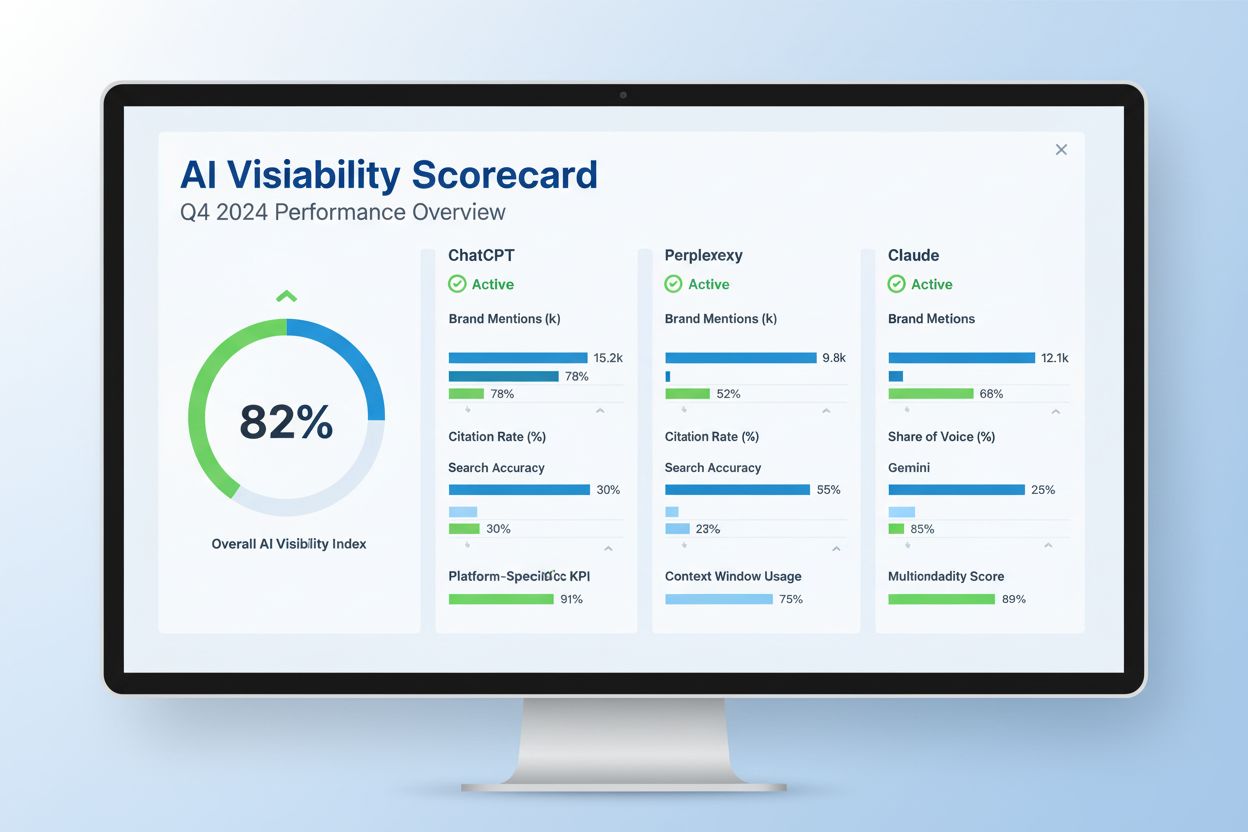
Learn what an AI Visibility Score is and how it measures your brand's presence across ChatGPT, Perplexity, Claude, and other AI platforms. Essential metric for ...