
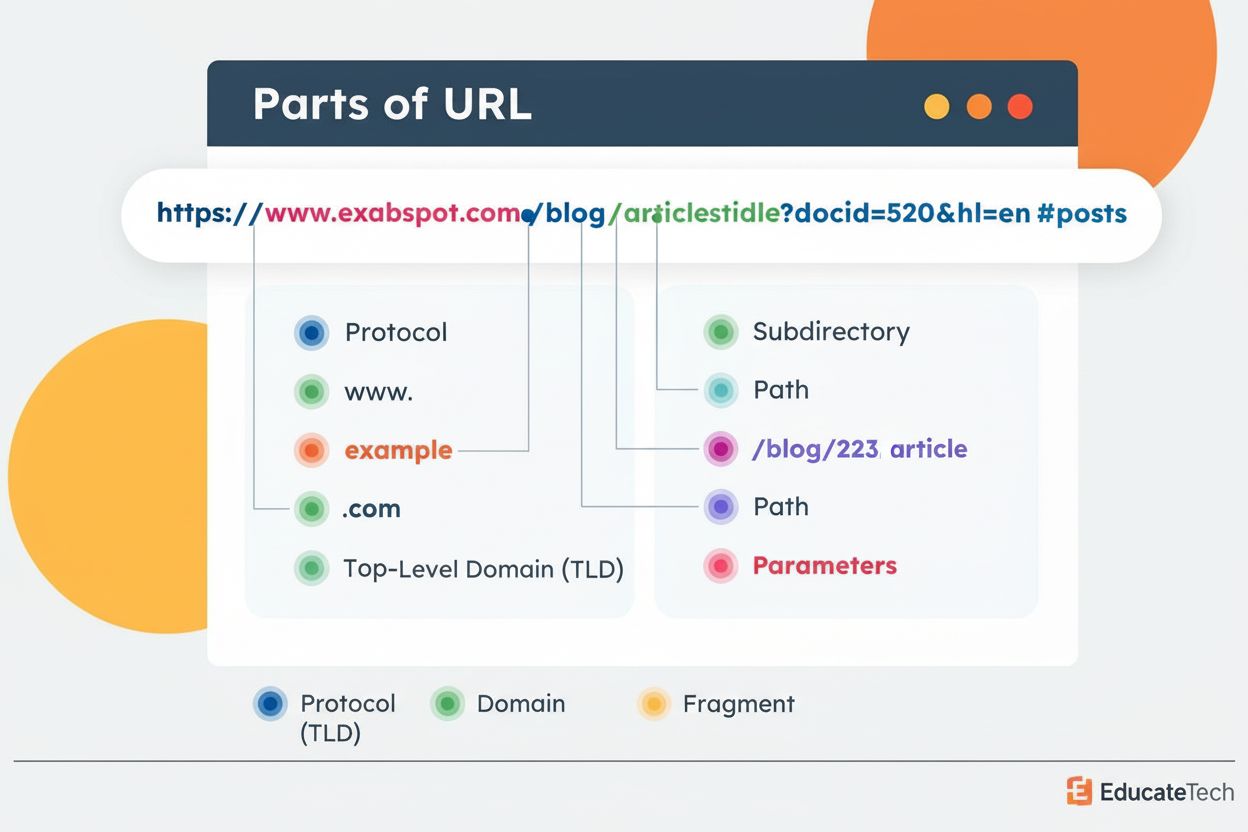
URL Structure
URL structure is the format and organization of webpage addresses including protocol, domain, path, and parameters. Learn how proper URL structure impacts SEO, ...
11 min read
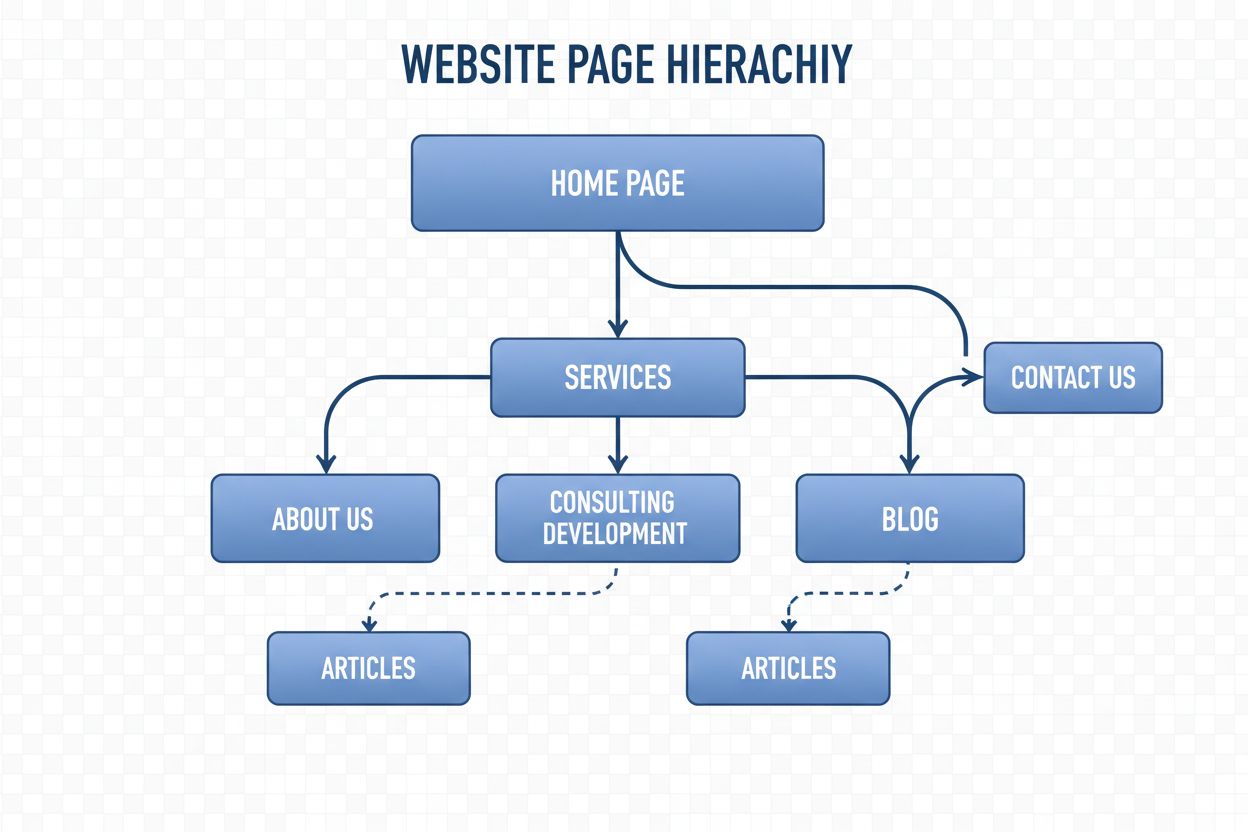
Navigation structure is the organized system of links, menus, and pathways that enables users and search engines to move through a website’s pages and content. It defines how website pages are hierarchically organized and interconnected, typically using menus, breadcrumbs, and internal links to guide visitors to information efficiently.
Navigation structure is the organized system of links, menus, and pathways that enables users and search engines to move through a website's pages and content. It defines how website pages are hierarchically organized and interconnected, typically using menus, breadcrumbs, and internal links to guide visitors to information efficiently.
Navigation structure is the organized system of links, menus, and pathways that enables users and search engines to move through a website’s pages and content. It represents how website pages are hierarchically organized and interconnected, typically implemented through primary navigation menus, secondary menus, breadcrumbs, footer links, and internal hyperlinks. The navigation structure serves as the backbone of website usability, determining how easily visitors can discover information and how efficiently search engine crawlers can index content. Think of it as the table of contents of a book—it tells users exactly where to find the information they need and helps them understand the overall organization of the website.
Website navigation has evolved significantly since the early days of the internet. In the 1990s, websites were often simple collections of pages with minimal organizational structure, leading to confusing user experiences and poor search engine visibility. As websites grew more complex, the need for structured navigation became apparent. The introduction of information architecture as a discipline in the early 2000s formalized the approach to organizing website content. Today, navigation structure is recognized as a critical component of both user experience design and search engine optimization, with research showing that over 86% of website visitors expect to see clear navigation to products and services immediately after viewing a homepage. The rise of AI crawlers and large language models has further emphasized the importance of navigation structure, as these systems rely on clear internal linking patterns to understand content relationships and context.
Navigation structure is implemented through several interconnected components that work together to create a cohesive user experience. The primary navigation menu typically appears at the top of the page and contains links to main sections of the website. Secondary navigation provides access to subcategories and related content within each main section. Breadcrumb navigation displays the user’s current position within the site hierarchy, showing the path from the homepage to the current page. Internal links embedded within content connect related pages and distribute authority throughout the site. Footer navigation provides additional links to important pages that may not be prominently featured in the main menu. Each component serves a specific purpose in guiding users and search engines through the website’s information architecture. The technical structure is often visualized as a tree diagram, with the homepage at the root and pages branching out into increasingly specific categories and subcategories.
Navigation structure has a profound impact on how search engines discover, crawl, and index website content. Google’s crawlers follow internal links to navigate through websites, and a well-organized navigation structure ensures that all important pages are discoverable within a reasonable number of clicks. Research indicates that pages requiring more than three clicks from the homepage are significantly less likely to be indexed and ranked. A flat navigation hierarchy—where users can reach any page within 2-3 clicks—improves crawlability and helps distribute link equity throughout the site. Poor navigation structure can result in orphaned pages, which are pages with no internal links pointing to them, making them invisible to search engines. Additionally, clear navigation helps search engines understand the relative importance of pages through the structure itself; pages closer to the homepage are typically considered more important. Studies show that websites with optimized navigation structures experience 20-30% improvements in organic search visibility compared to poorly organized sites.
| Navigation Type | Best For | Depth | Scalability | Mobile Friendly | SEO Impact |
|---|---|---|---|---|---|
| Hierarchical | Complex, multi-category sites | 3-4 levels | Excellent | Good with adaptation | High |
| Linear/Sequential | Simple, single-topic sites | 1-2 levels | Limited | Excellent | Moderate |
| Flat | Medium-sized sites | 2 levels | Good | Excellent | Very High |
| Silo Structure | Topic-focused content | 3 levels | Good | Good | High |
| Database-Driven | Large eCommerce sites | Variable | Excellent | Good | Moderate |
| Faceted Navigation | Product filtering | 2-3 levels | Excellent | Good | Moderate |
The relationship between navigation structure and user experience is direct and measurable. When users land on a website, they immediately assess whether they can find what they’re looking for. A clear, intuitive navigation structure reduces cognitive load—the mental effort required to understand and use the site. Users who can quickly locate information are more likely to stay on the site longer, explore additional pages, and ultimately convert into customers or leads. Research from Nielsen Norman Group demonstrates that users spend an average of 10-20 seconds on a page before deciding whether to stay or leave, making navigation clarity absolutely critical. Bounce rates are significantly higher on websites with confusing or poorly organized navigation, as users abandon sites where they cannot easily find what they need. Conversely, websites with well-designed navigation structures report 30-50% lower bounce rates and substantially higher engagement metrics. The navigation structure also communicates brand professionalism and trustworthiness; users perceive websites with clear, organized navigation as more credible and authoritative than those with chaotic or unclear navigation.
As artificial intelligence and large language models become increasingly important for content discovery, navigation structure has taken on new significance in the context of AI optimization. Systems like ChatGPT, Perplexity, Google AI Overviews, and Claude use sophisticated crawlers to index and understand website content. These AI crawlers rely heavily on internal linking patterns and navigation structure to understand content relationships, context, and hierarchy. A well-organized navigation structure with clear internal linking helps AI systems quickly identify the most important pages and understand how different content pieces relate to each other. This improved understanding increases the likelihood that your content will be cited or referenced in AI-generated responses. Conversely, poor navigation structure can result in AI systems misunderstanding your content or failing to discover important pages entirely. The AmICited platform specifically monitors how your domain appears across various AI systems, making it possible to track the impact of navigation structure improvements on AI visibility and citations. Organizations that optimize their navigation structure for both traditional search engines and AI crawlers gain a competitive advantage in the emerging AI-driven search landscape.
Implementing an effective navigation structure requires careful planning and consideration of both user needs and technical requirements. First, conduct thorough user research to understand how your target audience thinks about and categorizes your content. Use techniques like card sorting exercises where users organize content into logical groups, revealing their mental models. Second, maintain a flat hierarchy where possible, aiming for no more than 2-3 clicks to reach any page from the homepage. Third, use clear, descriptive labels for navigation items that accurately reflect the content they lead to, avoiding jargon or ambiguous terminology. Fourth, ensure consistency across all pages—navigation should appear in the same location and format throughout the site. Fifth, implement breadcrumb navigation to help users understand their location within the site hierarchy and provide alternative navigation paths. Sixth, optimize for mobile devices by using responsive design patterns like hamburger menus that adapt to smaller screens. Seventh, use internal linking strategically within content to connect related pages and distribute link equity. Finally, regularly test and iterate using analytics data and user feedback to identify navigation pain points and opportunities for improvement.
The future of navigation structure is being shaped by emerging technologies and changing user behaviors. Artificial intelligence will increasingly enable personalized navigation that adapts to individual user preferences and browsing history. Voice search and voice navigation will require new approaches to structuring content for spoken queries. Multimodal interfaces combining text, voice, gesture, and visual elements will demand more flexible navigation systems. Predictive navigation powered by machine learning will anticipate user needs and proactively surface relevant content. The rise of headless CMS architectures and API-first approaches will decouple navigation presentation from content structure, allowing for more flexible and dynamic navigation experiences. Additionally, as AI crawlers become more sophisticated, navigation structure will need to balance human usability with machine readability. Organizations that stay ahead of these trends by continuously evolving their navigation structures will maintain competitive advantages in search visibility and user engagement. The integration of structured data markup like schema.org will become increasingly important for helping both traditional search engines and AI systems understand navigation relationships and content hierarchy.
For organizations serious about maximizing their visibility across both traditional search engines and emerging AI systems, monitoring the impact of navigation structure changes is essential. AmICited provides comprehensive tracking of how your domain appears across multiple AI platforms including ChatGPT, Perplexity, Google AI Overviews, and Claude. By understanding how your navigation structure influences your appearance in AI-generated responses, you can make data-driven decisions about optimization priorities. The platform allows you to track specific URLs and monitor how changes to your navigation structure affect your AI visibility over time. This real-time monitoring capability enables rapid iteration and continuous improvement of your navigation strategy. Organizations using AmICited report better alignment between their SEO efforts and AI visibility, resulting in improved overall digital presence and increased qualified traffic from both traditional and AI-powered search channels.
Navigation structure directly impacts SEO because search engines like Google use internal links to discover and index pages. A well-organized, flat navigation structure with 2-3 clicks to reach any page helps crawlers efficiently index all content. Poor navigation can result in orphaned pages that search engines miss, leading to lower rankings and reduced organic visibility.
A flat navigation structure allows users to reach any page within 2-3 clicks from the homepage, reducing cognitive load and improving crawlability. A deep structure requires many clicks to reach certain pages, which frustrates users and makes it harder for search engines to discover and index content. Flat structures are generally preferred for better UX and SEO performance.
Navigation structure is critical for AI crawlers used by systems like ChatGPT, Perplexity, and Google AI Overviews. Clear internal linking and logical page hierarchy help AI systems understand content relationships and context. Well-structured navigation ensures your content is discoverable by AI systems, increasing the likelihood of your domain appearing in AI-generated responses.
Common navigation menu types include horizontal top menus, dropdown menus, hamburger menus for mobile, vertical sidebars, footer menus, and mega menus for content-rich sites. Each serves different purposes: horizontal menus work for simple sites, dropdowns handle complex hierarchies, hamburger menus save mobile space, and mega menus display extensive product catalogs efficiently.
Breadcrumbs display the user's current position within the site hierarchy and provide secondary navigation paths. They improve user experience by showing context and allowing quick navigation back to parent pages. Breadcrumbs also help search engines understand page relationships and hierarchy, contributing to better SEO performance and reduced bounce rates.
Clear navigation structure reduces friction in the user journey, helping visitors find information quickly without frustration. When users can easily navigate to desired pages, bounce rates decrease and time-on-site increases. This improved engagement signals quality to search engines and increases the likelihood of conversions, directly impacting business metrics.
Information architecture (IA) is the underlying organizational framework of website content, while navigation structure is how that framework is presented to users through menus and links. IA defines relationships between content; navigation structure implements those relationships visually. Good IA informs effective navigation design, ensuring both users and search engines understand content organization.
Mobile navigation should use responsive design with hamburger menus, sticky navigation bars, and touch-friendly link sizes. Mobile users have limited screen space, so navigation must be concise and accessible. Testing shows that 83% of mobile users expect seamless experiences across devices, making mobile-optimized navigation essential for user retention and SEO performance.
Start tracking how AI chatbots mention your brand across ChatGPT, Perplexity, and other platforms. Get actionable insights to improve your AI presence.
URL structure is the format and organization of webpage addresses including protocol, domain, path, and parameters. Learn how proper URL structure impacts SEO, ...
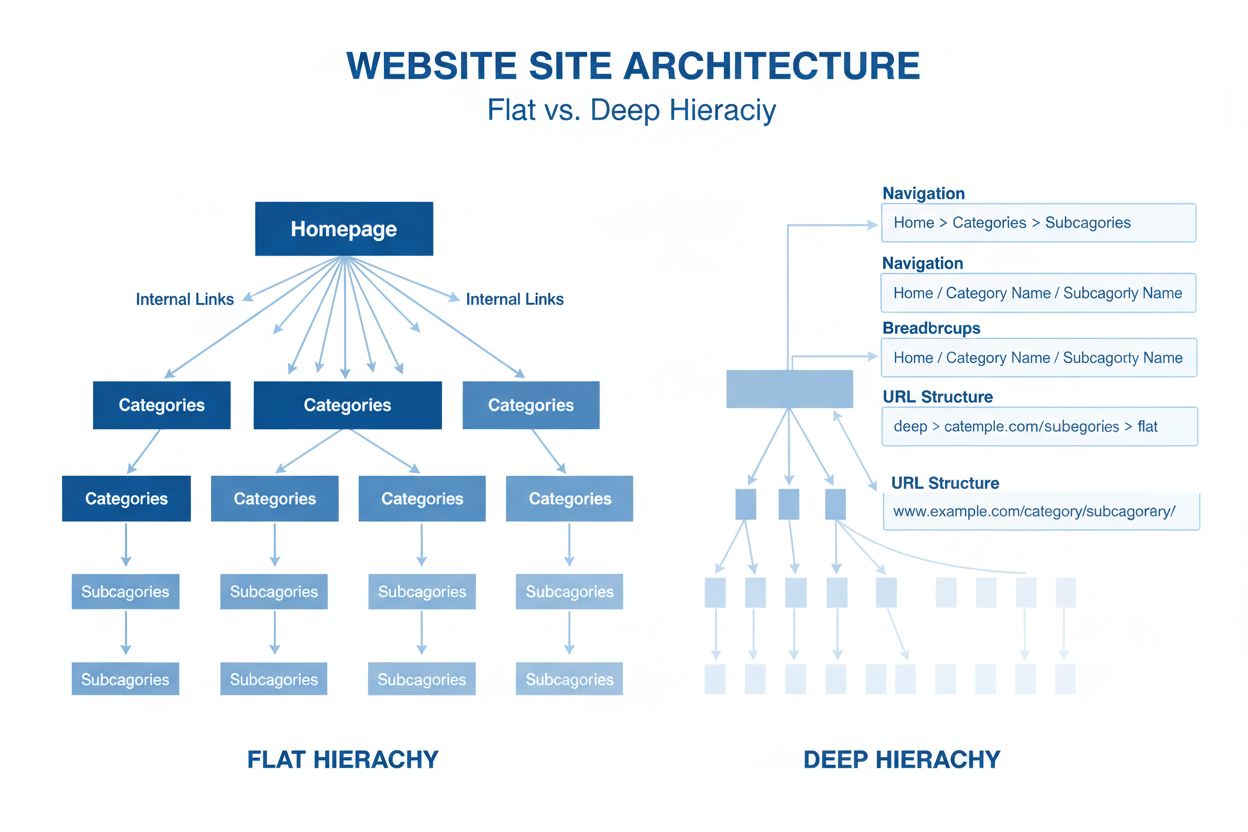
Site architecture is the hierarchical organization of website pages and content. Learn how proper site structure improves SEO, user experience, and AI monitorin...

Discover how website navigation structure impacts AI crawler accessibility, content discovery, and your brand's visibility in AI-powered search engines and answ...