
Return Visitor
Learn what return visitors are, how they're tracked using cookies and analytics, why they convert 73% more than new visitors, and their strategic importance for...
13 min read

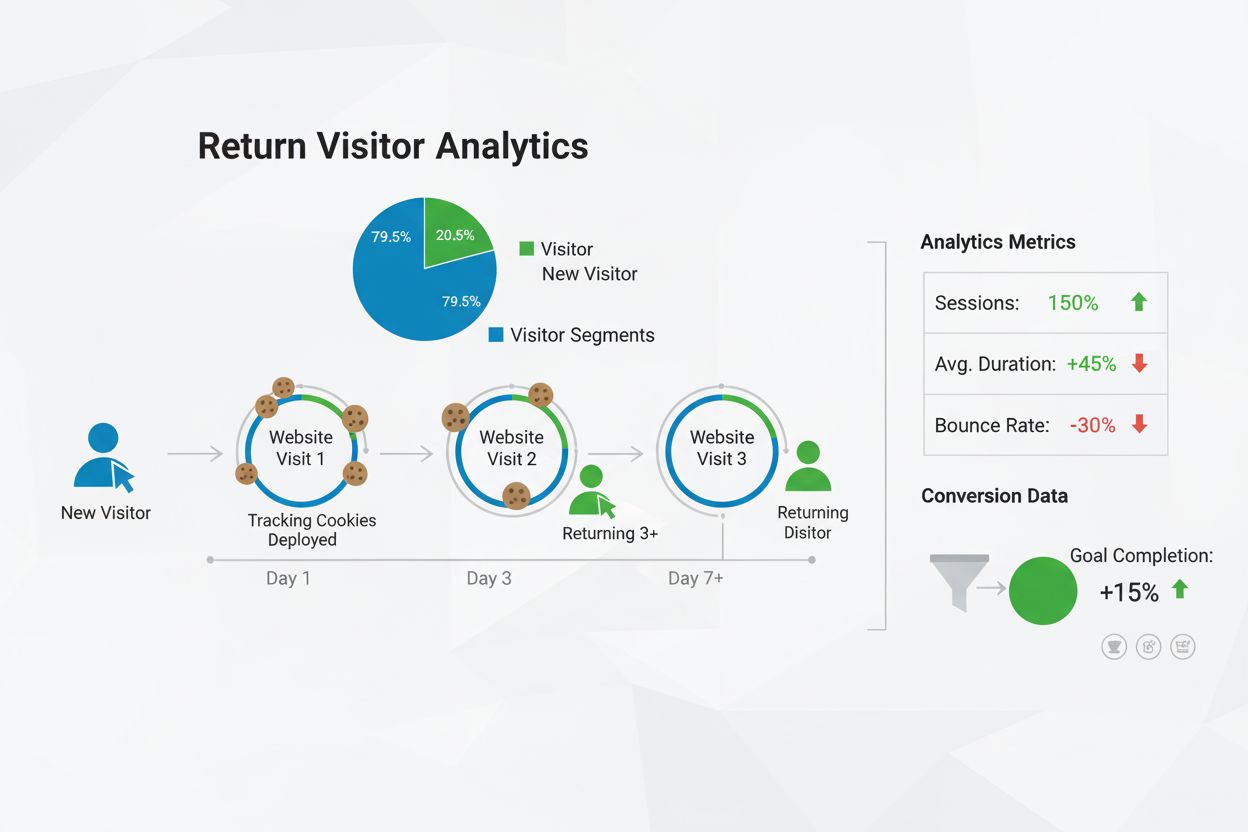
A new visitor is a user accessing a website for the first time, identified by the absence of a first-party cookie on their device. In analytics platforms, new visitors are tracked as distinct from returning visitors and represent the initial touchpoint in a user’s journey with a brand or domain.
A new visitor is a user accessing a website for the first time, identified by the absence of a first-party cookie on their device. In analytics platforms, new visitors are tracked as distinct from returning visitors and represent the initial touchpoint in a user's journey with a brand or domain.
A new visitor is a user accessing a website for the first time, identified in analytics systems by the absence of a first-party cookie on their device. In practical terms, new visitors represent the initial touchpoint in a user’s journey with a brand, domain, or specific URL. Analytics platforms like Google Analytics, Parse.ly, and other web tracking tools classify users as new based on cookie detection—if no cookie from your website exists on a user’s device within a defined time period (typically 30 days to 2 years depending on the platform), that user is counted as new. This distinction is fundamental to understanding audience acquisition, marketing effectiveness, and overall business growth, as new visitors represent untapped market potential and the expansion of your brand’s reach beyond existing customers.
The concept of new visitors extends beyond simple first-time access. New visitors are critical indicators of marketing channel effectiveness, content reach, and brand awareness. When you analyze new visitor metrics alongside other behavioral data—such as bounce rate, pages per session, and conversion rates—you gain insights into whether your acquisition strategies are attracting quality traffic or simply driving volume. For businesses operating in competitive markets, the ability to attract and convert new visitors directly impacts revenue growth, market share, and long-term sustainability. Understanding who these new visitors are, where they come from, and how they behave on your site enables data-driven decisions about content strategy, user experience optimization, and marketing budget allocation.
The practice of tracking new versus returning visitors emerged alongside the development of web analytics in the late 1990s and early 2000s. As websites became central to business operations, companies needed ways to understand audience composition and behavior. Cookie-based tracking technology became the standard method for distinguishing new from returning visitors, allowing websites to maintain persistent identifiers across sessions. This innovation transformed how businesses understood their audiences and enabled the development of sophisticated analytics platforms that could segment users, track journeys, and measure conversion funnels.
Over the past two decades, visitor tracking has become increasingly sophisticated. Modern analytics platforms now integrate first-party cookies with server-side tracking, cross-device identification, and machine learning algorithms to provide more accurate visitor classification. However, the fundamental principle remains unchanged: new visitors are identified by the absence of prior tracking data on a user’s device. The rise of privacy regulations like GDPR and CCPA, combined with browser changes limiting third-party cookies, has created new challenges for visitor tracking. Platforms now must balance accurate identification with user privacy, leading to innovations in consent management, first-party data collection, and privacy-preserving analytics approaches.
The importance of tracking new visitors has only increased as digital marketing has matured. According to industry research, companies that effectively segment and analyze new visitor behavior see significantly better conversion rates and customer acquisition efficiency. The average e-commerce website sees approximately 30% of traffic from returning visitors, with the remaining 70% representing new audience members. This ratio varies dramatically by industry—media sites often see 50-50 splits between new and returning visitors, while niche e-commerce businesses might see 80-90% new visitor traffic. Understanding these patterns and optimizing for new visitor acquisition has become a core competency for digital marketers, content strategists, and growth teams.
| Metric | New Visitor | Returning Visitor | New User (Session-Level) | Unique Visitor |
|---|---|---|---|---|
| Definition | User accessing site for first time; no prior cookie | User with existing cookie from previous visit | Session-level count of first-time sessions | Distinct individual counted once per period |
| Scope | User-level (permanent status) | User-level (permanent status) | Session-level (can occur multiple times) | User-level (aggregated count) |
| Tracking Method | Cookie absence detection | Cookie presence verification | Session initialization tracking | Unique identifier assignment |
| Bounce Rate | Typically 3x higher than returning | Lower, indicates engagement | Varies by session quality | Aggregate of both groups |
| Conversion Rate | Lower (baseline conversion) | 73% higher than new visitors | Depends on session quality | Combined metric |
| Time on Site | Shorter average duration | Significantly longer | Varies by session type | Average of both groups |
| Frequency | Can only occur once per user | Repeats with each return | Can occur multiple times per user | Single count per period |
| Business Value | Growth indicator, market expansion | Retention indicator, loyalty signal | Engagement quality measure | Overall audience size |
| Accuracy Challenges | Device/browser switching, incognito mode | Cookie deletion, privacy settings | Session boundary issues | Cross-device attribution gaps |
New visitor identification relies on first-party cookies—small data files stored on a user’s device that persist across browser sessions. When a user visits a website for the first time, the analytics platform generates a unique client ID and stores it in a cookie on their device. On subsequent visits from the same device and browser, the platform reads this cookie and classifies the user as returning. This cookie-based approach has been the industry standard for nearly two decades, though it faces increasing challenges from privacy regulations and browser changes.
The technical implementation of new visitor tracking involves several key components. First, the analytics platform must have permission to set cookies on the user’s device—typically granted through browser settings or explicit consent mechanisms. Second, the platform must assign a unique identifier to each new visitor, usually a randomly generated string that serves as the client ID. Third, the platform must store this identifier in a cookie with an appropriate expiration date—Google Analytics uses a 2-year default, though this varies by platform. Finally, on each subsequent visit, the platform must read the cookie, verify the client ID, and classify the user accordingly. This process happens automatically and invisibly to the user, occurring within milliseconds of page load.
However, cookie-based tracking has significant limitations that affect new visitor count accuracy. Users visiting from different devices are counted as new on each device, even if they’re the same person. Users in incognito or private browsing mode don’t receive persistent cookies, so they’re counted as new every visit. Users who delete cookies or deny cookie consent are tracked as new repeatedly. Additionally, privacy-conscious users and those with strict browser settings may not receive cookies at all. These limitations mean that new visitor counts are inherently inflated—the actual number of unique new people visiting your site is likely lower than reported. Despite these challenges, new visitor metrics remain valuable for understanding audience acquisition trends and comparing performance across time periods and marketing channels.
The behavioral differences between new and returning visitors are dramatic and have profound implications for business strategy. Returning visitors spend significantly more time on websites than new visitors, typically 2-3x longer on average. They visit more pages per session, have lower bounce rates, and are substantially more likely to complete desired actions like purchases, form submissions, or newsletter signups. Research shows that retained visitors convert 73% more than first-time visitors, making visitor retention a critical business priority. This conversion advantage stems from familiarity—returning visitors already understand your value proposition, have evaluated your offerings, and have decided to engage further.
New visitors, by contrast, arrive with no context about your brand, products, or services. They’re evaluating whether your site deserves their attention and whether you offer solutions to their problems. This evaluation period creates friction—new visitors need more information, more reassurance, and more compelling reasons to take action. They’re more likely to bounce (leave without visiting a second page), spend less time exploring, and require more persuasive messaging to convert. However, new visitors represent essential growth opportunities. Without continuous acquisition of new visitors, businesses cannot expand their customer base or reach new market segments. The challenge is balancing acquisition investment with retention efforts to maintain healthy business growth.
The quality of new visitors varies significantly based on traffic source. New visitors from organic search typically have higher intent and better conversion potential than new visitors from display advertising or social media. New visitors from referral traffic often have higher quality than those from paid ads, as they arrive with implicit endorsement from the referring source. Understanding these quality differences enables marketers to optimize acquisition channels, allocate budgets more effectively, and set realistic conversion expectations for different traffic sources. A healthy digital marketing strategy requires continuous optimization of both new visitor acquisition and returning visitor engagement, with investment levels adjusted based on business goals and market conditions.
In the emerging landscape of AI search and generative engine optimization (GEO), new visitor tracking takes on additional significance. Platforms like ChatGPT, Perplexity, Google AI Overviews, and Claude generate responses that may include brand mentions and recommendations. When these AI systems recommend your brand to users, those users often become new visitors to your website. Understanding new visitor patterns helps identify whether your brand is gaining visibility in AI-generated responses and whether that visibility translates to actual traffic and engagement.
AmICited and similar AI monitoring platforms track how often brands appear in AI-generated responses, providing insights into AI visibility that complement traditional analytics. When you see spikes in new visitor traffic from AI search sources, it indicates your brand is being mentioned in AI responses. Conversely, if you’re not seeing new visitor growth from AI channels despite investing in content optimization, it suggests your brand lacks visibility in AI-generated recommendations. This connection between AI monitoring and new visitor analytics creates a feedback loop—you can optimize content for AI visibility, measure the impact through new visitor acquisition, and refine your strategy based on results.
The importance of new visitors in the AI search context extends beyond simple traffic metrics. New visitors discovering your brand through AI recommendations represent a fundamentally different audience segment than those finding you through traditional search or paid advertising. These users have been pre-qualified by AI systems as relevant to their queries, suggesting higher intent and better conversion potential. Additionally, new visitors from AI sources may have different expectations and information needs than those from other channels. Understanding these differences enables marketers to create landing pages and content experiences specifically optimized for AI-sourced new visitors, improving conversion rates and maximizing the value of AI visibility investments.
The future of new visitor tracking is being shaped by significant shifts in privacy regulations, browser technology, and data collection practices. The deprecation of third-party cookies and increasing restrictions on tracking technologies are forcing analytics platforms to innovate new approaches to visitor identification. First-party data collection—information users willingly provide through forms, accounts, and explicit consent—is becoming increasingly important. Platforms are developing consent management systems, privacy-preserving analytics approaches, and server-side tracking methods that maintain visitor identification while respecting user privacy.
Machine learning and artificial intelligence are enabling more sophisticated visitor identification and behavior prediction despite reduced tracking data. Platforms can now infer visitor characteristics, predict behavior, and identify returning visitors with greater accuracy using contextual signals, behavioral patterns, and probabilistic modeling. Cross-device identification is improving through login-based tracking and machine learning algorithms that recognize the same person across devices. These advances suggest that new visitor tracking will become more accurate and privacy-compliant simultaneously, though the transition period creates challenges for marketers accustomed to cookie-based approaches.
The integration of AI monitoring with traditional analytics represents another significant trend. As brands increasingly invest in AI visibility and generative engine optimization, the ability to track new visitors specifically from AI sources becomes critical. Future analytics platforms will likely provide deeper integration between AI mention tracking and new visitor analytics, enabling marketers to see exactly how AI visibility translates to traffic, engagement, and conversions. This convergence of AI monitoring and visitor analytics will create new opportunities for optimization and new challenges for attribution—understanding which AI mentions drive which new visitors and which of those visitors convert will require sophisticated cross-platform tracking and analysis capabilities.
The regulatory environment continues to evolve, with GDPR, CCPA, and emerging privacy laws creating new requirements for visitor tracking and data handling. Compliance with these regulations while maintaining effective visitor identification requires careful implementation of consent management, data minimization, and privacy-by-design principles. Organizations that successfully navigate this transition—maintaining accurate visitor tracking while respecting privacy—will gain competitive advantages in understanding their audiences and optimizing marketing effectiveness. The future of new visitor tracking is not about collecting more data, but about collecting the right data, using it responsibly, and extracting maximum insight from privacy-compliant information sources.
Google Analytics identifies new visitors by checking for first-party cookies on a user's device. If no cookie exists from your website, the user is classified as new. The platform sets a 2-year expiration date on this classification, meaning if someone returns within 2 years from the same device and browser, they're marked as returning. However, if a user visits from a different device, browser, or in incognito mode, they'll be counted as new again even if they've visited before.
New visitors and new users are session-level versus user-level metrics. A new user refers to the session-level status—how many times a session was started by someone visiting for the first time. A new visitor is user-level status, meaning a person can only be counted as a new visitor once, even if they create multiple new sessions. This distinction explains why new user counts can be higher than new visitor counts, particularly when sessions break at midnight.
New visitor counts have inherent accuracy limitations because cookies are browser and device-specific. A returning visitor counted as new if they use a different device, browser, or incognito mode. Additionally, users who deny cookies are tracked as new every visit, inflating new visitor numbers. Privacy regulations and cookie deletion also affect accuracy. Despite these limitations, tracking new visitors still provides valuable insights into business health and audience acquisition effectiveness.
The ideal new-to-returning visitor ratio depends on your business type and goals. For media and content websites, a 50-50 split indicates strong reader retention. For e-commerce, approximately 30% returning visitors is considered healthy, showing a balance between customer acquisition and retention. Performance-focused businesses may prioritize new visitors, while subscription or community-based sites should aim for higher returning visitor percentages. Context matters—marketing campaigns naturally increase new visitor ratios temporarily.
New visitors typically have higher bounce rates and lower conversion rates than returning visitors. Research shows returning visitors convert 73% more than first-time visitors and spend significantly more time on websites. However, new visitors are essential for business growth and represent untapped market potential. The key is optimizing landing pages and user experience specifically for new visitors while simultaneously nurturing returning visitors through targeted messaging and personalization strategies.
Effective strategies include creating SEO-optimized blog content (which drives 53% of website traffic on average), investing in paid advertising to reach new audiences, maintaining active social media presence, developing a backlinking strategy, guest posting on relevant websites, getting featured in review sites and articles, and sponsoring industry newsletters. Each tactic should be tested individually to identify what works best for your specific audience and business model before scaling investment.
Tracking new visitors helps understand how your brand attracts fresh audiences and whether your content and marketing efforts reach new people. In the context of AI monitoring platforms like AmICited, understanding new visitor patterns reveals whether your brand appears in AI-generated recommendations and how effectively you're capturing attention from first-time users discovering your brand through AI search engines like ChatGPT, Perplexity, and Google AI Overviews.
Start tracking how AI chatbots mention your brand across ChatGPT, Perplexity, and other platforms. Get actionable insights to improve your AI presence.
Learn what return visitors are, how they're tracked using cookies and analytics, why they convert 73% more than new visitors, and their strategic importance for...
Learn what an entry page is, why it matters for user engagement and conversions, and how to optimize entry pages to reduce bounce rates and improve website perf...
Referral traffic definition: visitors from external websites. Learn how referral traffic works, its importance for SEO, conversion rates, and strategies to incr...
Cookie Consent
We use cookies to enhance your browsing experience and analyze our traffic. See our privacy policy.