

How to Implement Organization Schema for AI - Complete Guide
Learn how to implement Organization schema markup for AI visibility. Step-by-step guide to add JSON-LD structured data, improve AI citations, and enhance brand ...
9 min read

Organization Schema is a structured data markup type that helps search engines and AI systems understand company information such as name, logo, address, contact details, and business relationships. Implementing Organization Schema enables rich results, knowledge panels, and improved visibility in AI-powered search engines like Google AI Overviews, Perplexity, and Claude.
Organization Schema is a structured data markup type that helps search engines and AI systems understand company information such as name, logo, address, contact details, and business relationships. Implementing Organization Schema enables rich results, knowledge panels, and improved visibility in AI-powered search engines like Google AI Overviews, Perplexity, and Claude.
Organization Schema is a standardized structured data markup format that communicates company information to search engines and artificial intelligence systems in a machine-readable language. Defined by Schema.org and supported by major search engines including Google, Bing, and Yandex, Organization Schema uses JSON-LD, microdata, or RDFa syntax to describe administrative details about an organization—such as its name, logo, address, contact information, social media profiles, and business relationships. When properly implemented, Organization Schema enables search engines to display rich results, knowledge panels, and enhanced SERP features that showcase your organization’s key information. For AI-powered search platforms like Google AI Overviews, Perplexity, ChatGPT, and Claude, Organization Schema provides the structured context necessary for accurate citations and brand attribution in generative responses. This markup is not a ranking factor itself, but it significantly improves how your organization is understood, displayed, and cited across both traditional search results and emerging AI search experiences.
Organization Schema emerged as part of the broader Schema.org initiative, launched in 2011 by a collaborative effort between Google, Microsoft, Yahoo, and Yandex to standardize structured data markup across the web. Initially, organizations relied on unstructured HTML and meta tags to communicate business information, which limited search engines’ ability to accurately parse and display company details. The introduction of Organization Schema provided a formal vocabulary for describing organizational entities, enabling search engines to build more accurate knowledge graphs and display richer information in search results. Over the past decade, adoption has grown significantly: according to research from the Stanford AI Index Report, 78% of organizations reported using AI-driven tools in 2024, up from 55% in 2023, reflecting the increasing importance of machine-readable data. As generative AI systems have become more prevalent, Organization Schema has evolved from a nice-to-have SEO enhancement to a critical component of brand visibility strategy. Today, organizations that implement comprehensive Organization Schema markup gain competitive advantages in AI search visibility, knowledge panel eligibility, and brand disambiguation across multiple platforms. The schema continues to expand with new properties and subtypes to accommodate emerging use cases, such as merchant return policies, shipping services, and member programs for e-commerce organizations.
Organization Schema is implemented using JSON-LD (JavaScript Object Notation for Linked Data), which is the recommended format by Google and most SEO professionals due to its simplicity and maintainability. A basic Organization Schema markup includes a <script> tag with type="application/ld+json" placed in the <head> or <body> section of your website’s HTML. The markup contains a JSON object with @context set to “https://schema.org
” and @type set to “Organization” or a more specific subtype. Key properties include name (organization name), url (website URL), logo (logo image URL), address (postal address with street, locality, region, postal code, and country), contactPoint (phone and email), description (business overview), and sameAs (links to social media profiles and verified business listings). For organizations seeking enhanced AI visibility, including properties like foundingDate, numberOfEmployees, iso6523Code, vatID, and taxID strengthens entity disambiguation and trust signals. The @id property is particularly important for AI systems, as it provides a persistent, unique identifier for your organization that can be referenced across multiple pages and linked to other entities like authors (Person Schema) and content (Article Schema). According to Google Search Central documentation, there are no strictly required properties; however, adding as many relevant properties as possible improves the quality and usefulness of the structured data for both search engines and AI systems.
| Schema Type | Primary Use Case | Key Differentiator | Best For | AI Search Relevance |
|---|---|---|---|---|
| Organization | General company information | Broad applicability to any organization type | Corporations, NGOs, educational institutions, media companies | High—provides core entity context for AI citations |
| LocalBusiness | Location-specific business details | Includes opening hours, service areas, geo-coordinates | Restaurants, retail stores, service providers with physical locations | Medium-High—adds geographic context for local AI recommendations |
| OnlineStore | E-commerce business information | Includes shipping policies, return policies, product catalogs | Online retailers, marketplaces, digital service providers | High—enables product and merchant citations in AI shopping responses |
| Corporation | Large corporate entities | Subtype of Organization with emphasis on corporate structure | Public companies, multinational enterprises | High—supports complex organizational hierarchies in AI knowledge graphs |
| EducationalOrganization | Schools, universities, training institutions | Includes alumni, courses, accreditation details | Universities, colleges, online learning platforms | Medium—supports educational entity recognition in AI responses |
| NewsMediaOrganization | News publishers and media outlets | Includes editorial policies, corrections, diversity statements | News sites, journalism platforms, media companies | High—critical for news citation and credibility in AI overviews |
| Person | Individual professional or author | Represents people, not organizations | Authors, experts, company founders | High—when linked to Organization, strengthens E-E-A-T signals |
| Article/BlogPosting | Content pieces | Describes individual articles, not the organization | Blog posts, news articles, guides | High—when combined with Organization markup, improves content attribution |
Organization Schema serves as a bridge between human-readable web content and machine-readable data structures that search engines and AI systems require to understand, verify, and cite information accurately. Traditional search engines like Google use Organization Schema to populate knowledge panels, which are information boxes displayed on the right side of search results that showcase company name, logo, address, phone number, website, and social media links. These knowledge panels increase click-through rates and brand visibility, as they provide users with immediate access to key organizational information without requiring them to visit the website. For AI-powered search engines and large language models (LLMs), Organization Schema is even more critical. Generative AI systems like Google AI Overviews, Perplexity, ChatGPT, and Claude rely on structured data to disambiguate entities, verify facts, and attribute information to authoritative sources. When an AI system encounters a query about a company, it searches for Organization Schema markup to confirm the organization’s identity, retrieve verified contact information, and establish credibility signals. Research indicates that organizations with comprehensive, accurate Organization Schema markup are more likely to be cited correctly in AI-generated responses, which directly impacts brand visibility in the emerging AI search landscape. Additionally, Organization Schema helps prevent brand confusion and impersonation by providing a canonical source of truth for organizational information, reducing the likelihood that AI systems will conflate your organization with competitors or similarly-named entities.
Different AI search platforms and LLMs process Organization Schema with varying levels of sophistication, and understanding these differences is essential for optimizing your markup strategy. Google AI Overviews (formerly SGE) prioritizes Organization Schema when generating summaries of company information, using the markup to verify business details, extract contact information, and attribute content to the correct organization. Google’s systems cross-reference Organization Schema with Google Business Profile data, so consistency between these sources is critical. Perplexity, an AI search engine that emphasizes cited sources, actively uses Organization Schema to identify and credit organizations in its responses. When Perplexity encounters well-structured Organization Schema, it is more likely to cite your organization as a source and display your company information prominently in its answers. ChatGPT and other OpenAI models benefit from Organization Schema during their training phase and when processing real-time information through plugins and integrations. While ChatGPT’s knowledge cutoff limits its reliance on current web data, organizations with robust Organization Schema are more likely to be correctly identified and represented in responses about company information. Claude (Anthropic’s LLM) similarly uses structured data to improve entity recognition and reduce hallucinations about organizational details. For all these platforms, the consistency and completeness of your Organization Schema directly influence how accurately your organization is represented in AI-generated content. Organizations should ensure that their Organization Schema includes persistent @id values, multiple sameAs links to verified business profiles (LinkedIn, Crunchbase, Wikipedia), and accurate, up-to-date information that matches across all web properties.
Effective Organization Schema implementation requires a strategic, systematic approach that goes beyond simply adding markup to your homepage. First, choose the most specific schema subtype that matches your organization’s nature. If you operate an online store, use OnlineStore instead of generic Organization. If you’re a news publisher, use NewsMediaOrganization. This specificity helps AI systems understand your organization’s primary function and retrieve more relevant properties. Second, establish a persistent entity identifier by assigning a stable @id value to your organization (e.g., https://yourcompany.com/organization/main). This identifier should remain consistent across all pages and be referenced when linking to related entities like authors or content. Third, populate sameAs links comprehensively by including URLs to your organization’s verified profiles on LinkedIn, Crunchbase, Wikipedia, Twitter, Facebook, and industry-specific directories. These links help AI systems and search engines disambiguate your organization and establish its authority. Fourth, ensure data consistency across all web properties. Your Organization Schema should match information on your Google Business Profile, website footer, social media profiles, and business registries. Inconsistencies erode machine trust and can lead to incorrect citations in AI responses. Fifth, include supplementary properties that strengthen E-E-A-T signals, such as foundingDate, numberOfEmployees, awards, certifications, and contactPoint with multiple contact methods. Sixth, validate your markup using Google’s Rich Results Test, Schema.org’s Markup Validator, and Semrush’s Site Audit tool to identify errors and warnings before deployment. Finally, monitor performance by tracking impressions, clicks, and average position for pages with Organization Schema, and compare these metrics against control pages to isolate the impact of structured data on visibility.
As artificial intelligence becomes increasingly central to how users discover information, Organization Schema is evolving to meet new demands for entity verification, attribution, and trust. Historically, Organization Schema was primarily used to enhance traditional search results and knowledge panels. Today, its role has expanded to support AI citation, brand attribution in generative responses, and entity disambiguation across multiple AI platforms. The Schema.org community continues to add new properties and subtypes to accommodate emerging use cases: for example, recent additions include hasMemberProgram for loyalty programs, hasShippingService for detailed shipping policies, and hasMerchantReturnPolicy for return procedures. These additions reflect the growing importance of structured data in e-commerce and customer service contexts, where AI systems need to provide detailed, accurate information to users. Additionally, the integration of Organization Schema with knowledge graphs—both Google’s Knowledge Graph and proprietary knowledge graphs used by AI companies—has become more sophisticated. AI systems now use Organization Schema not just to extract basic company information, but to understand organizational relationships, industry classifications, and competitive positioning. Looking forward, Organization Schema will likely become even more critical as AI systems move beyond simple information retrieval to more complex tasks like competitive analysis, market research, and business intelligence. Organizations that invest in comprehensive, accurate Organization Schema markup today will be better positioned to benefit from these emerging AI capabilities and maintain visibility as search continues to evolve.
Measuring the impact of Organization Schema requires a multi-layered approach that tracks both traditional SEO metrics and AI-specific visibility indicators. Traditional SEO metrics include impressions, clicks, and average position for pages with Organization Schema compared to control pages without markup. Using Google Search Console, you can filter for branded queries and observe whether Organization Schema implementation correlates with increased impressions or click-through rates. Knowledge panel metrics can be tracked by monitoring whether your organization’s knowledge panel appears in search results and whether it displays the information from your Organization Schema markup correctly. AI search visibility metrics are more challenging to measure but increasingly important. Tools like AmICited allow you to track mentions of your organization across AI platforms like ChatGPT, Perplexity, Google AI Overviews, and Claude, and verify whether your Organization Schema information is being cited accurately. Engagement metrics such as time on page, scroll depth, and conversion rate for users arriving from AI-generated summaries can indicate whether AI citations are driving qualified traffic. Brand consistency metrics measure how consistently your organization is represented across AI platforms—for example, whether your logo, description, and contact information are displayed correctly in multiple AI systems. According to research from Single Grain, organizations that implement comprehensive schema markup and align their entity strategy with content and internal linking see measurable gains in AI visibility, with some case studies reporting 75% increases in AI Overview appearances and 100% lifts in Gemini citations. To establish a baseline, conduct a pre-implementation audit of your current AI search visibility, then implement Organization Schema systematically and re-measure after 4-8 weeks to isolate the impact.
Many organizations implement Organization Schema incorrectly or incompletely, which can limit its effectiveness or even trigger search engine penalties. Inconsistent data is one of the most common mistakes: if your Organization Schema lists a different address, phone number, or business description than what appears on your website or Google Business Profile, search engines and AI systems will flag this as unreliable. Always maintain a single source of truth for organizational information and synchronize it across all channels. Missing or incorrect sameAs links reduce your organization’s ability to be disambiguated and verified by AI systems. Ensure that every sameAs link points to an actual, verified profile of your organization, not to competitor pages or unrelated websites. Outdated information in Organization Schema can mislead both users and AI systems. If your organization moves, changes its phone number, or updates its business description, update your Organization Schema immediately. Incomplete markup that omits key properties like logo, address, or contactPoint limits the richness of information available to search engines and AI systems. Aim to populate as many relevant properties as possible, even if some are optional. Using generic or non-specific schema subtypes when more specific ones are available reduces the precision of information available to AI systems. For example, using generic Organization instead of OnlineStore for an e-commerce business misses opportunities to include e-commerce-specific properties. Duplicate or conflicting @id values across multiple pages or properties can confuse AI systems about your organization’s identity. Assign a single, persistent @id to your organization and reference it consistently. Ignoring validation errors from tools like Google’s Rich Results Test or Schema.org’s Markup Validator can result in your Organization Schema being ignored by search engines. Always validate your markup and fix any errors or warnings before deployment.
The future of Organization Schema is inextricably linked to the evolution of AI search and knowledge graph technologies. As generative AI systems become more sophisticated and widely adopted, the demand for accurate, verifiable organizational information will only increase. Several trends are likely to shape the future of Organization Schema: First, increased emphasis on entity verification and trust signals. As AI systems become more powerful, they will place greater emphasis on verifiable, authoritative sources of organizational information. Organizations with comprehensive Organization Schema markup, verified business credentials, and consistent information across multiple platforms will gain competitive advantages in AI search visibility. Second, deeper integration with knowledge graphs. AI systems will increasingly use Organization Schema to build and maintain knowledge graphs that capture not just basic organizational information, but complex relationships between organizations, people, products, and industries. This will require more sophisticated use of properties like parentOrganization, member, founder, and award. Third, expansion of schema properties for emerging business models. As new business models emerge—such as decentralized organizations, virtual companies, and AI-driven enterprises—Schema.org will likely expand Organization Schema to accommodate these new organizational forms. Fourth, real-time schema validation and monitoring. Tools like AmICited will become increasingly important for organizations to monitor how their Organization Schema is being interpreted and cited across multiple AI platforms in real-time. Fifth, integration with regulatory and compliance frameworks. As governments and regulatory bodies establish standards for AI transparency and accountability, Organization Schema may be extended to include compliance-related properties that help AI systems verify organizational legitimacy and regulatory status. Organizations that stay ahead of these trends by investing in comprehensive, accurate Organization Schema markup will be better positioned to maintain visibility and credibility as AI search continues to evolve.
Organization Schema is a general-purpose markup for any type of organization (corporations, NGOs, educational institutions, etc.) and focuses on company-level administrative details like name, logo, and contact information. LocalBusiness Schema is a more specific subtype designed for businesses with physical locations, including properties like opening hours, service areas, and geographic coordinates. If your organization has a physical storefront or office, LocalBusiness is more appropriate; for corporate entities without location-specific details, Organization Schema is sufficient.
Organization Schema provides AI systems with machine-readable company information, making it easier for generative engines like ChatGPT, Google AI Overviews, and Perplexity to cite your organization accurately in responses. When properly implemented with consistent entity identifiers (@id), sameAs links, and verified business details, your organization becomes more discoverable and trustworthy to AI models. Research shows that 78% of organizations now use AI-driven tools, and structured data is critical for ensuring your brand appears correctly in AI-generated summaries and recommendations.
Organization Schema has no strictly required properties; however, Google recommends including as many relevant properties as possible. Essential properties typically include: name (organization name), url (website), logo (company logo URL), address (physical or mailing address), contactPoint (phone/email), and description (business overview). For enhanced AI visibility, also include sameAs (links to social profiles and verified business listings), foundingDate, and numberOfEmployees. The more complete your markup, the better search engines and AI systems can understand and represent your organization.
Yes, Organization Schema is specifically designed to disambiguate your organization from others with similar names. By including properties like iso6523Code, leiCode, vatID, taxID, and multiple sameAs links to authoritative sources (Wikipedia, Crunchbase, LinkedIn), you help search engines and AI systems correctly identify your unique organization. This is especially important for companies with common names or those operating in multiple countries, as it ensures your brand is properly distinguished in knowledge graphs and AI responses.
For multi-location businesses, implement Organization Schema at the corporate level on your homepage with the main company details, then use LocalBusiness Schema for each individual location. Include multiple address entries in the Organization Schema's address property (as an array), or create separate LocalBusiness markup for each branch with a parentOrganization property linking back to the main Organization. This hierarchical approach helps AI systems understand your corporate structure while maintaining location-specific information for local search and AI recommendations.
Organization Schema strengthens E-E-A-T (Experience, Expertise, Authoritativeness, Trustworthiness) signals by providing verifiable, structured information about your organization's credentials, history, and authority. Including properties like foundingDate, numberOfEmployees, awards, certifications, and links to verified business profiles (sameAs) demonstrates organizational legitimacy. When combined with author markup (Person Schema) and high-quality content, Organization Schema helps AI systems and search engines assess your organization's trustworthiness, which is increasingly important for AI citation and ranking in generative search results.
Organization Schema is the primary, standardized schema type defined by Schema.org for representing organizations of all kinds. There is no separate 'Company' or 'Business' schema type in the official Schema.org vocabulary; instead, Organization serves as the parent type with specialized subtypes like Corporation, LocalBusiness, OnlineStore, and EducationalOrganization. Using Organization or its appropriate subtype ensures compatibility with search engines and AI systems, whereas non-standard schema types may not be recognized or processed correctly.
Start tracking how AI chatbots mention your brand across ChatGPT, Perplexity, and other platforms. Get actionable insights to improve your AI presence.
Learn how to implement Organization schema markup for AI visibility. Step-by-step guide to add JSON-LD structured data, improve AI citations, and enhance brand ...
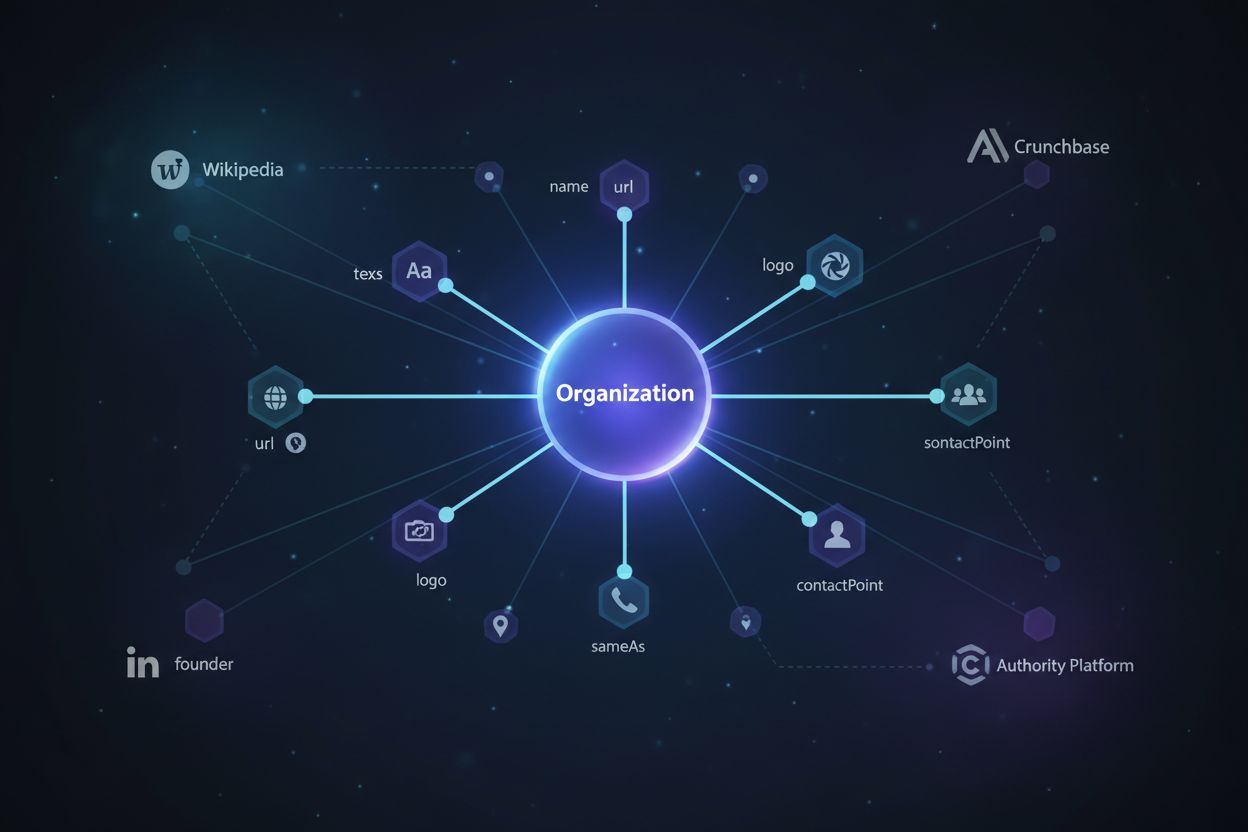
Learn how Organization schema helps AI systems understand and cite your brand. Complete guide to brand entity markup for LLM visibility and AI citations.
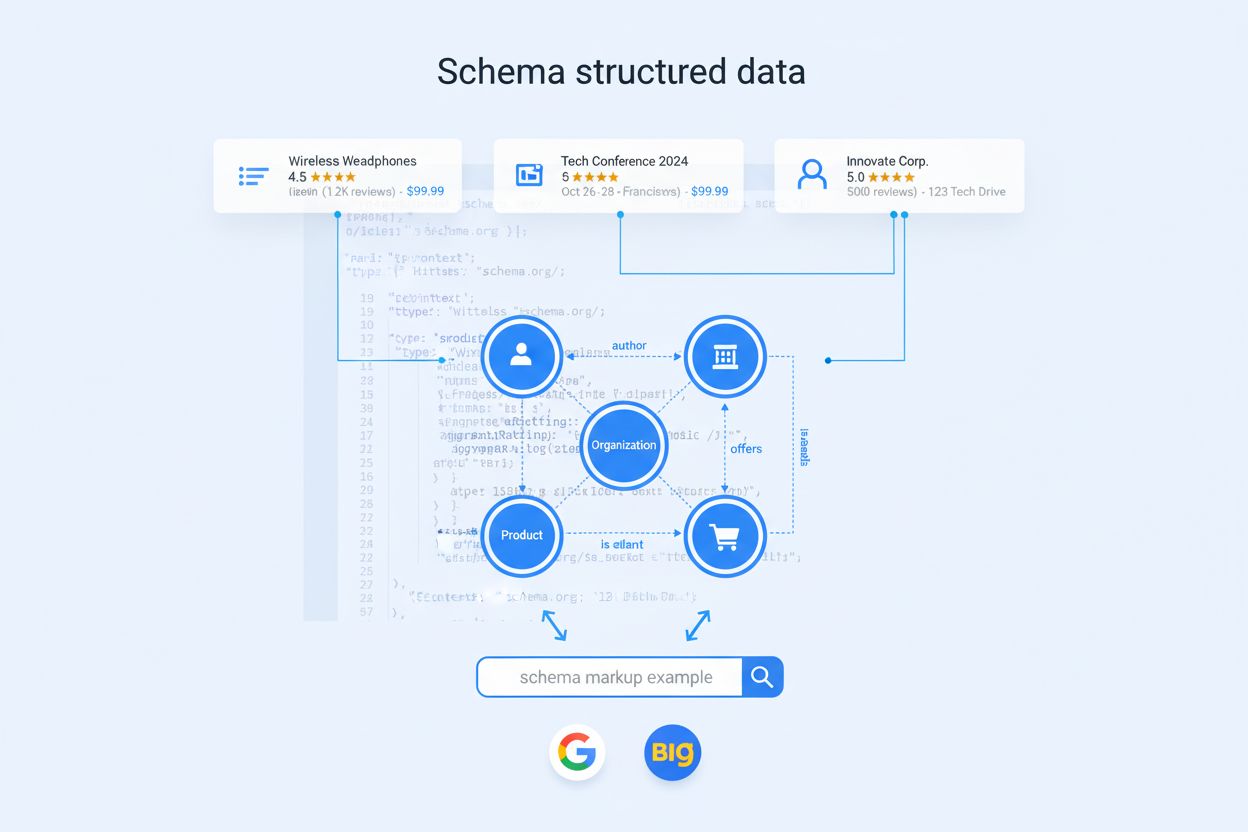
Schema markup is standardized code that helps search engines understand content. Learn how structured data improves SEO, enables rich results, and supports AI s...