


- OTT advertising is video advertising on streaming services delivered over the internet, on smart TVs, streaming sticks, phones, tablets and laptops.
- It is bought per thousand impressions (CPM) and targeted by audience, either directly from publishers or through a DSP. Most premium spots are 15 or 30 seconds and cannot be skipped.
- Viewers rarely click a TV ad, so judge OTT by completion rate, cost per completed view, reach, frequency and lift in holdout tests.
- OTT describes the delivery, CTV the screen. Most OTT spend ends up on TV screens, which is why the terms get mixed up.
Where AmICited fits
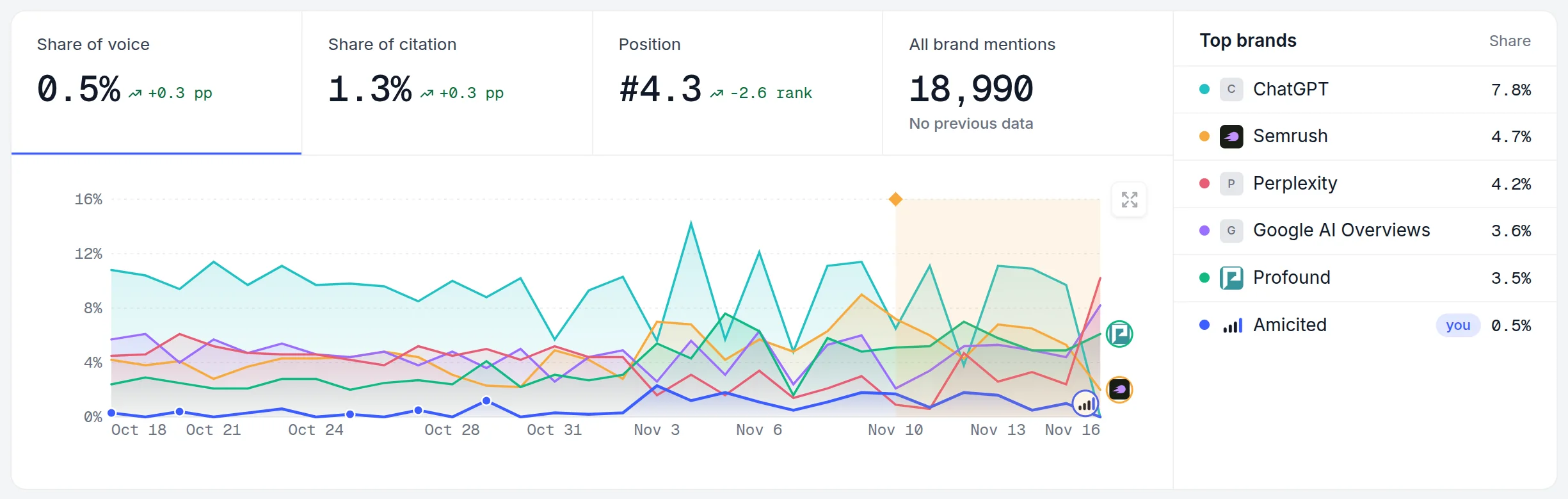
Streaming ads do not change what AI engines say about you, but they raise branded searches and questions. AmICited splits your search clicks into brand and non-brand and tracks your AI share of voice, so during a campaign you can see whether the extra interest ends with your brand.
See AI visibility tracking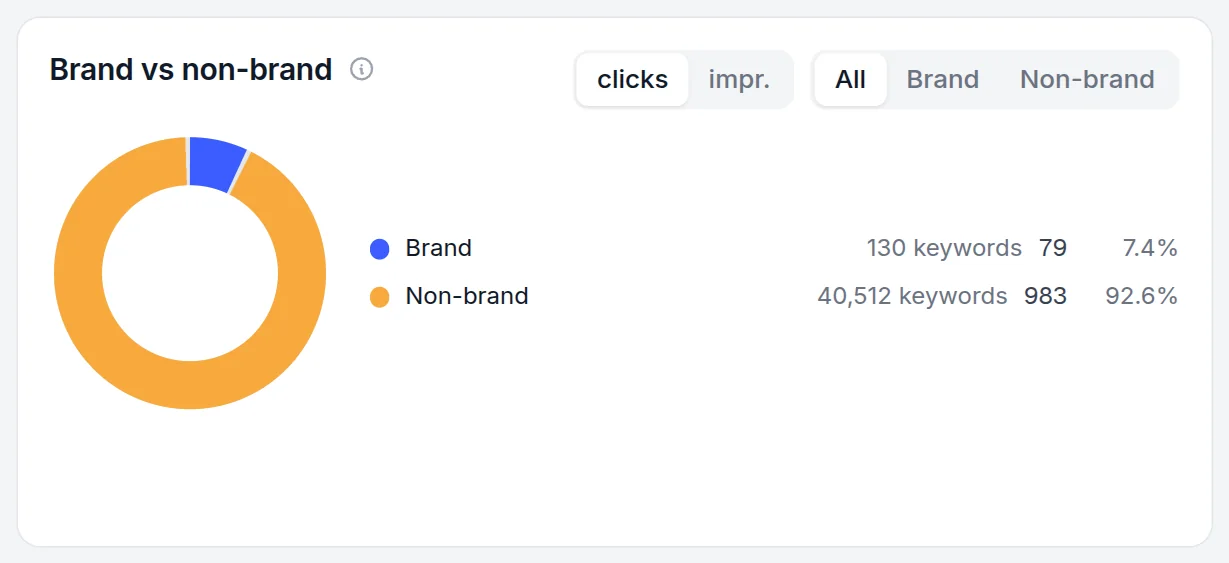
What Is OTT Advertising?
OTT advertising is video advertising delivered through streaming services that reach viewers “over the top” of traditional cable and satellite distribution. If you watch a show on the ad-supported tier of Hulu, Peacock, Netflix, Max, Pluto TV, Tubi or Amazon Prime Video and see an ad break, that is OTT advertising. It plays on any device that streams: a smart TV, a streaming stick, a phone, a tablet or a laptop.
Brands use OTT to get TV-style video in front of audiences that have cut the cord or watch mostly streaming. Unlike linear TV, where you buy a time slot on a network, OTT is sold by the impression and targeted by audience: location, demographics, interests or the brand’s own customer lists. It is bought directly from publishers, through their self-serve platforms, or through a demand-side platform as part of programmatic advertising.
How OTT Advertising Works
- A viewer starts a stream. The streaming app reaches an ad break: pre-roll before the show, mid-roll inside it, or a pause ad when the viewer pauses.
- The app requests ads. For server-side ad insertion, the platform stitches ads into the video stream so they play like normal TV and are harder to block.
- Ads are selected. Direct campaigns are delivered according to the deal. Programmatic slots go to an auction or a private deal between the publisher’s SSP and buyers’ DSPs.
- The ad plays. Most premium OTT ads are 15 or 30 seconds and non-skippable.
- Delivery is reported. Impressions, completion rate, reach and frequency, and sometimes household-level outcomes.
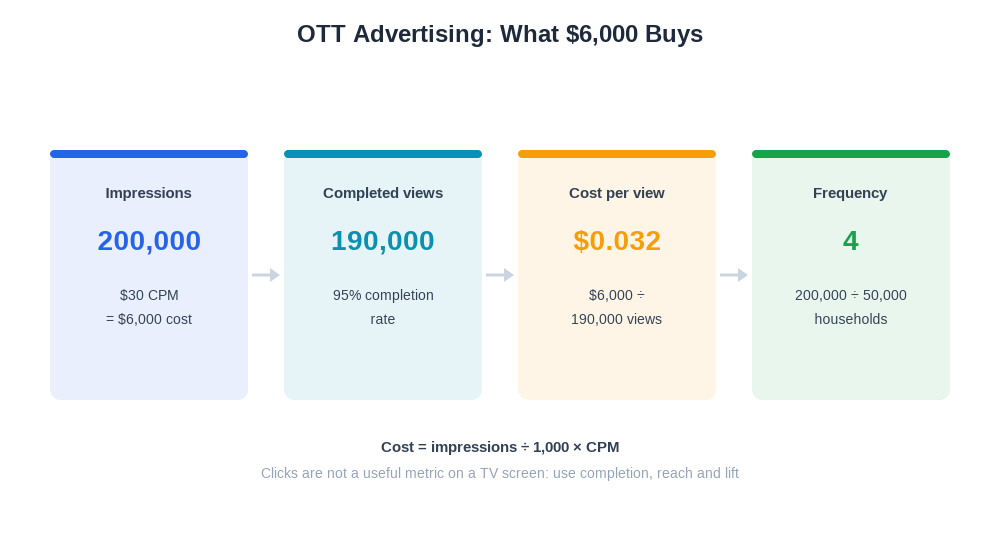
Cost is measured as CPM, cost per thousand impressions. Because clicks are not meaningful on a TV, buyers also look at cost per completed view (CPCV):
Cost = (Impressions ÷ 1,000) × CPM and CPCV = Cost ÷ Completed views
Say you buy 200,000 impressions at a $30 CPM. Cost is 200 × $30 = $6,000. With a 95% completion rate you get 190,000 completed views, so CPCV is 6,000 ÷ 190,000 = about $0.032. If those impressions reach 50,000 households, average frequency is 200,000 ÷ 50,000 = 4.
OTT vs CTV vs Linear TV
These terms overlap, and people use them loosely. Here is how they differ.
| OTT advertising | CTV advertising | Linear TV | |
|---|---|---|---|
| Defined by | Delivery over the internet | The screen: an internet-connected TV | Scheduled broadcast or cable |
| Devices | TV, mobile, tablet, desktop | TV only (smart TV, stick, console) | TV |
| Buying unit | Impression (CPM) | Impression (CPM) | Time slot, ratings points |
| Targeting | Audience, location, device | Audience, household, location | Program, daypart, region |
| Measurement | Impressions, completion, outcome matching | Same, at household level | Ratings panels |
| Interaction | Possible on mobile and desktop | QR codes, remote prompts | None |
In practice, most OTT spend ends up on TV screens, which is why “OTT” and “CTV” are often used interchangeably. The distinction matters when you plan creative. A viewer on a phone can tap. A viewer on a living room TV cannot.
Buying routes matter too. Buying directly from a large streaming publisher gives you known placements and often first-party audience data, but usually requires a minimum spend. Buying through a DSP lets you reach many apps with one budget and one frequency cap, but placement quality depends on the supply you allow. Many advertisers start with a DSP for reach and add direct deals with the two or three apps that perform best.
OTT Advertising and AI Search
OTT and AI search do not connect directly: streaming ads do not influence what ChatGPT or Google AI Overviews say about a brand. The indirect link is demand. A streaming campaign can lift branded searches and questions about your product, and some of those questions now go to AI assistants. If an AI answer then recommends a competitor, part of the awareness you paid for leaks away. Tracking your AI visibility during a large OTT flight shows whether the extra interest ends with your brand.

Stay Updated on AI Visibility Trends
Get the latest insights on AI mentions, brand monitoring, and optimization strategies.
Best Practices for OTT Advertising
- Make the creative work without a click: clear brand, clear offer, and a URL or QR code people can remember.
- Set frequency caps across publishers, because the same household can see your ad on several apps.
- Prefer premium, transparent inventory. Ask where ads ran, by app and channel, not just “OTT”.
- Hold out a set of regions or households to measure incremental lift, not just exposure.
- Use 15-second and 30-second versions and compare completion and outcome rates.
- Plan for mobile and TV separately, since viewing context and interaction differ.
Common OTT Advertising Mistakes
The biggest mistake is buying “OTT” without knowing where it runs. Some low-cost inventory sold as OTT is mobile in-app video or obscure apps with weak quality. Ask for app-level placement reports and check for invalid traffic. Another common problem is running without a cross-publisher frequency cap. A household can see the same ad ten times in one evening across different apps, which wastes budget and annoys viewers.
Advertisers also judge OTT on clicks or last-click conversions, which badly undervalues a channel built for viewing, not clicking. Measure it with household outcome matching, holdout tests or a marketing mix model instead.