
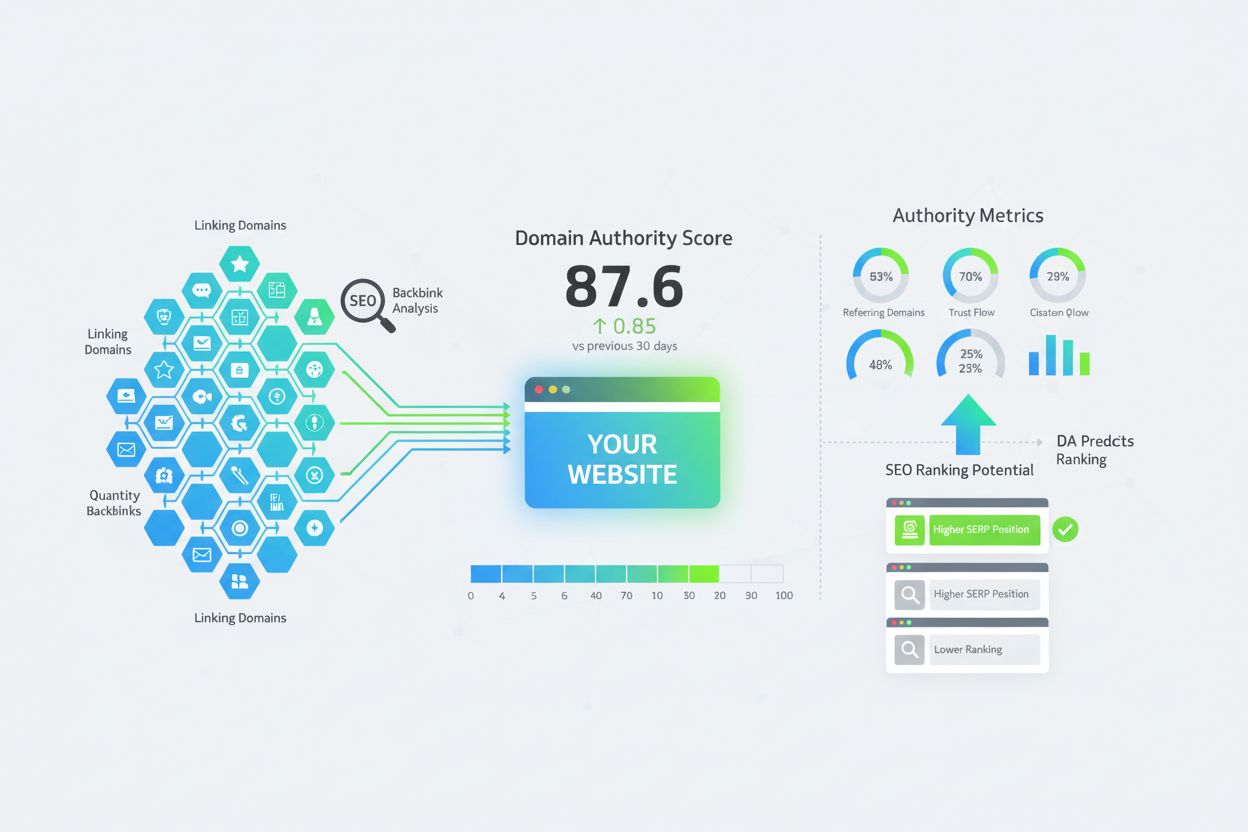
Domain Authority
Domain Authority is a Moz-developed SEO metric (1-100 scale) predicting website ranking potential. Learn how DA is calculated, its importance for SEO strategy, ...
10 min read
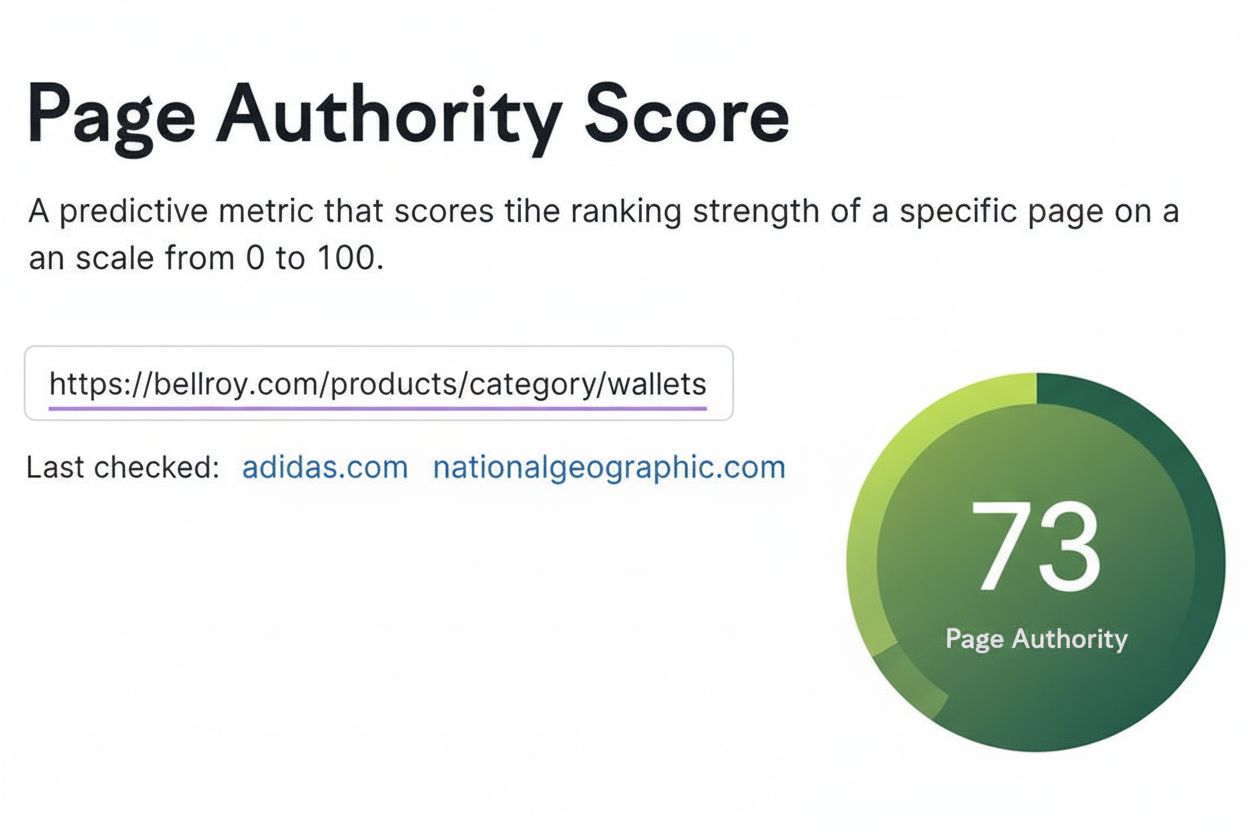
Page Authority (PA) is a predictive metric developed by Moz that scores individual webpages on a 0-100 scale to estimate their likelihood of ranking well in search engine results. It analyzes dozens of factors including backlink quality, link profile strength, and domain trust to forecast a page’s ranking potential.
Page Authority (PA) is a predictive metric developed by Moz that scores individual webpages on a 0-100 scale to estimate their likelihood of ranking well in search engine results. It analyzes dozens of factors including backlink quality, link profile strength, and domain trust to forecast a page's ranking potential.
Page Authority (PA) is a predictive metric developed by Moz that scores individual webpages on a logarithmic scale from 0 to 100 to estimate their likelihood of ranking well in search engine results. Unlike broader domain-level metrics, Page Authority focuses specifically on the ranking potential of a single page by analyzing its link profile, domain trust, and dozens of other factors. The metric serves as a valuable tool for SEO professionals, content marketers, and digital agencies to assess page-level ranking strength and make data-driven optimization decisions. Page Authority is not a Google ranking factor but rather a predictive model that correlates strongly with actual search engine rankings, making it an essential component of competitive SEO analysis and link-building strategy.
Moz introduced Page Authority as part of its comprehensive suite of SEO metrics to provide marketers with actionable insights into individual page performance. The metric emerged from extensive research analyzing thousands of search engine result pages (SERPs) and their corresponding ranking factors. Over the past decade, Page Authority has become one of the most widely adopted authority metrics in the SEO industry, with integration into numerous third-party platforms and tools. The development of PA reflected the industry’s growing recognition that domain-level authority alone was insufficient for understanding ranking potential—individual pages within a domain could have vastly different authority levels based on their unique link profiles and content characteristics. Today, approximately 78% of enterprises use some form of authority-based metrics in their SEO monitoring and optimization strategies, with Page Authority remaining among the most trusted and frequently referenced metrics for page-level analysis.
Page Authority operates through a sophisticated machine learning algorithm that analyzes over 40 distinct factors to generate a predictive score. The algorithm examines the quantity and quality of links pointing to a page, the authority of linking domains, the diversity of link sources, and various trust signals. MozTrust and MozRank are foundational components of the PA calculation, with MozTrust measuring the trustworthiness of a page based on its link profile and MozRank evaluating the importance of links based on their source authority. The system distinguishes between followed and nofollowed links, analyzes anchor text distribution patterns, and evaluates the age and freshness of links. Additionally, the algorithm considers spam indicators, domain-level factors, and the overall health of the link profile to prevent artificially inflated scores from low-quality or manipulative linking practices. Because Page Authority uses a logarithmic scale, the difficulty of improving scores increases exponentially—gaining 10 points from PA 20 to PA 30 requires significantly less effort than improving from PA 70 to PA 80, reflecting the diminishing returns of authority building at higher levels.
| Metric | Scope | Scale | Primary Focus | Use Case |
|---|---|---|---|---|
| Page Authority (PA) | Individual webpage | 0-100 | Single page ranking potential | Competitive page analysis, link targeting |
| Domain Authority (DA) | Entire domain/subdomain | 0-100 | Overall domain strength | Site-wide SEO strategy, domain comparison |
| Brand Authority | Brand mentions and citations | 0-100 | Brand recognition and trust | Brand monitoring, reputation management |
| MozRank | Link importance | 0-10 | Link quality and value | Backlink evaluation, link building |
| MozTrust | Link trustworthiness | 0-10 | Trust signal strength | Spam detection, quality assessment |
| Semrush Authority Score | Domain or page level | 0-100 | Compound authority metric | Multi-factor authority analysis |
Backlinks are the primary driver of Page Authority scores, functioning as “votes of confidence” that signal to search engines the value and credibility of a page. The quality of backlinks matters far more than quantity—a single link from a high-authority domain like Forbes or TechCrunch carries significantly more weight than dozens of links from low-authority sites. Page Authority evaluates not just the number of linking domains but also their individual authority levels, creating a compounding effect where links from already-authoritative pages boost PA more substantially. The diversity of linking domains is another critical factor; links from 50 different domains carry more weight than 50 links from a single domain. Additionally, the relevance of linking pages to your content, the anchor text used in links, and whether links are followed or nofollowed all influence the PA calculation. Research indicates that pages with high-quality backlink profiles from relevant, authoritative sources typically see PA scores 40-60% higher than pages with similar content but weaker link profiles, demonstrating the dominant role of link equity in authority determination.
Page Authority serves as an invaluable tool for competitive analysis and strategic link-building prioritization. When researching competitors, examining their page-level PA scores reveals which of their pages have accumulated the most authority and are likely performing best in search results. This intelligence helps identify which competitor pages you should target for link-building outreach or content benchmarking. For link-building campaigns, PA helps prioritize which pages to pursue for backlinks—a link from a page with PA 70 is typically worth far more than a link from a page with PA 20. Many SEO professionals use Page Authority to evaluate potential link sources, focusing outreach efforts on high-PA pages within relevant websites. Additionally, PA analysis reveals gaps in your own site’s authority distribution; pages that should rank well but have low PA scores indicate opportunities for internal linking optimization or additional link-building efforts. By comparing your page’s PA to ranking competitors’ PA scores, you can establish realistic benchmarks for what authority level is needed to compete for specific keywords, enabling more strategic resource allocation and ROI-focused optimization efforts.
In the emerging landscape of AI-powered search engines and generative AI systems like ChatGPT, Perplexity, Google AI Overviews, and Claude, Page Authority takes on new significance. These AI systems increasingly cite and reference high-authority pages when generating responses, making PA a relevant indicator of which pages are likely to be selected as authoritative sources by AI models. Pages with strong Page Authority scores demonstrate the link-based credibility signals that AI systems use to evaluate source trustworthiness. As AI monitoring becomes essential for brand visibility, understanding which of your pages have high PA scores helps predict their likelihood of appearing in AI-generated responses. Organizations using platforms like AmICited to track their brand mentions across AI systems often correlate high PA pages with increased AI citations, suggesting that authority metrics remain relevant even as search paradigms evolve. The relationship between traditional SEO authority and AI visibility represents an important convergence point—pages that rank well in traditional search results due to high PA scores are also more likely to be cited as authoritative sources in AI responses, creating a multiplier effect for well-optimized, high-authority content.
Page Authority has become a standard metric in SEO reporting and performance tracking, particularly for agencies demonstrating value to clients. Including PA trends in monthly reports provides tangible evidence of SEO progress, as improving Page Authority directly correlates with improved ranking potential and organic traffic growth. Agencies track PA changes month-over-month to identify which optimization efforts are most effective—successful link-building campaigns typically show corresponding PA increases within 4-8 weeks. Page Authority also serves as a diagnostic tool; unexpected PA drops can indicate lost backlinks, negative SEO attacks, or algorithm changes affecting your site. When reporting PA to clients, context is essential—comparing your page’s PA to competitor pages and industry benchmarks helps clients understand whether their scores are competitive. Visual representations of PA trends over time make reports more compelling and easier for stakeholders to understand. Additionally, correlating PA improvements with increases in organic traffic and keyword rankings demonstrates the practical business impact of authority-building efforts. Many agencies use PA as a leading indicator of future ranking improvements, allowing them to set realistic expectations with clients about the timeline for SEO results.
Improving Page Authority requires a multifaceted approach focused on strengthening the page’s link profile and overall authority signals. The most direct method is acquiring high-quality backlinks from relevant, authoritative websites through guest blogging, resource creation, and strategic outreach. Creating genuinely valuable, linkable content—such as original research, comprehensive guides, or unique tools—naturally attracts backlinks from other authoritative sites. Internal linking optimization also plays a role; linking to target pages from other high-authority pages on your own site helps distribute authority and signals importance to search engines. Content quality and freshness matter as well; regularly updating pages with new information, statistics, and insights can improve their perceived value and authority. Ensuring proper technical SEO implementation—including fast page load times, mobile responsiveness, and clean site architecture—supports overall page authority by improving user experience signals. Avoiding spammy practices and maintaining a clean link profile free of low-quality or manipulative links is equally important, as spam indicators can negatively impact PA scores. Finally, building your overall domain authority through site-wide link-building and content quality improvements creates a rising tide that lifts individual page authority scores, as domain-level authority influences page-level calculations.
Page Authority continues to evolve as search engines and AI systems refine their ranking algorithms and citation mechanisms. The metric’s relevance is expanding beyond traditional search into AI-powered search environments, where authority signals help determine which sources AI systems cite as credible. As generative AI becomes more prevalent in information discovery, the correlation between high Page Authority and AI citations is likely to strengthen, making PA optimization increasingly important for brand visibility across multiple channels. Moz regularly updates the Page Authority algorithm to reflect changes in search behavior and ranking factors, ensuring the metric remains predictive of actual search performance. The integration of Page Authority into more third-party platforms and tools continues to expand its accessibility and utility for SEO professionals. Looking forward, Page Authority will likely become even more important as organizations seek to understand their content’s authority and credibility across both traditional search engines and emerging AI systems. The metric’s evolution will probably incorporate additional signals related to brand authority, topical expertise, and content quality, reflecting the industry’s growing emphasis on E-E-A-T (Experience, Expertise, Authoritativeness, Trustworthiness) principles. For organizations monitoring their presence across AI platforms through tools like AmICited, understanding and optimizing Page Authority represents a strategic advantage in ensuring their high-authority content gets discovered and cited by AI systems.
Page Authority measures the ranking potential of a single, specific webpage on a 0-100 scale, while Domain Authority evaluates the overall strength and credibility of an entire domain or subdomain. Both metrics use similar calculation methodologies based on link profiles and trust factors, but PA focuses on individual page-level performance whereas DA provides a broader assessment of overall website authority. Improving one metric often positively influences the other, creating a mutually beneficial relationship.
Page Authority is calculated using machine learning algorithms that analyze over 40 factors, with the most significant being linking URLs, linking root domains, link quality, MozTrust, MozRank, anchor text distribution, and spam indicators. The algorithm uses a logarithmic scale, making it significantly easier to improve from PA 20 to 30 than from PA 70 to 80. Importantly, PA does not directly consider on-page SEO elements like keyword usage or content optimization, focusing instead on the page's link profile and external authority signals.
No, Page Authority is not an acknowledged Google ranking factor. It is a proprietary metric developed by Moz to predict ranking potential based on observed correlations with actual search results. However, many of the underlying factors that influence PA—particularly backlink quality and quantity—are confirmed by Google as important ranking signals. PA serves as a useful predictive tool for SEO professionals, but it should not be confused with Google's actual ranking algorithms.
A good Page Authority score typically ranges from 50-70, though the ideal score depends on your industry and competitive landscape. Rather than viewing PA as an absolute measure, it's best used as a comparative metric against competitor pages and industry benchmarks. A page with PA 30 might be excellent in a niche market, while PA 50 could be below average in highly competitive industries. The median PA score across SMB campaigns is currently 31, providing a useful reference point for small to medium-sized businesses.
The most effective way to improve Page Authority is to strengthen your page's link profile by acquiring high-quality backlinks from authoritative, relevant websites. This can be accomplished through guest blogging, content marketing, resource creation, and strategic outreach. Additionally, improving content quality, ensuring proper page structure with header tags, optimizing user experience, and maintaining a clean link profile free of spam indicators all contribute to PA improvement. Internal linking from high-authority pages on your own site can also help distribute authority to newer or lower-authority pages.
Pages with higher Page Authority scores typically rank better for their target keywords, which generally results in increased organic traffic. This creates a reciprocal relationship: strong keyword performance and high organic traffic can boost a page's authority score, while higher PA scores improve ranking potential and traffic generation. However, PA is not the only factor affecting rankings—content quality, search intent alignment, and technical SEO also play crucial roles. Tracking PA alongside organic traffic and keyword rankings provides a more complete picture of page performance.
Page Authority fluctuates regularly because it's calculated using machine learning algorithms that update as new link data is indexed and analyzed. Changes can occur due to new backlinks acquired or lost, updates to linking domain authority, algorithm refinements, or shifts in your competitive landscape. Significant PA fluctuations may result from major link building campaigns, negative SEO attacks, algorithm updates, or changes in your content strategy. It's important to view PA as a relative metric for comparison rather than an absolute score, and to track trends over time rather than focusing on month-to-month variations.
Start tracking how AI chatbots mention your brand across ChatGPT, Perplexity, and other platforms. Get actionable insights to improve your AI presence.
Domain Authority is a Moz-developed SEO metric (1-100 scale) predicting website ranking potential. Learn how DA is calculated, its importance for SEO strategy, ...

Learn how page authority works in AI search engines like ChatGPT and Perplexity. Discover what signals AI systems use to evaluate page credibility and how to op...
Learn how domain authority affects AI search visibility. Discover why ChatGPT, Perplexity, and Claude prioritize expertise over DA scores and what metrics actua...