
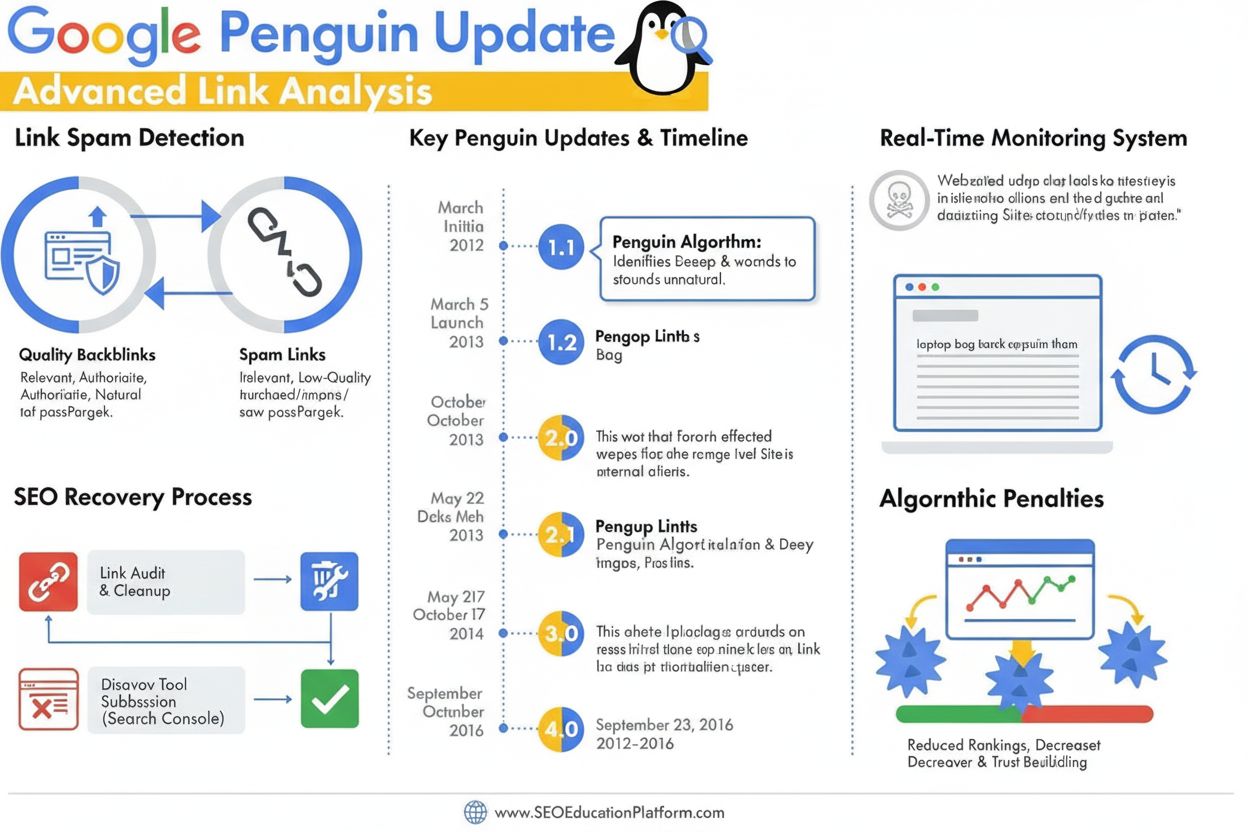
Penguin Update
Learn what the Google Penguin Update is, how it detects link spam, and strategies for recovery. Comprehensive guide to understanding Google's backlink quality a...
10 min read

The Panda Update is a Google algorithm change launched in February 2011 designed to reduce rankings for low-quality websites and reward high-quality content. It evaluates entire websites based on quality signals and has become a core component of Google’s ranking system, fundamentally reshaping SEO practices and content strategy.
The Panda Update is a Google algorithm change launched in February 2011 designed to reduce rankings for low-quality websites and reward high-quality content. It evaluates entire websites based on quality signals and has become a core component of Google's ranking system, fundamentally reshaping SEO practices and content strategy.
The Panda Update is a major Google algorithm change launched on February 23, 2011, designed to reduce rankings for low-quality websites and reward high-quality content in search results. Named after engineer Navneet Panda, this groundbreaking update impacted approximately 11.8% of all search queries in the United States, making it one of the most significant algorithm changes in Google’s history. The Panda Update introduced a site-level quality score that evaluates entire websites based on comprehensive quality signals rather than assessing individual pages in isolation. This fundamental shift meant that poor-quality content on any part of a website could negatively impact rankings across the entire domain, establishing quality as a critical ranking factor that remains central to Google’s search algorithm today.
In 2010, Google faced a significant challenge: the proliferation of content farms and low-quality websites dominating search results. Companies like Demand Media were mass-producing thousands of shallow, keyword-targeted articles daily, prioritizing search engine rankings over user value. These content farms employed freelance writers to generate enormous volumes of minimally useful content, monetizing traffic through display advertising. The situation became so problematic that major publications criticized Google’s search quality, with headlines declaring “Google’s Search Algorithm Has Been Ruined.” Google’s own engineers acknowledged that the Caffeine Update of 2009, which dramatically increased indexing speed, had inadvertently allowed more low-quality content to rank prominently. This created an urgent need for algorithmic solutions to distinguish high-quality sites from content farms. The Panda Update represented Google’s response to this crisis, introducing machine learning techniques to assess content quality at scale. Over 11.8% of queries were immediately affected by the initial rollout, with subsequent updates and refreshes continuing to refine the algorithm through 2015 before being incorporated into Google’s core ranking system.
The Panda Update operates through a sophisticated machine learning algorithm that assigns a quality score to entire websites or large sections of sites. Unlike traditional ranking factors that evaluate individual pages, Panda assesses the overall quality and trustworthiness of a domain by analyzing hundreds of signals. Google’s engineers developed the algorithm by having human quality raters evaluate websites using specific criteria, then training machine learning models to identify patterns that distinguish high-quality from low-quality sites. The algorithm examines signals including content originality, editorial quality, expertise demonstration, user engagement metrics, spelling and grammar accuracy, content comprehensiveness, and advertising density. Panda assigns a sitewide quality score that influences how pages from that domain rank across all queries, regardless of individual page quality. This means a site with many low-quality pages will receive a lower overall quality score, which can suppress rankings even for high-quality pages on the same domain. The algorithm operates continuously but was historically updated on a monthly basis with noticeable ranking fluctuations. After January 2016, Panda became fully integrated into Google’s core algorithm, operating in real-time as a permanent ranking factor rather than a separate, periodic update.
The Panda Update evaluates content quality through multiple interconnected signals that Google’s quality raters assess manually. Originality and uniqueness are paramount—the algorithm penalizes duplicate content, scraped content, and content that merely repackages information from other sources without adding value. Expertise and authorship matter significantly; content should be written by individuals with genuine knowledge or experience in the topic, not by generalist writers creating content solely for search engine optimization. Trustworthiness is evaluated through factors like author credentials, site reputation, security indicators (HTTPS), and whether the site appears to be operated by legitimate entities. Editorial quality includes proper spelling, grammar, professional writing standards, and evidence of careful editing and fact-checking. Content comprehensiveness assesses whether articles provide complete, in-depth coverage of topics rather than shallow, surface-level information. User-centric design evaluates whether content is created for genuine user interests rather than algorithmic manipulation, whether pages have excessive advertising that interferes with content, and whether the site demonstrates quality control processes. Topical authority considers whether sites establish themselves as recognized authorities in their subject areas through consistent, high-quality coverage. Content freshness and update frequency signal that sites maintain current, relevant information. These signals work together to create an overall quality assessment that influences how prominently a site ranks across all its pages.
| Aspect | Panda Update | Penguin Update | Hummingbird Update | Core Updates |
|---|---|---|---|---|
| Launch Date | February 23, 2011 | April 24, 2012 | September 26, 2013 | Ongoing (monthly) |
| Primary Focus | Content quality and site-level quality scoring | Link quality and spam detection | Semantic search and user intent | Overall ranking quality |
| Evaluation Level | Site-wide quality assessment | Link profile analysis | Query interpretation | Comprehensive ranking factors |
| Key Signals | Originality, expertise, trustworthiness, editorial quality | Link authority, anchor text, link velocity | Semantic relevance, entity recognition | E-E-A-T, content quality, user experience |
| Impact Scope | Affects all pages on low-quality sites | Targets specific link-based penalties | Improves relevance for complex queries | Broad ranking adjustments |
| Recovery Method | Improve overall content quality | Remove or disavow low-quality links | Optimize for semantic relevance | Enhance E-E-A-T signals |
| Current Status | Integrated into core algorithm (2016) | Integrated into core algorithm (2016) | Integrated into core algorithm | Active ranking system |
| Affected Content Types | Content farms, thin content, duplicate content | Link schemes, paid links, link networks | Long-tail queries, conversational searches | All content types |
The Panda Update had profound consequences for the digital marketing industry, fundamentally reshaping how businesses approach content strategy and SEO. Thousands of websites experienced dramatic ranking drops, with some companies losing 50-90% of their organic traffic overnight. Demand Media, the quintessential content farm, lost $6.4 million in revenue in the fourth quarter of 2012 following Panda updates. The update effectively ended the content farm business model as it had existed, forcing companies to choose between investing in genuine quality or abandoning search engine optimization entirely. The impact extended beyond content farms; legitimate websites with quality issues also experienced ranking declines, prompting widespread site audits and content improvement initiatives. The Panda Update catalyzed the emergence of content marketing as a distinct discipline, shifting focus from keyword optimization to creating genuinely valuable, authoritative content. Marketing budgets increasingly allocated resources toward quality content creation, editorial processes, and expertise development rather than volume-based content production. The update demonstrated that Google could algorithmically assess quality at scale, establishing a precedent for future algorithm refinements focused on user experience and content value. For SEO professionals, Panda marked a turning point where technical optimization alone became insufficient; content quality became non-negotiable for ranking success.
While the Panda Update was specifically a Google algorithm change, its principles have become universal standards across search engines and AI systems. Bing, DuckDuckGo, and other search engines adopted similar quality assessment approaches following Panda’s success. In the modern AI search landscape, these quality principles are increasingly relevant as AI-powered search engines like ChatGPT, Perplexity, Google AI Overviews, and Claude determine which sources to cite and reference. These AI systems prioritize authoritative, high-quality, trustworthy sources—exactly the criteria Panda established. Websites that maintain strong E-E-A-T signals (Experience, Expertise, Authoritativeness, Trustworthiness) are more likely to be cited by AI systems, making Panda’s quality framework essential for visibility in AI search results. The Panda Update evolved into the Coati algorithm, which Google’s VP of Search revealed in 2022 as the successor to Panda. Coati continues to assess content quality using similar principles but with enhanced machine learning capabilities. For modern content creators and SEO professionals, understanding Panda’s quality framework remains critical because Google’s core updates—which occur monthly—continue to emphasize the same quality signals Panda introduced over a decade ago.
Recovering from a Panda penalty requires a systematic, quality-focused approach rather than quick fixes or technical tricks. Google’s official guidance emphasizes improving overall site quality rather than removing content indiscriminately. The first step involves conducting a comprehensive content audit to identify low-quality pages, thin content, duplicate content, and pages with poor editorial standards. For each problematic page, webmasters should decide whether to: (1) significantly improve and enhance the content to meet quality standards, (2) merge shallow pages into more comprehensive resources, (3) use noindex tags to prevent indexing while keeping pages live, or (4) move low-quality content to a separate domain. Improving content means adding original research, expert insights, comprehensive coverage, proper citations, and ensuring pages provide substantial value compared to competing results. Removing duplicate content across the site, fixing spelling and grammar errors, and ensuring proper editorial review processes are essential. Webmasters should also evaluate advertising density—excessive ads that interfere with content consumption can trigger Panda penalties. Building topical authority by creating comprehensive, interconnected content around core topics helps establish site-wide quality signals. Recovery is gradual; Google doesn’t immediately restore rankings after improvements. Instead, recovery occurs during algorithm refreshes and core updates as Google re-evaluates site quality. Patience and persistence are critical—some sites took 6-12 months to fully recover from Panda penalties.
The Panda Update continues to evolve as Google refines its quality assessment capabilities through advanced machine learning and AI technologies. The integration of Panda into Google’s core algorithm in 2016 marked a shift from periodic updates to continuous quality evaluation, with monthly core updates now incorporating Panda’s quality signals alongside other ranking factors. The emergence of Coati as Panda’s successor suggests Google is developing even more sophisticated quality assessment methods, potentially incorporating natural language processing, semantic analysis, and user behavior signals to evaluate content quality. As AI-generated content becomes increasingly prevalent, Panda’s principles are evolving to distinguish between high-quality AI-assisted content and low-quality, mass-produced AI content. The E-E-A-T framework (Experience, Expertise, Authoritativeness, Trustworthiness) represents the modern evolution of Panda’s quality assessment, with Google emphasizing these signals in quality rater guidelines and core updates. For AI search engines like ChatGPT, Perplexity, and Google AI Overviews, Panda’s quality principles determine which sources are cited and referenced, making content quality increasingly important for visibility across all search channels. The future of Panda-related quality assessment likely involves more sophisticated evaluation of author expertise, content originality, factual accuracy, and user satisfaction signals. Organizations that embrace Panda’s quality-first philosophy—prioritizing genuine value creation over algorithmic optimization—will maintain competitive advantages as search algorithms continue to evolve toward rewarding authentic, authoritative, trustworthy content.
The Panda Update is a Google algorithm change that launched on February 23, 2011, designed to reduce rankings for low-quality websites and improve search result quality. Named after engineer Navneet Panda, it impacted approximately 11.8% of search queries in the United States. The update introduced a site-level quality score that evaluates entire websites rather than individual pages, fundamentally changing how Google assesses content quality and ranking eligibility.
Panda uses machine learning algorithms to assess content quality by analyzing over 200 signals including originality, expertise, trustworthiness, spelling and grammar, editorial standards, and user engagement metrics. Google's human quality raters evaluate websites using criteria like whether content is original, whether it provides substantial value compared to competitors, and whether it demonstrates genuine expertise. The algorithm assigns a quality score to entire sites or large sections, which then affects rankings across all pages on that domain.
Panda penalizes thin content (shallow, unsubstantial pages), duplicate content, scraped content, auto-generated content, content farms, excessive advertising, poor editorial quality, spelling and grammar errors, and content created primarily for search engine rankings rather than user value. It also targets sites with mass-produced content outsourced to numerous creators without proper quality control, as well as pages with misleading or deceptive practices designed to manipulate search rankings.
Recovery involves improving overall site quality by removing or significantly enhancing low-quality pages, eliminating duplicate content, fixing spelling and grammar errors, and ensuring all content provides genuine value to users. Google recommends either improving low-quality content to meet quality standards, using noindex tags to prevent indexing of thin pages, or moving low-quality content to a separate domain. Recovery is gradual and requires demonstrating sustained quality improvements over time through multiple algorithm refreshes.
Yes, Panda remains highly relevant as it was incorporated into Google's core algorithm in January 2016 and evolved into the Coati algorithm. Modern core updates continue to emphasize the same quality principles Panda established, including E-E-A-T (Experience, Expertise, Authoritativeness, Trustworthiness). Content quality assessment remains central to Google's ranking system, making Panda's principles essential for long-term SEO success.
Unlike Penguin (which targets link quality) or Hummingbird (which focuses on semantic search), Panda specifically evaluates overall website quality and content value. Panda operates at the site level rather than page level, meaning poor-quality content can harm rankings across an entire domain. While other updates target specific ranking factors, Panda assesses the holistic quality and trustworthiness of entire websites using machine learning and human quality rater feedback.
Google published 23 quality assessment questions including: Would you trust the information? Is it written by an expert? Does the site have duplicate content? Would you give your credit card information? Are there spelling errors? Is content original? Does it provide substantial value? How much quality control exists? Does it describe both sides? Is the site authoritative? Is content mass-produced? Was it edited well? For health queries, would you trust it? Would you recognize it as authoritative? Is it comprehensive? Does it contain insightful analysis? Would you bookmark it? Are there excessive ads? Would you expect it in a magazine? Are articles substantial? Are pages carefully produced? Would users complain?
Start tracking how AI chatbots mention your brand across ChatGPT, Perplexity, and other platforms. Get actionable insights to improve your AI presence.
Learn what the Google Penguin Update is, how it detects link spam, and strategies for recovery. Comprehensive guide to understanding Google's backlink quality a...

Explore the complete timeline of AI search algorithm updates from Google, ChatGPT, and Perplexity. Learn how AI search evolved and what it means for your brand ...
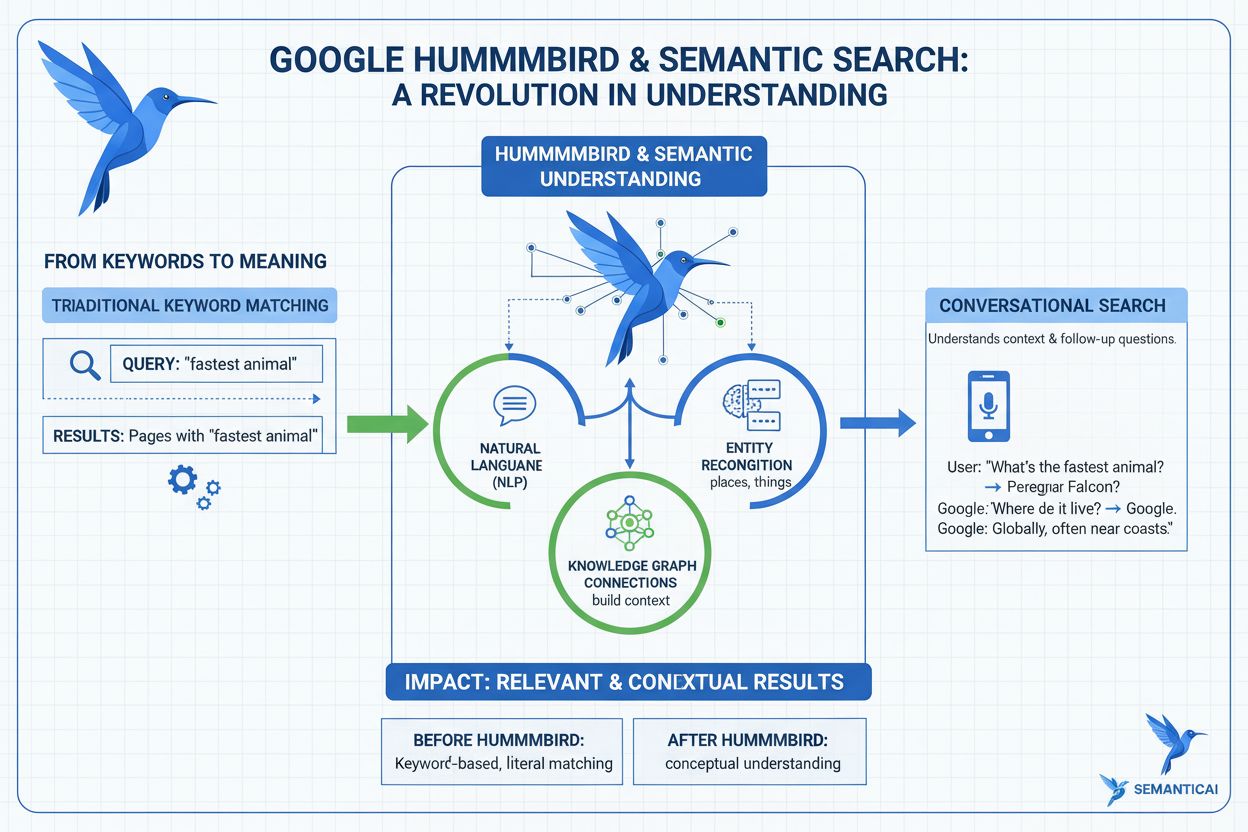
Learn what the Hummingbird Update is, how it revolutionized semantic search in 2013, and why it matters for AI monitoring and brand visibility across search pla...