
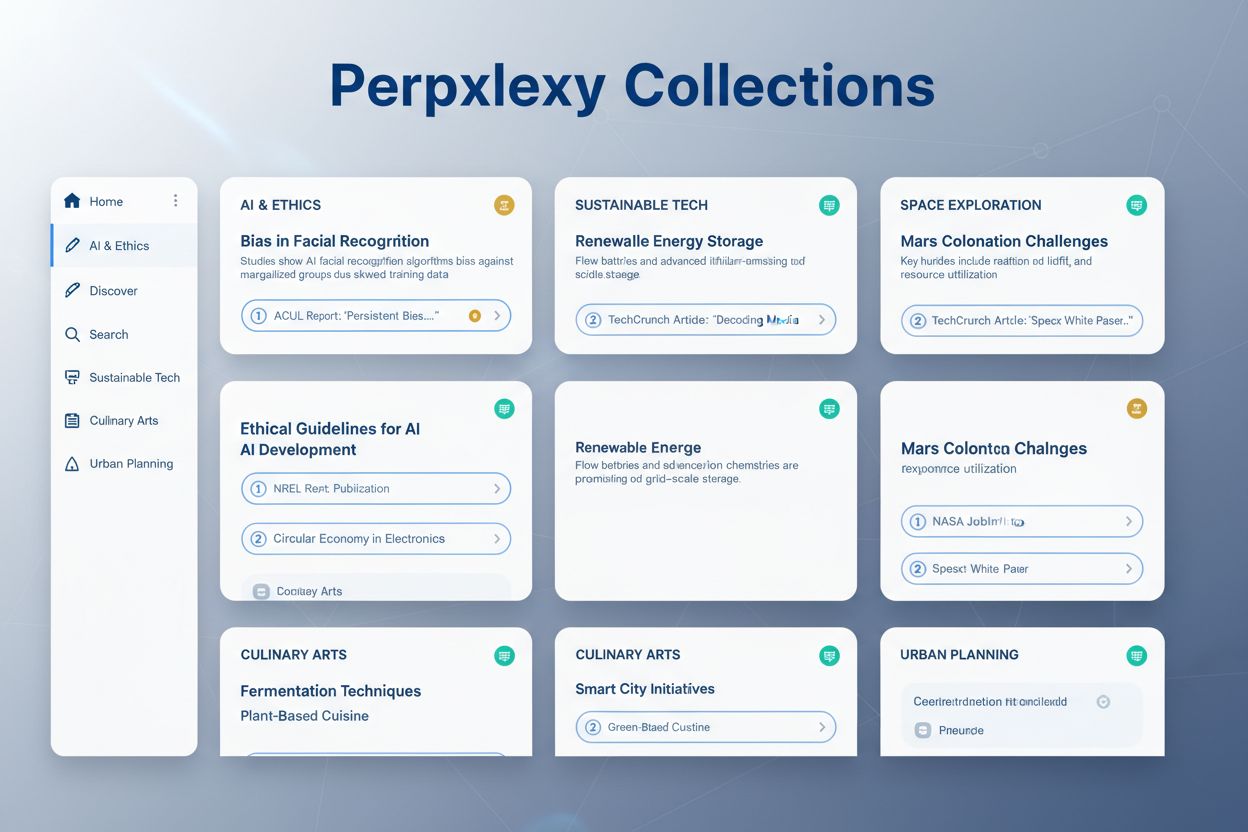
Perplexity Collections
Learn what Perplexity Collections are and how they help organize AI-generated answers and sources into curated knowledge bases for research, content creation, a...
6 min read
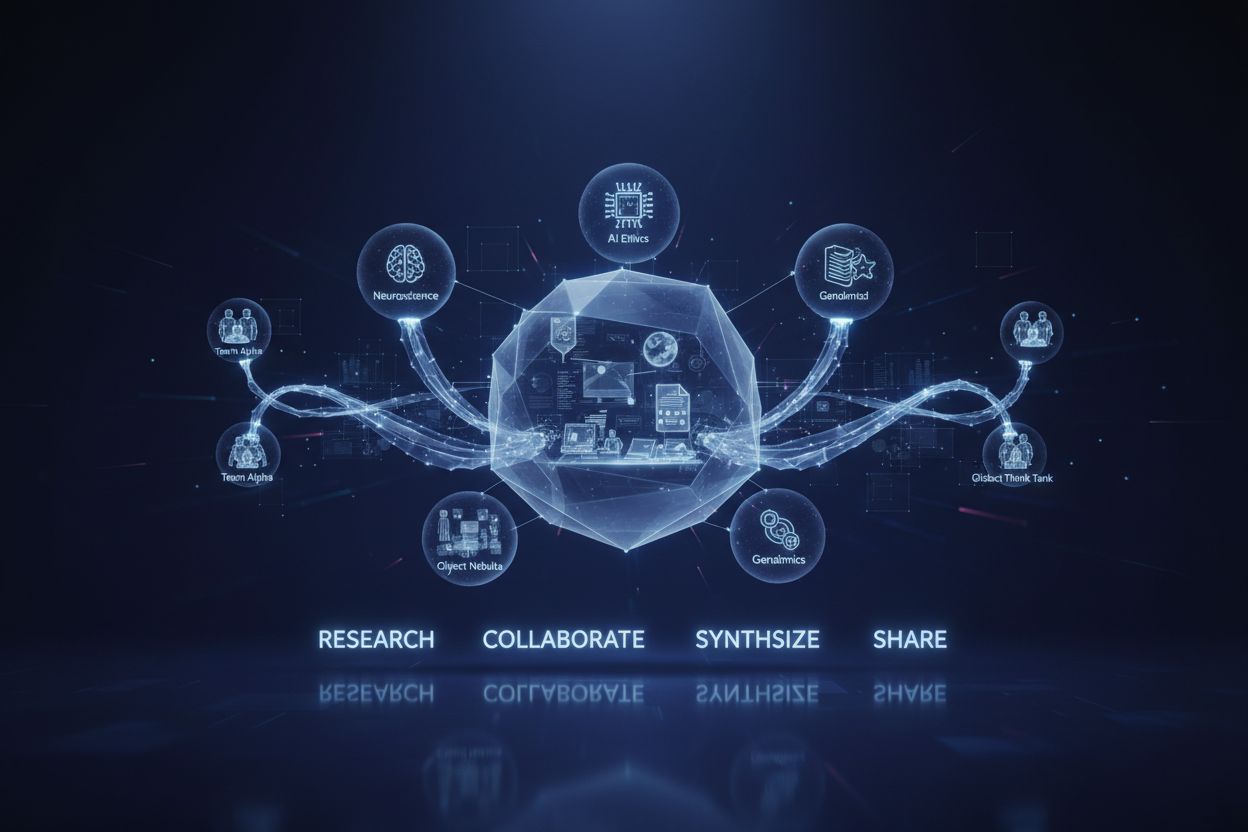
Collaborative research environments in Perplexity where users can save, organize, and share AI-generated research on specific topics. These dedicated workspaces combine real-time web search with internal document analysis, enabling teams to maintain persistent context and build cumulative intelligence across research projects.
Collaborative research environments in Perplexity where users can save, organize, and share AI-generated research on specific topics. These dedicated workspaces combine real-time web search with internal document analysis, enabling teams to maintain persistent context and build cumulative intelligence across research projects.
Perplexity Spaces are dedicated collaborative research environments within the Perplexity AI platform that enable users and teams to organize, save, and share AI-generated research on specific topics. These workspaces combine real-time web search capabilities with internal document analysis, creating unified knowledge environments where teams can collaborate on complex research projects. Unlike traditional search tools that treat each query independently, Spaces maintain persistent conversation threads that build context over time, allowing research to become progressively more sophisticated and relevant. This persistent context transforms how teams approach research, enabling them to accumulate insights rather than starting from scratch with each new query.

Perplexity Spaces offers a comprehensive suite of features designed for both individual researchers and enterprise teams. The platform allows users to upload and organize files within each Space, with standard Pro accounts supporting up to 50 files and Enterprise Pro accounts accommodating up to 500 files. Custom AI instructions enable teams to specify exactly how the AI should respond—matching particular tones, domain expertise, or reasoning styles needed for each project. Real-time web search is seamlessly integrated with internal document analysis, allowing the AI to synthesize insights from both current information and organizational knowledge bases. Conversation threads maintain full context across multiple interactions, enabling teams to build on previous research without losing important details. Role-based access controls provide granular permissions, allowing Space creators to designate collaborators as viewers or contributors with specific controls over thread creation, member invitations, and settings modifications.
| Feature | Capability | Benefit |
|---|---|---|
| File Upload | 50 files (Pro) / 500 files (Enterprise) | Comprehensive internal knowledge integration |
| Custom AI Instructions | Tailored response parameters | Domain-specific and context-aware answers |
| Real-time Web Search | Current information access | Up-to-date research with proper citations |
| Conversation Threads | Persistent context | Building research momentum over time |
| Role-based Access | Granular permissions | Secure collaboration with controlled access |
| App Connectors | Google Drive, SharePoint, OneDrive, Box, Dropbox | Seamless integration with existing workflows |
Creating a Perplexity Space begins with defining a topic or research area, which becomes the organizational hub for all related conversations and documents. Users upload relevant files—PDFs, presentations, spreadsheets, or other documents—that serve as internal knowledge sources for the AI to reference. Custom instructions are then configured to specify how the AI should approach research within that Space, including response tone, citation requirements, and analysis depth. When team members ask questions within the Space, the AI synthesizes insights from both uploaded documents and real-time web searches, providing comprehensive answers with proper source attribution. The platform maintains conversation persistence, meaning each interaction builds on previous discussions, allowing the AI to understand project context and provide increasingly relevant responses. This workflow eliminates the context-switching that typically fragments research processes, keeping all relevant information and insights within a single collaborative environment.
Enterprise Pro accounts unlock advanced capabilities designed for organizations with complex research and security requirements. SOC 2 Type II compliance ensures that Perplexity meets rigorous security and privacy standards required by regulated industries. All files and searches within Enterprise Spaces are excluded from AI training by default, addressing critical concerns about using AI tools with sensitive business information. Granular role-based access controls allow administrators to manage permissions at a detailed level, controlling who can create threads, invite members, or modify Space settings. Data residency options provide flexibility for organizations with specific geographic data storage requirements. Enterprise Pro also includes advanced integrations with specialized databases like Crunchbase and FactSet, enabling teams to incorporate external business intelligence directly into their research environments. These enterprise-grade features transform Spaces into a secure, compliant platform suitable for organizations handling confidential information and operating in regulated sectors.
Perplexity Spaces serves diverse organizational needs across multiple functions and industries:
Market Research and Competitive Intelligence: Teams create dedicated Spaces for each major competitor, uploading relevant documents and setting up monitoring queries that provide ongoing intelligence based on new web information while maintaining context from previous research sessions.
Project Team Collaboration: Cross-functional teams use Spaces as central repositories for project research, combining internal documents with external market intelligence to ensure all team members understand project background and current status.
Sales Enablement: Sales teams build Spaces around key prospects or market segments, combining internal sales materials with external research about target companies and industries to support more informed customer conversations.
Student Research and Learning: Educational institutions leverage Spaces to help students organize research by topic, maintain citation records, and collaborate on group projects while building comprehensive knowledge bases.
Recurring Process Management: Organizations use Spaces for ongoing processes like client scoping, where teams analyze briefs, break down work streams, and maintain institutional knowledge about project approaches and methodologies.
Internal Knowledge Management: Spaces serve as centralized repositories for organizational knowledge, making information more discoverable and actionable compared to traditional document storage systems.

Perplexity Spaces occupies a unique position in the productivity landscape by combining capabilities that other tools typically keep separate. Traditional collaboration platforms like Slack, Microsoft Teams, and Google Workspace excel at communication and file sharing but lack AI-powered research and synthesis capabilities. Individual AI tools such as ChatGPT and Claude provide excellent analysis but don’t offer collaborative features or real-time web access. Enterprise knowledge management systems like SharePoint and Confluence store information effectively but struggle with intelligent retrieval and synthesis across multiple sources. Perplexity Spaces bridges these gaps by combining persistent collaboration with intelligent research assistance, enabling teams to build cumulative intelligence rather than simply organizing conversations or files. The platform’s integration of real-time web search with internal document analysis creates a research environment that becomes progressively more valuable as teams accumulate context and insights. This unique combination positions Spaces as a comprehensive solution for organizations seeking to transform how teams conduct research and manage knowledge.
Successful Spaces implementations begin with identifying specific, high-value use cases rather than attempting organization-wide rollouts. Teams should start with functions where research is critical to decision-making—such as market research, competitive analysis, or project planning—and expand gradually based on demonstrated value. Investing time in custom instructions yields significant returns, as well-crafted instructions that specify response tone, domain expertise expectations, citation requirements, and analysis depth lead to substantially better AI responses and faster team adoption. Organizations should prioritize connecting their most-used file repositories first through app connectors, then expand based on usage patterns and user feedback rather than attempting to integrate everything simultaneously. Team training and change management are essential, as successful adoption requires helping team members understand how to leverage Spaces effectively and how to structure research questions for optimal AI responses. Starting small, refining processes based on real usage, and gradually expanding integration creates sustainable adoption that delivers measurable productivity gains.
Organizations implementing Perplexity Spaces report significant measurable benefits across multiple dimensions. Faster decision-making emerges as teams spend less time searching for information and more time analyzing insights, accelerating the pace at which organizations can respond to market changes and opportunities. Reduced knowledge silos occur naturally as research and insights accumulate in shared Spaces, making organizational knowledge accessible to broader teams rather than locked in individual inboxes or documents. Improved research quality results from the AI’s ability to synthesize insights from multiple sources while maintaining context across extended research projects. The platform democratizes AI capabilities by making advanced research assistance available to entire teams rather than just technical specialists or power users, enabling organizations to become more intelligent at every level. Perhaps most importantly, Spaces provide competitive advantage through intelligence amplification, where teams can conduct research and analysis that would be impossible to replicate manually, enabling faster insights and more informed strategic decisions. These benefits combine to create organizations that are fundamentally more capable of navigating complex information landscapes and making decisions based on comprehensive, synthesized intelligence.
Regular Perplexity searches treat each query independently, providing answers based on current web information. Perplexity Spaces maintain persistent conversation threads and context, allowing research to build over time. Spaces also enable file uploads, custom AI instructions, and team collaboration features that aren't available in standard searches.
Standard Perplexity Pro accounts allow up to 50 files per Space, while Enterprise Pro accounts support up to 500 files. These files can include PDFs, presentations, spreadsheets, and other document types that the AI can reference when answering questions within the Space.
Yes, Perplexity Spaces are designed for team collaboration. Space creators can invite team members and assign them specific roles—either as viewers (read-only access) or contributors (ability to add threads and participate in research). Granular access controls allow you to manage permissions precisely.
Enterprise Pro Spaces include SOC 2 Type II compliance, ensuring they meet rigorous security standards. All files and searches are excluded from AI training by default, protecting sensitive information. The platform also offers role-based access controls and configurable data residency options for organizations with specific geographic requirements.
Custom AI instructions allow you to specify exactly how the AI should respond within a Space—including response tone, domain expertise level, citation requirements, and analysis depth. This customization enables the AI to adapt to different contexts, whether you need formal financial analysis, creative marketing insights, or technical engineering documentation.
Common use cases include market research and competitive intelligence, project team collaboration, sales enablement, student research and learning, recurring process management, and internal knowledge management. Organizations use Spaces whenever they need to organize research by topic and collaborate on complex information synthesis.
Perplexity Spaces requires a paid subscription. Standard Perplexity Pro accounts include access to Spaces with basic features, while Enterprise Pro accounts unlock advanced capabilities including higher file limits, app connectors, and specialized database integrations.
Traditional knowledge management systems like SharePoint and Confluence excel at storing and organizing documents but lack intelligent retrieval and synthesis capabilities. Perplexity Spaces inverts this approach by making AI-powered search the primary interface, combining real-time web information with internal documents to create actionable intelligence rather than just organized storage.
AmICited tracks how AI platforms like Perplexity reference your brand in their answers. Get insights into your AI visibility and competitive positioning.
Learn what Perplexity Collections are and how they help organize AI-generated answers and sources into curated knowledge bases for research, content creation, a...
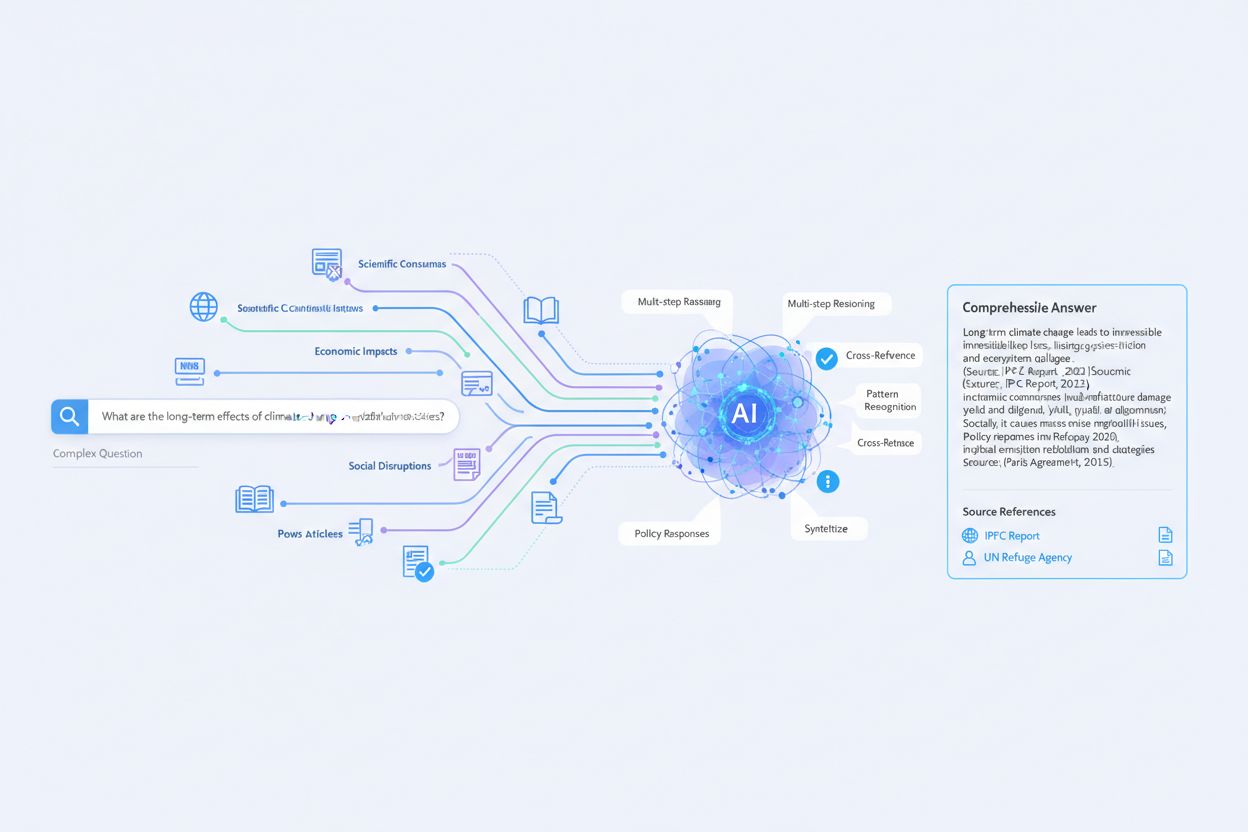
Learn about Perplexity Pro Search, an advanced AI search mode that performs multi-step reasoning and analyzes 20-25+ sources for comprehensive research. Discove...

Perplexity AI is an AI-powered answer engine combining real-time web search with LLMs to deliver cited, accurate responses. Learn how it works and its impact on...