

PerplexityBot: What Every Website Owner Needs to Know
Complete guide to PerplexityBot crawler - understand how it works, manage access, monitor citations, and optimize for Perplexity AI visibility. Learn about stea...
8 min read
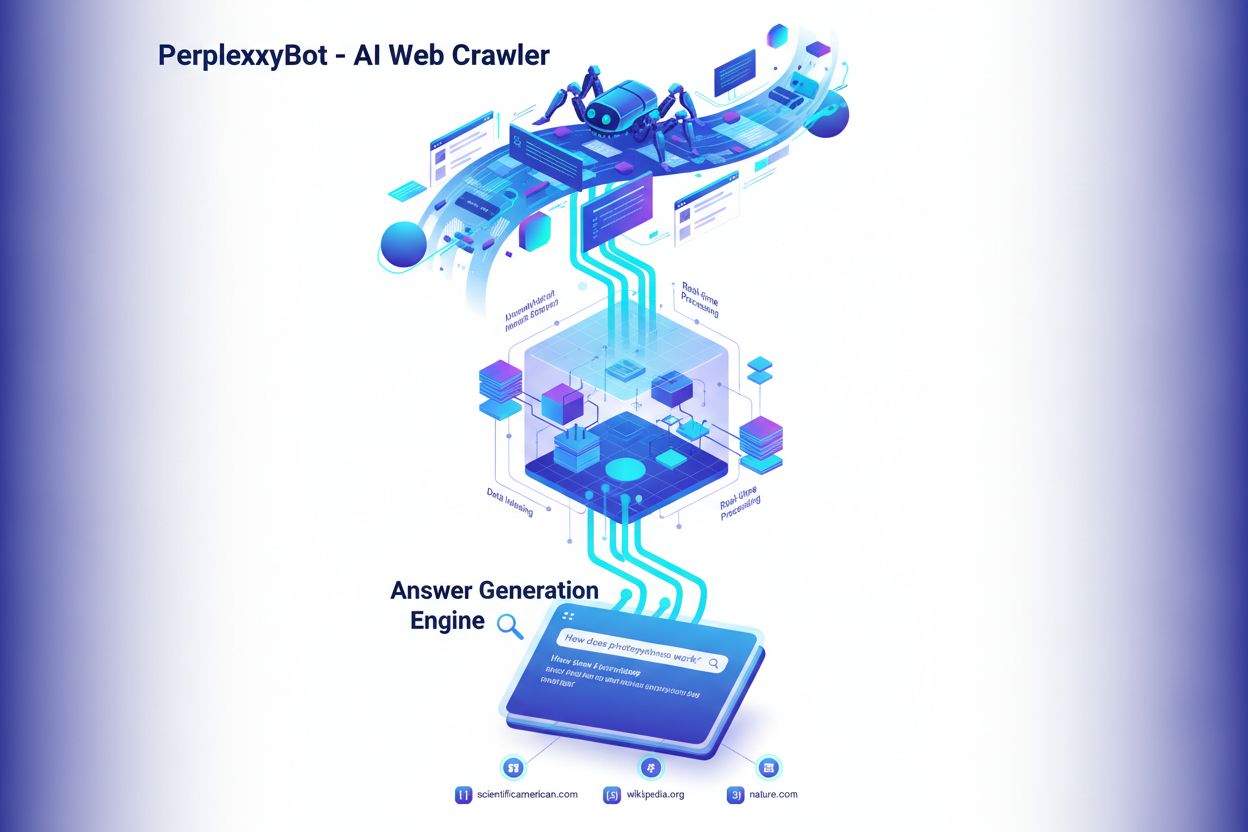
PerplexityBot is Perplexity AI’s web crawler that indexes web content to power its answer engine. It respects robots.txt directives, provides transparent source citations in responses, and is not used for training AI foundation models. The crawler helps Perplexity deliver accurate, sourced answers to user queries.
PerplexityBot is Perplexity AI's web crawler that indexes web content to power its answer engine. It respects robots.txt directives, provides transparent source citations in responses, and is not used for training AI foundation models. The crawler helps Perplexity deliver accurate, sourced answers to user queries.
PerplexityBot is the web crawler developed by Perplexity AI to index and retrieve content for its answer engine. Unlike traditional search engine crawlers, PerplexityBot operates with a specific purpose: gathering real-time information to power Perplexity’s AI-driven search and answer generation capabilities. The crawler identifies itself with a clear user-agent string: Mozilla/5.0 AppleWebKit/537.36 (KHTML, like Gecko; compatible; PerplexityBot/1.0; +https://perplexity.ai/perplexitybot). Importantly, PerplexityBot respects the robots.txt protocol, allowing website owners to control crawling behavior on their domains. A critical distinction: PerplexityBot is not used for AI model training—it exclusively feeds content into Perplexity’s answer generation system, and the platform provides transparent source citations for all information used in responses.

PerplexityBot operates as a distributed web crawler that systematically indexes web content to build a searchable knowledge base for Perplexity’s answer engine. The crawler uses its distinctive user-agent identifier to announce itself transparently to web servers, allowing site administrators to recognize and manage its requests. Perplexity operates specific IP address ranges for PerplexityBot, which can be configured in Web Application Firewalls (WAFs) like Cloudflare and AWS to allow or restrict access as needed. It’s essential to distinguish between PerplexityBot (the content crawler) and Perplexity-User (which represents actual user traffic from the Perplexity platform), as these serve different functions and may require different handling strategies. Unlike GoogleBot, which crawls for search indexing and ranking purposes, PerplexityBot focuses exclusively on content retrieval for answer generation without influencing search rankings. The crawler’s architecture reflects a modern approach to web crawling that balances the need for comprehensive content access with respect for website owner preferences and technical constraints.
| Crawler Name | Purpose | Respects robots.txt | Used for AI Training | Source Attribution |
|---|---|---|---|---|
| PerplexityBot | Answer engine content retrieval | Yes | No | Yes, transparent citations |
| ChatGPT-User | User traffic from ChatGPT | N/A | No | N/A |
| GoogleBot | Search indexing and ranking | Yes | No | N/A |
Perplexity has adopted a transparent crawling approach that stands in contrast to some competitors who employ stealth crawling techniques. Research from Cloudflare revealed that certain AI companies have attempted to mask their crawlers by spoofing legitimate user-agent strings, making it difficult for website owners to identify and manage their traffic. PerplexityBot’s clear identification and adherence to RFC 9309 (the standard for responsible web crawling) demonstrates a commitment to ethical practices in the AI era. Transparency in web crawling serves multiple purposes: it allows website owners to make informed decisions about their content, enables proper traffic attribution in analytics platforms, and builds trust within the broader web ecosystem. The distinction between transparent and stealth crawling has become increasingly important as AI companies compete for content access, with transparent approaches proving more sustainable and respectful of website owner autonomy.
Best practices for ethical web crawling include:
Perplexity’s crawling infrastructure has evolved significantly since the platform’s early days of relying on Bing’s index. The company developed its own custom crawler to gain greater control over content freshness, quality, and relevance for answer generation. Rather than attempting to index the entire web indiscriminately, Perplexity focuses on the “head of the distribution curve”—prioritizing popular, authoritative, and high-quality content that’s most likely to provide accurate answers to user queries. The crawler employs sophisticated content parsing techniques to extract relevant information, identify key passages, and understand semantic relationships within documents. Perplexity assigns domain trust scores based on factors like content quality, accuracy history, and authority signals, which influence how heavily content from specific sources is weighted in answer generation. The platform maintains a recrawling schedule that balances freshness with server load, typically revisiting high-authority domains more frequently while less-frequently-updated sites receive less frequent crawl visits.
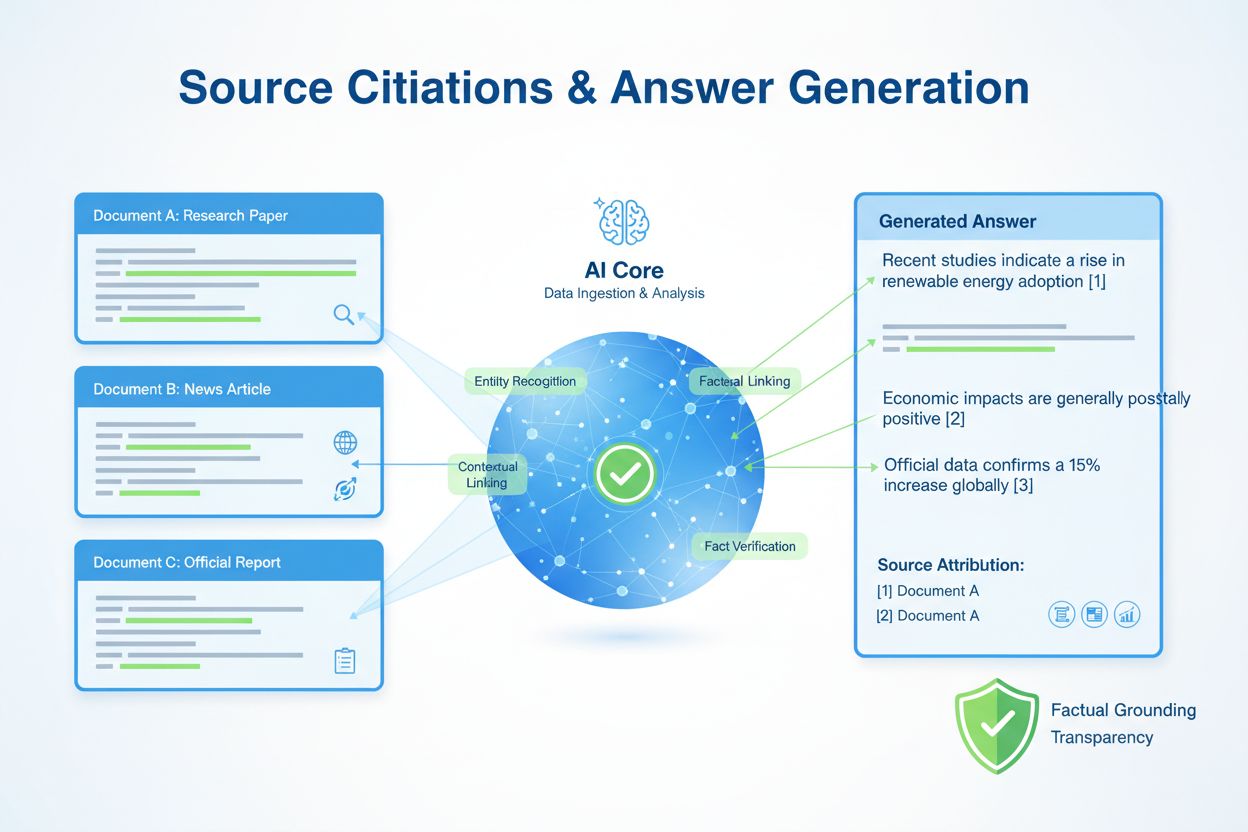
When PerplexityBot crawls and indexes content, that information feeds directly into Perplexity’s answer generation pipeline, where the AI synthesizes information from multiple sources to create comprehensive responses. The platform’s citation mechanism is fundamental to its design—every answer includes transparent links to the sources used, allowing users to verify information and explore topics in greater depth. This approach differs markedly from traditional search engines, which primarily rank pages rather than synthesizing information, and from some AI systems that generate responses without clear source attribution. Website owners can track PerplexityBot traffic through Google Analytics 4 and other analytics platforms, where it appears as a distinct crawler, enabling them to understand the traffic volume and content being accessed. The user experience benefits significantly from this transparency: readers see exactly which sources informed each part of an answer, building confidence in the information and driving qualified traffic back to authoritative websites. This citation-driven model creates a symbiotic relationship where content creators benefit from visibility and traffic while users receive trustworthy, sourced information.
Website owners who wish to prevent PerplexityBot from crawling their content can do so through the robots.txt file, the standard mechanism for communicating crawler preferences to web servers. Adding a simple directive blocks the crawler from accessing your site’s content:
User-agent: PerplexityBot
Disallow: /
For more granular control, you can block PerplexityBot from specific directories or file types while allowing access to other areas. Web Application Firewalls like Cloudflare and AWS provide additional configuration options, allowing you to block requests from PerplexityBot’s IP address ranges at the infrastructure level. Before implementing blocks, verify that requests are genuinely from PerplexityBot by checking the user-agent string and confirming IP addresses against Perplexity’s published ranges. It’s important to note that robots.txt changes typically propagate within 24 hours, though some crawlers may take longer to fully respect new directives. Before blocking PerplexityBot entirely, consider the potential benefits of being indexed: inclusion in Perplexity’s answer engine can drive significant qualified traffic and increase content visibility in an increasingly important AI search channel. A more nuanced approach might involve allowing crawling while using robots.txt to exclude sensitive or duplicate content.
Inclusion in PerplexityBot’s index represents a significant opportunity for website visibility in the AI search era. As Perplexity and similar AI answer engines grow in popularity, being indexed becomes increasingly important for content discoverability and traffic generation. Websites that appear in Perplexity answers receive direct traffic from users who click through to verify information or explore topics further, creating a new channel for audience acquisition beyond traditional search engines. The quality and relevance of your content directly influence whether PerplexityBot crawls it and how prominently it appears in answer generation—well-researched, authoritative content is more likely to be selected as a source. SEO optimization for AI answer engines differs somewhat from traditional search optimization, emphasizing clear structure, comprehensive coverage of topics, and demonstrated expertise and authority. As AI search continues to mature and capture increasing market share, the ability to rank in answer engines will become as important as traditional search rankings, making PerplexityBot indexing a critical component of modern content strategy.
You can identify PerplexityBot activity in your server logs by searching for requests containing the distinctive user-agent string PerplexityBot/1.0 or by filtering for IP addresses within Perplexity’s published ranges. Analytics platforms like Google Analytics 4, Matomo, and server-level logging tools all capture PerplexityBot traffic, allowing you to understand crawl frequency, which content is being accessed, and the volume of traffic the crawler generates. Understanding crawl patterns helps you optimize your site’s structure and content for better indexing—for example, if PerplexityBot frequently accesses certain content types, you can ensure those pages are well-optimized and easily discoverable. The performance impact of PerplexityBot is typically minimal, as the crawler is designed to be respectful of server resources and distributes requests across time to avoid overwhelming sites. Specialized monitoring tools like AmICited.com provide deeper insights into how your content is being used across AI answer engines, tracking citations, traffic attribution, and competitive positioning in the AI search landscape—valuable intelligence for understanding your visibility in this emerging channel.
PerplexityBot is Perplexity AI's web crawler designed to index and retrieve content for Perplexity's answer engine. It crawls websites to gather information that powers Perplexity's AI-driven search results and answer generation. Unlike some AI crawlers, PerplexityBot is not used for training AI foundation models—it exclusively feeds content into Perplexity's answer generation system with transparent source citations.
You can identify PerplexityBot by searching for the user-agent string 'PerplexityBot/1.0' in your server logs. The full user-agent string is: Mozilla/5.0 AppleWebKit/537.36 (KHTML, like Gecko; compatible; PerplexityBot/1.0; +https://perplexity.ai/perplexitybot). You can also filter for IP addresses within Perplexity's published IP ranges, which are available at https://www.perplexity.com/perplexitybot.json.
Whether to block PerplexityBot depends on your content strategy. Allowing it can drive qualified traffic from Perplexity's answer engine and increase your content's visibility in AI search results. However, if you have concerns about content usage or prefer to limit crawling, you can block it via robots.txt. Consider the benefits of AI search visibility before implementing a complete block.
PerplexityBot and GoogleBot serve different purposes. GoogleBot crawls for search indexing and ranking in Google Search results, while PerplexityBot crawls specifically to retrieve content for Perplexity's answer engine. PerplexityBot focuses on content quality and relevance for answer generation rather than search ranking, and it provides transparent source citations in responses.
Yes, PerplexityBot respects robots.txt directives. You can control its access by adding specific rules to your robots.txt file. For example, to block all PerplexityBot crawling, add: User-agent: PerplexityBot followed by Disallow: /. Changes to robots.txt typically propagate within 24 hours.
No, PerplexityBot is explicitly not used for training AI foundation models. Perplexity has stated that PerplexityBot is designed exclusively for indexing content to power its answer engine and provide sourced responses to users. This distinguishes it from some other AI crawlers that may be used for model training purposes.
To allow PerplexityBot through your Web Application Firewall, create rules that whitelist both the user-agent string (PerplexityBot) and IP addresses from Perplexity's published ranges. For Cloudflare, use Custom Rules to allow requests matching the PerplexityBot user-agent and IP conditions. For AWS WAF, create IP sets and string match conditions for the same identifiers. Always use the official IP ranges from https://www.perplexity.com/perplexitybot.json.
PerplexityBot is the automated crawler that indexes web content for Perplexity's search index. Perplexity-User represents actual user traffic from the Perplexity platform when users click through to websites from Perplexity answers. PerplexityBot respects robots.txt, while Perplexity-User generally ignores robots.txt since it represents user-initiated requests. Both should be identified by their respective user-agent strings in your logs.
Track how your content appears in Perplexity, ChatGPT, Google AI Overviews, and other AI systems with AmICited. Get insights into your AI citations and visibility.
Complete guide to PerplexityBot crawler - understand how it works, manage access, monitor citations, and optimize for Perplexity AI visibility. Learn about stea...

Perplexity AI is an AI-powered answer engine combining real-time web search with LLMs to deliver cited, accurate responses. Learn how it works and its impact on...

Discover how stealth crawlers bypass robots.txt directives, the technical mechanisms behind crawler evasion, and solutions to protect your content from unauthor...
Cookie Consent
We use cookies to enhance your browsing experience and analyze our traffic. See our privacy policy.