
Exact Match
Exact match is a precise keyword matching method in search advertising and SEO that displays results only for queries matching specified phrases. Learn how it w...
10 min read
Phrase match is a keyword matching option in Google Ads that displays ads when search queries contain a specific phrase in the designated order, with possible additional words before or after. It offers a balance between broad match’s wide reach and exact match’s precision, allowing advertisers to target intent-aligned searches while maintaining control over keyword relevance.
Phrase match is a keyword matching option in Google Ads that displays ads when search queries contain a specific phrase in the designated order, with possible additional words before or after. It offers a balance between broad match's wide reach and exact match's precision, allowing advertisers to target intent-aligned searches while maintaining control over keyword relevance.
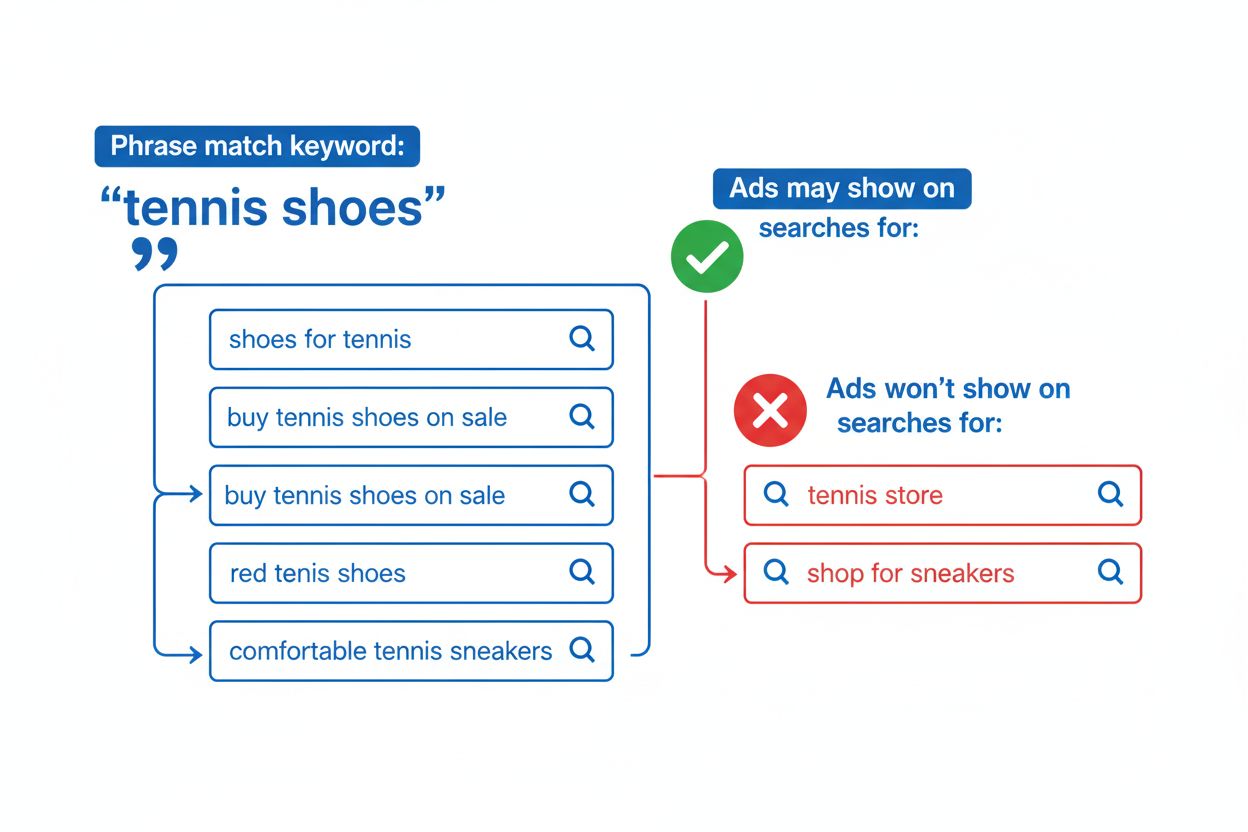
Phrase match is a keyword matching option in Google Ads that displays advertisements when user search queries contain a specific phrase in the designated order, with the possibility of additional words appearing before or after the phrase. Denoted by placing quotation marks around the keyword (e.g., “tennis shoes”), phrase match represents a middle-ground approach between the broad reach of broad match and the precision of exact match. This matching type enables advertisers to capture intent-aligned searches while maintaining greater control over ad relevance compared to broad match. Phrase match has become increasingly important in modern PPC (pay-per-click) campaigns as Google’s AI-driven systems evolve to prioritize user intent over strict keyword matching. Understanding phrase match is essential for advertisers seeking to optimize campaign performance, manage advertising budgets efficiently, and reach qualified audiences without excessive wasted spend.
The concept of keyword matching in search advertising emerged with the early days of Google AdWords (now Google Ads) in the early 2000s. Initially, advertisers had limited control over how their keywords matched user searches, leading to both missed opportunities and irrelevant traffic. As the platform matured, Google introduced multiple match types to give advertisers greater control. Phrase match was developed as a solution to the limitations of broad match, which cast too wide a net, and exact match, which was too restrictive for most campaigns. In 2014, Google introduced close variants, a significant update that allowed phrase match keywords to match searches with plurals, misspellings, and synonyms—fundamentally changing how phrase match operated. This evolution reflected Google’s shift toward intent-based matching rather than strict keyword matching. By 2024, phrase match underwent another major transformation, with Google emphasizing AI-driven relevance over word-order preservation. According to industry data, approximately 36% of keywords in active Google Ads accounts are phrase match keywords, making it the most commonly used match type among advertisers. This prevalence underscores phrase match’s importance as a foundational element of modern search advertising strategy.
Phrase match operates through a sophisticated matching algorithm that evaluates both the literal presence of keywords and the underlying intent of user searches. When you create a phrase match keyword by placing quotation marks around your phrase (e.g., “eco-friendly cleaning supplies”), Google’s system analyzes incoming search queries to determine if they meet the matching criteria. The traditional definition required the phrase to appear in the exact order specified, with additional words permitted before or after. For example, “tennis shoes” would match searches like “best tennis shoes” or “buy tennis shoes online,” but not “shoes for tennis” or “tennis shoe.” However, Google’s 2024 updates introduced intent-based matching, which allows phrase match keywords to trigger ads for searches that align with the keyword’s meaning, even if the word order differs. This means “eco-friendly cleaning supplies” might now match “sustainable cleaning products” or “green cleaning solutions” if Google’s AI determines the user intent is sufficiently aligned. The matching process considers multiple contextual signals, including the user’s recent search history, the content of landing pages and ad assets, and other keywords within the ad group. This multi-factor approach ensures that phrase match delivers both reach and relevance, capturing qualified traffic while filtering out irrelevant searches. The system also accounts for close variants, including plurals (e.g., “shoes” matching “shoe”), misspellings, and synonyms, further expanding the potential reach of phrase match keywords.
| Match Type | Syntax | Reach Level | Control Level | Avg. ROAS | Avg. CTR | Avg. Conversion Rate | Best For |
|---|---|---|---|---|---|---|---|
| Broad Match | No special characters | Highest | Lowest | 277.71% | 8.53% | 8.52% | Maximum reach, high-volume campaigns |
| Phrase Match | “keyword phrase” | Medium | Medium | 313.17% | 11.36% | 9.31% | Balanced reach and relevance |
| Exact Match | [keyword phrase] | Lowest | Highest | 415.33% | 21.66% | 7.98% | High-intent, precision targeting |
This comparison table illustrates the fundamental trade-offs between keyword match types. Broad match casts the widest net, making it ideal for advertisers seeking maximum impressions and relying on Smart Bidding to filter quality traffic. However, it often results in lower return on ad spend (ROAS) and requires extensive negative keyword management. Exact match delivers the highest precision and ROAS, making it suitable for high-intent campaigns where budget efficiency is paramount. However, it captures fewer searches and may miss valuable long-tail variations. Phrase match occupies the middle ground, offering the second-highest ROAS (313.17%) and a respectable click-through rate (11.36%), while maintaining broader reach than exact match. According to Optmyzr’s November 2024 analysis of 992,028 keywords across 15,491 accounts, phrase match also delivers the highest conversion rate at 9.31%, making it particularly valuable for campaigns prioritizing conversion quality alongside reach.
Recent performance data provides compelling evidence of phrase match’s effectiveness in modern PPC campaigns. Optmyzr’s comprehensive 2024 study analyzed 353,050 phrase match keywords and revealed critical insights into how this match type performs relative to alternatives. Phrase match keywords generated an average conversion rate of 9.31%, surpassing both exact match (7.98%) and broad match (8.52%). This higher conversion rate suggests that phrase match attracts users with genuine purchase intent, as the phrase requirement filters out tangentially related searches. The return on ad spend (ROAS) for phrase match averaged 313.17%, positioning it as the second-most efficient match type after exact match’s 415.33%. The cost per click (CPC) for phrase match averaged $1.71, slightly higher than exact match’s $1.40 but lower than broad match’s $1.81, reflecting the balance between reach and relevance. The click-through rate (CTR) for phrase match averaged 11.36%, significantly higher than broad match’s 8.53%, indicating that phrase match keywords attract more engaged users. Among the nearly one million keywords analyzed, 36% were phrase match, 33% were exact match, and 31% were broad match, demonstrating that phrase match remains the most widely adopted match type among professional advertisers. These metrics underscore phrase match’s value as a reliable, performance-driven matching strategy that balances reach with conversion quality.
As AI search platforms like ChatGPT, Perplexity, Google AI Overviews, and Claude become increasingly prominent in how users discover information, the relevance of traditional keyword matching extends beyond paid search. These AI systems generate responses based on complex algorithms that evaluate content relevance, authority, and user intent—concepts closely aligned with how phrase match operates. When users query AI platforms with phrases like “best eco-friendly cleaning supplies,” the AI system evaluates which sources and brands to cite based on relevance to the user’s intent. This mirrors phrase match’s evolution toward intent-based matching. For advertisers and brands, understanding phrase match becomes crucial not only for Google Ads optimization but also for brand monitoring across AI platforms. Tools like AmICited track where brands and domains appear in AI-generated responses, providing visibility into how AI systems match user queries to brand content. Just as phrase match keywords must align with user intent to trigger ads, brands must ensure their content aligns with the intent behind user queries to appear in AI responses. This convergence highlights the importance of phrase match as a foundational concept in modern digital marketing, extending its relevance beyond traditional paid search into the emerging landscape of AI-driven search and discovery.
Successful phrase match implementation requires a strategic, data-driven approach that balances reach with relevance. First, organize keywords thematically within ad groups, grouping related phrases that target similar user intent. For example, an ad group focused on athletic footwear might include phrase match keywords like “running shoes,” “trail running shoes,” and “lightweight running shoes.” This thematic organization ensures that ads remain relevant to the user’s search intent while allowing phrase match to capture variations. Second, implement comprehensive negative keyword strategies to filter out irrelevant traffic. Regularly review your search terms report to identify queries that triggered your ads but don’t align with your offerings. For instance, if you sell premium athletic shoes, adding negative keywords like “cheap,” “discount,” or “clearance” prevents your ads from appearing for budget-conscious searches. Third, leverage Smart Bidding strategies in conjunction with phrase match. Google’s machine learning algorithms optimize bids in real-time based on contextual signals, maximizing conversion likelihood while staying within your target cost per acquisition (CPA) or return on ad spend (ROAS). Fourth, monitor performance metrics consistently, tracking conversion rates, ROAS, and CTR to identify underperforming keywords. If a phrase match keyword consistently underperforms, consider adjusting your bid strategy, refining your ad copy, or pausing the keyword entirely. Fifth, use brand controls introduced in Google’s June 2024 update, including brand exclusions to prevent ads from appearing on irrelevant brand-related searches and brand inclusions to focus broad match reach on specific brands. These controls provide additional precision without sacrificing the reach benefits of phrase match.
Close variants represent a critical evolution in how phrase match operates, fundamentally expanding the scope of searches that can trigger phrase match keywords. Introduced in 2014, close variants allow phrase match keywords to match searches containing plurals, misspellings, synonyms, and reordered words with the same intent. For example, a phrase match keyword “tennis shoes” might match searches for “tennis shoe” (singular), “tenis shoes” (misspelling), “tennis sneakers” (synonym), or even “shoes for tennis” (reordered, if intent aligns). This expansion reflects Google’s recognition that users don’t always search using the exact terminology advertisers use, and that matching based on intent rather than literal keywords improves user experience and advertiser ROI. However, close variants also introduce complexity and potential for irrelevant matches. Some advertisers report that close variants have become too broad, matching searches that don’t genuinely align with their offerings. For instance, a luxury shoe retailer might find their “premium tennis shoes” keyword matching “cheap tennis shoes” due to close variant expansion. To manage this risk, advertisers should maintain vigilant negative keyword management, regularly reviewing search term reports and adding irrelevant variations as negatives. Additionally, Google’s 2024 updates introduced enhanced search term reporting, which now includes misspelled queries alongside their correct counterparts, revealing approximately 9% more search terms previously categorized as “Other.” This improved visibility enables advertisers to identify trends more effectively and spot irrelevant terms, providing better data for refining phrase match strategies.
In competitive markets where cost per click (CPC) is high and budget efficiency is critical, phrase match offers distinct advantages over broad match. Broad match, while maximizing reach, often attracts exploratory searches with lower conversion intent, leading to wasted spend. Phrase match filters out these low-intent searches by requiring the keyword phrase to appear in the user’s query, ensuring that your ads reach users actively searching for solutions related to your offerings. For example, in the competitive legal services market, a law firm specializing in personal injury claims might use phrase match keywords like “personal injury attorney” or “car accident lawyer.” These keywords will match searches like “best personal injury attorney near me” or “experienced car accident lawyer,” capturing high-intent users actively seeking legal representation. Broad match might also match searches like “injury prevention tips” or “accident statistics,” which represent informational intent rather than commercial intent. This filtering effect makes phrase match particularly valuable in high-cost-per-click industries such as legal services, financial services, healthcare, and e-commerce. Additionally, phrase match’s higher conversion rate (9.31% according to 2024 data) makes it ideal for campaigns where conversion quality matters as much as volume. Advertisers in competitive markets often combine phrase match with exact match keywords, using exact match for their highest-intent, most profitable keywords and phrase match to capture related variations at a lower cost per conversion.
The trajectory of phrase match evolution points toward increasingly sophisticated intent-based matching powered by artificial intelligence and machine learning. Google’s 2024 updates represent a significant shift away from strict keyword matching toward semantic understanding of user intent. This evolution reflects broader trends in search technology, where AI systems prioritize understanding what users mean rather than what they literally type. As natural language processing (NLP) and large language models (LLMs) become more sophisticated, phrase match will likely continue expanding to capture increasingly diverse variations of user intent. For advertisers, this evolution presents both opportunities and challenges. The opportunity lies in reaching broader audiences without manually creating extensive keyword lists—AI handles the matching complexity. The challenge involves maintaining control over ad relevance as matching becomes more flexible. Future phrase match implementations may incorporate additional contextual signals, such as user location, device type, time of day, and browsing history, to refine matching further. Additionally, as AI search platforms like ChatGPT and Perplexity grow in prominence, the concept of phrase matching may extend beyond traditional paid search into these new discovery channels. Brands will need to optimize their content not just for phrase match keywords in Google Ads, but also for how AI systems interpret and cite their content in response to user queries. This convergence of traditional keyword matching and AI-driven content discovery suggests that understanding phrase match principles will remain essential for digital marketers, even as the specific implementation details continue to evolve.
While phrase match provides the foundation for targeted keyword matching, negative keywords serve as the essential complement that refines and protects campaign performance. Negative keywords prevent your ads from appearing for searches containing terms you’ve designated as irrelevant or undesirable. There are three types of negative keywords: broad match negatives, phrase match negatives, and exact match negatives, each with different matching behavior. A negative phrase match keyword, denoted by placing quotation marks around the term (e.g., “-cheap shoes”), prevents ads from appearing for searches containing that exact phrase in order. For example, if you sell premium athletic shoes and add “-cheap shoes” as a negative phrase match, your ads won’t appear for searches like “cheap running shoes” or “cheap athletic shoes.” This prevents your premium brand from appearing alongside budget-conscious searches. Negative keywords can be applied at three levels: account-wide, campaign-level, or ad-group-level, providing flexibility in how you manage exclusions. Account-wide negatives apply across all campaigns and are ideal for broad exclusions like “free” or “DIY.” Campaign-level negatives apply to specific campaigns, useful for excluding terms relevant to some campaigns but not others. Ad-group-level negatives provide the most granular control, allowing you to exclude terms within specific ad groups. For example, if you have separate ad groups for “men’s shoes” and “women’s shoes,” you might add “women’s” as a negative keyword in the men’s ad group and vice versa. Effective negative keyword management requires ongoing attention to your search terms report, where you can see the actual queries triggering your ads. By regularly reviewing this report and adding irrelevant terms as negatives, you continuously refine your phrase match strategy, improving relevance and reducing wasted spend.
Evaluating phrase match performance requires tracking multiple key performance indicators (KPIs) that collectively reveal campaign health and efficiency. The primary KPI is conversion rate, which measures the percentage of clicks that result in desired actions (purchases, form submissions, etc.). Phrase match’s average conversion rate of 9.31% indicates strong performance in attracting high-intent users. However, conversion rate alone doesn’t tell the complete story; you must also consider return on ad spend (ROAS), which measures revenue generated per dollar spent on advertising. Phrase match’s average ROAS of 313.17% means that for every dollar spent, you generate $3.13 in revenue. This metric is particularly important for e-commerce and other revenue-generating campaigns. Click-through rate (CTR), averaging 11.36% for phrase match, measures the percentage of impressions that result in clicks. A higher CTR indicates that your ads are relevant and compelling to users. Cost per click (CPC), averaging $1.71 for phrase match, measures the average amount you pay for each click. While higher CPC might seem negative, it often reflects higher-quality traffic willing to engage with your ads. Cost per acquisition (CPA), averaging $18.33 for phrase match, measures the average cost to acquire one customer. This metric is crucial for budget planning and profitability analysis. Beyond these standard metrics, consider tracking quality score, Google’s rating of your keyword, ad, and landing page quality on a scale of 1-10. Higher quality scores lead to lower CPCs and better ad positions. Additionally, monitor impression share, which measures the percentage of available impressions your ads received. Low impression share might indicate budget constraints or low bids. By tracking these KPIs consistently and comparing phrase match performance against exact match and broad match, you can make data-driven decisions about keyword strategy and budget allocation.
Phrase match remains a cornerstone of effective PPC campaign management, offering advertisers a balanced approach to keyword targeting that captures qualified traffic while maintaining control over relevance. The evolution from strict word-order matching to intent-based matching reflects the broader transformation of search technology toward semantic understanding and user intent. With an average conversion rate of 9.31%, ROAS of 313.17%, and CTR of 11.36%, phrase match delivers measurable value that justifies its position as the most widely used match type among professional advertisers. Success with phrase match requires strategic implementation, including thematic keyword organization, comprehensive negative keyword management, Smart Bidding integration, and consistent performance monitoring. As AI search platforms continue to grow in prominence, the principles underlying phrase match—understanding user intent, matching content to queries, and balancing reach with relevance—will extend beyond traditional paid search into new discovery channels. For brands seeking to maximize visibility across both traditional search and emerging AI platforms, understanding phrase match is essential. Tools like AmICited enable brands to monitor how their content appears in AI-generated responses, extending the concept of keyword matching into the AI era. By mastering phrase match and complementary strategies, advertisers can optimize their campaigns for both immediate performance and long-term visibility in an increasingly AI-driven search landscape.
Phrase match allows ads to appear for searches containing your keyword phrase in order, plus additional words before or after (e.g., 'best tennis shoes' matches 'tennis shoes'). Exact match is more restrictive, showing ads only for searches with the same meaning or intent as your keyword, with minimal variations. According to Optmyzr's 2024 analysis, exact match delivers higher ROAS (415%) and CTR (21.6%), while phrase match offers broader reach with 314% ROAS and 11.4% CTR.
Broad match is the least restrictive, showing ads for related searches including synonyms, misspellings, and words in any order. Phrase match requires the keyword phrase to appear in the specified order but allows additional words before or after. Broad match has the lowest ROAS (278%) but highest conversion rate (8.52%), while phrase match balances reach and relevance with 314% ROAS and 9.31% conversion rate.
To create a phrase match keyword in Google Ads, place quotation marks around your keyword phrase. For example, 'tennis shoes' is a phrase match keyword. This syntax signals to Google that you want ads to appear for searches containing that exact phrase in order, with possible additional words before or after the phrase.
Yes, with Google's 2024 updates to phrase match, ads can now appear for searches with reordered words if the search intent remains the same. For example, 'tennis shoes' might match 'shoes for tennis' if Google's AI determines the intent is aligned. This represents a shift toward intent-based matching rather than strict word-order preservation.
Close variants are variations of your phrase match keyword that Google considers relevant enough to trigger your ads. These include plurals, misspellings, synonyms, and reordered words with the same intent. Google introduced close variants in 2014 to expand phrase match reach, allowing ads to appear for 'tennis sneakers' when bidding on 'tennis shoes' if the intent aligns.
Negative phrase match keywords prevent your ads from appearing for searches containing that exact phrase in order. For example, if you add negative phrase match '-cheap shoes', your ads won't show for searches like 'cheap tennis shoes' or 'cheap running shoes'. This helps filter out irrelevant traffic and protect your budget from unqualified clicks.
According to Optmyzr's November 2024 analysis of 353,050 phrase match keywords across 15,491 accounts, phrase match has a 9.31% conversion rate, which is higher than both exact match (7.98%) and broad match (8.52%). This makes phrase match particularly effective for campaigns where conversion quality matters alongside reach.
Yes, Google recommends using phrase match with Smart Bidding strategies like Target CPA or Target ROAS. Smart Bidding algorithms optimize bids in real-time based on contextual signals, helping phrase match keywords achieve better performance. This combination allows you to leverage phrase match's balanced reach while AI handles bid optimization for maximum efficiency.
Start tracking how AI chatbots mention your brand across ChatGPT, Perplexity, and other platforms. Get actionable insights to improve your AI presence.
Exact match is a precise keyword matching method in search advertising and SEO that displays results only for queries matching specified phrases. Learn how it w...
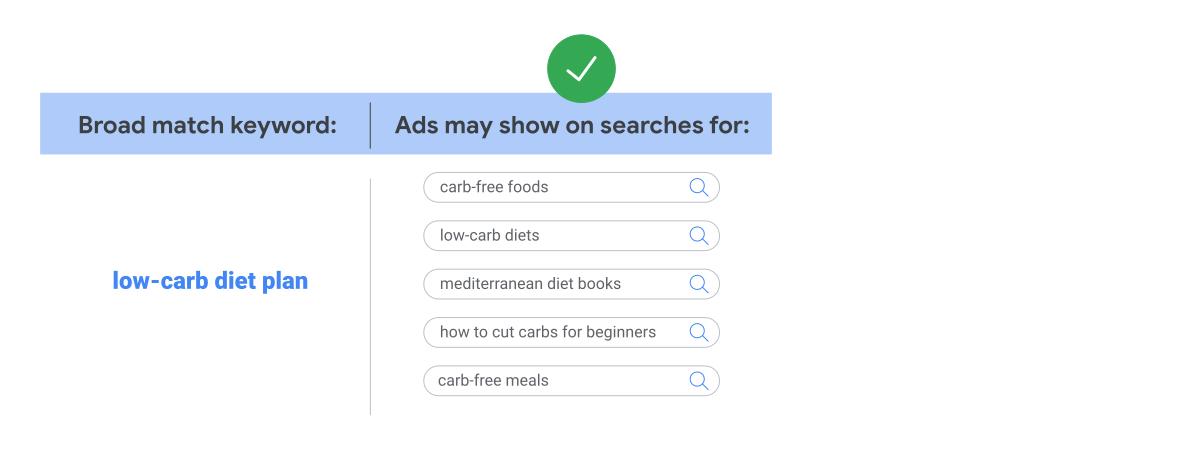
Learn what broad match is in Google Ads and PPC advertising. Understand how broad match keywords work, compare it to exact and phrase match, and discover best p...

Understand the relationship between PPC advertising and AI search engines. Learn how AI search disrupts traditional PPC models while creating new opportunities ...
Cookie Consent
We use cookies to enhance your browsing experience and analyze our traffic. See our privacy policy.