
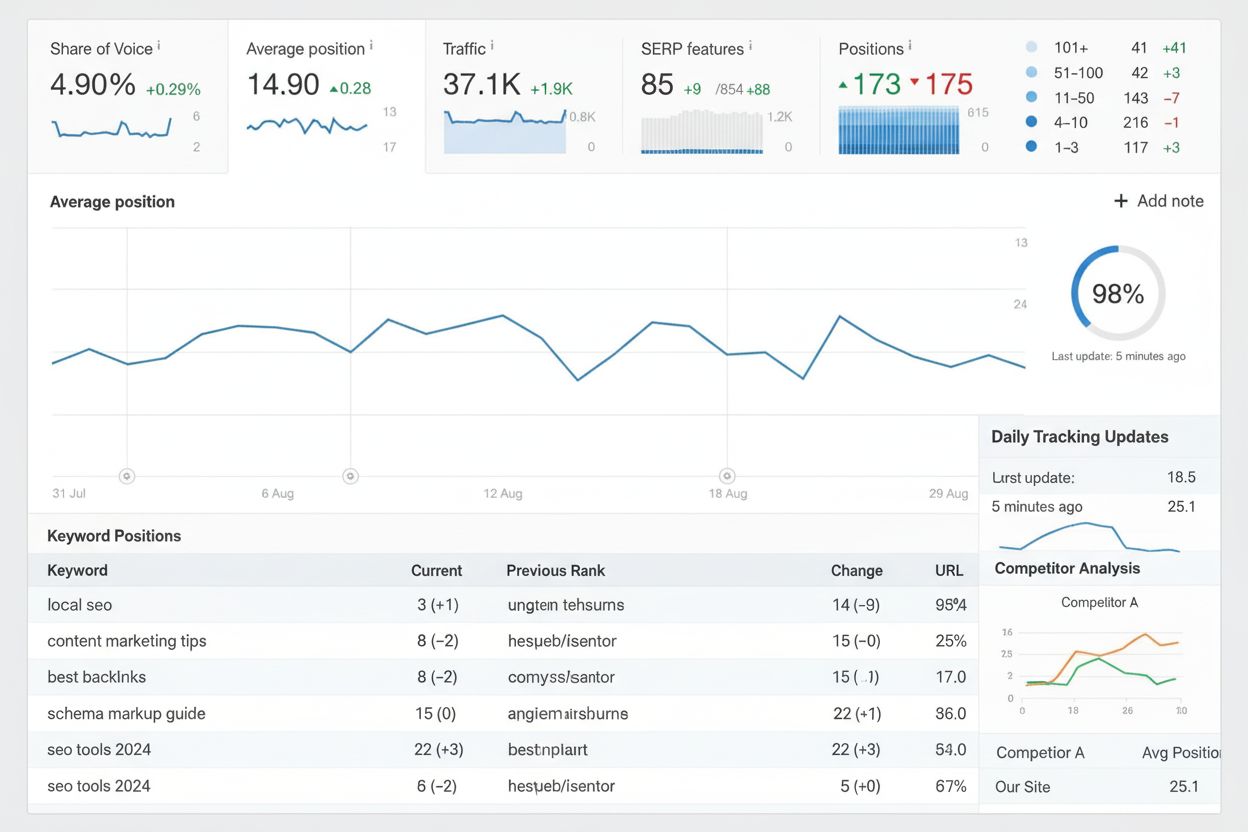
Rank Tracking
Rank tracking monitors keyword positions in search results over time. Learn how it works, why it matters for SEO, and how to use rank tracking tools effectively...
18 min read
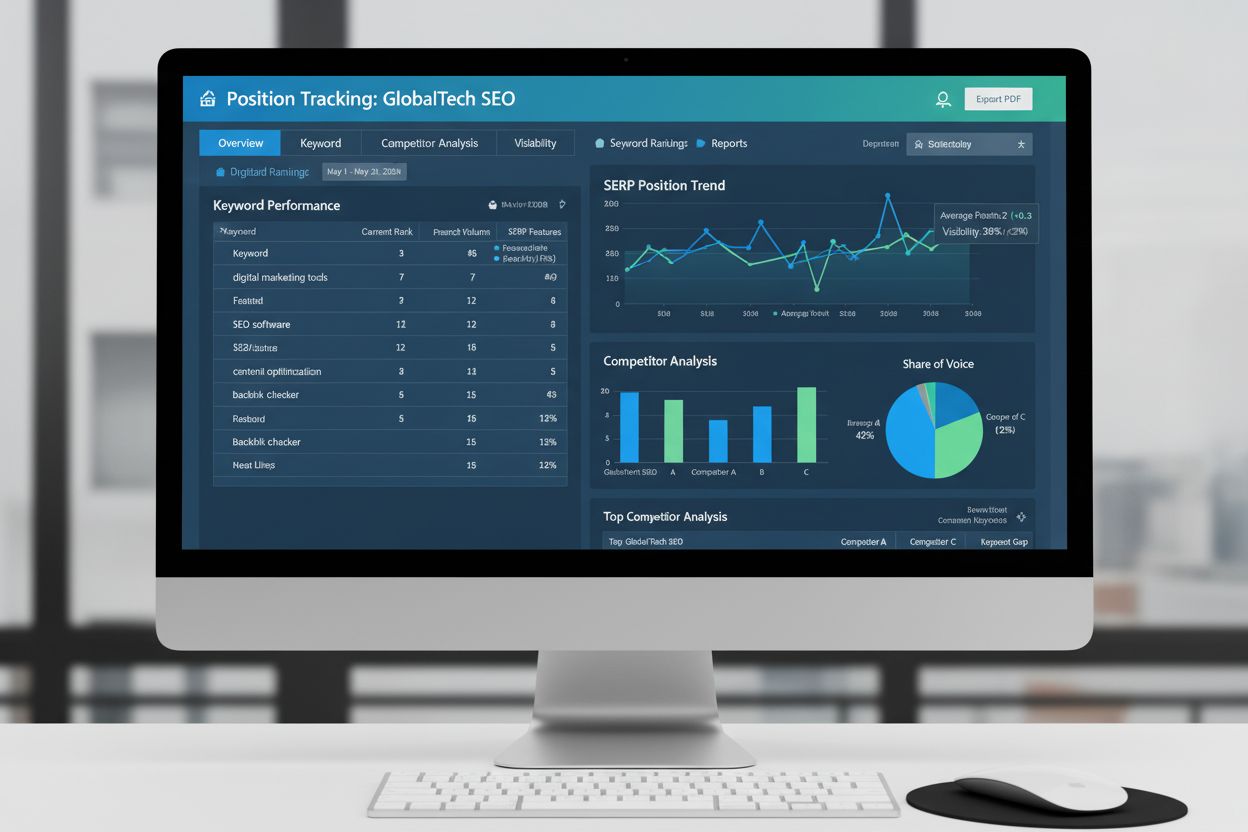
Position tracking is the process of monitoring where your website ranks in search engine results pages (SERPs) for specific keywords over time. It measures ranking changes across devices, locations, and search engines to evaluate the effectiveness of SEO efforts and identify optimization opportunities.
Position tracking is the process of monitoring where your website ranks in search engine results pages (SERPs) for specific keywords over time. It measures ranking changes across devices, locations, and search engines to evaluate the effectiveness of SEO efforts and identify optimization opportunities.
Position tracking is the systematic process of monitoring where your website’s pages rank in search engine results pages (SERPs) for specific keywords over time. It measures the exact position (ranking) your content achieves for target search queries, tracking changes across different devices, geographic locations, and search engines. Position tracking answers the fundamental SEO question: “Where does my website appear in search results, and is that position improving or declining?” By collecting and analyzing this data consistently, position tracking provides quantifiable evidence of whether your SEO efforts are working and identifies areas requiring optimization or strategic adjustment.
The importance of position tracking extends beyond simple curiosity about rankings. According to industry research, over 78% of enterprises now use AI-driven content monitoring tools to track their online visibility, recognizing that understanding search performance is critical to digital success. Position tracking transforms SEO from guesswork into data-driven strategy, enabling marketers to make informed decisions about content optimization, link building, and technical improvements. Without position tracking, you’re essentially flying blind—unable to measure the return on your SEO investments or understand how algorithm updates affect your visibility.
The concept of position tracking emerged alongside the growth of search engine optimization as a discipline in the early 2000s. Initially, SEO professionals manually checked rankings by searching keywords in Google’s incognito mode and recording positions. This manual approach was unreliable, time-consuming, and prone to errors due to personalization, location variations, and search history influences. As SEO matured into a professional discipline, automated rank tracking tools emerged to solve these problems, providing consistent, objective data about keyword positions across multiple dimensions.
Today’s position tracking tools have evolved dramatically from their early iterations. Modern platforms like Semrush, Ahrefs, Nightwatch, and SERPWatcher offer sophisticated capabilities including daily ranking updates, historical data spanning months or years, competitor tracking, SERP feature monitoring, and integration with analytics platforms. The industry has also expanded to include AI search position tracking, recognizing that traditional SERP rankings no longer capture the complete picture of search visibility. As Gartner predicts a 50% decline in organic search traffic by 2028 due to AI search adoption, position tracking tools now monitor rankings across ChatGPT, Google AI Overviews, Perplexity, Claude, and other AI search platforms alongside traditional search engines.
The evolution of position tracking reflects broader changes in how people discover information online. Where search once meant typing a query into Google and scanning a list of results, today’s users increasingly rely on AI-generated answers that cite only a handful of sources. This shift has fundamentally changed what “position” means—it’s no longer just about ranking #1 on a SERP, but about whether your brand appears in AI-generated answers at all. Position tracking has adapted to this reality, expanding from traditional SERP monitoring to comprehensive AI search visibility tracking that measures brand mentions, citation frequency, and share of voice across multiple AI platforms.
| Concept | Definition | Primary Focus | Metrics Tracked | Tools Used |
|---|---|---|---|---|
| Position Tracking | Monitoring exact keyword rankings in SERPs over time | Where pages rank for specific keywords | Keyword position, visibility score, average position | Semrush, Ahrefs, SERPWatcher |
| Rank Tracking | Broader process of monitoring rankings across multiple dimensions | Overall ranking performance across devices/locations | Positions, trends, competitor rankings | Advanced Web Ranking, Nightwatch |
| SERP Tracking | Monitoring changes in search results pages for specific queries | What appears in search results (organic, ads, features) | SERP features, snippets, ads, organic results | Semrush, Moz, Sistrix |
| AI Search Monitoring | Tracking brand mentions and citations in AI-generated answers | Whether brand appears in AI responses | Citation frequency, brand mentions, share of voice | OtterlyAI, Geoptie, AmICited |
| Visibility Tracking | Measuring overall domain visibility across all tracked keywords | Aggregate visibility percentage | Visibility %, estimated traffic, average position | Semrush, SEOmonitor |
| Competitor Tracking | Monitoring competitor keyword rankings and performance | How competitors rank vs. your site | Competitor positions, keyword gaps, market share | Ahrefs, Semrush, SimilarWeb |
Position tracking operates through automated systems that regularly query search engines for your target keywords and record where your website appears in the results. The process begins when you configure a tracking campaign by selecting keywords, specifying geographic locations, choosing device types (desktop, mobile, tablet), and selecting search engines to monitor. Once configured, the tracking tool automatically sends queries to search engines at regular intervals—typically daily—and captures the position of your website in the results.
The technical implementation of position tracking involves several sophisticated components. Tracking tools must simulate real user searches while avoiding detection as automated bots, handle search result variations caused by personalization and localization, and store historical data for trend analysis. Most tools use data centers in different geographic locations to capture location-specific results, ensuring accuracy for local SEO campaigns. The data collection happens continuously, with daily snapshots captured for the first 60 days, then weekly data points stored for up to 140 weeks, providing both short-term and long-term trend visibility.
Position tracking data flows into dashboards and reports that transform raw ranking information into actionable insights. The Overview Report shows visibility trends and average position changes over time. The Rankings Distribution Report reveals how many keywords rank in top 3, top 10, and top 100 positions. The Pages Report identifies which landing pages drive the most traffic from target keywords. The Landscape Report benchmarks your visibility against competitors. Advanced features like Cannibalization Reports detect when multiple pages compete for the same keywords, and Featured Snippets Reports highlight opportunities to win zero-click SERP features.
Understanding the metrics tracked by position tracking tools is essential for interpreting data and making strategic decisions. Keyword Position is the most fundamental metric—the exact ranking (1-100) your page achieves for a specific keyword. Visibility Score represents your overall domain visibility as a percentage, calculated based on the average position of all tracked keywords and their search volumes. A higher visibility score indicates better aggregate performance across your keyword portfolio.
Average Position calculates the mean ranking across all tracked keywords, providing a single number that represents your overall SEO health. If your average position improves from 18 to 10, it signals broad improvement across your keyword set. Click-Through Rate (CTR) shows what percentage of searchers click your result after seeing it in the SERP—a critical metric because high rankings mean little if your title and meta description don’t compel clicks. SERP Feature Presence tracks whether your pages appear in featured snippets, knowledge panels, image packs, or “People Also Ask” boxes, which can significantly boost visibility without requiring a #1 ranking.
For AI search position tracking, additional metrics have emerged. Citation Frequency measures how often your website appears as a source in AI-generated answers. Brand Mention Rate tracks how often AI platforms reference your brand when answering relevant queries. Share of Voice compares your brand mentions to competitors’ mentions in AI responses, revealing your competitive position in the AI search landscape. Sentiment Analysis examines how AI platforms characterize your brand—whether mentions are positive, neutral, or negative. These AI-specific metrics recognize that visibility in generative search differs fundamentally from traditional SERP rankings.
Traditional position tracking focused exclusively on Google, which dominates search with approximately 92% market share. However, modern position tracking tools now monitor rankings across multiple search engines including Bing, Yahoo, Baidu, and YouTube. This multi-engine tracking is important because different search engines use different algorithms, resulting in different rankings for the same keywords. A page might rank #5 on Google but #12 on Bing, requiring different optimization strategies for each platform.
The emergence of AI search platforms has fundamentally expanded what position tracking means. Tools like Semrush Position Tracking now monitor rankings in ChatGPT Search, Google AI Mode, and Google AI Overviews. Nightwatch offers dedicated AI Tracking features for monitoring visibility in AI-powered search experiences. OtterlyAI specializes in tracking brand mentions and citations across ChatGPT, Perplexity, Claude, Gemini, and Microsoft Copilot. This multi-platform approach recognizes that search visibility is no longer confined to traditional SERPs—it extends across an ecosystem of search experiences, each with different ranking factors and citation patterns.
The shift toward multi-platform position tracking reflects changing user behavior. Research shows that 58% of consumers have replaced traditional search engines with generative AI tools for product recommendations. ChatGPT referrals now drive 10% of new user sign-ups, up from less than 1% just six months prior. These statistics underscore why position tracking must evolve beyond traditional SERP monitoring. A brand might rank #1 on Google for a valuable keyword but receive zero citations in ChatGPT responses for the same query—a critical visibility gap that traditional position tracking would miss.
Geographic position tracking has become increasingly sophisticated, allowing marketers to monitor rankings at multiple levels of geographic specificity. Tools like Local Viking specialize in tracking local SEO performance, monitoring Google Business Profile rankings across specific coordinates, cities, and regions. This capability is essential for businesses serving multiple locations, as search results vary significantly by geography. A restaurant might rank #1 for “best pizza near me” in one neighborhood but not appear in results five miles away.
International position tracking extends this concept across countries and languages. Marketers can track keyword positions in different countries, each with its own search engine preferences, language variations, and local competitors. A company selling products globally might track the same keyword in English (for US/UK markets), Spanish (for Latin America), German (for Europe), and Mandarin (for Asia). Position tracking tools support this complexity by allowing configuration of language, country, and even regional variations within countries. This granular tracking reveals which markets are performing well and which require additional optimization effort.
The relationship between position tracking and local search features has also evolved. Position tracking tools now monitor whether your business appears in Google Maps results, local pack features, and local knowledge panels. These SERP features often drive more qualified traffic than organic rankings because they appear prominently and include business information like hours, reviews, and directions. Tracking your presence in these features alongside traditional rankings provides a complete picture of local search visibility.
Implementing effective position tracking begins with keyword selection. Rather than tracking hundreds of random keywords, successful position tracking focuses on keywords aligned with business goals. This includes primary keywords directly related to your core offerings, secondary keywords representing related topics, and long-tail keywords capturing specific user intent. The quality of your keyword list directly determines the usefulness of your position tracking data—tracking irrelevant keywords wastes resources and clutters reports with noise.
Keyword organization is equally important. Grouping keywords into clusters based on topic, intent, or funnel stage enables more meaningful analysis. For example, organizing keywords into “awareness,” “consideration,” and “decision” stages reveals which funnel stages are performing well and which need optimization. Tagging keywords by content type (blog posts, product pages, category pages) shows which content formats rank best for different query types. This organizational structure transforms position tracking from a simple ranking list into a strategic tool that guides content and optimization priorities.
Baseline establishment is critical for meaningful position tracking. Before making major changes, document your current positions for all tracked keywords. This baseline enables you to measure the impact of your optimization efforts. If you improve a page’s average position from 15 to 8 after optimization, you have quantifiable proof that your work was effective. Without a baseline, you can’t distinguish between improvements from your efforts and natural ranking fluctuations caused by algorithm updates or competitor activity.
Frequency of analysis should match your business needs. High-competition industries with frequent algorithm updates might warrant weekly reviews, while stable niches might only need monthly analysis. The key is avoiding two extremes: obsessing over daily fluctuations (which are often noise) or ignoring data for months (which delays response to problems). Most SEO professionals find that biweekly or monthly analysis provides the right balance between staying informed and avoiding analysis paralysis.
Google algorithm updates can dramatically shift rankings, making position tracking an early warning system for detecting these changes. When multiple keywords suddenly drop in position across your site, it often indicates an algorithm update rather than a specific content issue. Position tracking tools help distinguish between normal fluctuations and significant changes by showing patterns across your entire keyword portfolio. If 30% of your keywords drop 5+ positions simultaneously, an algorithm update is likely responsible.
Understanding algorithm update impacts through position tracking enables faster response. Rather than panicking over individual keyword drops, you can analyze the pattern to understand what changed. Did pages with thin content drop? Did sites with poor mobile experience lose rankings? Did pages lacking E-E-A-T signals decline? Position tracking data combined with analysis of affected pages reveals the update’s focus, guiding your recovery strategy. Some position tracking tools like Semrush include Sensor, which tracks algorithm volatility across the web, helping you contextualize your own ranking changes within broader market movements.
Recovery from algorithm updates is accelerated by position tracking. By monitoring positions daily after an update, you can quickly identify which recovery efforts are working. If you improve a page’s content and its position improves within days, you have evidence that your fix addressed the algorithm’s concerns. Position tracking transforms algorithm recovery from guesswork into data-driven optimization, reducing the time to regain lost visibility.
Competitor position tracking reveals market dynamics and identifies strategic opportunities. By monitoring competitor rankings for your target keywords, you understand which competitors are gaining ground and which are losing visibility. If a competitor suddenly ranks #1 for a keyword you previously dominated, position tracking alerts you to investigate what changed. Did they publish new content? Improve their page? Build new backlinks? Understanding competitor moves enables proactive strategy adjustments rather than reactive responses.
Keyword gap analysis powered by position tracking identifies keywords competitors rank for that you don’t. These gaps represent untapped opportunities—keywords where demand exists but you’re not capturing it. If a competitor ranks for 50 keywords you don’t track, those represent potential growth opportunities. Conversely, identifying keywords where you rank but competitors don’t reveals your competitive advantages worth defending and promoting.
Share of voice metrics in position tracking show your competitive position across your entire keyword portfolio. If you and three competitors track the same 100 keywords, share of voice reveals what percentage of top-10 positions you collectively own. Improving your share of voice—by moving from 20% to 25% of top-10 positions—indicates you’re gaining ground against competitors. This metric provides a high-level view of competitive performance that individual keyword rankings don’t capture.
Position tracking data directly informs content optimization priorities. Keywords ranking 11-20 (second page of Google) represent quick-win opportunities—small improvements might push them to page one, significantly increasing traffic. Position tracking identifies these opportunities, allowing you to prioritize content updates that will have the biggest impact. Conversely, keywords ranking 50+ might require more substantial content overhauls or new content creation.
Content performance analysis through position tracking reveals which content types rank best for different query types. Blog posts might dominate informational queries, while product pages rank for commercial queries. This insight guides content creation strategy—if you want to rank for commercial keywords, you need product-focused content, not blog posts. Position tracking makes these patterns visible, enabling strategic content planning.
Keyword cannibalization detection through position tracking reveals when multiple pages compete for the same keywords, diluting your ranking power. If two pages both rank for the same keyword (one at #5, one at #8), consolidating them into a single, stronger page might push you to #2 or #3. Position tracking tools with cannibalization reports automate this detection, identifying opportunities to strengthen your rankings through content consolidation.
The future of position tracking is inextricably linked to the rise of generative AI search. As AI search platforms grow in user adoption, traditional SERP position tracking becomes insufficient. The next generation of position tracking tools will seamlessly integrate traditional rankings with AI search visibility, providing a unified view of where your brand appears across the entire search landscape. This integration is already beginning—tools like Semrush now track both traditional rankings and AI search citations in a single platform.
Multimodal search represents another frontier for position tracking evolution. As AI search platforms begin processing images, video, and voice alongside text, position tracking will need to expand beyond keyword-based monitoring. Future tools might track your visibility for image queries, video content performance in AI search, and voice search rankings. This expansion recognizes that search is becoming increasingly diverse in format and modality.
Real-time position tracking with sub-daily update frequencies will likely become standard as competition intensifies. Current daily updates provide sufficient granularity for most purposes, but as markets become more competitive, hourly or even real-time tracking might become necessary for high-stakes keywords. The infrastructure to support this already exists—the question is whether the value justifies the cost.
Predictive position tracking powered by machine learning represents an exciting frontier. Rather than just reporting current positions, future tools might predict how positions will change based on content updates, link building, or algorithm patterns. This predictive capability would transform position tracking from a backward-looking metric into a forward-looking strategic tool, enabling marketers to forecast the impact of their optimization efforts before implementing them.
Position tracking has evolved from a simple ranking check into a sophisticated, multi-dimensional monitoring system that captures visibility across traditional search engines and emerging AI platforms. The fundamental principle remains unchanged—understanding where your content appears in search results and how that position changes over time—but the execution has become far more complex and valuable. Modern position tracking tools provide the data infrastructure necessary to make informed SEO decisions, measure the impact of optimization efforts, and stay competitive in an increasingly complex search landscape.
The rise of AI search has expanded the definition of “position” beyond traditional SERP rankings to include brand mentions, citation frequency, and share of voice in AI-generated answers. This expansion reflects a fundamental shift in how people discover information and how search visibility is achieved. Brands that embrace comprehensive position tracking—monitoring both traditional rankings and AI search visibility—will have a significant advantage over those relying on outdated metrics. As search continues to evolve, position tracking will remain essential infrastructure for understanding and optimizing your online visibility.
Position tracking and rank tracking are often used interchangeably, but position tracking specifically refers to monitoring where your website appears in search results for target keywords. Rank tracking is the broader process of monitoring rankings across multiple dimensions including devices, locations, and search engines. Both terms describe the same core activity of tracking keyword positions over time to measure SEO performance and identify optimization opportunities.
Most SEO professionals review position tracking data weekly or biweekly to identify meaningful trends rather than reacting to daily fluctuations. Daily updates are available from most tracking tools, but analyzing data over longer periods (monthly or quarterly) provides more reliable insights into whether your SEO efforts are working. Sudden drops may indicate algorithm updates, while gradual improvements suggest your optimization strategies are effective.
As AI search platforms like ChatGPT, Perplexity, and Google AI Overviews grow in popularity, traditional position tracking alone is insufficient. Modern position tracking tools now monitor both traditional SERP rankings and AI search citations, showing whether your brand appears in AI-generated answers. This dual tracking helps you understand your complete search visibility across both traditional and generative search experiences.
Key position tracking metrics include keyword position (exact ranking), visibility score (overall domain visibility), average position (mean ranking across all tracked keywords), click-through rate (CTR), and SERP feature presence. For AI search, also track citation frequency, brand mention rate, and share of voice compared to competitors. These metrics together provide a comprehensive view of your search performance.
Yes, most modern position tracking tools allow you to monitor competitor rankings for the same keywords you track. This competitive intelligence helps you understand market dynamics, identify which competitors are gaining ground, and discover keywords where you're losing visibility. Comparing your positions against competitors reveals opportunities to improve and strategies you might adopt.
Search results vary significantly by geographic location due to local intent, language preferences, and regional algorithm variations. Advanced position tracking tools allow you to track keywords by specific countries, states, cities, or even postal codes. This location-based tracking is essential for businesses serving multiple markets or those focused on local SEO, as it reveals performance differences across regions.
While position tracking shows where you rank, it doesn't directly measure traffic. However, higher positions typically correlate with more clicks and organic traffic. The relationship isn't linear—position 1 doesn't always generate 10x more traffic than position 10. Position tracking combined with Google Analytics or Google Search Console data provides the complete picture of how rankings translate into actual visitor behavior and conversions.
Position tracking data reveals which keywords are improving, declining, or stagnating. Use this information to identify underperforming pages that need optimization, discover quick-win opportunities (keywords ranking 11-20 that could reach page one), and understand the impact of your content updates and link-building efforts. Regular analysis of position tracking data guides strategic decisions about where to invest your SEO resources.
Start tracking how AI chatbots mention your brand across ChatGPT, Perplexity, and other platforms. Get actionable insights to improve your AI presence.
Rank tracking monitors keyword positions in search results over time. Learn how it works, why it matters for SEO, and how to use rank tracking tools effectively...
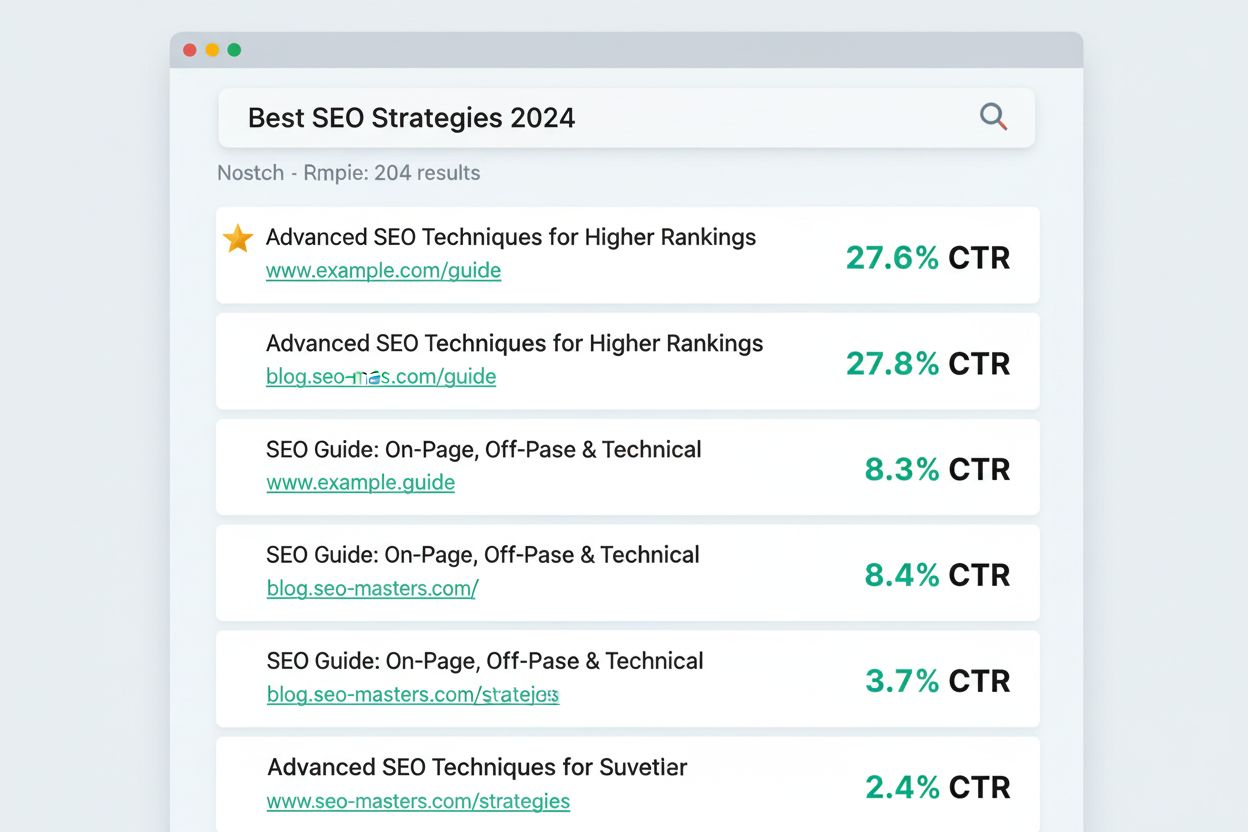
Ranking position is the location of a webpage in search results (1-10 on page 1). Position 1 gets 39.8% CTR. Learn how ranking position affects traffic and visi...
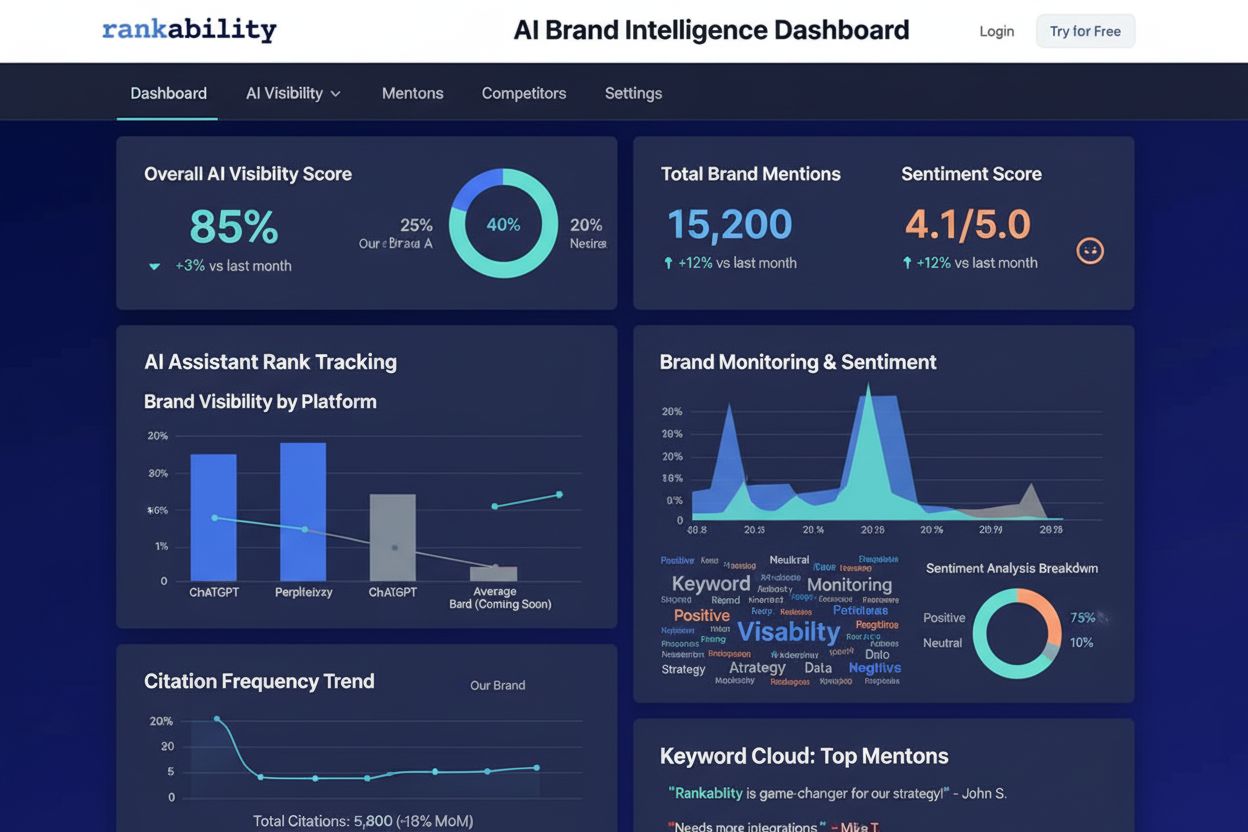
AI rank tracking monitors brand visibility and citations across ChatGPT, Perplexity, Google AI Overviews, and Claude. Learn how to measure AI search presence an...
Cookie Consent
We use cookies to enhance your browsing experience and analyze our traffic. See our privacy policy.