The transition period as conversational AI replaces traditional keyword-based search. This era marks the shift from keyword-centric discovery to intent-driven, conversational AI systems that synthesize information and provide direct answers. While traditional search remains dominant, AI platforms like ChatGPT, Google AI Overviews, and Perplexity are reshaping how users find information and make decisions.
Post-Search Era
The transition period as conversational AI replaces traditional keyword-based search. This era marks the shift from keyword-centric discovery to intent-driven, conversational AI systems that synthesize information and provide direct answers. While traditional search remains dominant, AI platforms like ChatGPT, Google AI Overviews, and Perplexity are reshaping how users find information and make decisions.
What is the Post-Search Era?
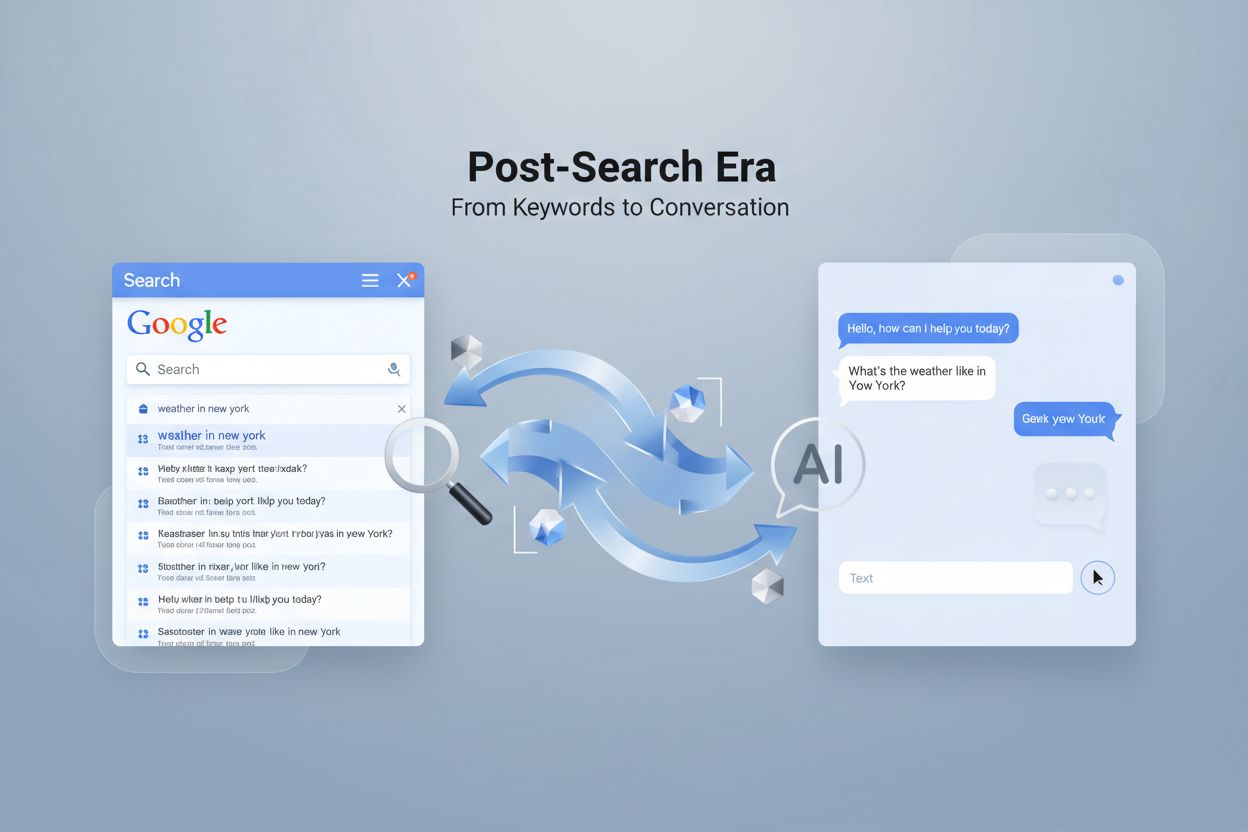
The Post-Search Era represents a fundamental transition in how users discover information online, shifting from traditional keyword-based search to conversational AI-powered discovery. This period marks the emergence of generative search engines and AI assistants as viable alternatives to Google’s keyword-centric model, with platforms like ChatGPT, Google AI Overviews, Perplexity, and Gemini reshaping user behavior. Rather than typing keywords and scanning blue links, users now engage in natural language conversations with AI systems that synthesize information and provide direct answers. The transition is not instantaneous—traditional search still dominates with 96.98% of clicks in the top 10 results—but the trajectory is unmistakable. 50% of consumers now use AI search, signaling a generational shift in information-seeking behavior. AmICited.com monitors this evolving landscape, tracking how brands and content perform across both traditional and AI-powered search channels. Understanding the Post-Search Era is essential for any organization seeking to maintain visibility and authority as search behavior fundamentally transforms.
The Shift from Keywords to Conversational Intent
The Post-Search Era demands a fundamental rethinking of how search engines interpret user queries. Rather than matching keywords to indexed pages, modern AI search systems employ semantic search and vector embeddings to understand the intent behind questions, returning synthesized answers drawn from multiple sources. This shift prioritizes entity-based search—recognizing that users are searching for concepts, people, and organizations rather than exact phrases—and elevates the importance of E-E-A-T signals (Experience, Expertise, Authoritativeness, Trustworthiness) in determining which sources get cited. Content freshness has become increasingly critical, with 25.7% fresher content receiving preferential treatment in AI search results. The semantic layer means that traditional keyword optimization becomes less relevant; instead, brands must focus on being the authoritative source on topics their audience cares about. Long-form, comprehensive content that demonstrates genuine expertise now outperforms thin, keyword-stuffed pages. This represents a return to content quality as the primary ranking factor, though the mechanisms by which quality is measured have evolved significantly.
Ready to Monitor Your AI Visibility?
Track how AI chatbots mention your brand across ChatGPT, Perplexity, and other platforms.
The Post-Search Era exhibits several defining characteristics that distinguish it from traditional search:
Zero-click searches dominate: 60% of all searches result in zero clicks, with users finding answers directly in AI overviews or conversational responses without visiting source websites
AI Overviews reduce traditional clicks: Google’s AI Overviews have reduced click-through rates by 34.5%, fundamentally altering traffic patterns for established websites
Conversion advantage is dramatic: AI search traffic converts 23x better than traditional search, indicating users are further along the decision journey
Multi-platform search is standard: Users no longer rely on a single search engine; they compare answers across ChatGPT, Google, Perplexity, and other platforms
Brand authority trumps rankings: Being cited by AI systems depends more on brand authority and trustworthiness than traditional ranking factors
Content freshness is critical: AI systems prioritize recently updated content, making regular publishing cycles essential
Structured data becomes foundational: Schema markup, JSON-LD, and semantic HTML enable AI systems to better understand and cite your content
Citation frequency matters more than traffic: Being mentioned across multiple authoritative sources now drives visibility in AI search results
Impact on Traditional Search and SEO
Traditional search remains the dominant force in the digital discovery landscape, with Google sending 345x more traffic than AI search engines and maintaining 96.98% of clicks in the top 10 results. However, this dominance masks a critical evolution: Google itself is integrating AI features directly into its search experience through AI Overviews, creating a hybrid model that combines traditional ranking with generative capabilities. This integration means that SEO professionals must optimize for both the traditional ten blue links and the AI-generated overview that appears above them. The two channels serve fundamentally different purposes—traditional search drives volume and awareness, while AI search drives qualified, high-intent traffic—and successful brands must excel in both. The relationship between traditional and AI search is not competitive but complementary; a strong traditional SEO foundation often translates to better AI search visibility, as AI systems prioritize sources that already demonstrate authority. AmICited.com’s research shows that brands performing well in traditional search are more likely to be cited in AI search results, though the correlation is not perfect. Organizations that abandon traditional SEO in favor of AI optimization will find themselves invisible to the majority of users still relying on conventional search.
Stay Updated on AI Visibility Trends
Get the latest insights on AI mentions, brand monitoring, and optimization strategies.
The Rise of Generative Engine Optimization (GEO)
As AI search becomes increasingly important, a new discipline has emerged: Generative Engine Optimization (GEO). Unlike traditional SEO, which focuses on ranking for keywords, GEO prioritizes being cited and mentioned by AI systems as an authoritative source. The core principle of GEO is that brand mentions and citations matter more than rankings—if an AI system cites your brand as a source, users see your perspective regardless of whether you rank in Google’s top 10. GEO strategies emphasize building multi-platform presence across industry publications, news outlets, and authoritative websites where AI systems source information. Content structure becomes critical; AI systems favor well-organized, clearly formatted content with distinct sections, headers, and data points that can be easily extracted and synthesized. Authority building through thought leadership, original research, and expert positioning directly influences citation frequency in AI search results. Tools like FlowHunt.io help brands track their mentions and citations across AI search platforms, providing visibility into GEO performance. The transition from SEO to GEO represents a shift from optimizing for algorithms to optimizing for being recognized as a trustworthy source of information.
Platform-Specific Dynamics
Different AI search platforms exhibit distinct sourcing patterns and citation preferences, requiring platform-specific optimization strategies:
Platform
Traffic Share
Key Characteristics
Citation Patterns
ChatGPT
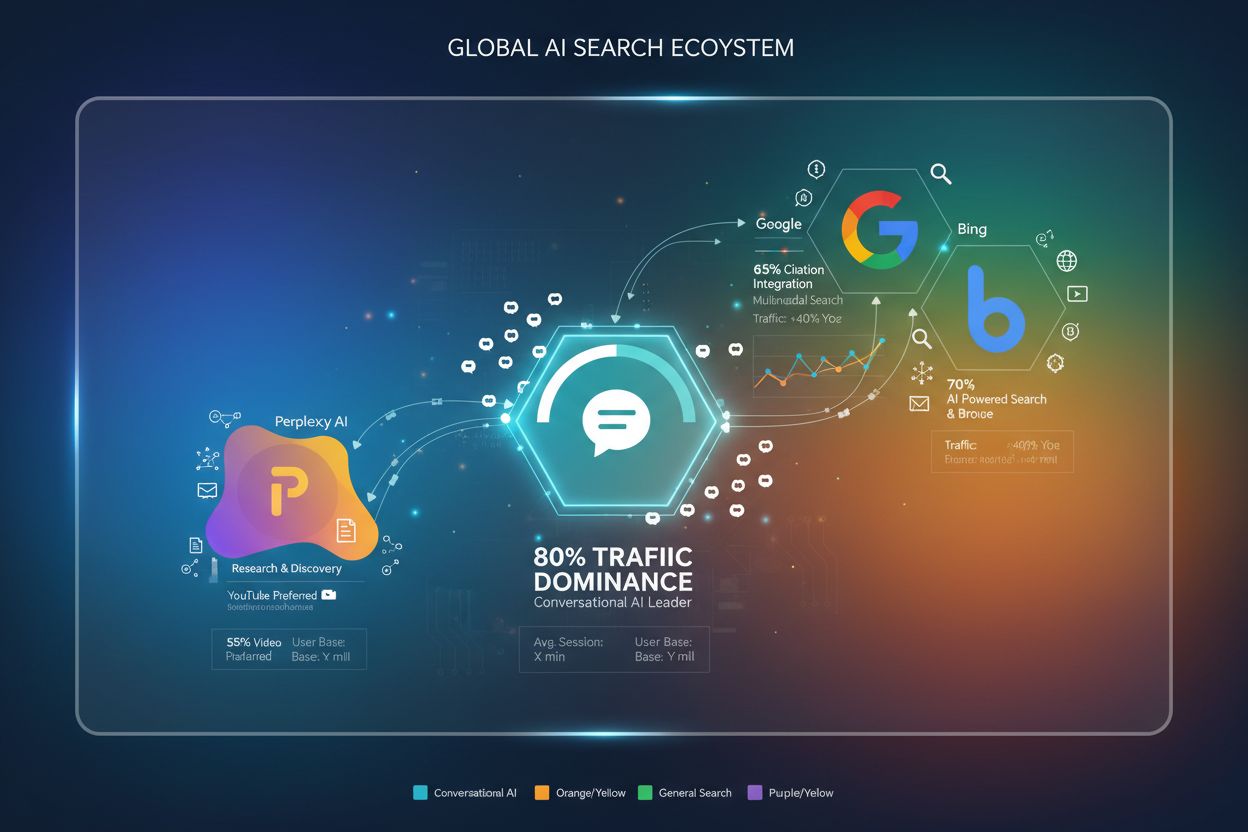
80% of AI traffic
Prioritizes fresh content; strong preference for recent updates
76.4% of citations updated in last 30 days; 16.3% from Wikipedia
Google AI Overviews
Integrated into traditional search
Draws heavily from top-ranking pages
76% of sources from top 10 Google results; favors Reddit and Quora
Perplexity
Growing alternative
Emphasizes multimedia and video content
16.1% of citations from YouTube; strong visual content preference
Gemini
Emerging platform
Distinct weighting algorithm
Unique sourcing patterns; less reliance on traditional ranking signals
A critical insight emerges from this platform analysis: 80% of sources cited in AI search don’t appear in Google’s top 10 results, indicating that AI systems source from a broader range of websites than traditional search. This creates opportunity for brands that may not rank highly in Google but maintain strong authority and fresh content. ChatGPT’s preference for recently updated content means that brands publishing frequently gain disproportionate visibility. Google AI Overviews’ reliance on top-ranking pages suggests that traditional SEO remains a prerequisite for AI search visibility on Google’s platform. Understanding these platform-specific dynamics allows brands to tailor their content strategy to maximize visibility across the AI search ecosystem.
Business Implications and Conversion Dynamics
The shift to AI search fundamentally changes the economics of digital marketing. AI search traffic represents pre-qualified, high-intent users who have already engaged with synthesized information and are further along the decision journey. These users view 50% more pages on average and spend 8 seconds longer on site compared to traditional search visitors, indicating deeper engagement and higher purchase intent. The conversion advantage is staggering: AI search converts 23x better than traditional search, meaning that even small amounts of AI search traffic can drive significant revenue. This quality-over-quantity dynamic shifts the ROI calculation for content investment; a single AI search visitor may be worth dozens of traditional search visitors. The market opportunity is substantial, with $750B projected spending through AI search by 2028, though this varies significantly by industry—B2B software, healthcare, and financial services see higher AI search adoption than e-commerce or entertainment. AmICited.com’s metrics tracking reveals that brands receiving consistent AI search citations experience higher customer lifetime value and lower acquisition costs. Organizations that can capture even 1-2% of their traffic from AI search often see outsized revenue impact due to conversion advantages.
Content Strategy Evolution
Successful content in the Post-Search Era requires fundamental strategic shifts from traditional SEO approaches. Answer-first formatting becomes essential; content should lead with direct answers to common questions rather than burying conclusions in lengthy introductions. Structured data and schema markup enable AI systems to extract and cite specific information, making semantic HTML and JSON-LD implementation non-negotiable. Multi-platform distribution ensures that your content reaches AI systems that source from diverse websites rather than relying solely on owned channels. Regular updates and content refreshes signal to AI systems that information remains current and authoritative; brands that publish quarterly updates see significantly higher citation frequency than those with static content. The hub-and-spoke architecture—where comprehensive pillar content links to detailed supporting articles—helps AI systems understand topic relationships and cite your brand as a comprehensive authority. Editorial thinking becomes increasingly important; AI systems recognize and reward original research, unique perspectives, and data-driven insights more than commodity content. 97% of leading brands maintain human editorial review of AI-generated or AI-assisted content, ensuring quality and accuracy that AI systems recognize and reward.
Challenges and Opportunities
The Post-Search Era presents both significant challenges and unprecedented opportunities for brands. 26% of brands have zero mentions in AI search results, indicating that many organizations remain invisible to this growing user segment. The strongest correlation with AI search visibility is brand authority—established, trusted brands receive disproportionate citations regardless of content volume. Most organizations must optimize for both traditional and AI search simultaneously, creating operational complexity; brands cannot simply abandon SEO in favor of GEO. Common mistakes include focusing exclusively on ChatGPT while ignoring Google AI Overviews (which reach more users), failing to update content regularly, and neglecting structured data implementation. Only 16% of brands actively track their AI search performance, creating a significant information gap that disadvantages most organizations. Early movers in GEO optimization gain substantial advantages, as AI systems’ citation patterns are still forming and less competitive than traditional search. AmICited.com’s research indicates that brands implementing comprehensive GEO strategies 12-18 months ahead of competitors capture disproportionate share of AI search visibility. The window for establishing authority in AI search remains open, but it is closing rapidly as more organizations recognize the opportunity.
Future Outlook and Preparation
The Post-Search Era will continue to evolve significantly through 2028 and beyond. AI search is projected to grow from current levels to 5-10% of total search traffic by 2028, representing a 10-50x increase in volume and user base. The platforms themselves will converge, with Google, Microsoft, and other major players integrating AI search more deeply into their core products while maintaining traditional search capabilities. Paid advertising in AI search is emerging, creating new channels for brands to reach high-intent users willing to pay for visibility. Integration between traditional and AI search will deepen, with ranking signals and citation patterns becoming increasingly intertwined. Organizations should take immediate action by auditing their current AI search visibility, implementing structured data across their website, establishing a content refresh cadence, and building brand authority through thought leadership. Long-term success requires maintaining flexibility and monitoring platform changes, as the AI search landscape remains volatile and subject to rapid evolution. The brands that thrive in the Post-Search Era will be those that recognize it not as a replacement for traditional search but as a complementary channel requiring distinct optimization strategies and sustained investment.
Frequently asked questions
What exactly is the Post-Search Era?
The Post-Search Era represents a fundamental transition in how users discover information online, shifting from traditional keyword-based search to conversational AI-powered discovery. This period marks the emergence of generative search engines and AI assistants like ChatGPT, Google AI Overviews, Perplexity, and Gemini as viable alternatives to Google's keyword-centric model. Rather than typing keywords and scanning blue links, users now engage in natural language conversations with AI systems that synthesize information and provide direct answers. The transition is not instantaneous—traditional search still dominates—but the trajectory is unmistakable.
Is traditional SEO dead in the Post-Search Era?
No, traditional SEO remains essential and will continue to be important for the foreseeable future. Google sends 345 times more traffic than all AI platforms combined, and 96.98% of clicks still happen in the top 10 traditional search results. Rather than replacing traditional SEO, the Post-Search Era creates an additional optimization opportunity. The winning strategy combines both traditional SEO and Generative Engine Optimization (GEO), recognizing that each channel serves different purposes in the customer journey and that strong traditional SEO often translates to better AI search visibility.
How do I optimize for AI search platforms?
To optimize for AI search, focus on: implementing structured data and schema markup, creating fresh, regularly updated content (AI platforms prefer content 25.7% fresher than traditional search citations), building brand authority through web mentions and citations, ensuring content appears in sources AI platforms cite (like forums, review sites, and authoritative publications), and structuring information with clear, direct answers followed by supporting context. Additionally, develop a multi-platform content distribution strategy and maintain regular content refresh cycles to signal freshness to AI systems.
Which AI platform should I focus on first?
ChatGPT dominates AI referral traffic with 80% of all AI search traffic to websites, making it the logical starting point. However, Google AI Overviews reach more total users through integration with traditional Google Search, so optimizing for both is essential. Perplexity is growing rapidly and shows unique characteristics (strong preference for video content), while Gemini represents Microsoft's competitive offering. A comprehensive strategy addresses all major platforms, but ChatGPT and Google AI Overviews should be primary focuses due to their traffic volume and user reach.
What's the difference between SEO and GEO?
SEO (Search Engine Optimization) focuses on ranking your website in traditional search engines like Google through keyword optimization, backlinks, and technical improvements. GEO (Generative Engine Optimization) focuses on getting your brand cited and recommended in AI platforms like ChatGPT, Perplexity, and Google AI Overviews. While SEO emphasizes owned content and website rankings, GEO requires managing how your brand appears across the entire web ecosystem, including third-party sites, forums, and review platforms. Both are essential in the Post-Search Era, and strong performance in one often supports the other.
How can I track my brand's visibility in AI search?
AmICited.com provides comprehensive monitoring of your brand's visibility across AI search platforms including ChatGPT, Perplexity, Google AI Overviews, and Gemini. The platform tracks how often your brand is cited, in what context, and how your visibility compares to competitors. Key metrics include citation frequency, share of voice in your category, and the quality of citations. Only 16% of brands actively track AI search performance, creating a significant competitive advantage for those who do. Regular monitoring enables data-driven optimization and helps identify which GEO strategies are most effective.
Will AI search completely replace traditional search?
Unlikely. While AI search is growing rapidly and projected to reach 5-10% of total search traffic by 2028, traditional search will remain dominant for the foreseeable future. The more probable scenario is convergence, where traditional and AI search become increasingly integrated. Google is already embedding AI Overviews into traditional search results, creating a hybrid experience. Different user intents and query types will continue to favor different search methods—transactional searches often work better in traditional search, while research and comparison queries benefit from AI synthesis. Success requires optimizing for both channels simultaneously.
What content strategy works best in the Post-Search Era?
Successful content in the Post-Search Era requires: answer-first formatting (leading with direct answers before context), implementation of structured data and schema markup, multi-platform distribution beyond your owned website, regular content updates to signal freshness, and a hub-and-spoke architecture where comprehensive pillar content links to supporting articles. Original research, unique perspectives, and data-driven insights are rewarded more than commodity content. Additionally, 97% of leading brands maintain human editorial review of AI-generated or AI-assisted content, ensuring quality and accuracy that AI systems recognize and reward.
Monitor Your Brand Across AI Search Platforms
Track how your brand is cited in ChatGPT, Perplexity, Google AI Overviews, and other AI platforms with AmICited.com's comprehensive monitoring solution.
What is Post-Purchase AI Search Behavior and How Does It Impact Your Brand?
Understand post-purchase AI search behavior, how customers use AI tools after buying, and why monitoring your brand mentions in AI answers is critical for custo...
How AI Agents Change Search Behavior: Impact on User Queries and Discovery
Discover how AI agents reshape search behavior, from conversational queries to zero-click results. Learn the impact on user habits, brand visibility, and search...
Branded Search Volume and AI Visibility: The Connection Explained
Discover how branded search volume directly correlates with AI visibility. Learn to measure brand signals in LLMs and optimize for AI-driven discovery with acti...
8 min read
Cookie Consent We use cookies to enhance your browsing experience and analyze our traffic. See our privacy policy.