

What is Pre-rendering for AI Search?
Learn how pre-rendering helps your website appear in AI search results from ChatGPT, Perplexity, and Claude. Understand the technical implementation and benefit...
8 min read
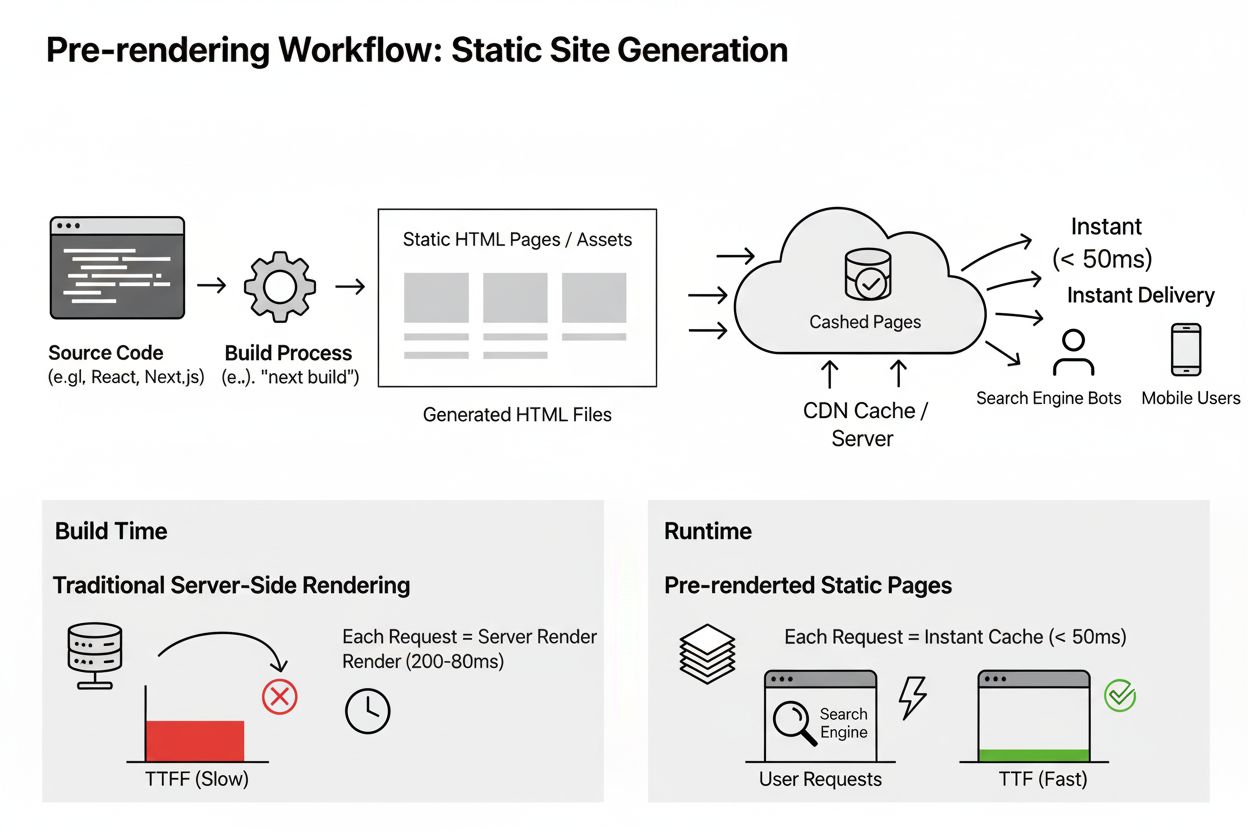
Pre-rendering is a web development technique that generates static HTML pages at build time before user requests, enabling instant page delivery and improved SEO performance. These pre-built pages are cached and served to both users and search engine bots, eliminating the need for real-time rendering on each request.
Pre-rendering is a web development technique that generates static HTML pages at build time before user requests, enabling instant page delivery and improved SEO performance. These pre-built pages are cached and served to both users and search engine bots, eliminating the need for real-time rendering on each request.
Pre-rendering is a web development technique that generates static HTML versions of web pages at build time, before any user requests are made. These pre-built HTML files are cached and served directly to visitors and search engine bots, eliminating the need for real-time rendering on each request. The primary goal of pre-rendering is to combine the performance benefits of static HTML delivery with the flexibility of dynamic web applications. By shifting the rendering process from runtime (when users request pages) to build time (during deployment preparation), pre-rendering dramatically improves page load speeds, search engine indexing efficiency, and overall user experience. This technique has become increasingly critical in modern web development, particularly for JavaScript-heavy applications and single-page applications (SPAs) that traditionally struggle with SEO and performance.
Pre-rendering emerged as a solution to fundamental challenges in web development that became apparent with the rise of JavaScript frameworks like React, Angular, and Vue. In the early 2010s, developers faced a critical dilemma: JavaScript frameworks enabled rich, interactive user experiences but created significant problems for search engine optimization and performance. Search engines struggled to execute JavaScript and index dynamically rendered content, while users experienced slow page loads due to the computational overhead of client-side rendering. The concept of pre-rendering gained prominence around 2015-2016 when frameworks like Gatsby and Next.js introduced native pre-rendering capabilities. These frameworks recognized that many websites don’t require real-time rendering for every page—blogs, documentation sites, e-commerce product pages, and marketing content could be pre-rendered at build time without sacrificing functionality. Today, pre-rendering has become an industry standard practice, with research showing that over 65,000 developers and marketers globally use pre-rendering solutions like Prerender.io. The technique has evolved beyond simple static site generation to include sophisticated strategies like incremental static regeneration (ISR) and on-demand rendering, making it applicable to increasingly dynamic content scenarios.
Pre-rendering operates through a straightforward but powerful process that occurs during the build phase of web development. When a developer initiates a build, the pre-rendering system executes the application code, renders each page to its final HTML state, and saves these rendered files to disk. This process is fundamentally different from server-side rendering (SSR), where HTML is generated on-demand for each user request. During pre-rendering, the system can execute API calls, fetch data, and process all necessary computations before deployment, embedding the results directly into the static HTML files. When a user or search engine bot requests a page, the server simply retrieves and serves the pre-rendered HTML file without any additional processing. This approach eliminates the computational overhead that would otherwise occur on the server or client side. The pre-rendered files are typically stored in a content delivery network (CDN) or web server, enabling global distribution and lightning-fast delivery. Modern pre-rendering implementations often include cache invalidation strategies that automatically regenerate pages when source content changes, ensuring that pre-rendered pages remain current without requiring manual rebuilds.
| Rendering Method | Execution Timing | HTML Generation | Performance | SEO | Dynamic Content | Best Use Case |
|---|---|---|---|---|---|---|
| Pre-Rendering (SSG) | Build time | Once at build | Fastest (cached) | Excellent | Limited (with ISR) | Static/semi-static content, blogs, documentation |
| Server-Side Rendering (SSR) | Per request | On each request | Moderate | Good | Excellent | Frequently updated content, personalized pages |
| Client-Side Rendering (CSR) | Runtime (browser) | In browser | Slowest | Poor | Excellent | Interactive SPAs, real-time applications |
| Dynamic Rendering | Hybrid | Conditional | Fast (for bots) | Excellent | Good | JavaScript-heavy sites needing SEO optimization |
| Incremental Static Regeneration (ISR) | Build + on-demand | Build + revalidation | Very fast | Excellent | Good | E-commerce, news sites, frequently updated content |
Pre-rendering fundamentally transforms SEO performance by addressing the core challenge that JavaScript-based websites face: search engine crawlability. Traditional JavaScript applications require search engines to execute code, render pages, and extract content—a process that is resource-intensive, time-consuming, and often incomplete. Research indicates that JavaScript-based pages take 9 times longer to rank compared to pre-rendered HTML pages, representing a massive competitive disadvantage. Pre-rendering eliminates this problem by delivering fully rendered HTML directly to search engine crawlers. When Googlebot, Bingbot, or other search engine bots request a pre-rendered page, they receive complete, ready-to-index HTML containing all text, links, metadata, and structured data. This ensures that every SEO element—title tags, meta descriptions, heading hierarchy, schema markup, and internal links—is immediately visible and indexable. The impact on crawl budget is particularly significant: pre-rendered pages consume far less crawl budget because search engines don’t need to spend resources executing JavaScript or waiting for dynamic content to load. Studies show that pre-rendering can reduce crawling and indexing time by approximately 50%, allowing search engines to crawl more pages within their allocated budget. Additionally, pre-rendered pages typically achieve better Core Web Vitals scores, which are critical Google ranking factors. The combination of improved crawlability, faster indexing, and better performance metrics creates a compounding SEO advantage that can significantly boost search visibility and organic traffic.
The emergence of AI-powered search platforms like ChatGPT, Perplexity, Google AI Overviews, and Claude has created a new dimension of importance for pre-rendering. Unlike traditional search engines that have evolved to handle JavaScript, most AI crawlers and large language models (LLMs) cannot execute JavaScript code. These systems analyze the raw HTML of web pages to extract information for training data and search results. This fundamental limitation means that content hidden behind JavaScript—including prices, product details, FAQs, accordion content, and dynamic elements—remains invisible to AI systems. Pre-rendering solves this critical problem by converting JavaScript-dependent content into static HTML that AI crawlers can immediately access and index. Research indicates that approximately 45% of web traffic now originates from AI crawlers, making AI visibility as important as traditional search engine visibility. When your pages are pre-rendered, all content is available in plain HTML format that AI systems can parse, understand, and incorporate into their training data and responses. This is particularly crucial for e-commerce sites, SaaS platforms, and content-heavy websites where product information, pricing, and detailed descriptions need to be visible to AI systems. Pre-rendering essentially ensures that your brand and content appear in AI-generated responses, AI search results, and LLM training datasets—a capability that will become increasingly valuable as AI search continues to grow.
Pre-rendering can be implemented through several approaches, each suited to different project requirements and technical constraints. The most straightforward method is using frameworks with native pre-rendering support, such as Next.js, Gatsby, Hugo, Nuxt, or SvelteKit. These frameworks automate the pre-rendering process during the build phase, requiring minimal additional configuration. Developers simply specify which pages should be pre-rendered, and the framework handles the rest. For projects using frameworks without native pre-rendering, services like Prerender.io and Netlify Prerendering offer middleware-based solutions that intercept requests and serve pre-rendered versions to crawlers while delivering dynamic content to users. This approach requires minimal code changes and can be implemented without modifying the existing tech stack. Another implementation strategy involves using static site generators like Hugo or Jekyll, which are purpose-built for pre-rendering entire websites. These tools are particularly effective for blogs, documentation sites, and content-focused websites. For more complex scenarios involving frequently updated content, incremental static regeneration (ISR) provides a hybrid approach where pages are pre-rendered at build time but can be automatically regenerated on-demand when content changes. Best practices for pre-rendering include: identifying which pages benefit most from pre-rendering (typically content that doesn’t change frequently), implementing proper cache invalidation strategies to keep content current, monitoring pre-rendering build times to ensure they remain manageable as site size grows, and combining pre-rendering with client-side rendering for interactive elements that require real-time updates.
The performance improvements delivered by pre-rendering are substantial and measurable. Pre-rendered websites typically achieve page load times under 100 milliseconds, compared to 5+ seconds for non-optimized JavaScript sites—representing a 50x to 100x performance improvement. This dramatic speed increase directly translates to better user experience, higher conversion rates, and improved search rankings. The Largest Contentful Paint (LCP) metric, which measures when the main content becomes visible, improves dramatically because pre-rendered pages deliver fully rendered HTML immediately without requiring JavaScript execution. First Input Delay (FID) and Interaction to Next Paint (INP) metrics also improve significantly since the browser has less work to do on the client side. Cumulative Layout Shift (CLS) scores improve because content isn’t being dynamically inserted and repositioned after the page loads. Time to First Byte (TTFB) decreases substantially because the server simply retrieves a cached file rather than generating HTML on-demand. These improvements in Core Web Vitals directly impact Google’s ranking algorithm, making pre-rendering a critical technical SEO strategy. Beyond search rankings, the performance benefits create tangible business value: studies show that every 100-millisecond improvement in page load time can increase conversion rates by 1%, and faster pages significantly reduce bounce rates. Users on slower connections and mobile devices experience particularly dramatic improvements, as pre-rendered pages eliminate the computational overhead that would otherwise slow their devices.
Pre-rendering effectiveness varies depending on content type and update frequency. Static content like marketing pages, landing pages, and documentation sites are ideal candidates for pre-rendering, as they rarely change and benefit maximally from the performance improvements. Blog posts and articles are excellent pre-rendering candidates because they’re published infrequently and don’t require real-time updates. E-commerce product pages can be effectively pre-rendered, especially when combined with incremental static regeneration to handle inventory updates and price changes. News and media sites can use pre-rendering for published articles while using dynamic rendering for breaking news or frequently updated content. SaaS dashboards and user-specific content are poor candidates for traditional pre-rendering because they require real-time personalization and frequent updates. However, hybrid approaches combining pre-rendering with client-side rendering can work well for these scenarios. The key to successful pre-rendering is accurately assessing which content can be pre-rendered without sacrificing freshness or functionality. Modern frameworks and tools make this assessment easier by supporting selective pre-rendering, where developers can choose which pages or sections to pre-render while leaving others to render dynamically.
Pre-rendering continues to evolve in response to changing web development needs and emerging technologies. The rise of AI-powered search has elevated pre-rendering from a performance optimization technique to a critical requirement for visibility in AI systems. As AI crawlers become increasingly important for traffic and brand visibility, pre-rendering will likely become a standard expectation rather than an optional optimization. The development of more sophisticated incremental static regeneration techniques is expanding pre-rendering’s applicability to increasingly dynamic content scenarios. Edge computing and serverless architectures are enabling new pre-rendering strategies where pages can be generated and cached at the edge, further reducing latency. The integration of pre-rendering with headless CMS platforms is making it easier for content teams to benefit from pre-rendering without requiring deep technical knowledge. Looking forward, pre-rendering will likely become more intelligent and automated, with systems automatically determining optimal pre-rendering strategies based on content type, update frequency, and traffic patterns. The convergence of pre-rendering with other optimization techniques like image optimization, code splitting, and resource prioritization will create increasingly sophisticated performance solutions. As web standards evolve and new rendering capabilities emerge, pre-rendering will adapt to remain the optimal solution for delivering fast, SEO-friendly, and AI-visible web experiences. Organizations that master pre-rendering today will be well-positioned to maintain competitive advantages in search visibility, user experience, and operational efficiency as web technologies continue to advance.
Pre-rendering generates HTML pages once at build time and reuses them for every request, while server-side rendering (SSR) generates HTML on-demand for each user request. Pre-rendering offers faster response times and better performance since pages are already compiled, whereas SSR provides more dynamic content but requires server processing for every visitor. Pre-rendering is ideal for static or semi-static content, while SSR suits frequently updated data.
AI crawlers from platforms like ChatGPT, Perplexity, and Claude typically cannot execute JavaScript, making them unable to index dynamically rendered content. Pre-rendering converts JavaScript-heavy pages into static HTML that AI crawlers can immediately read and index. This ensures your content appears in AI search results and LLM training data, significantly improving visibility in AI-powered search experiences.
Pre-rendering dramatically improves SEO by ensuring search engines receive fully rendered HTML pages that are easy to crawl and index. It reduces crawl budget waste, improves Core Web Vitals scores, and accelerates indexing time by up to 50%. Pre-rendered pages also load faster, improving user experience and PageSpeed scores, which are critical Google ranking factors.
Popular frameworks with built-in pre-rendering support include Next.js, Gatsby, Hugo, Nuxt, and SvelteKit. These frameworks automate the pre-rendering process at build time, making it seamless for developers. Additionally, services like Prerender.io and Netlify offer pre-rendering capabilities for applications that don't have native support, such as Create React App.
Build time refers to when code executes before deployment, during which pre-rendering generates static HTML files. Runtime is when code executes after a user requests a page. Pre-rendering shifts rendering from runtime to build time, eliminating the need for server processing on each request and enabling instant page delivery to users and crawlers.
Traditional pre-rendering works best for static content, but modern solutions support incremental static regeneration (ISR) and on-demand revalidation. These techniques allow pre-rendered pages to update automatically when content changes, making pre-rendering viable for blogs, e-commerce product listings, and other semi-dynamic content. For highly dynamic content, hybrid approaches combining pre-rendering with client-side rendering are recommended.
Pre-rendering significantly improves Core Web Vitals by reducing Largest Contentful Paint (LCP), First Input Delay (FID), and Cumulative Layout Shift (CLS). Since pages are pre-built and cached, server response time (SRT) drops below 50 milliseconds, and Time to First Byte (TTFB) improves dramatically. Studies show pre-rendered sites load 104x faster than non-optimized JavaScript sites, directly impacting user experience and search rankings.
Pre-rendering and static site generation (SSG) are closely related concepts. SSG is a specific implementation of pre-rendering where all pages are generated at build time into static HTML files. Pre-rendering is the broader technique that can also include dynamic rendering and on-demand rendering strategies. SSG represents the most common and straightforward form of pre-rendering used by modern frameworks.
Start tracking how AI chatbots mention your brand across ChatGPT, Perplexity, and other platforms. Get actionable insights to improve your AI presence.
Learn how pre-rendering helps your website appear in AI search results from ChatGPT, Perplexity, and Claude. Understand the technical implementation and benefit...
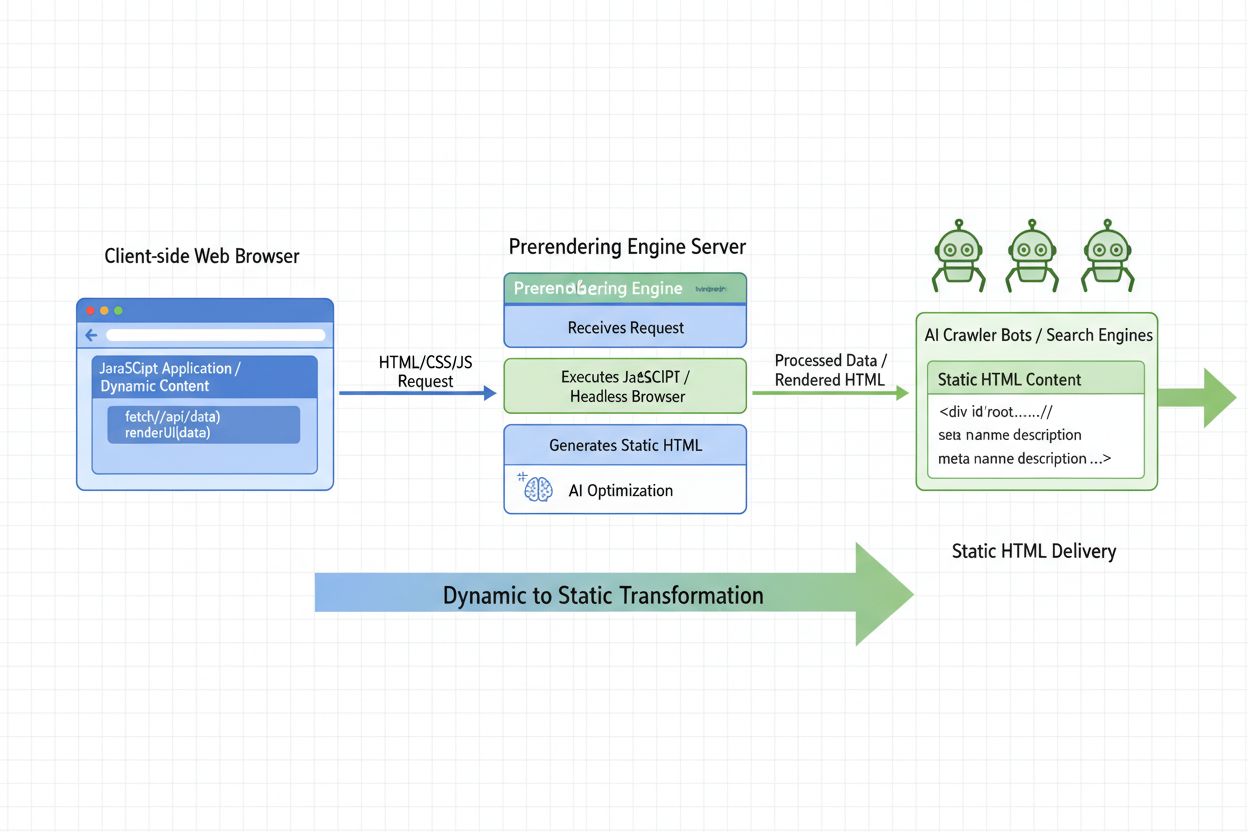
Learn what AI Prerendering is and how server-side rendering strategies optimize your website for AI crawler visibility. Discover implementation strategies for C...
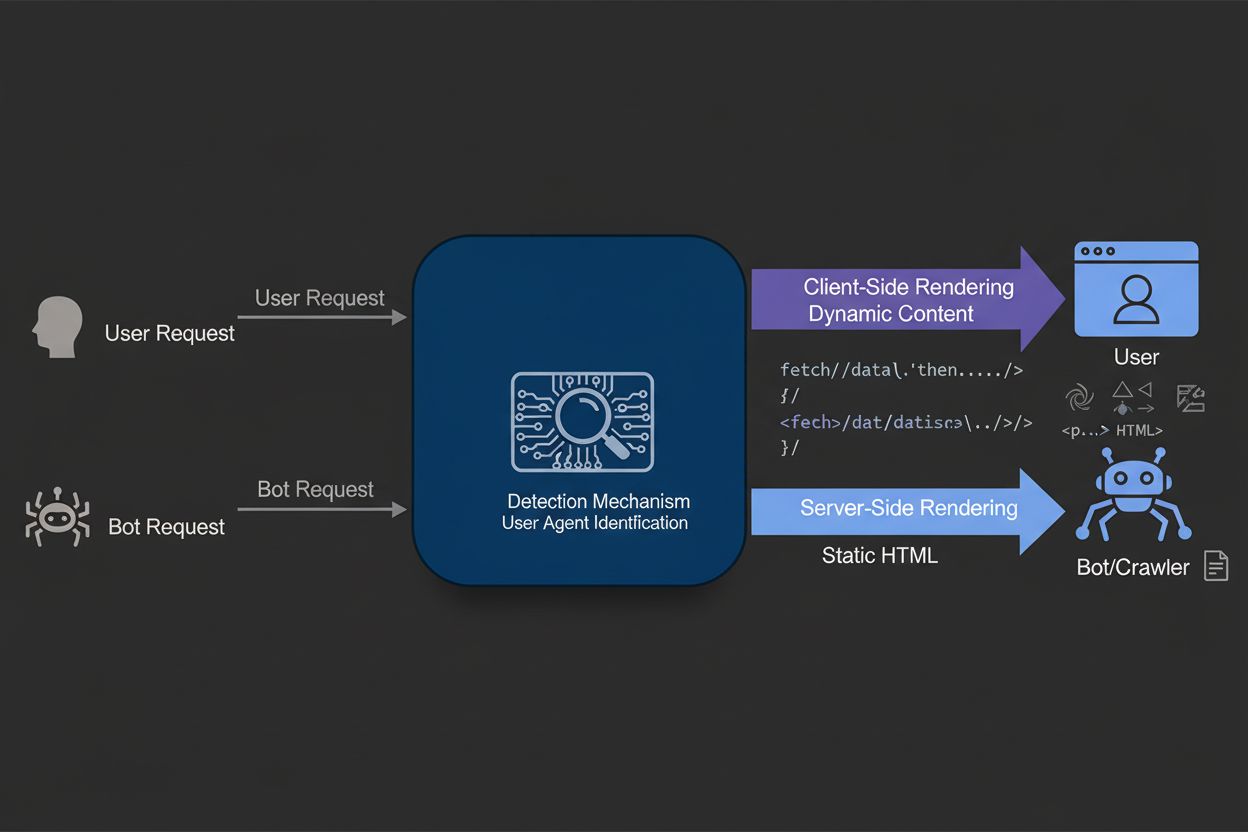
Dynamic rendering serves static HTML to search engine bots while delivering client-side rendered content to users. Learn how this technique improves SEO, crawl ...
Cookie Consent
We use cookies to enhance your browsing experience and analyze our traffic. See our privacy policy.