


Price Elasticity
Price elasticity of demand measures how much the quantity sold of a product changes in response to a change in its price. A product is elastic if a small price change causes a large shift in demand, and inelastic if demand barely moves, which determines how safely a retailer can raise or lower prices.
Definition of Price Elasticity
Price elasticity of demand measures how sensitive the quantity of a product sold is to a change in its price. If a small price increase causes shoppers to buy substantially less, demand is described as elastic; if the same price increase barely changes how much sells, demand is inelastic. The concept comes from classical economics but applies directly to day-to-day e-commerce merchandising decisions: it is the difference between a price increase that quietly boosts margin and one that tanks sales volume enough to reduce total profit. Elasticity isn’t a fixed property of a product category in the abstract — it depends on how many substitutes shoppers can find, how price-transparent the market is, and how attached customers are to the specific brand or item.
How Price Elasticity Is Calculated
The standard formula is:
Price Elasticity of Demand = (% change in quantity demanded) ÷ (% change in price)
Because price and quantity typically move in opposite directions, the result is usually negative, though it is common to discuss elasticity in absolute value terms. A value greater than 1 (ignoring the sign) means demand is elastic — quantity changes proportionally more than price did. A value less than 1 means demand is inelastic. A value of exactly 1 is unit elastic, where revenue stays roughly flat regardless of price direction.
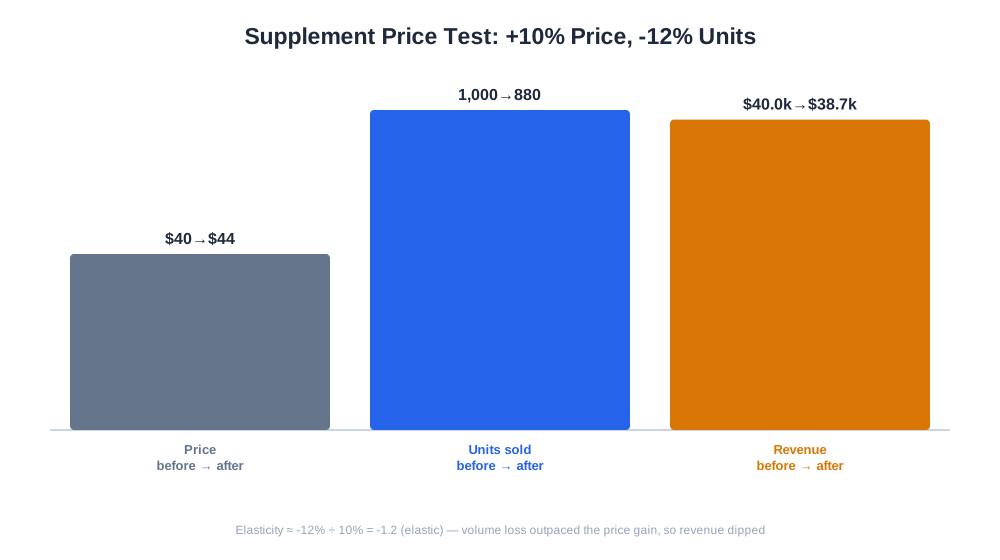
Worked example: a supplement brand raises the price of its flagship product from $40 to $44, a 10% increase. In the following month, units sold drop from 1,000 to 880, an 12% decrease. Dividing -12% by 10% gives an elasticity of roughly -1.2, meaning demand is mildly elastic — the volume loss slightly outpaced the price gain, so total revenue actually dipped slightly (from $40,000 to $38,720) even though the unit price rose. Had units only dropped to 950 (a 5% decrease), elasticity would be -0.5, inelastic, and revenue would have risen to $41,800 — the same size price increase, a very different outcome depending on elasticity.

Ready to Monitor Your AI Visibility?
Track how AI chatbots mention your brand across ChatGPT, Perplexity, and other platforms.
Why Price Elasticity Matters for E-commerce Brands
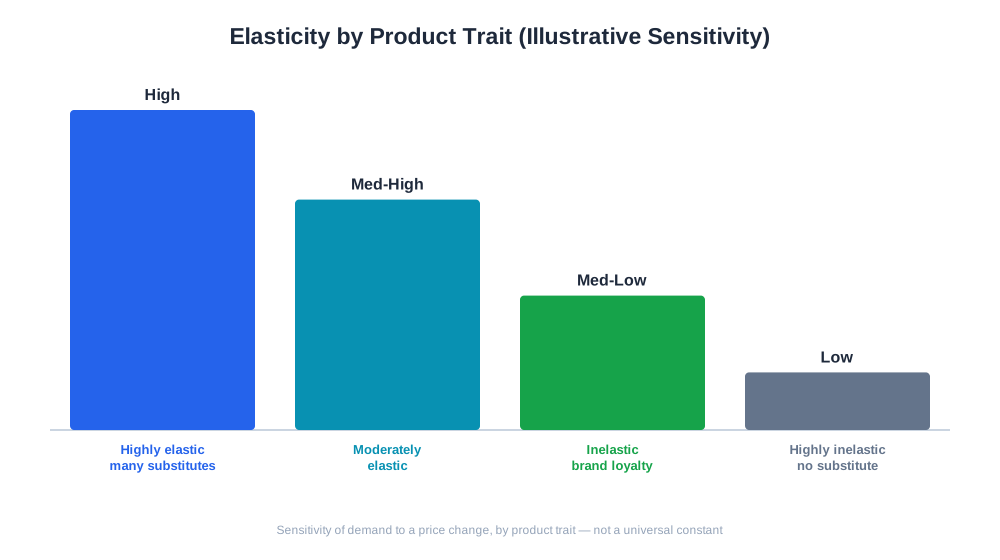
Elasticity is the safety check behind every pricing decision. Raising the price of an elastic product without accounting for the expected volume drop can shrink total revenue even as the unit margin looks better on paper — exactly the trap in the example above. Conversely, underpricing an inelastic product leaves margin on the table that a price increase could have captured with almost no effect on sales volume. Elasticity also varies within a single catalog: a store’s best-known hero product, purchased out of habit or brand loyalty, is often meaningfully less elastic than a commodity accessory sold at a similar price point but widely available elsewhere.
| Elasticity Level | Typical Product Traits | Pricing Implication |
|---|---|---|
| Highly elastic | Many substitutes, low brand loyalty, easily comparison-shopped | Small price increases risk large volume loss; competitive pricing matters most |
| Moderately elastic | Some substitutes, moderate brand preference | Modest price moves are usually safe; monitor volume closely |
| Inelastic | Few substitutes, strong brand loyalty, habitual purchase | Price increases can often be absorbed with little volume impact |
| Highly inelastic | Essential item, no real substitute, low price relative to budget | Price is rarely the deciding factor in the purchase decision |
Price Elasticity and AI-Driven Commerce
AI shopping assistants such as ChatGPT Shopping, Perplexity Shopping, and Amazon’s Rufus make comparison shopping nearly effortless — a shopper can ask an assistant to compare prices across several retailers for the same item in seconds, which tends to push measured elasticity higher for products that are easy to describe and match across stores. This means elasticity should be reassessed periodically rather than treated as a one-time calculation, especially for products that become easy for AI tools to identify and price-compare. AmICited’s eshop_get_product_price_series tool gives merchants the day-by-day achieved price history needed to actually observe how their own products responded to past price changes, rather than relying on generic industry assumptions about what’s elastic and what isn’t.
Stay Updated on AI Visibility Trends
Get the latest insights on AI mentions, brand monitoring, and optimization strategies.
Best Practices for Price Elasticity
- Estimate elasticity from your own historical price changes before assuming an industry-average figure applies
- Re-test elasticity periodically, since it shifts as competitors enter or exit a category
- Segment elasticity analysis by customer type where possible — loyal repeat customers are often less price-sensitive than new visitors
- Move prices in small, measurable increments so the resulting volume change is easy to attribute to the price change itself
- Track both units sold and total revenue after any price test, not just one or the other
Common Price Elasticity Mistakes
The most common mistake is assuming every product in a catalog shares the same elasticity and applying a blanket price increase across the board, when in practice a handful of commodity items may be highly elastic while hero products are not — testing at the SKU level avoids overcorrecting on the wrong products. Another frequent error is confusing a short-term promotional response with true underlying elasticity: a temporary discount during a holiday sale reflects seasonal demand shifts as much as price sensitivity, so elasticity estimates should ideally come from price changes made outside of major promotional windows. Some merchants read a revenue increase after a price hike as proof that demand was inelastic, without checking whether unit volume actually held steady or simply hadn’t fully reacted yet — elasticity effects can take a few weeks to fully show up as repeat-purchase customers adjust behavior more slowly than first-time buyers. Finally, teams sometimes ignore elasticity entirely and set prices purely off competitor matching, missing the fact that their own brand’s specific loyalty and substitute landscape can make the “right” price meaningfully different from a competitor selling a similar-looking product.