

Google Algorithm Update
Learn what Google Algorithm Updates are, how they work, and their impact on SEO. Understand core updates, spam updates, and ranking changes.
13 min read
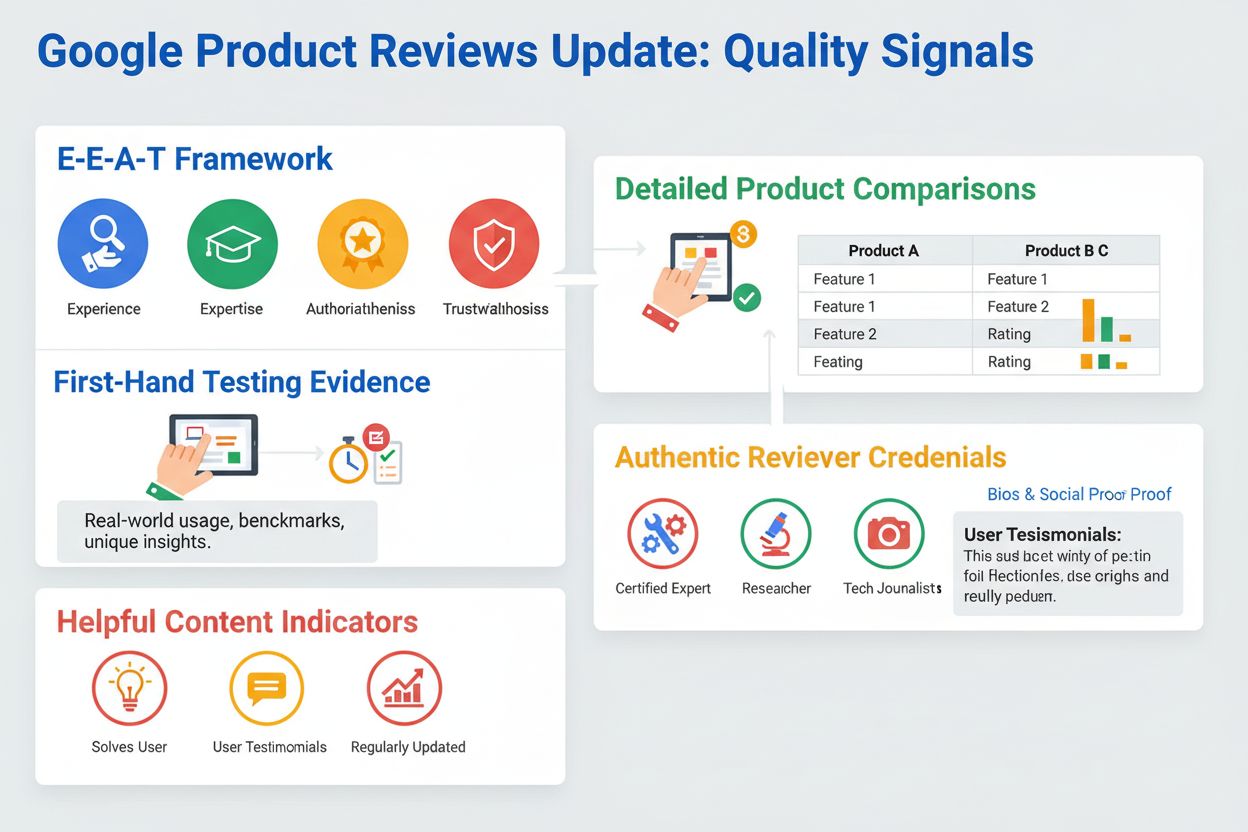
Google’s algorithmic update designed to improve the ranking and visibility of high-quality, in-depth product reviews in search results by prioritizing authentic, first-hand testing evidence and expert analysis over generic or low-value review content.
Google's algorithmic update designed to improve the ranking and visibility of high-quality, in-depth product reviews in search results by prioritizing authentic, first-hand testing evidence and expert analysis over generic or low-value review content.
The Google Product Reviews Update is a series of algorithmic improvements launched by Google Search to enhance the ranking and visibility of high-quality, in-depth product reviews while demoting low-value, generic review content. First announced in April 2021, this update represents Google’s commitment to rewarding authentic, first-hand product testing evidence and expert analysis over superficial or affiliate-driven reviews created primarily for search engine optimization. The update specifically targets review content across all formats—including single-product reviews, comparison articles, ranked lists, and multi-product reviews—applying consistent quality standards to ensure users discover genuinely helpful purchasing guidance rather than thin, low-effort content designed to capture search traffic.
Google’s focus on product review quality emerged from user feedback indicating that searchers prefer detailed reviews with evidence of actual product testing. Prior to the Product Reviews Update, many search results featured generic reviews lacking original research, personal experience, or meaningful differentiation. In April 2021, Google announced the initial Product Reviews Update, which introduced specific ranking signals designed to identify and promote reviews demonstrating first-hand expertise and authentic testing. This update marked a significant shift in how Google evaluated e-commerce and review content, moving beyond traditional ranking factors to emphasize the reviewer’s genuine experience with products.
The December 2021 iteration expanded the update’s scope by introducing new best practices, including the recommendation to link to multiple merchants and provide purchasing choices to readers. This change particularly impacted affiliate marketers, who now needed to demonstrate relationships with competing merchants to satisfy Google’s quality signals. The March 2022 update further refined Google’s ability to identify high-quality reviews by enhancing machine-learning algorithms that assess review authenticity, depth, and usefulness. According to Google’s official announcement, this update “builds on that work to enhance our ability to identify high quality product reviews,” with the company noting that the combination of these updates and related quality improvements reduced low-quality, unoriginal content in search results by 40% as of April 2024.
The Google Product Reviews Update relies heavily on the E-E-A-T framework—Experience, Expertise, Authoritativeness, and Trustworthiness—to evaluate review content quality. Experience refers to the reviewer’s direct, hands-on interaction with the product being reviewed. Google’s systems identify reviews that demonstrate genuine product usage through specific details, personal anecdotes, and original testing results. Expertise encompasses the reviewer’s deep knowledge of the product category, including understanding of competing products, industry standards, and technical specifications. Authoritativeness signals that the reviewer has established credibility within their niche, whether through professional credentials, recognized expertise, or a strong track record of helpful content. Trustworthiness is built through transparent disclosure of affiliate relationships, honest assessment of product limitations, and consistent alignment between the reviewer’s recommendations and their stated values.
Google’s machine-learning systems automatically identify reviews that demonstrate these signals by analyzing content patterns, author credentials, user engagement metrics, and comparative analysis with other reviews on the same topic. Reviews that clearly communicate first-hand testing through original images, videos, and detailed performance data rank significantly higher than generic reviews lacking such evidence. The update also considers whether reviewers explain their reasoning for recommending specific products as “best” for particular use cases, requiring substantive justification rather than vague claims. Additionally, Google evaluates whether reviews provide sufficient depth to help readers make informed purchasing decisions, with shallow or incomplete reviews receiving lower rankings regardless of other factors.
| Aspect | Product Reviews Update | Helpful Content Update | Core Algorithm Update |
|---|---|---|---|
| Launch Date | April 2021 (initial); December 2021, March 2022 (iterations) | August 2022 | Ongoing (quarterly) |
| Scope | Product review content only | All website content broadly | All ranking factors |
| Primary Focus | First-hand testing, authenticity, E-E-A-T | People-first content, user satisfaction | General quality and relevance |
| Key Signal | Original testing evidence, expert credentials | Satisfying user experience, topical focus | Multiple ranking factors |
| Impact Specificity | Highly targeted to review content | Site-wide quality classifier | Distributed across all content types |
| Ranking Improvement | 40% reduction in low-quality reviews | 45% reduction in unoriginal content | Variable by industry and niche |
| Language Support | English (expanding to other languages) | Multiple languages | All languages |
| Affiliate Considerations | Requires links to multiple merchants | No specific affiliate requirements | No specific affiliate requirements |
The Google Product Reviews Update operates through sophisticated machine-learning classifiers that continuously analyze review content to assess quality signals. Unlike traditional algorithm updates that roll out completely within a defined timeframe, the Product Reviews Update employs a continuously gradual rollout mechanism, meaning its effects compound over time as Google’s systems gather more data about individual websites and their review content. This approach allows Google to refine its understanding of review quality through ongoing observation of user behavior, click-through rates, and engagement metrics associated with different review types.
Google’s systems examine multiple dimensions of review content simultaneously, including the depth of product analysis, the presence of original testing evidence, the comprehensiveness of pros-and-cons discussions, and the reviewer’s demonstrated expertise. The update specifically rewards reviews that include original images and videos from product testing, as these elements provide verifiable evidence of first-hand experience. Performance data, comparison metrics, and detailed specifications also signal authenticity, as do references to how products have improved over time or how they compare to competing alternatives. The machine-learning algorithms also assess whether reviews adequately address user intent by determining if readers would feel satisfied with the information provided or if they would need to search elsewhere for answers.
The Google Product Reviews Update has demonstrated measurable impact on search result rankings, particularly for e-commerce and review-focused websites. According to Google’s official reporting, the combination of the Product Reviews Update and related quality initiatives has reduced low-quality, unoriginal content in search results by 40%, with subsequent refinements achieving 45% reduction as of April 2024. This improvement indicates that high-quality reviews now receive significantly more visibility compared to the pre-update landscape, where generic and thin reviews could rank competitively.
Websites that have implemented the update’s best practices—including first-hand testing evidence, comprehensive product analysis, and transparent affiliate disclosures—have reported improved organic traffic and higher click-through rates from search results. Conversely, sites relying on generic, affiliate-driven reviews without original research or testing have experienced ranking declines. The update’s impact extends beyond individual review pages to affect site-wide authority signals; websites with consistently high-quality review content benefit from improved rankings across their entire domain, while sites with mixed-quality review content may experience site-wide ranking penalties. This site-wide effect means that even well-written individual reviews may underperform if the overall website contains substantial amounts of low-quality review content.
To align with the Google Product Reviews Update and maximize search visibility, content creators should implement the following best practices:
As AI systems like ChatGPT, Perplexity, Google AI Overviews, and Claude increasingly generate product recommendations and review summaries, the visibility of your review content in these AI responses has become critical. High-quality reviews optimized for the Google Product Reviews Update are more likely to be cited as authoritative sources by AI systems, as these platforms prioritize content that demonstrates expertise, authenticity, and user satisfaction. Monitoring how your product reviews appear in AI-generated responses helps you understand whether your content is being recognized as a trusted source for product information.
Platforms like AmICited enable review creators and e-commerce businesses to track how their product review content is cited across multiple AI systems, providing insights into content visibility and citation frequency. This monitoring capability is particularly valuable for understanding whether your reviews are reaching audiences through AI-powered search and recommendation systems, not just traditional Google Search results. By tracking AI citations, you can identify which reviews are most frequently referenced, which products generate the most AI-driven interest, and whether your E-E-A-T signals are effectively communicating expertise to both human readers and AI systems.
Google has explicitly stated its intention to expand the Google Product Reviews Update beyond English-language content to support additional languages and regional markets. As of 2024, the company is actively working on extending the update’s quality signals and ranking improvements to non-English reviews, recognizing that product review quality is a global concern affecting users across all languages. This expansion will likely follow a phased approach, with Google first refining the update’s effectiveness in English before rolling out language-specific versions that account for cultural differences in review writing styles and product evaluation criteria.
The future trajectory of the Product Reviews Update suggests continued refinement of machine-learning algorithms to better identify subtle quality signals, such as reviewer authenticity, original research depth, and user satisfaction indicators. Google may also integrate additional signals related to reviewer reputation, historical accuracy of recommendations, and user feedback on review helpfulness. As AI systems become more sophisticated in generating product recommendations and summaries, the importance of high-quality, authoritative review content will likely increase, making optimization for the Product Reviews Update an increasingly critical component of content strategy for e-commerce and review-focused websites. Additionally, Google’s ongoing efforts to combat AI-generated spam and low-quality content suggest that future iterations of the Product Reviews Update may include specific signals designed to identify and demote artificially generated or manipulated review content.
The Google Product Reviews Update exists within a broader ecosystem of Google’s quality-focused initiatives, including the Helpful Content Update (launched August 2022) and various spam-fighting policies. While the Product Reviews Update specifically targets review content, the Helpful Content Update applies similar E-E-A-T principles to all website content, creating a unified quality framework across Google Search. The two updates complement each other, with the Product Reviews Update serving as a specialized application of the broader helpful content principles. Websites that excel at satisfying the Product Reviews Update’s criteria typically also perform well under the Helpful Content Update, as both prioritize authentic, user-focused content created by knowledgeable experts.
Google’s March 2024 core update further reinforced the importance of review quality by introducing new spam policies targeting scaled content abuse, site reputation abuse, and expired domain abuse. These policies work in conjunction with the Product Reviews Update to ensure that only genuinely helpful, original review content ranks prominently in search results. The integration of these initiatives demonstrates Google’s comprehensive approach to improving search quality, moving beyond individual algorithm updates to create a cohesive system that rewards authentic expertise and punishes manipulative practices. For content creators and e-commerce businesses, understanding how the Product Reviews Update fits within this broader quality ecosystem is essential for developing sustainable, long-term SEO strategies.
Tracking the performance of product reviews after the Google Product Reviews Update requires monitoring multiple metrics and signals. Primary indicators include organic search traffic to review pages, average ranking position for target keywords, click-through rates from search results, and user engagement metrics such as time on page and bounce rate. Google Search Console provides valuable data on search performance, showing which reviews are generating impressions and clicks, while tools like Ahrefs, Semrush, and Moz offer competitive analysis and ranking tracking capabilities. Additionally, monitoring how your reviews are cited in AI-generated responses through platforms like AmICited provides insights into whether your content is being recognized as authoritative by emerging AI systems.
Content decay analysis is particularly important for review content, as competitive landscapes shift and new products emerge. Regularly auditing existing reviews to identify declining traffic, updating outdated information, and refreshing performance data helps maintain rankings and relevance. A/B testing different review formats, testing evidence types, and author credential presentations can reveal which approaches resonate most with both Google’s algorithms and human readers. By combining traditional SEO metrics with AI citation tracking and user engagement analysis, review creators can develop a comprehensive understanding of their content’s performance and make data-driven decisions about optimization priorities.
+++
The Google Product Reviews Update is a series of algorithmic improvements launched by Google Search to enhance the ranking and visibility of high-quality, in-depth product reviews while demoting low-value, generic review content. First announced in April 2021, this update represents Google’s commitment to rewarding authentic, first-hand product testing evidence and expert analysis over superficial or affiliate-driven reviews created primarily for search engine optimization. The update specifically targets review content across all formats—including single-product reviews, comparison articles, ranked lists, and multi-product reviews—applying consistent quality standards to ensure users discover genuinely helpful purchasing guidance rather than thin, low-effort content designed to capture search traffic.
Google’s focus on product review quality emerged from user feedback indicating that searchers prefer detailed reviews with evidence of actual product testing. Prior to the Product Reviews Update, many search results featured generic reviews lacking original research, personal experience, or meaningful differentiation. In April 2021, Google announced the initial Product Reviews Update, which introduced specific ranking signals designed to identify and promote reviews demonstrating first-hand expertise and authentic testing. This update marked a significant shift in how Google evaluated e-commerce and review content, moving beyond traditional ranking factors to emphasize the reviewer’s genuine experience with products.
The December 2021 iteration expanded the update’s scope by introducing new best practices, including the recommendation to link to multiple merchants and provide purchasing choices to readers. This change particularly impacted affiliate marketers, who now needed to demonstrate relationships with competing merchants to satisfy Google’s quality signals. The March 2022 update further refined Google’s ability to identify high-quality reviews by enhancing machine-learning algorithms that assess review authenticity, depth, and usefulness. According to Google’s official announcement, this update “builds on that work to enhance our ability to identify high quality product reviews,” with the company noting that the combination of these updates and related quality improvements reduced low-quality, unoriginal content in search results by 40% as of April 2024.
The Google Product Reviews Update relies heavily on the E-E-A-T framework—Experience, Expertise, Authoritativeness, and Trustworthiness—to evaluate review content quality. Experience refers to the reviewer’s direct, hands-on interaction with the product being reviewed. Google’s systems identify reviews that demonstrate genuine product usage through specific details, personal anecdotes, and original testing results. Expertise encompasses the reviewer’s deep knowledge of the product category, including understanding of competing products, industry standards, and technical specifications. Authoritativeness signals that the reviewer has established credibility within their niche, whether through professional credentials, recognized expertise, or a strong track record of helpful content. Trustworthiness is built through transparent disclosure of affiliate relationships, honest assessment of product limitations, and consistent alignment between the reviewer’s recommendations and their stated values.
Google’s machine-learning systems automatically identify reviews that demonstrate these signals by analyzing content patterns, author credentials, user engagement metrics, and comparative analysis with other reviews on the same topic. Reviews that clearly communicate first-hand testing through original images, videos, and detailed performance data rank significantly higher than generic reviews lacking such evidence. The update also considers whether reviewers explain their reasoning for recommending specific products as “best” for particular use cases, requiring substantive justification rather than vague claims. Additionally, Google evaluates whether reviews provide sufficient depth to help readers make informed purchasing decisions, with shallow or incomplete reviews receiving lower rankings regardless of other factors.
| Aspect | Product Reviews Update | Helpful Content Update | Core Algorithm Update |
|---|---|---|---|
| Launch Date | April 2021 (initial); December 2021, March 2022 (iterations) | August 2022 | Ongoing (quarterly) |
| Scope | Product review content only | All website content broadly | All ranking factors |
| Primary Focus | First-hand testing, authenticity, E-E-A-T | People-first content, user satisfaction | General quality and relevance |
| Key Signal | Original testing evidence, expert credentials | Satisfying user experience, topical focus | Multiple ranking factors |
| Impact Specificity | Highly targeted to review content | Site-wide quality classifier | Distributed across all content types |
| Ranking Improvement | 40% reduction in low-quality reviews | 45% reduction in unoriginal content | Variable by industry and niche |
| Language Support | English (expanding to other languages) | Multiple languages | All languages |
| Affiliate Considerations | Requires links to multiple merchants | No specific affiliate requirements | No specific affiliate requirements |
The Google Product Reviews Update operates through sophisticated machine-learning classifiers that continuously analyze review content to assess quality signals. Unlike traditional algorithm updates that roll out completely within a defined timeframe, the Product Reviews Update employs a continuously gradual rollout mechanism, meaning its effects compound over time as Google’s systems gather more data about individual websites and their review content. This approach allows Google to refine its understanding of review quality through ongoing observation of user behavior, click-through rates, and engagement metrics associated with different review types.
Google’s systems examine multiple dimensions of review content simultaneously, including the depth of product analysis, the presence of original testing evidence, the comprehensiveness of pros-and-cons discussions, and the reviewer’s demonstrated expertise. The update specifically rewards reviews that include original images and videos from product testing, as these elements provide verifiable evidence of first-hand experience. Performance data, comparison metrics, and detailed specifications also signal authenticity, as do references to how products have improved over time or how they compare to competing alternatives. The machine-learning algorithms also assess whether reviews adequately address user intent by determining if readers would feel satisfied with the information provided or if they would need to search elsewhere for answers.
The Google Product Reviews Update has demonstrated measurable impact on search result rankings, particularly for e-commerce and review-focused websites. According to Google’s official reporting, the combination of the Product Reviews Update and related quality initiatives has reduced low-quality, unoriginal content in search results by 40%, with subsequent refinements achieving 45% reduction as of April 2024. This improvement indicates that high-quality reviews now receive significantly more visibility compared to the pre-update landscape, where generic and thin reviews could rank competitively.
Websites that have implemented the update’s best practices—including first-hand testing evidence, comprehensive product analysis, and transparent affiliate disclosures—have reported improved organic traffic and higher click-through rates from search results. Conversely, sites relying on generic, affiliate-driven reviews without original research or testing have experienced ranking declines. The update’s impact extends beyond individual review pages to affect site-wide authority signals; websites with consistently high-quality review content benefit from improved rankings across their entire domain, while sites with mixed-quality review content may experience site-wide ranking penalties. This site-wide effect means that even well-written individual reviews may underperform if the overall website contains substantial amounts of low-quality review content.
To align with the Google Product Reviews Update and maximize search visibility, content creators should implement the following best practices:
As AI systems like ChatGPT, Perplexity, Google AI Overviews, and Claude increasingly generate product recommendations and review summaries, the visibility of your review content in these AI responses has become critical. High-quality reviews optimized for the Google Product Reviews Update are more likely to be cited as authoritative sources by AI systems, as these platforms prioritize content that demonstrates expertise, authenticity, and user satisfaction. Monitoring how your product reviews appear in AI-generated responses helps you understand whether your content is being recognized as a trusted source for product information.
Platforms like AmICited enable review creators and e-commerce businesses to track how their product review content is cited across multiple AI systems, providing insights into content visibility and citation frequency. This monitoring capability is particularly valuable for understanding whether your reviews are reaching audiences through AI-powered search and recommendation systems, not just traditional Google Search results. By tracking AI citations, you can identify which reviews are most frequently referenced, which products generate the most AI-driven interest, and whether your E-E-A-T signals are effectively communicating expertise to both human readers and AI systems.
Google has explicitly stated its intention to expand the Google Product Reviews Update beyond English-language content to support additional languages and regional markets. As of 2024, the company is actively working on extending the update’s quality signals and ranking improvements to non-English reviews, recognizing that product review quality is a global concern affecting users across all languages. This expansion will likely follow a phased approach, with Google first refining the update’s effectiveness in English before rolling out language-specific versions that account for cultural differences in review writing styles and product evaluation criteria.
The future trajectory of the Product Reviews Update suggests continued refinement of machine-learning algorithms to better identify subtle quality signals, such as reviewer authenticity, original research depth, and user satisfaction indicators. Google may also integrate additional signals related to reviewer reputation, historical accuracy of recommendations, and user feedback on review helpfulness. As AI systems become more sophisticated in generating product recommendations and summaries, the importance of high-quality, authoritative review content will likely increase, making optimization for the Product Reviews Update an increasingly critical component of content strategy for e-commerce and review-focused websites. Additionally, Google’s ongoing efforts to combat AI-generated spam and low-quality content suggest that future iterations of the Product Reviews Update may include specific signals designed to identify and demote artificially generated or manipulated review content.
The Google Product Reviews Update exists within a broader ecosystem of Google’s quality-focused initiatives, including the Helpful Content Update (launched August 2022) and various spam-fighting policies. While the Product Reviews Update specifically targets review content, the Helpful Content Update applies similar E-E-A-T principles to all website content, creating a unified quality framework across Google Search. The two updates complement each other, with the Product Reviews Update serving as a specialized application of the broader helpful content principles. Websites that excel at satisfying the Product Reviews Update’s criteria typically also perform well under the Helpful Content Update, as both prioritize authentic, user-focused content created by knowledgeable experts.
Google’s March 2024 core update further reinforced the importance of review quality by introducing new spam policies targeting scaled content abuse, site reputation abuse, and expired domain abuse. These policies work in conjunction with the Product Reviews Update to ensure that only genuinely helpful, original review content ranks prominently in search results. The integration of these initiatives demonstrates Google’s comprehensive approach to improving search quality, moving beyond individual algorithm updates to create a cohesive system that rewards authentic expertise and punishes manipulative practices. For content creators and e-commerce businesses, understanding how the Product Reviews Update fits within this broader quality ecosystem is essential for developing sustainable, long-term SEO strategies.
Tracking the performance of product reviews after the Google Product Reviews Update requires monitoring multiple metrics and signals. Primary indicators include organic search traffic to review pages, average ranking position for target keywords, click-through rates from search results, and user engagement metrics such as time on page and bounce rate. Google Search Console provides valuable data on search performance, showing which reviews are generating impressions and clicks, while tools like Ahrefs, Semrush, and Moz offer competitive analysis and ranking tracking capabilities. Additionally, monitoring how your reviews are cited in AI-generated responses through platforms like AmICited provides insights into whether your content is being recognized as authoritative by emerging AI systems.
Content decay analysis is particularly important for review content, as competitive landscapes shift and new products emerge. Regularly auditing existing reviews to identify declining traffic, updating outdated information, and refreshing performance data helps maintain rankings and relevance. A/B testing different review formats, testing evidence types, and author credential presentations can reveal which approaches resonate most with both Google’s algorithms and human readers. By combining traditional SEO metrics with AI citation tracking and user engagement analysis, review creators can develop a comprehensive understanding of their content’s performance and make data-driven decisions about optimization priorities.
Google first announced the Product Reviews Update in April 2021, with subsequent iterations in December 2021 and March 2022. The initial update focused on rewarding in-depth research and authentic product testing. The March 2022 update expanded the algorithm's ability to identify high-quality reviews across all languages, with plans to extend support beyond English-language content.
While the Product Reviews Update specifically targets review content quality, the Helpful Content Update applies to all website content broadly. The Product Reviews Update emerged first in 2021 and served as a foundation for the broader Helpful Content Update launched in August 2022. Both updates share similar principles around E-E-A-T and prioritize content created for people rather than search engines.
E-E-A-T stands for Experience, Expertise, Authoritativeness, and Trustworthiness. Google uses these signals to evaluate content quality. For product reviews, E-E-A-T means demonstrating that you've actually used the product, showing deep knowledge of the category, establishing authority through credentials or recognition, and building trust through transparent, honest assessments. Reviews that clearly demonstrate E-E-A-T signals rank significantly better in Google's search results.
Yes, Google explicitly confirmed that the Product Reviews Update applies to all forms of review content, including ranked lists, comparison reviews, and multi-product reviews. However, due to the shorter nature of ranked lists, reviewers should demonstrate expertise and authenticity more concisely by citing relevant results and including original images from product testing.
Google reported that the combination of the Product Reviews Update and related quality improvements reduced low-quality, unoriginal content in search results by 40% as of April 2024. The update has shown positive effects on the English-language ecosystem and online shoppers, with Google planning to extend these improvements to additional languages beyond English.
To optimize for the Product Reviews Update, include first-hand testing evidence with original images and videos, demonstrate expertise through detailed product knowledge, provide comparison data and performance metrics, explain pros and cons thoroughly, include links to multiple merchants for purchasing options, and ensure your content answers user questions comprehensively. Focus on creating content that helps readers make informed purchasing decisions rather than optimizing for search engines.
Reviews that lack first-hand testing evidence, demonstrate low expertise, provide minimal original analysis, or appear created primarily for search engine ranking will see reduced visibility in Google search results. These reviews may be demoted in favor of higher-quality alternatives. Over time, sites with consistently low-quality review content may experience site-wide ranking penalties affecting all their content.
Start tracking how AI chatbots mention your brand across ChatGPT, Perplexity, and other platforms. Get actionable insights to improve your AI presence.
Learn what Google Algorithm Updates are, how they work, and their impact on SEO. Understand core updates, spam updates, and ranking changes.

Learn about Google's Helpful Content Update: an algorithm system rewarding people-first content while demoting search-engine-first material. Understand E-E-A-T,...
Learn what a Google Core Update is, how it affects website rankings, the difference between core and algorithm updates, and strategies for recovery and long-ter...
Cookie Consent
We use cookies to enhance your browsing experience and analyze our traffic. See our privacy policy.