
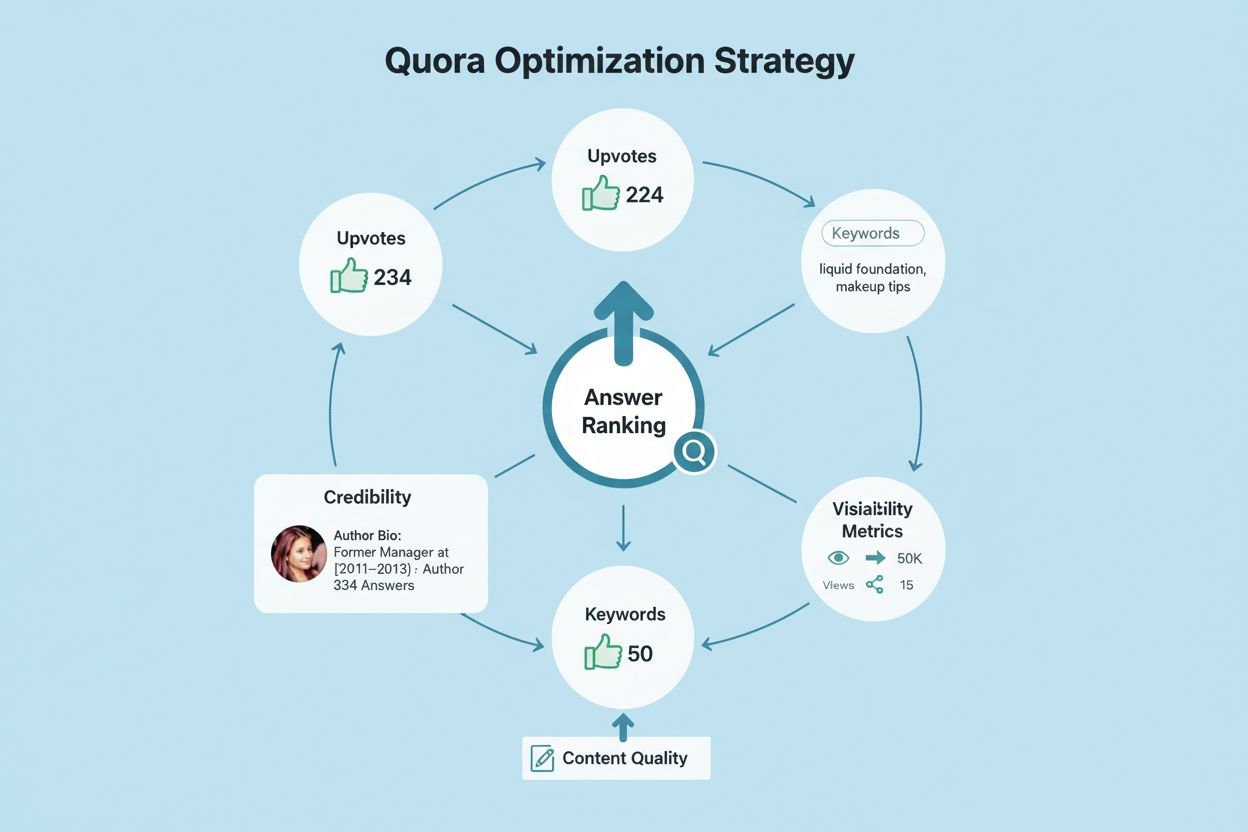
Quora Optimization
Learn Quora Optimization strategies to boost visibility, answer rankings, and brand authority. Discover best practices for keyword integration, engagement metri...
12 min read
Quora Answer Optimization is the strategic practice of crafting, formatting, and promoting answers on Quora to maximize visibility in AI-generated search results. This discipline targets the algorithmic preferences of AI systems like Google AI Overviews, ChatGPT, and Perplexity that cite Quora as a primary source for synthesizing answers to user queries. Unlike traditional SEO focused on ranking web pages, Quora optimization prioritizes answer quality, credibility signals, and engagement metrics that AI systems evaluate when selecting sources to cite. The practice recognizes that Quora is the #1 cited source in Google AI Overviews, making it a critical channel for AI visibility and brand authority.
Quora Answer Optimization is the strategic practice of crafting, formatting, and promoting answers on Quora to maximize visibility in AI-generated search results. This discipline targets the algorithmic preferences of AI systems like Google AI Overviews, ChatGPT, and Perplexity that cite Quora as a primary source for synthesizing answers to user queries. Unlike traditional SEO focused on ranking web pages, Quora optimization prioritizes answer quality, credibility signals, and engagement metrics that AI systems evaluate when selecting sources to cite. The practice recognizes that Quora is the #1 cited source in Google AI Overviews, making it a critical channel for AI visibility and brand authority.
Quora Answer Optimization refers to the strategic practice of crafting, formatting, and promoting answers on Quora to maximize visibility in AI-generated search results, particularly Google AI Overviews and similar AI-powered platforms. This discipline emerged as AI systems increasingly cite Quora as a primary source for synthesizing answers to user queries, making the platform a critical channel for AI visibility and brand authority. Unlike traditional SEO, which focuses on ranking individual web pages, Quora Answer Optimization targets the algorithmic preferences of AI systems that evaluate content quality, credibility, and engagement metrics when selecting sources to cite. The practice recognizes that 7.25% of all AI Mode results cite Quora, making it the #1 cited source in Google AI Overviews after Reddit and YouTube. Organizations and professionals who master this discipline gain significant competitive advantages in AI-driven search environments where direct answer attribution drives qualified traffic and brand recognition.
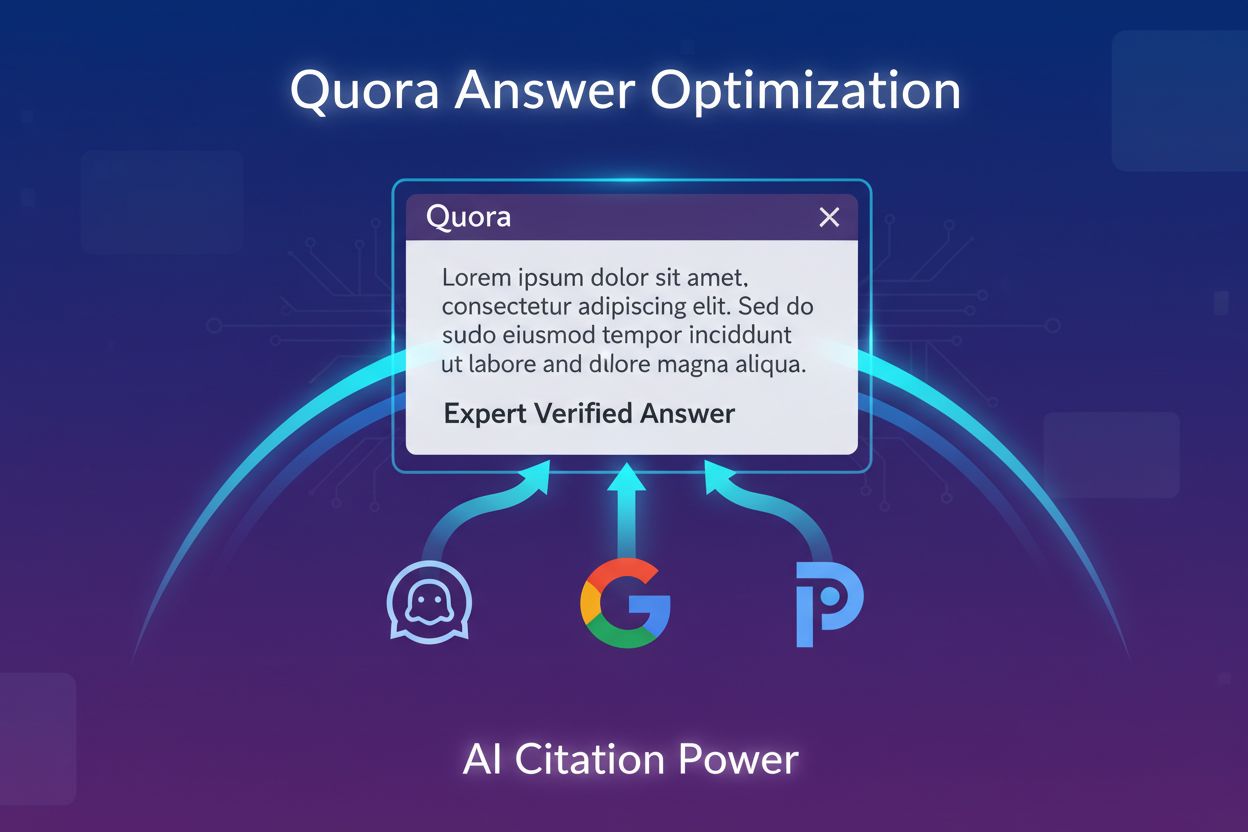
Quora’s prominence in AI citations stems from several structural advantages that align perfectly with how AI systems evaluate source credibility and relevance. The platform’s topic-driven architecture creates natural topical authority clusters where experts congregate around specific subjects, making it easier for AI systems to identify authoritative voices. Engagement metrics—particularly upvotes, comments, and reply counts—serve as social proof signals that AI algorithms interpret as content quality indicators. Quora’s emphasis on E-E-A-T (Experience, Expertise, Authoritativeness, Trustworthiness) through user profiles, credentials, and answer history creates a built-in credibility framework that AI systems can evaluate. The platform’s conversational format and question-answer structure naturally align with how AI systems synthesize information for direct answers.
| AI Platform | Top Citation Sources | Citation Pattern |
|---|---|---|
| Google AI Overviews | Reddit (1st), YouTube (2nd), Quora (3rd) | 7.25% of results |
| ChatGPT | Academic sources, news sites, Quora | Blended synthesis |
| Perplexity | News, Quora, Reddit, YouTube | Direct attribution |
| Claude | Diverse sources, Quora for Q&A | Contextual blending |
Answers that consistently appear in AI citations share distinct structural and content characteristics that make them algorithmically favorable. The most successful answers follow this framework:
Successful Quora Answer Optimization requires a strategic approach that balances content quality with platform mechanics. Lead with the answer by placing your most direct, useful response in the opening sentences—AI systems prioritize answers that immediately address the question without requiring readers to scroll through context or preamble. Establish credibility early by mentioning relevant experience, certifications, or expertise in your first paragraph, signaling to AI algorithms that this answer comes from an authoritative source. Apply the 80/20 rule by dedicating 80% of your answer to genuinely helpful information and only 20% to any business context or soft promotion, ensuring the answer provides standalone value regardless of your commercial interests.
Format answers for AI readability using clear hierarchies, numbered steps, and bullet points that make content structure obvious to both human readers and algorithmic systems. Consider answer repurposing by developing answers that can be expanded into blog posts, social content, or other formats, creating a content ecosystem where Quora serves as a discovery and credibility-building channel. Include strategic hyperlinks to authoritative sources, your own detailed resources, or relevant Quora spaces that provide additional context, but only when genuinely relevant—AI systems recognize and reward contextual linking while penalizing over-promotion. Maintain consistency in voice and expertise across your answers, building a recognizable author brand that AI systems and readers associate with reliable information in your domain.
Quora offers two distinct profile types, each serving different strategic purposes in an AI visibility strategy. Individual profiles work best for personal brand building, establishing yourself as a thought leader, and creating authentic connections with community members—these profiles benefit from personality, storytelling, and direct engagement that humanizes expertise. Business profiles serve organizational goals, allowing companies to provide official answers, promote products contextually, and build brand authority at scale, though they require careful balance to avoid appearing overly promotional. The most effective strategies often employ both simultaneously: individual profiles for authentic expertise-building and community engagement, paired with business profiles for official organizational statements and product-specific answers. Individual profiles typically generate higher engagement and citation rates due to perceived authenticity, while business profiles provide institutional credibility and allow multiple team members to contribute under a unified brand voice.
Maximizing Quora Answer Optimization requires active engagement strategies that signal quality and relevance to both the platform’s algorithm and AI systems. Implement consistent answer schedules by regularly responding to questions in your expertise areas, building momentum and demonstrating active participation that platforms reward with increased visibility. Focus on quality over quantity by selecting high-potential questions with strong search volume and engagement history rather than answering every question in your feed. Actively engage with replies by responding thoughtfully to comments, addressing follow-up questions, and participating in discussions—this engagement signals answer quality and keeps content fresh in algorithmic rankings. Test answer variations by monitoring which formats, lengths, and approaches generate the most upvotes and AI citations, then refining your approach based on performance data.
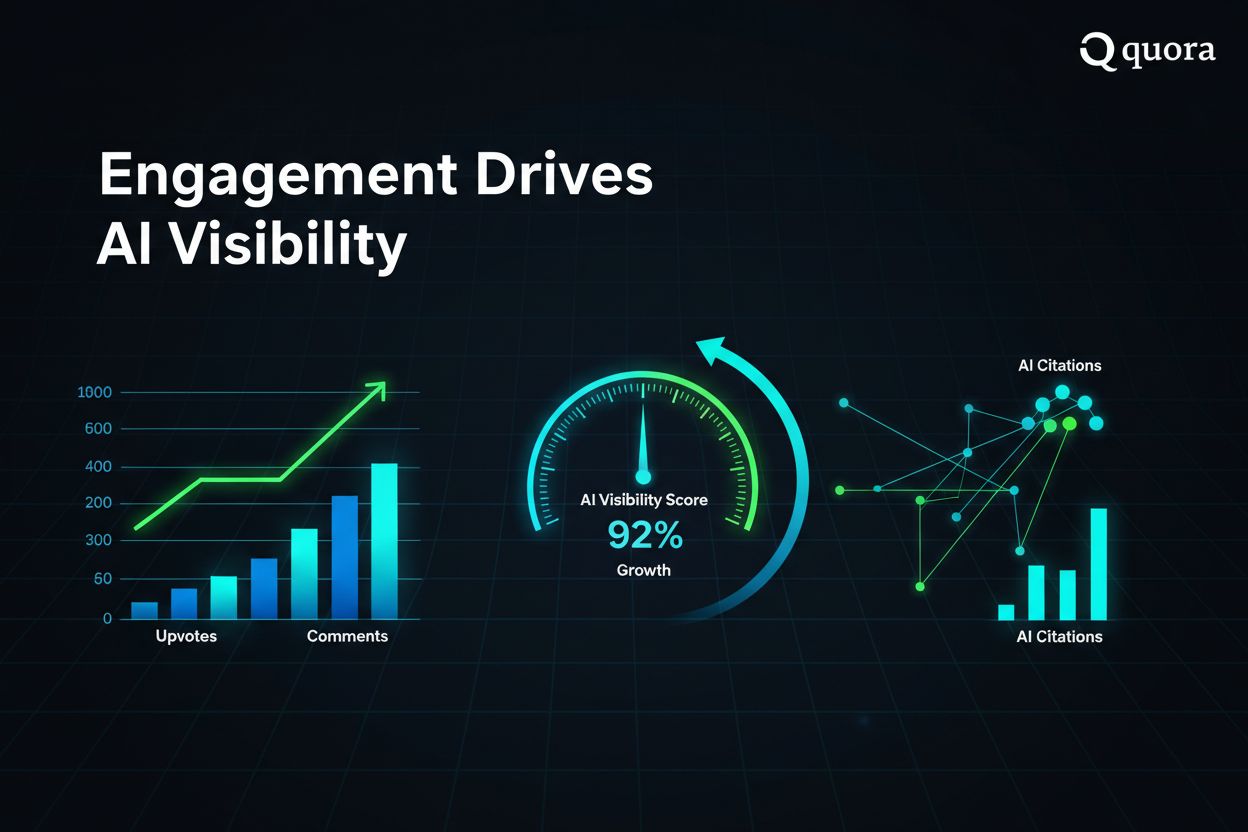
Consider promoting high-performing answers through Quora’s paid promotion tools to expand reach beyond your existing audience, particularly for answers addressing high-volume search queries. Build topical authority by concentrating your answers in specific subject areas rather than spreading effort across unrelated topics, making it easier for AI systems to recognize you as an expert in particular domains.
While both strategies aim to increase visibility and drive qualified traffic, Quora Answer Optimization and traditional SEO operate through fundamentally different mechanisms. Traditional SEO focuses on ranking individual web pages in search engine results through backlinks, on-page optimization, and domain authority, requiring months of effort to achieve visibility. Quora Answer Optimization targets AI-generated results and community-driven visibility, often producing faster results because answers can gain traction within days through engagement metrics and algorithmic promotion. Traditional SEO emphasizes keyword optimization and technical implementation, while Quora optimization prioritizes answer quality, credibility signals, and engagement—two distinct skill sets requiring different expertise.
The most effective AI visibility strategy integrates both approaches: use traditional SEO to build owned-media authority through your website and blog, while simultaneously building Quora presence to capture AI citations and community-driven traffic. Quora answers often link back to detailed resources on your website, creating a complementary funnel where Quora serves as a discovery and credibility-building channel that drives qualified traffic to owned properties. Organizations that master both channels create multiple pathways for visibility in AI-driven search environments while building resilience against algorithm changes in any single platform.
Tracking the right metrics ensures your Quora Answer Optimization efforts deliver measurable business value. Monitor these key performance indicators:
Even well-intentioned Quora strategies fail when practitioners make preventable errors that undermine credibility and algorithmic performance. Avoid these critical mistakes:
Quora Answer Optimization functions most effectively as one component of a comprehensive AI visibility strategy rather than as an isolated tactic. The platform works synergistically with owned media (your website and blog), social platforms (LinkedIn, Twitter, industry forums), and other citation sources to create multiple pathways for AI systems to discover and cite your expertise. Organizations should develop integrated content strategies where Quora answers serve as entry points that drive traffic to detailed resources on owned properties, creating a funnel that captures both AI citations and direct audience engagement. Consider Quora as a credibility amplification channel that builds authority signals AI systems recognize, complementing traditional SEO efforts and establishing you as a trusted source across multiple platforms. The most successful AI visibility strategies treat Quora not as a standalone marketing channel but as a critical component of a diversified approach that maximizes visibility across AI-generated results, traditional search, and community-driven platforms.
Quora Answer Optimization is the strategic practice of crafting, formatting, and promoting answers on Quora to maximize visibility in AI-generated search results. It targets the algorithmic preferences of AI systems like Google AI Overviews, ChatGPT, and Perplexity that cite Quora as a primary source. Unlike traditional SEO, which focuses on ranking web pages, Quora optimization prioritizes answer quality, credibility signals, and engagement metrics that AI systems evaluate when selecting sources to cite.
AI systems cite Quora extensively because the platform's topic-driven architecture creates natural topical authority clusters, engagement metrics serve as quality indicators, and user profiles establish E-E-A-T (Experience, Expertise, Authoritativeness, Trustworthiness). Quora's conversational format and question-answer structure naturally align with how AI systems synthesize information for direct answers. According to recent data, Quora is the #1 cited source in Google AI Overviews, appearing in 7.25% of AI Mode results.
Results from Quora Answer Optimization typically appear faster than traditional SEO. Well-crafted answers can gain traction within days through engagement metrics and algorithmic promotion. However, building consistent topical authority and achieving regular AI citations usually requires 2-3 months of consistent, high-quality contributions. The timeline depends on your expertise area, competition level, and answer quality.
The most effective strategy uses both simultaneously. Individual profiles work best for personal brand building and establishing yourself as a thought leader, generating higher engagement due to perceived authenticity. Business profiles serve organizational goals, allowing companies to provide official answers and build brand authority at scale. Individual profiles typically generate higher citation rates, while business profiles provide institutional credibility and allow multiple team members to contribute under a unified brand voice.
Yes, but with careful balance. Apply the 80/20 rule: dedicate 80% of your answer to genuinely helpful information and only 20% to any business context or soft promotion. Answers that prioritize selling over helping get downvoted, hidden, and ignored by AI systems. Focus on providing standalone value regardless of your commercial interests, and only mention your products when genuinely relevant to solving the user's problem.
Track these key metrics: upvote velocity and total upvotes (answers with 50+ upvotes typically achieve higher AI citation rates), AI citation frequency (monitor mentions in Google AI Overviews and other AI platforms), referral traffic from Quora using UTM parameters, backlinks generated to your website, and engagement metrics like comments and replies. Use analytics platforms and AI monitoring tools to quantify the business impact of your Quora presence.
Traditional SEO focuses on ranking individual web pages in search engine results through backlinks, on-page optimization, and domain authority, requiring months of effort. Quora Answer Optimization targets AI-generated results and community-driven visibility, often producing faster results. Traditional SEO emphasizes keyword optimization and technical implementation, while Quora optimization prioritizes answer quality, credibility signals, and engagement. The most effective strategy integrates both approaches for maximum visibility.
Consistency matters more than frequency. Start with 2-3 high-quality answers per week and adjust based on your capacity and results. Focus on quality over quantity—a few strong answers outperform dozens of weak ones. Maintain regular engagement in your expertise areas to build topical authority and signal active participation to the platform's algorithm. Sporadic answering prevents building authority and reduces visibility.
Track how AI systems cite your Quora answers and other content across ChatGPT, Google AI Overviews, and Perplexity. Get real-time insights into your AI visibility and optimize your strategy.
Learn Quora Optimization strategies to boost visibility, answer rankings, and brand authority. Discover best practices for keyword integration, engagement metri...

Learn what Answer Engine Optimization (AEO) is and how it helps your brand appear in AI-powered answers from ChatGPT, Perplexity, and Google AI Overviews. Disco...
Learn what citation optimization for AI is and how to optimize your content to be cited by ChatGPT, Perplexity, Google Gemini, and other AI search engines.