
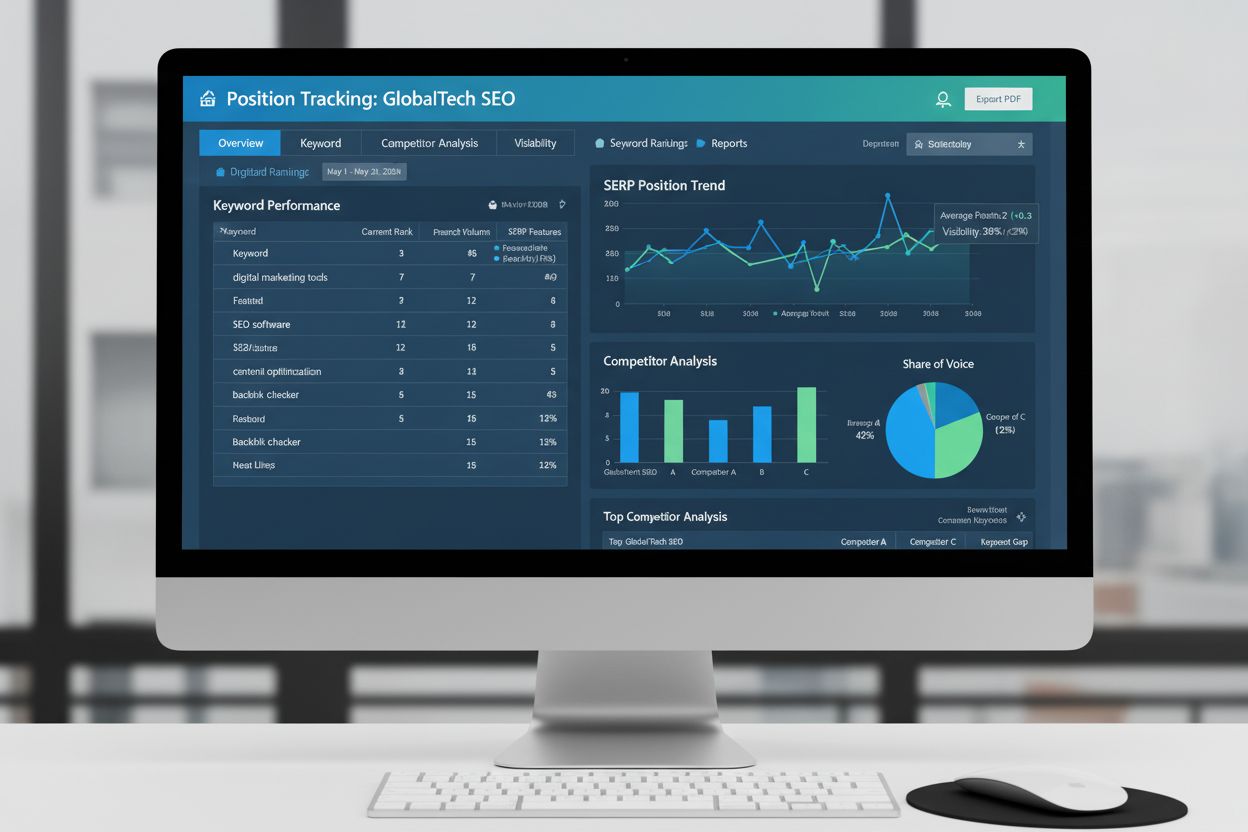
Position Tracking
Position tracking monitors keyword rankings across SERPs to measure SEO performance. Learn how to track rankings, key metrics, and why it matters for AI search ...
16 min read
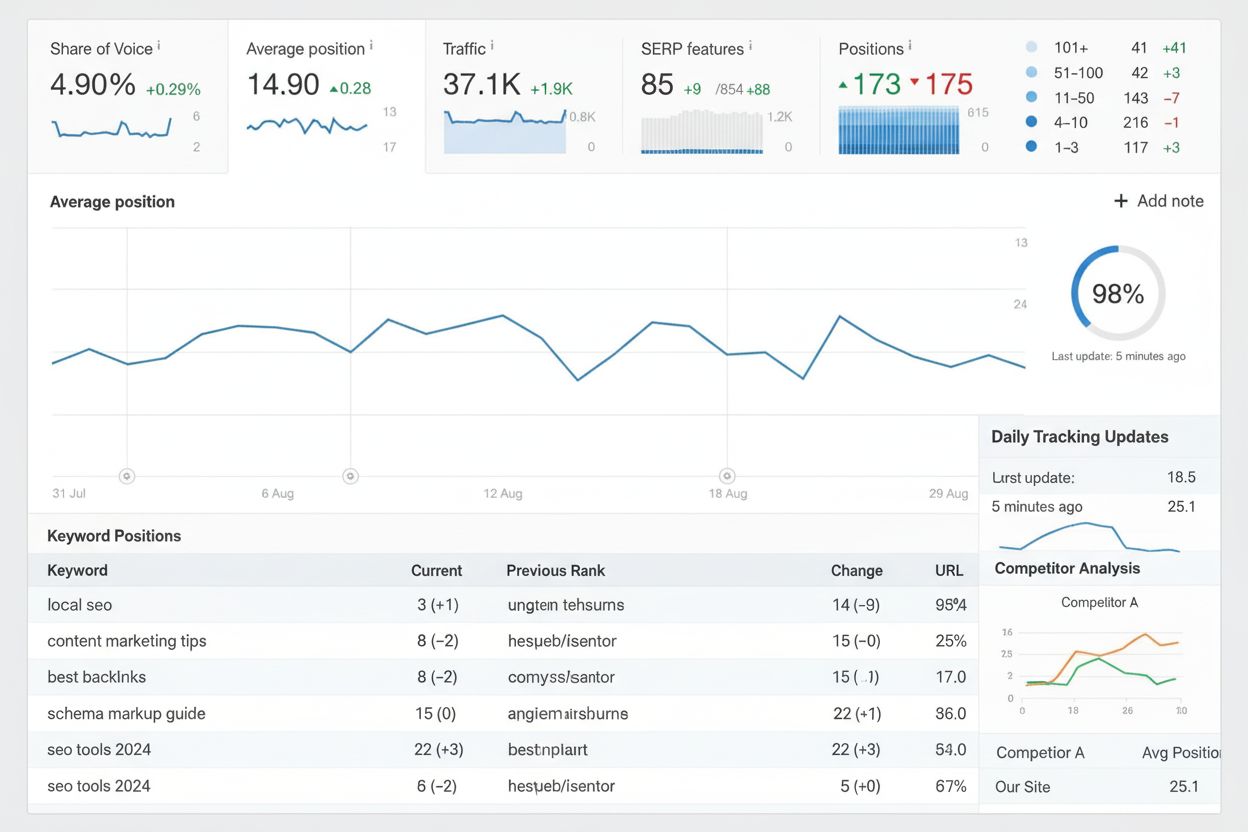
Rank tracking is the process of monitoring where a website’s pages appear in search engine results pages (SERPs) for specific keywords over time. It involves using specialized tools to periodically check keyword positions, track changes, and measure SEO performance across different search engines, devices, and locations.
Rank tracking is the process of monitoring where a website's pages appear in search engine results pages (SERPs) for specific keywords over time. It involves using specialized tools to periodically check keyword positions, track changes, and measure SEO performance across different search engines, devices, and locations.
Rank tracking is the systematic process of monitoring where a website’s pages appear in search engine results pages (SERPs) for specific keywords over time. It involves using specialized software tools to periodically scan search engines, record keyword positions, and track how those positions change daily, weekly, or monthly. The primary purpose of rank tracking is to measure the effectiveness of SEO efforts, identify performance trends, and provide actionable data for optimizing search visibility. Unlike manual searches that produce inconsistent results based on location and browsing history, rank tracking tools deliver objective, repeatable data that reveals true search performance across different devices, locations, and search engines. This foundational SEO practice has become indispensable for understanding how websites compete in organic search and how SEO strategies translate into measurable business results.
Rank tracking emerged as a critical SEO practice in the early 2000s when search engine optimization became a recognized discipline. Initially, SEO professionals manually checked rankings by typing keywords into Google and recording positions—a tedious, unreliable process prone to inconsistencies. As the SEO industry matured and competition intensified, the need for automated, accurate rank tracking solutions became apparent. The first dedicated rank tracking tools appeared in the mid-2000s, offering basic position monitoring for a limited number of keywords. Over the past two decades, rank tracking technology has evolved dramatically, incorporating advanced features like competitor analysis, SERP feature tracking, multi-location monitoring, and integration with other SEO platforms. Today’s rank tracking solutions leverage sophisticated algorithms and distributed infrastructure to monitor millions of keywords across multiple search engines, devices, and geographic locations simultaneously. According to industry research, over 87% of SEO professionals now use dedicated rank tracking tools as a core component of their optimization strategy, reflecting the practice’s evolution from optional to essential.
Rank tracking operates through automated systems that simulate real user searches across search engines. When you set up a rank tracking campaign, the tool’s servers periodically query search engines for your target keywords, recording where your website appears in the results. The process involves several technical steps: first, the tool sends search queries to Google, Bing, or other search engines from various IP addresses and geographic locations to avoid detection and ensure accurate, localized results. Second, it parses the search results pages to identify your website’s position for each keyword. Third, it stores this positional data in a database, creating a historical record that allows you to track changes over time. Modern rank tracking tools can monitor hundreds or thousands of keywords simultaneously, updating data daily or on custom schedules. Advanced platforms also track SERP features like featured snippets, local packs, and knowledge panels, providing insights beyond traditional blue link rankings. The accuracy of rank tracking depends on the tool’s ability to simulate authentic searches and account for personalization factors that Google uses to customize results for individual users.
| Aspect | Rank Tracking | Google Search Console | Google Analytics | Manual Search Checks |
|---|---|---|---|---|
| Data Granularity | Exact positions for hundreds of keywords | Average positions only | No ranking data | Single snapshot |
| Historical Tracking | Complete history over months/years | Limited 16-month history | Traffic data only | Not possible |
| Update Frequency | Daily or custom schedule | Real-time but limited | Real-time | One-time only |
| Competitor Monitoring | Yes, built-in | No | No | Manual comparison only |
| Device Tracking | Desktop and mobile separately | Limited | Yes | Manual for each device |
| Location Tracking | Multiple countries/cities | Limited | Yes | Single location only |
| SERP Features | Tracked and reported | Limited visibility | Not tracked | Visible but not quantified |
| Cost | $50-$500+ monthly | Free | Free | Free but time-intensive |
| Accuracy | High (automated, consistent) | Medium (limited data) | High for traffic only | Low (inconsistent results) |
Rank tracking serves as the primary measurement tool for SEO success, providing quantifiable evidence of whether optimization efforts are working. Without rank tracking, SEO professionals operate blindly, unable to determine which strategies drive improvements and which waste resources. The practice enables data-driven decision-making by revealing which keywords are gaining ground, which are losing visibility, and where competitive threats emerge. Research shows that 78% of enterprises using rank tracking tools report improved ability to justify SEO investments to stakeholders, demonstrating the practice’s value for demonstrating ROI. Rank tracking also reveals keyword opportunities—terms currently ranking in positions 11-20 that could reach page one with targeted optimization efforts. By identifying these “low-hanging fruit” keywords, SEO teams can prioritize efforts on high-impact opportunities. Additionally, rank tracking serves as an early warning system for algorithm updates, helping teams quickly identify unexpected ranking drops that signal broader issues requiring investigation. The practice transforms SEO from guesswork into a measurable discipline where every optimization can be tracked, analyzed, and refined based on concrete performance data.
As artificial intelligence reshapes the search landscape, rank tracking is evolving beyond traditional search engines to include AI-powered search platforms. Historically, rank tracking focused exclusively on Google, Bing, and Yahoo results. However, the emergence of ChatGPT, Perplexity, Google AI Overviews, and Claude has created new visibility channels that traditional rank tracking doesn’t capture. Forward-thinking platforms now offer unified monitoring that tracks both traditional SERP positions and AI search citations. This integration is critical because research indicates that 35% of search queries now receive AI-generated responses, and this percentage continues growing. A website appearing in a ChatGPT response or Google AI Overview can drive significant traffic without ranking traditionally. Modern rank tracking solutions increasingly incorporate AI search monitoring capabilities, allowing marketers to understand their complete visibility across both traditional and conversational search interfaces. This evolution reflects the reality that rank tracking must adapt to how users actually search—increasingly through AI assistants rather than traditional search engines. Organizations using integrated rank tracking and AI monitoring gain competitive advantages by understanding their presence across the entire search ecosystem.
Successful rank tracking requires strategic planning and disciplined execution. First, identify and prioritize keywords that align with business objectives—focus on high-intent keywords with reasonable search volume rather than tracking hundreds of irrelevant terms. Second, organize keywords into logical groups using tags or categories, making it easier to analyze performance by topic, product line, or target audience. Third, establish baseline rankings before implementing optimizations, creating a clear before-and-after comparison. Fourth, set up automated alerts for significant ranking changes, enabling quick response to algorithm updates or competitive threats. Fifth, track keywords across multiple locations and devices if your business serves different geographic markets or mobile users. Sixth, monitor competitor rankings alongside your own, providing context for your performance and revealing competitive strategies. Seventh, integrate rank tracking data with other metrics like organic traffic, conversions, and engagement to understand whether ranking improvements translate to business results. Finally, review rank tracking data regularly—weekly or biweekly—but focus on long-term trends rather than daily fluctuations, which are normal and often temporary. Consistent application of these practices transforms rank tracking from a passive monitoring activity into an active strategic tool driving continuous SEO improvement.
Rank tracking generates multiple metrics that collectively reveal SEO performance. Keyword position is the most obvious metric—the exact ranking (1-100+) for each tracked keyword. Average position aggregates all keyword positions into a single metric showing overall ranking health. Search visibility or visibility score represents the estimated percentage of potential clicks your site captures across all tracked keywords, accounting for click-through rates at different positions. Estimated organic traffic projects how many monthly visits your rankings should generate based on search volume and typical CTR patterns. Share of voice compares your visibility to competitors’ visibility for the same keywords, revealing your competitive standing. SERP feature presence tracks whether your pages appear in featured snippets, local packs, image results, or other special features. Ranking volatility measures how much positions fluctuate, with high volatility indicating algorithm instability or competitive pressure. Keyword difficulty shows how competitive each keyword is, helping prioritize optimization efforts. Understanding these metrics collectively—rather than obsessing over any single metric—provides comprehensive insight into SEO performance and guides strategic decisions about where to focus optimization efforts for maximum impact.
The rank tracking market offers numerous solutions serving different needs and budgets. Semrush provides comprehensive rank tracking through its Position Tracking tool, offering daily updates for up to 5,000 keywords, competitor monitoring, and advanced SERP feature tracking. Ahrefs delivers powerful rank tracking with parent keyword identification and extensive historical data, though at a premium price point. SE Ranking offers affordable rank tracking starting at $55/month with cannibalization reports and 14-day free trials. Nightwatch specializes in accurate rank tracking with real-time updates and AI search monitoring capabilities. Serpstat provides budget-friendly rank tracking with API access and comprehensive SERP analysis. Moz Pro offers rank tracking with ready-made integrations and a generous 30-day free trial. Accuranker delivers real-time rank tracking with daily position updates and volatility alerts. UberSuggest provides free and paid rank tracking options suitable for beginners. Each platform has distinct strengths—some excel at competitor analysis, others at SERP feature tracking, and some at affordability. Selecting the right rank tracking tool depends on your specific needs, keyword volume, budget, and whether you need features like local tracking, multi-language support, or API access.
Rank tracking continues evolving as search behavior and technology change. The integration of AI search monitoring represents the most significant shift, with platforms increasingly tracking visibility across ChatGPT, Perplexity, Google AI Overviews, and other AI search interfaces alongside traditional rankings. Machine learning is enhancing rank tracking accuracy by better accounting for personalization, localization, and user behavior factors that influence results. Real-time rank tracking is becoming more accessible, with some platforms now offering hourly or continuous updates rather than daily snapshots. Predictive analytics are emerging, using historical rank tracking data to forecast future ranking movements and identify optimization opportunities before competitors. Integration with content management systems and SEO platforms is deepening, allowing rank tracking data to automatically inform content optimization recommendations. Voice search tracking is becoming increasingly important as voice queries grow, requiring rank tracking tools to monitor positions in voice search results. The future of rank tracking will likely involve more sophisticated attribution modeling, connecting ranking changes to specific optimization actions and business outcomes. As search continues fragmenting across traditional engines, AI platforms, voice assistants, and emerging channels, rank tracking will evolve from monitoring a single SERP to tracking visibility across an increasingly complex search ecosystem. Organizations that adapt their rank tracking strategies to this evolving landscape will maintain competitive advantages in organic search visibility.
Rank tracking is the systematic process of monitoring where a website’s pages appear in search engine results pages (SERPs) for specific keywords over time. It involves using specialized software tools to periodically scan search engines, record keyword positions, and track how those positions change daily, weekly, or monthly. The primary purpose of rank tracking is to measure the effectiveness of SEO efforts, identify performance trends, and provide actionable data for optimizing search visibility. Unlike manual searches that produce inconsistent results based on location and browsing history, rank tracking tools deliver objective, repeatable data that reveals true search performance across different devices, locations, and search engines. This foundational SEO practice has become indispensable for understanding how websites compete in organic search and how SEO strategies translate into measurable business results.
Rank tracking emerged as a critical SEO practice in the early 2000s when search engine optimization became a recognized discipline. Initially, SEO professionals manually checked rankings by typing keywords into Google and recording positions—a tedious, unreliable process prone to inconsistencies. As the SEO industry matured and competition intensified, the need for automated, accurate rank tracking solutions became apparent. The first dedicated rank tracking tools appeared in the mid-2000s, offering basic position monitoring for a limited number of keywords. Over the past two decades, rank tracking technology has evolved dramatically, incorporating advanced features like competitor analysis, SERP feature tracking, multi-location monitoring, and integration with other SEO platforms. Today’s rank tracking solutions leverage sophisticated algorithms and distributed infrastructure to monitor millions of keywords across multiple search engines, devices, and geographic locations simultaneously. According to industry research, over 87% of SEO professionals now use dedicated rank tracking tools as a core component of their optimization strategy, reflecting the practice’s evolution from optional to essential.
Rank tracking operates through automated systems that simulate real user searches across search engines. When you set up a rank tracking campaign, the tool’s servers periodically query search engines for your target keywords, recording where your website appears in the results. The process involves several technical steps: first, the tool sends search queries to Google, Bing, or other search engines from various IP addresses and geographic locations to avoid detection and ensure accurate, localized results. Second, it parses the search results pages to identify your website’s position for each keyword. Third, it stores this positional data in a database, creating a historical record that allows you to track changes over time. Modern rank tracking tools can monitor hundreds or thousands of keywords simultaneously, updating data daily or on custom schedules. Advanced platforms also track SERP features like featured snippets, local packs, and knowledge panels, providing insights beyond traditional blue link rankings. The accuracy of rank tracking depends on the tool’s ability to simulate authentic searches and account for personalization factors that Google uses to customize results for individual users.
| Aspect | Rank Tracking | Google Search Console | Google Analytics | Manual Search Checks |
|---|---|---|---|---|
| Data Granularity | Exact positions for hundreds of keywords | Average positions only | No ranking data | Single snapshot |
| Historical Tracking | Complete history over months/years | Limited 16-month history | Traffic data only | Not possible |
| Update Frequency | Daily or custom schedule | Real-time but limited | Real-time | One-time only |
| Competitor Monitoring | Yes, built-in | No | No | Manual comparison only |
| Device Tracking | Desktop and mobile separately | Limited | Yes | Manual for each device |
| Location Tracking | Multiple countries/cities | Limited | Yes | Single location only |
| SERP Features | Tracked and reported | Limited visibility | Not tracked | Visible but not quantified |
| Cost | $50-$500+ monthly | Free | Free | Free but time-intensive |
| Accuracy | High (automated, consistent) | Medium (limited data) | High for traffic only | Low (inconsistent results) |
Rank tracking serves as the primary measurement tool for SEO success, providing quantifiable evidence of whether optimization efforts are working. Without rank tracking, SEO professionals operate blindly, unable to determine which strategies drive improvements and which waste resources. The practice enables data-driven decision-making by revealing which keywords are gaining ground, which are losing visibility, and where competitive threats emerge. Research shows that 78% of enterprises using rank tracking tools report improved ability to justify SEO investments to stakeholders, demonstrating the practice’s value for demonstrating ROI. Rank tracking also reveals keyword opportunities—terms currently ranking in positions 11-20 that could reach page one with targeted optimization efforts. By identifying these “low-hanging fruit” keywords, SEO teams can prioritize efforts on high-impact opportunities. Additionally, rank tracking serves as an early warning system for algorithm updates, helping teams quickly identify unexpected ranking drops that signal broader issues requiring investigation. The practice transforms SEO from guesswork into a measurable discipline where every optimization can be tracked, analyzed, and refined based on concrete performance data.
As artificial intelligence reshapes the search landscape, rank tracking is evolving beyond traditional search engines to include AI-powered search platforms. Historically, rank tracking focused exclusively on Google, Bing, and Yahoo results. However, the emergence of ChatGPT, Perplexity, Google AI Overviews, and Claude has created new visibility channels that traditional rank tracking doesn’t capture. Forward-thinking platforms now offer unified monitoring that tracks both traditional SERP positions and AI search citations. This integration is critical because research indicates that 35% of search queries now receive AI-generated responses, and this percentage continues growing. A website appearing in a ChatGPT response or Google AI Overview can drive significant traffic without ranking traditionally. Modern rank tracking solutions increasingly incorporate AI search monitoring capabilities, allowing marketers to understand their complete visibility across both traditional and conversational search interfaces. This evolution reflects the reality that rank tracking must adapt to how users actually search—increasingly through AI assistants rather than traditional search engines. Organizations using integrated rank tracking and AI monitoring gain competitive advantages by understanding their presence across the entire search ecosystem.
Successful rank tracking requires strategic planning and disciplined execution. First, identify and prioritize keywords that align with business objectives—focus on high-intent keywords with reasonable search volume rather than tracking hundreds of irrelevant terms. Second, organize keywords into logical groups using tags or categories, making it easier to analyze performance by topic, product line, or target audience. Third, establish baseline rankings before implementing optimizations, creating a clear before-and-after comparison. Fourth, set up automated alerts for significant ranking changes, enabling quick response to algorithm updates or competitive threats. Fifth, track keywords across multiple locations and devices if your business serves different geographic markets or mobile users. Sixth, monitor competitor rankings alongside your own, providing context for your performance and revealing competitive strategies. Seventh, integrate rank tracking data with other metrics like organic traffic, conversions, and engagement to understand whether ranking improvements translate to business results. Finally, review rank tracking data regularly—weekly or biweekly—but focus on long-term trends rather than daily fluctuations, which are normal and often temporary. Consistent application of these practices transforms rank tracking from a passive monitoring activity into an active strategic tool driving continuous SEO improvement.
Rank tracking generates multiple metrics that collectively reveal SEO performance. Keyword position is the most obvious metric—the exact ranking (1-100+) for each tracked keyword. Average position aggregates all keyword positions into a single metric showing overall ranking health. Search visibility or visibility score represents the estimated percentage of potential clicks your site captures across all tracked keywords, accounting for click-through rates at different positions. Estimated organic traffic projects how many monthly visits your rankings should generate based on search volume and typical CTR patterns. Share of voice compares your visibility to competitors’ visibility for the same keywords, revealing your competitive standing. SERP feature presence tracks whether your pages appear in featured snippets, local packs, image results, or other special features. Ranking volatility measures how much positions fluctuate, with high volatility indicating algorithm instability or competitive pressure. Keyword difficulty shows how competitive each keyword is, helping prioritize optimization efforts. Understanding these metrics collectively—rather than obsessing over any single metric—provides comprehensive insight into SEO performance and guides strategic decisions about where to focus optimization efforts for maximum impact.
The rank tracking market offers numerous solutions serving different needs and budgets. Semrush provides comprehensive rank tracking through its Position Tracking tool, offering daily updates for up to 5,000 keywords, competitor monitoring, and advanced SERP feature tracking. Ahrefs delivers powerful rank tracking with parent keyword identification and extensive historical data, though at a premium price point. SE Ranking offers affordable rank tracking starting at $55/month with cannibalization reports and 14-day free trials. Nightwatch specializes in accurate rank tracking with real-time updates and AI search monitoring capabilities. Serpstat provides budget-friendly rank tracking with API access and comprehensive SERP analysis. Moz Pro offers rank tracking with ready-made integrations and a generous 30-day free trial. Accuranker delivers real-time rank tracking with daily position updates and volatility alerts. UberSuggest provides free and paid rank tracking options suitable for beginners. Each platform has distinct strengths—some excel at competitor analysis, others at SERP feature tracking, and some at affordability. Selecting the right rank tracking tool depends on your specific needs, keyword volume, budget, and whether you need features like local tracking, multi-language support, or API access.
Rank tracking continues evolving as search behavior and technology change. The integration of AI search monitoring represents the most significant shift, with platforms increasingly tracking visibility across ChatGPT, Perplexity, Google AI Overviews, and other AI search interfaces alongside traditional rankings. Machine learning is enhancing rank tracking accuracy by better accounting for personalization, localization, and user behavior factors that influence results. Real-time rank tracking is becoming more accessible, with some platforms now offering hourly or continuous updates rather than daily snapshots. Predictive analytics are emerging, using historical rank tracking data to forecast future ranking movements and identify optimization opportunities before competitors. Integration with content management systems and SEO platforms is deepening, allowing rank tracking data to automatically inform content optimization recommendations. Voice search tracking is becoming increasingly important as voice queries grow, requiring rank tracking tools to monitor positions in voice search results. The future of rank tracking will likely involve more sophisticated attribution modeling, connecting ranking changes to specific optimization actions and business outcomes. As search continues fragmenting across traditional engines, AI platforms, voice assistants, and emerging channels, rank tracking will evolve from monitoring a single SERP to tracking visibility across an increasingly complex search ecosystem. Organizations that adapt their rank tracking strategies to this evolving landscape will maintain competitive advantages in organic search visibility.
Google Search Console provides limited ranking data showing average positions and impressions for keywords your site already ranks for, but it doesn't track specific keyword positions or show where you rank on page two or beyond. Rank tracking tools like Semrush, Ahrefs, and Nightwatch offer more granular data, including exact positions for hundreds of keywords, historical trends, competitor comparisons, and SERP feature tracking. While GSC is free and useful for basic monitoring, dedicated rank trackers provide the detailed insights needed for comprehensive SEO strategy development and competitive analysis.
Most SEO professionals recommend checking rankings at least weekly, though daily tracking is ideal for high-priority keywords and competitive terms. Many rank tracking tools offer flexible scheduling—you can track money keywords daily, secondary keywords weekly, and your entire keyword set monthly. The frequency depends on your industry competitiveness, budget, and how quickly your rankings typically change. For highly competitive niches, daily updates help you catch algorithm changes and competitor movements faster, while less competitive markets may only need weekly or biweekly monitoring.
Yes, rank tracking can reveal technical SEO problems indirectly. If a page with quality content suddenly drops in rankings without obvious reasons, it may indicate technical issues like crawl errors, indexing problems, or site speed degradation. By monitoring ranking trends alongside other metrics like organic traffic and CTR, you can identify when technical problems are affecting visibility. However, rank tracking should be combined with tools like Google Search Console and site audit tools for comprehensive technical issue detection and resolution.
SERP features are special search result elements beyond traditional blue links, including featured snippets, local packs, image results, knowledge panels, and 'People Also Ask' boxes. Tracking SERP features is crucial because they can generate significant traffic—sometimes more than ranking #1 for a traditional result. Modern rank tracking tools show which SERP features appear for your tracked keywords and whether your pages appear in them. This helps you optimize for featured snippets, local results, or other features that can dramatically increase visibility and click-through rates without necessarily improving your traditional ranking position.
Traditional rank tracking monitors positions in Google, Bing, and other search engines, but AI search monitoring tracks whether your brand appears in responses from ChatGPT, Perplexity, Google AI Overviews, and Claude. As AI-generated search results grow in importance, monitoring both traditional rankings and AI citations becomes essential. Some advanced platforms now offer unified monitoring across both traditional SERPs and AI search platforms, helping you understand your complete visibility in the evolving search landscape where users increasingly get answers from conversational AI rather than traditional search results.
Key metrics to monitor include keyword position (exact ranking), average position (across all tracked keywords), search visibility (percentage of potential clicks), estimated organic traffic, and click-through rate (CTR). Additionally, track SERP feature presence, keyword difficulty trends, and competitor positions. Rather than obsessing over daily fluctuations, focus on long-term trends over weeks or months. Remember that rankings alone don't guarantee success—correlate ranking improvements with actual traffic increases and conversions to ensure your SEO efforts drive meaningful business results.
Absolutely. Rank tracking is especially valuable for small businesses and local SEO because it helps you understand your competitive position in your specific market. For local businesses, tracking rankings by location (city or zip code level) reveals how visible you are to nearby customers. Small businesses often compete in less saturated niches where rank tracking can quickly show the impact of optimization efforts. Many affordable rank tracking tools offer plans suitable for small budgets, making it accessible for businesses of all sizes to monitor their local and organic search performance.
Start tracking how AI chatbots mention your brand across ChatGPT, Perplexity, and other platforms. Get actionable insights to improve your AI presence.
Position tracking monitors keyword rankings across SERPs to measure SEO performance. Learn how to track rankings, key metrics, and why it matters for AI search ...
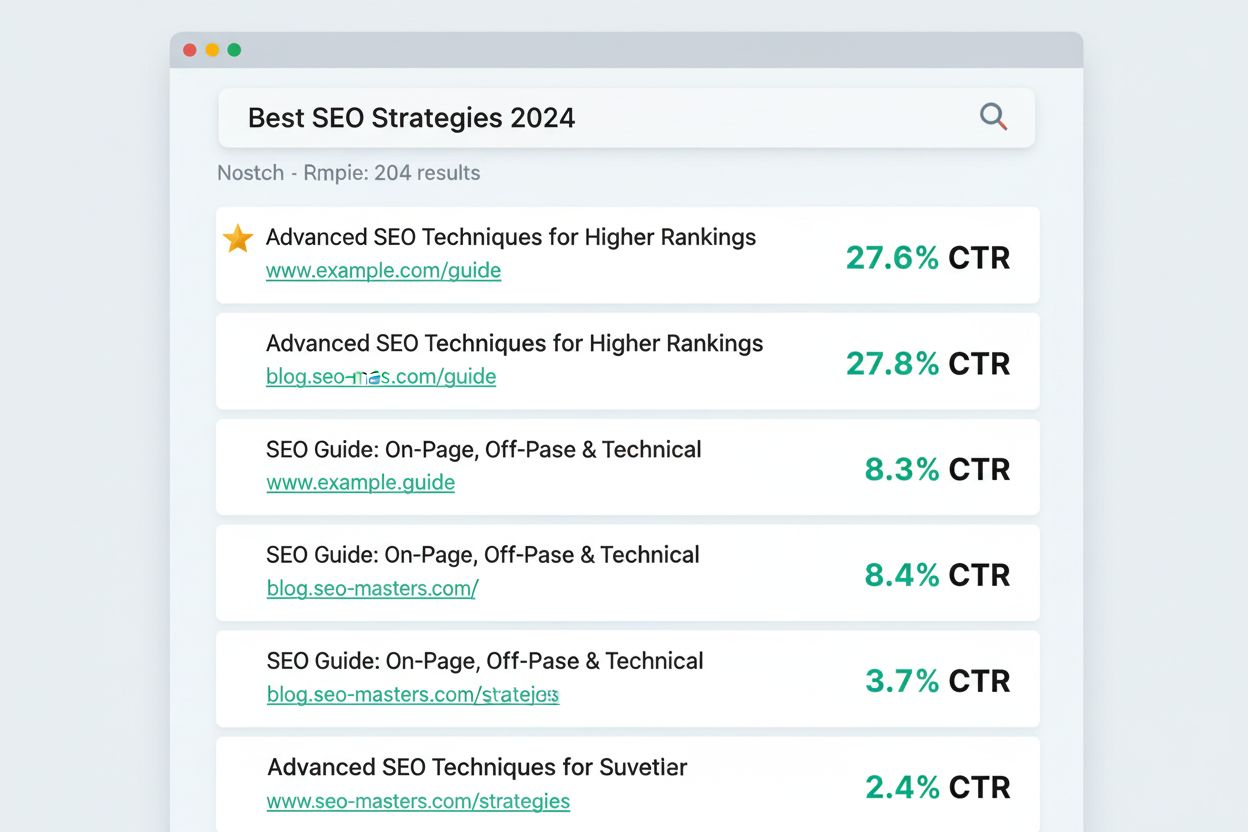
Ranking position is the location of a webpage in search results (1-10 on page 1). Position 1 gets 39.8% CTR. Learn how ranking position affects traffic and visi...

Goal tracking is the systematic monitoring of specific user objectives and performance metrics. Learn how to implement effective goal tracking systems for AI mo...
Cookie Consent
We use cookies to enhance your browsing experience and analyze our traffic. See our privacy policy.