

Position Tracking
Position tracking monitors keyword rankings across SERPs to measure SEO performance. Learn how to track rankings, key metrics, and why it matters for AI search ...
16 min read
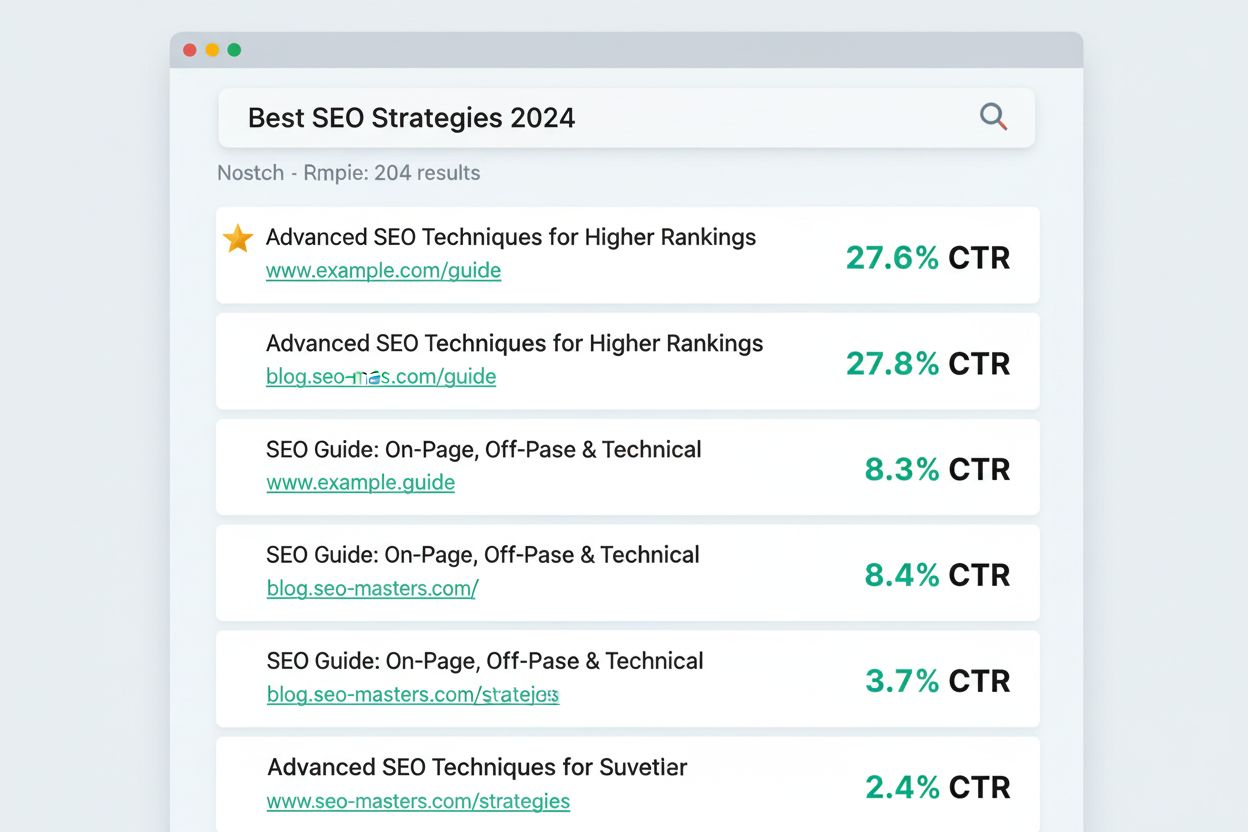
Ranking position refers to the location or placement of a webpage in search engine results pages (SERPs), typically numbered from 1 to 10 on the first page. It indicates where a specific URL appears relative to other results for a given search query, with position 1 being the most visible and valuable placement.
Ranking position refers to the location or placement of a webpage in search engine results pages (SERPs), typically numbered from 1 to 10 on the first page. It indicates where a specific URL appears relative to other results for a given search query, with position 1 being the most visible and valuable placement.
Ranking position is the specific location or placement of a webpage within search engine results pages (SERPs), typically numbered from 1 to 10 on the first page of results. It represents where a particular URL appears relative to all other results for a given search query. When someone searches for a keyword, search engines display results in a ranked order based on relevance, authority, and hundreds of other algorithmic factors. The ranking position determines visibility and click-through potential—position 1 is the most prominent and valuable placement, while positions further down the page receive progressively fewer clicks. Understanding ranking position is fundamental to search engine optimization because it directly correlates with organic traffic, brand visibility, and business outcomes.
The concept of ranking position extends beyond traditional Google search to encompass results across all search engines (Bing, Yahoo, DuckDuckGo) and increasingly, AI search platforms like ChatGPT, Perplexity, and Google AI Overviews. In the context of AmICited, a platform dedicated to monitoring brand appearances in AI responses, ranking position takes on additional significance—it refers not just to where your content appears in traditional search results, but also how prominently your brand gets cited in AI-generated answers. This dual importance makes ranking position one of the most critical metrics for modern digital visibility.
The difference between ranking positions is far more dramatic than most people realize. Research analyzing over 4 million Google search results reveals that position 1 receives 39.8% of all clicks for a given search query, while position 2 receives only 18.7% of clicks. This means the top result receives more than double the traffic of the second-place result. The disparity becomes even more pronounced when comparing position 1 to lower positions: the #1 result is approximately 10 times more likely to receive a click compared to a page ranking in position 10. These statistics underscore why achieving top ranking positions should be a primary focus for any organization seeking organic search visibility.
The concentration of clicks at the top positions creates what researchers call the “first page effect.” Analysis shows that the top 3 organic results collectively capture 54.4% of all clicks, meaning more than half of all search traffic goes to just three positions. Conversely, positions 8, 9, and 10 receive virtually identical click-through rates—moving from position 10 to position 9 results in only an 11% increase in clicks, making incremental improvements at the bottom of the first page relatively insignificant. This distribution explains why SEO professionals focus intensely on achieving top 3 positions rather than simply aiming for “first page” placement. The difference between position 1 and position 10 isn’t merely a matter of visibility—it’s the difference between capturing substantial organic traffic and receiving minimal engagement.
Click-through rate (CTR) represents the percentage of search impressions that result in clicks to your website. Ranking position is the single most influential factor determining CTR. When a user searches for a keyword, they see your result in a specific position, and that position dramatically influences whether they click. The #1 result in Google’s organic search results has an average CTR of 27.6% to 39.8% depending on the query type and industry. This means roughly 4 out of every 10 people who see the #1 result click on it.
The relationship between ranking position and CTR isn’t linear—it’s exponential. Moving from position 2 to position 1 results in a 74.5% increase in relative CTR, the largest single-position improvement possible. However, moving from position 9 to position 8 results in only an 11% CTR increase. This non-linear relationship means that the effort required to move from position 5 to position 4 yields dramatically different traffic benefits than moving from position 4 to position 3. For businesses with limited SEO resources, this reality suggests focusing optimization efforts on achieving top 3 positions rather than spreading efforts across the entire first page.
Several factors influence how ranking position translates to actual clicks. SERP features like featured snippets, knowledge panels, local packs, and paid advertisements occupy space above organic results, pushing organic rankings lower on the page. When these features are present, even position 1 organic results may appear below the fold on mobile devices, reducing their visibility and click-through rate. Additionally, search intent affects CTR—navigational queries (where users search for a specific brand) show higher CTR for position 1 compared to informational queries where users browse multiple results. Understanding these nuances helps explain why ranking position alone doesn’t guarantee traffic—context matters significantly.
Ranking position varies across different search engines and devices, creating complexity for organizations tracking visibility. Google dominates search with approximately 92% market share, making Google ranking positions the primary focus for most SEO efforts. However, Bing and Yahoo (which uses Bing’s index) serve millions of searches daily, and ranking positions on these platforms may differ from Google rankings. A page might rank in position 3 on Google while occupying position 7 on Bing for the same keyword, requiring separate optimization strategies for each platform.
Mobile versus desktop ranking positions present another important distinction. Google implemented mobile-first indexing, meaning the mobile version of your site determines your ranking position for most users. However, ranking positions can still vary between mobile and desktop results, particularly for local searches where mobile users receive location-specific results. A business might rank in position 1 for desktop searches but position 4 for mobile searches in the same geographic area. This variation makes it essential to track ranking positions separately for mobile and desktop when analyzing SEO performance.
AI search platforms introduce an entirely new dimension to ranking position. Unlike traditional search engines that display a ranked list of results, AI platforms like ChatGPT and Perplexity synthesize information from multiple sources to create conversational answers. In this context, “ranking position” transforms from a numbered placement to a citation—whether your content gets mentioned at all, and how prominently. Research shows that pages ranking in positions 1-3 on Google receive disproportionately more citations from AI systems, suggesting that traditional ranking position still influences AI visibility. However, AI platforms also cite pages that don’t rank highly on Google, creating new opportunities for visibility through alternative channels.
Domain authority significantly influences ranking position across all search platforms. Established websites with strong backlink profiles, extensive content libraries, and years of search history tend to rank higher than newer sites with equivalent content quality. This creates a compounding advantage: high-authority domains achieve better ranking positions more easily, which drives more traffic and engagement, which further strengthens authority. Conversely, new websites must overcome this authority deficit through exceptional content quality, strategic link building, and consistent optimization efforts.
The relationship between domain authority and ranking position explains why some websites rank in position 1 despite having less comprehensive content than competitors ranking lower. A well-established brand with strong domain authority can achieve top ranking positions with content that a newer competitor would struggle to rank with, even if the newer competitor’s content is superior. This reality doesn’t mean new sites can’t achieve top ranking positions—it means they must invest more heavily in content quality, user experience, and authority-building activities like link acquisition and brand mentions.
Understanding this dynamic is particularly important for AmICited users monitoring AI search visibility. AI platforms increasingly factor domain authority into citation decisions, meaning established brands receive more AI citations than newer competitors. However, AI systems also recognize exceptional content quality and original research, creating opportunities for newer brands to achieve visibility through differentiated content strategies. The key is recognizing that ranking position results from multiple factors working together—domain authority, content quality, technical optimization, user experience, and relevance signals all contribute to final ranking positions.
Effective SEO requires continuous monitoring of ranking position changes. Rank tracking tools like SE Ranking, Semrush, Ahrefs, and Moz provide automated monitoring of ranking positions across keywords, devices, and locations. These tools track historical ranking data, allowing organizations to identify trends, detect algorithm updates, and measure the impact of optimization efforts. Most rank trackers update daily or multiple times daily, providing near-real-time visibility into ranking position fluctuations.
Ranking position changes often signal important developments. Sudden drops in ranking position may indicate algorithm updates, technical issues, or competitive threats. Gradual improvements suggest that optimization efforts are working. Volatile positions (where rankings fluctuate significantly day-to-day) may indicate that your content is competing closely with other results, suggesting that small improvements in content quality or user experience could yield significant ranking position gains. Analyzing these patterns helps SEO professionals prioritize optimization efforts and adjust strategies based on performance data.
AmICited extends ranking position monitoring beyond traditional search to include AI search platforms. By tracking where your brand appears in AI-generated responses across ChatGPT, Perplexity, Google AI Overviews, and Claude, AmICited provides visibility into a new dimension of ranking position. This AI-focused monitoring reveals whether your content is being cited by AI systems, how frequently citations occur, and which topics drive the most AI visibility. This data complements traditional ranking position tracking, providing a comprehensive view of your brand’s visibility across all search channels.
| Metric | Position 1 | Position 2 | Position 3 | Positions 4-7 | Positions 8-10 |
|---|---|---|---|---|---|
| Average CTR | 39.8% | 18.7% | 10.2% | 3-5% | 0.5-1% |
| Traffic Share | ~40% | ~19% | ~10% | ~20% | ~11% |
| Relative CTR Increase from Previous Position | Baseline | -53% | -45% | -50% | -80% |
| Effort to Achieve | Very High | High | High | Moderate | Low |
| Sustainability | Requires ongoing optimization | Requires ongoing optimization | Requires ongoing optimization | Moderate maintenance | Minimal maintenance |
| AI Citation Probability | Very High | High | High | Moderate | Low |
| Mobile Visibility | Often above fold | Often above fold | Sometimes above fold | Below fold | Below fold |
| Competitive Value | Highest | High | High | Moderate | Low |
SERP features fundamentally change how ranking position translates to visibility and traffic. Featured snippets, knowledge panels, local packs, image carousels, and paid advertisements occupy premium space above organic results, pushing organic ranking positions lower on the page. When a featured snippet appears for a query, the organic result in position 1 may actually appear below the fold on mobile devices, significantly reducing its click-through rate despite technically being the top organic result.
The presence of SERP features creates a paradox: achieving position 1 for a keyword with extensive SERP features may yield less traffic than achieving position 1 for a keyword with minimal SERP features. Research shows that queries with featured snippets, knowledge panels, and paid ads receive lower overall CTR to organic results because users find answers in the SERP features themselves. This reality requires SEO professionals to analyze not just ranking position but also the SERP landscape for target keywords. A keyword where position 1 receives 15% CTR due to SERP features may be less valuable than a keyword where position 3 receives 12% CTR but has minimal SERP features.
Understanding SERP features also reveals optimization opportunities. If a featured snippet exists for your target keyword, optimizing your content to capture that snippet may drive more traffic than achieving position 1 in organic results. Similarly, if a knowledge panel dominates the SERP, ensuring your business information is accurate and complete in Google Business Profile becomes more important than traditional ranking position optimization. This nuanced understanding of how ranking position interacts with SERP features separates sophisticated SEO strategies from basic approaches.
Search intent—the underlying reason behind a search query—significantly influences how ranking position translates to traffic. Queries with clear, specific intent (like “best project management software for remote teams”) show higher CTR concentration at the top positions because users know exactly what they want. Conversely, queries with mixed or ambiguous intent (like “project management”) show more distributed CTR across multiple positions because users need to browse results to find what they’re seeking.
Navigational queries (where users search for a specific brand or website) show dramatically higher CTR for position 1 compared to other query types. When someone searches for “Slack,” they’re looking for Slack’s website specifically, so position 1 receives exceptionally high CTR. Informational queries (where users seek knowledge or answers) show more moderate CTR concentration at top positions because users may find satisfactory answers at multiple positions. Transactional queries (where users intend to make a purchase or complete an action) show high CTR concentration at top positions because users want to find the best options quickly.
This variation in search intent explains why ranking position benchmarks vary across industries and query types. A ranking position 1 for a transactional e-commerce query might receive 50%+ CTR, while position 1 for a broad informational query might receive only 20% CTR. Understanding your target keywords’ search intent helps set realistic ranking position goals and interpret ranking position data accurately. A drop from position 1 to position 3 for an informational query might have minimal traffic impact, while the same drop for a transactional query could represent significant lost revenue.
The emergence of AI search platforms like ChatGPT, Perplexity, and Google AI Overviews introduces new considerations for ranking position strategy. Traditional ranking position (1-10 on Google) remains important because AI systems often cite pages that rank well on Google. However, AI platforms also cite pages that don’t rank highly on Google, particularly when those pages contain original research, unique data, or exceptional expertise. This creates opportunities for brands to achieve AI visibility without necessarily achieving top Google ranking positions.
Citation frequency in AI responses correlates with traditional ranking position but isn’t determined solely by it. Pages ranking in positions 1-3 on Google receive more AI citations than lower-ranking pages, but the relationship isn’t perfectly linear. A page in position 5 with exceptional original research might receive more AI citations than a position 2 page with generic content. This suggests that AI optimization requires a different approach than traditional SEO—while ranking position remains important, content quality, originality, and authority become even more critical.
For organizations using AmICited to monitor AI search visibility, understanding ranking position’s role in AI citations helps contextualize results. If your page ranks in position 1 for a keyword but receives few AI citations, it suggests the content lacks the depth, originality, or authority that AI systems prioritize. Conversely, if a lower-ranking page receives frequent AI citations, it indicates that content quality and uniqueness matter more than traditional ranking position for AI visibility. This insight allows organizations to refine their content strategies to optimize for both traditional search and AI platforms simultaneously.
Achieving and maintaining top ranking positions requires a comprehensive approach addressing multiple ranking factors. Content quality remains foundational—pages with comprehensive, well-researched, original content consistently outrank thin, generic alternatives. Content should thoroughly address search intent, provide unique insights or data unavailable elsewhere, and demonstrate expertise through clear writing and authoritative sources. Pages exceeding 2,900 words tend to rank higher than shorter content, though length alone doesn’t guarantee ranking position improvements.
Technical SEO ensures search engines can effectively crawl, index, and understand your content. Page speed significantly influences ranking position—pages loading in under 2.5 seconds rank higher than slower alternatives. Mobile optimization is essential since Google uses mobile-first indexing. Structured data (schema markup) helps search engines understand content meaning and context. Core Web Vitals (loading performance, interactivity, visual stability) directly impact ranking positions. Addressing these technical factors creates a foundation upon which content quality and link building can improve ranking positions.
Link building remains one of the most influential ranking factors. Pages with more high-quality backlinks from authoritative, relevant sources tend to rank higher than pages with fewer links. However, link quality matters far more than quantity—a single link from a highly authoritative, topically relevant source may contribute more to ranking position than dozens of low-quality links. Strategic link building through digital PR, guest posting, resource creation, and relationship building helps improve ranking positions over time.
User experience signals increasingly influence ranking position. Pages with high click-through rates, low bounce rates, and strong engagement metrics tend to rank higher than pages with poor user experience. This creates a virtuous cycle: better ranking positions drive more traffic, which improves engagement metrics, which further improves ranking positions. Optimizing for user experience—through clear navigation, readable formatting, fast loading, and compelling content—indirectly improves ranking positions by improving these engagement signals.
The concept of ranking position is evolving as search itself transforms. AI search platforms are shifting from ranked lists of results to synthesized answers citing multiple sources. In this new paradigm, traditional ranking position (1-10) becomes less relevant, replaced by citation frequency and prominence in AI-generated responses. Organizations must adapt their visibility strategies to succeed in this changing landscape, focusing not just on ranking position but on becoming a trusted, cited source across multiple platforms.
Personalization is increasing across search platforms, meaning ranking positions vary more significantly between users based on search history, location, device, and preferences. A page might rank in position 1 for one user while ranking in position 5 for another user searching the same keyword. This personalization makes aggregate ranking position data less meaningful and requires more sophisticated tracking approaches that account for personalization variables.
Zero-click searches continue growing, where users find answers directly in search results without clicking through to websites. Featured snippets, knowledge panels, and AI Overviews all contribute to zero-click search behavior. This trend means that ranking position alone becomes insufficient—organizations must also optimize for SERP features and AI citations to capture visibility in zero-click scenarios. The future of search visibility requires success across multiple channels simultaneously: traditional ranking positions, SERP features, and AI citations.
Despite these changes, ranking position remains fundamentally important. Pages ranking in top positions on Google continue to receive more traffic, more backlinks, and more brand mentions than lower-ranking pages. The core principle—that higher ranking positions drive more visibility and traffic—remains true across traditional search and emerging AI platforms. However, the definition of “ranking position” is expanding to encompass visibility across multiple search channels, requiring more sophisticated monitoring and optimization strategies than traditional SEO alone.
Ranking position specifically refers to the numerical location (1-10) of a webpage on a search results page, while ranking more broadly refers to the overall process of appearing in search results. Ranking position is the measurable outcome of ranking efforts—it's the exact spot your page occupies. For example, you might say 'our page ranks for this keyword' (general ranking) versus 'our page is in position 3 for this keyword' (specific ranking position).
Position 1 receives approximately 39.8% of all clicks for a given search query, while position 2 receives around 18.7% of clicks. This means the #1 result gets more than double the traffic of the #2 result. Moving from position 2 to position 1 results in a 74.5% increase in click-through rate, making it the most valuable single position improvement possible in search results.
Ranking position matters for AI search visibility because AI platforms like ChatGPT, Perplexity, and Google AI Overviews prioritize highly-ranked pages when selecting sources to cite. Pages ranking in positions 1-3 receive disproportionately more citations from AI systems. Additionally, AmICited tracks where your brand appears in AI-generated responses, making ranking position a key metric for monitoring AI search visibility and brand mentions.
First page ranking means appearing anywhere on the first page of search results (positions 1-10), while first position ranking means occupying the #1 spot. The distinction is significant: the top 3 positions capture 54.4% of all clicks, while positions 8-10 receive virtually identical traffic. Aiming for 'first page' is insufficient—the real goal should be achieving top 3 positions, with position 1 being most valuable.
SERP features like featured snippets, knowledge panels, local packs, and ads occupy space above traditional organic results, pushing organic rankings lower on the page. This means position 1 in organic results may actually appear below the fold on many devices. When SERP features are present, even position 1 organic results receive lower click-through rates. Understanding your target keyword's SERP features is essential for realistic ranking position expectations.
Yes, ranking positions change frequently—sometimes daily or even multiple times per day. Search algorithms continuously evaluate pages based on freshness, user engagement, backlinks, and dozens of other factors. Monitoring ranking position changes helps identify algorithm updates, competitive threats, and the effectiveness of SEO efforts. Tools like AmICited track these fluctuations across both traditional search and AI platforms.
You should target position 1 whenever possible, as it receives 39.8% of clicks. However, realistic targets depend on keyword difficulty and competition. For highly competitive keywords, achieving top 3 (which collectively get 54.4% of clicks) may be a more achievable initial goal. For less competitive, niche keywords, position 1 is more attainable. Consider your industry, current domain authority, and available resources when setting ranking position targets.
Start tracking how AI chatbots mention your brand across ChatGPT, Perplexity, and other platforms. Get actionable insights to improve your AI presence.
Position tracking monitors keyword rankings across SERPs to measure SEO performance. Learn how to track rankings, key metrics, and why it matters for AI search ...

Position Zero (featured snippet) appears above organic results on Google SERPs, providing direct answers to queries. Learn how P0 impacts SEO, CTR, and AI searc...
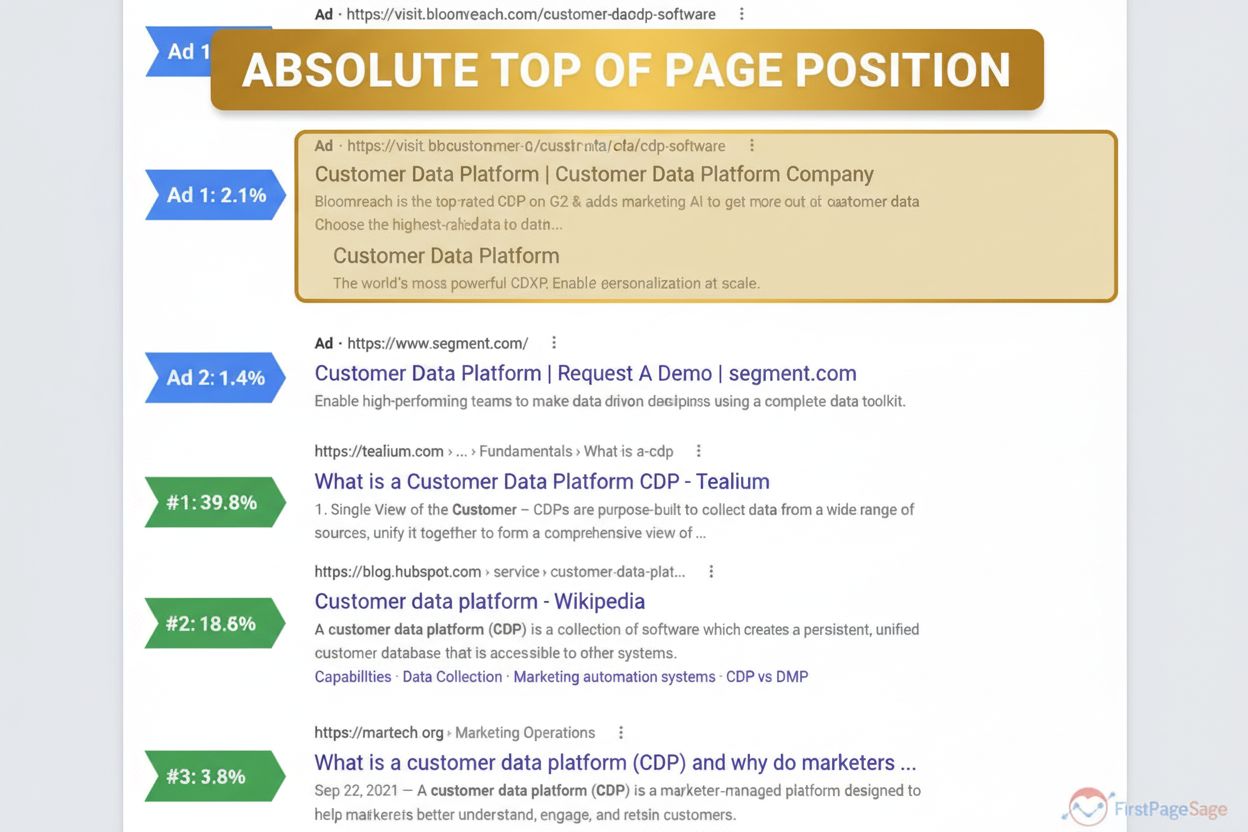
Absolute Top of Page (ATP) is the first ad position on Google Search results. Learn how this premium placement affects CTR, bidding strategies, and campaign per...
Cookie Consent
We use cookies to enhance your browsing experience and analyze our traffic. See our privacy policy.