


Recurring Revenue
Recurring revenue is income a business can reliably expect to receive again in future periods from the same customers, typically through subscriptions, memberships, or repeat replenishment purchases. It is valued more highly than one-time sales because it makes future revenue predictable rather than dependent on constantly finding new customers.
Definition of Recurring Revenue
Recurring revenue is the portion of a business’s income that comes from customers who are expected to keep paying on an ongoing basis, rather than a one-time transaction. The clearest form is subscription revenue — a customer billed monthly or annually for continued access to a product or service — but the concept extends more loosely to any predictable, repeating purchase pattern, such as a household that reliably reorders the same consumable product every six to eight weeks. What separates recurring revenue from a simple repeat sale is the expectation of continuation: a business with strong recurring revenue can reasonably forecast a meaningful share of next month’s income before a single new sale happens, because it is largely locked in by existing, ongoing customer relationships.
How Recurring Revenue Works
Recurring revenue is typically built through one of a few structures: a formal subscription (billed automatically on a set schedule until canceled), a membership (recurring fee for ongoing access or perks), or a replenishment program (a subscribe-and-save option layered onto an otherwise one-time-purchase product). The common thread is that the customer has opted into — or through habitual behavior effectively created — an expectation of continued, scheduled purchasing.
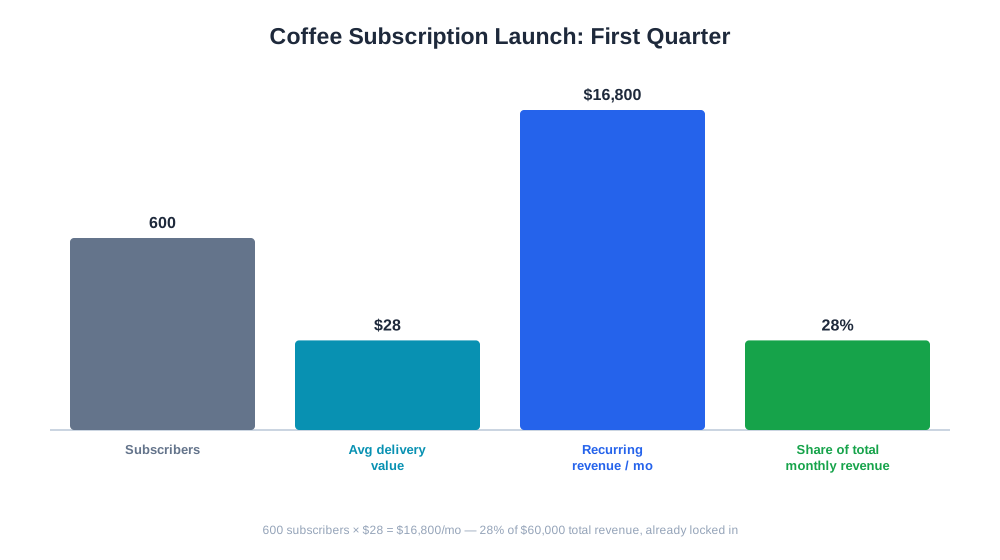
Worked example: an e-commerce coffee brand launches a subscribe-and-save option alongside its regular one-time purchase listing. In its first quarter, 600 customers sign up for a monthly subscription averaging $28 per delivery. That creates a base recurring revenue figure of $16,800 per month that the brand can count on continuing into future months, separate from and in addition to whatever one-time purchases come in from new or non-subscribed customers. If the brand’s overall monthly revenue is $60,000, that $16,800 in recurring revenue represents 28% of total revenue that doesn’t need to be re-earned through fresh acquisition spend each month.

Ready to Monitor Your AI Visibility?
Track how AI chatbots mention your brand across ChatGPT, Perplexity, and other platforms.
Why Recurring Revenue Matters for E-commerce Brands
Recurring revenue changes the fundamental risk profile of a business. A store built entirely on one-time purchases has to win every single dollar of next month’s revenue over again, largely through continued marketing spend and new customer acquisition. A store with a meaningful recurring revenue base starts each period with a portion of revenue already effectively locked in, which reduces reliance on constant top-of-funnel spend and makes cash flow materially easier to plan around. It also tends to raise customer lifetime value, since a subscribed customer who might have made three one-time purchases a year instead makes twelve scheduled ones.
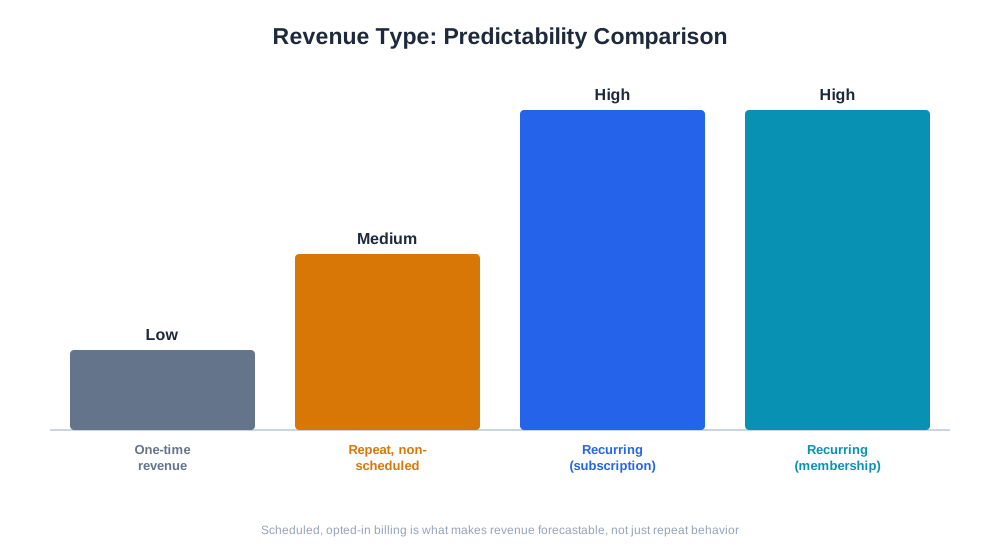
| Revenue Type | Predictability | Typical Driver | Example |
|---|---|---|---|
| One-time revenue | Low | New or occasional purchase | A shopper buying a one-off gift item |
| Repeat revenue (non-scheduled) | Medium | Habitual but unscheduled reorder | Apparel customer buying again after a few months |
| Recurring revenue (subscription) | High | Scheduled, opted-in billing | Monthly coffee or supplement subscription |
| Recurring revenue (membership) | High | Ongoing access fee | Paid loyalty tier with recurring perks |
Recurring Revenue and AI-Driven Commerce
As AI shopping assistants take over more of the discovery and comparison-shopping work for one-time purchases, the relative value of an existing recurring revenue relationship goes up — a subscribed customer isn’t subject to being re-routed to a competitor by an AI assistant’s next product search the way a first-time, one-off shopper is. This makes recurring revenue an increasingly important buffer against the more competitive discovery landscape AI shopping tools are creating. AmICited’s eshop_get_series tool tracks daily revenue trends for a connected store, which is the practical starting point for separating the recurring, predictable portion of a store’s revenue from the more volatile, one-time portion — a distinction that a single blended revenue total can’t show on its own.
Stay Updated on AI Visibility Trends
Get the latest insights on AI mentions, brand monitoring, and optimization strategies.
Best Practices for Recurring Revenue
- Identify which specific products in your catalog have naturally short, predictable reorder cycles before building a subscription program around them
- Start a subscribe-and-save option with your highest-repeat-rate SKUs rather than the entire catalog at once
- Track recurring revenue as its own line, separate from total revenue, to see the real trend beneath period-to-period fluctuation
- Offer a genuine incentive (discount, free shipping, exclusive access) for subscribing, not just convenience, to drive meaningful sign-up rates
- Monitor subscription cancellation reasons closely, since recurring revenue is only valuable if churn is kept low
Common Recurring Revenue Mistakes
A common mistake is launching a subscription option across an entire catalog at once, including products with no natural reorder pattern, which produces low sign-up rates and dilutes focus from the SKUs that would actually benefit. Another frequent error is counting loosely repeat but unscheduled purchases as “recurring revenue” in internal reporting, overstating how predictable the business’s revenue actually is — recurring revenue should describe genuinely scheduled, forecastable income, not just any repeat sale. Some brands also underinvest in retention once a subscription is sold, treating the sign-up as the finish line rather than the start of an ongoing relationship that needs active management to prevent early cancellation. Finally, teams sometimes fail to separate recurring revenue from total revenue in their own reporting, which makes it hard to tell whether overall growth is coming from a strengthening recurring base or simply from more one-time transactions — a distinction that matters enormously for forecasting future periods with any confidence.