

Source Ranking Signals
Learn how AI systems evaluate and rank sources for citations. Discover the 7 core ranking signals including authority, freshness, relevance, and E-E-A-T that de...
12 min read

A relevance signal is an indicator or metric that search engines and AI systems use to determine how well content matches a user’s query intent and demonstrates applicability to their information needs. These signals evaluate whether content is semantically aligned, authoritative, fresh, and structured in ways that AI models can easily understand and extract.
A relevance signal is an indicator or metric that search engines and AI systems use to determine how well content matches a user's query intent and demonstrates applicability to their information needs. These signals evaluate whether content is semantically aligned, authoritative, fresh, and structured in ways that AI models can easily understand and extract.
A relevance signal is an indicator or metric that search engines and AI systems use to evaluate how well content matches a user’s query intent and demonstrates applicability to their information needs. In the context of AI-powered search and content monitoring, relevance signals are the measurable factors that determine whether an AI system will retrieve, cite, and recommend your content in generated responses. Unlike traditional SEO ranking factors that determine position in a search results list, relevance signals determine whether your content is selected at all by AI systems like ChatGPT, Perplexity, Google AI Overviews, and Claude. These signals operate across multiple dimensions—from semantic alignment and content structure to authority and freshness—creating a comprehensive evaluation framework that AI models use to assess content applicability. The shift from ranking-based visibility to relevance-based retrieval represents a fundamental change in how content is discovered and surfaced in the AI era.
The concept of relevance in search has evolved dramatically over the past two decades. In traditional search engines like Google, relevance was initially determined through simple keyword matching—if your page contained the search term, it was considered relevant. However, as search technology advanced, relevance became increasingly sophisticated. The introduction of RankBrain in 2015 marked a turning point, allowing Google to understand semantic relationships between words and concepts rather than relying solely on exact keyword matches. This evolution accelerated with the development of BERT (Bidirectional Encoder Representations from Transformers) in 2018, which enabled search engines to understand the nuanced meaning behind queries and content.
Today, with the rise of large language models (LLMs) and generative AI, relevance signals have undergone another transformation. According to research from SE Ranking in 2025, 68.94% of websites receive AI traffic, indicating that AI visibility has become a critical metric for content success. The relevance signals that determine AI citation are fundamentally different from traditional ranking signals. While Google’s core ranking systems still matter (as they influence which sources AI systems can access), the retrieval mechanisms of AI systems prioritize semantic relevance, content extractability, and entity clarity over traditional link-based authority. This shift reflects a broader industry recognition that relevance is no longer about position—it’s about presence and applicability.
| Aspect | Relevance Signals (AI Systems) | Traditional Ranking Factors (Google Search) |
|---|---|---|
| Primary Focus | Whether content is retrieved and cited | Where content ranks in results list |
| Evaluation Method | Semantic similarity, embedding relevance, entity matching | Keyword density, backlinks, domain authority |
| Content Structure | Q&A format, extractable chunks, clear headings | Title tags, meta descriptions, header hierarchy |
| Authority Indicator | Citation consistency, source trust, cross-platform agreement | Backlink profile, domain age, PageRank |
| Freshness Impact | Content updated within 3 months is 2x more likely to be cited | Freshness matters for time-sensitive queries |
| Content Length | Articles over 2,900 words are 59% more likely to be cited | Optimal length varies by topic and intent |
| Measurement | AI citation tracking, embedding similarity scores | Search position, click-through rate, impressions |
| Platform Consistency | Signals vary slightly across ChatGPT, Perplexity, Gemini, Claude | Primarily Google-focused metrics |
| Entity Clarity | Critical for brand matching and disambiguation | Less emphasized in traditional ranking |
| Multimedia Integration | Videos and images improve retrieval probability | Images help with featured snippets and visual search |
Relevance signals operate through multiple interconnected mechanisms that AI systems evaluate simultaneously. The most fundamental signal is embedding relevance, which measures semantic similarity between a user’s query and content. When someone asks an AI system a question, the model converts both the query and potential answers into mathematical vectors (numerical representations of meaning) and selects content that sits closest in semantic space. This is why content that uses the same language and terminology as user queries performs better than content that covers the same topic using different vocabulary.
Beyond semantic alignment, entity matching represents a critical relevance signal. AI systems need to confidently associate a business, brand, or concept with its attributes, services, and online footprint. If your brand name, services, locations, and descriptions appear inconsistently across the web, AI engines cannot confidently match your business to your attributes, reducing retrieval probability. Citation signals also play a vital role—these are external confidence indicators that help AI validate a business or fact across multiple sources. The more consistent and repeated your footprint is across Google Business Profile, industry directories, review platforms, and niche communities, the stronger your citation layer becomes.
Source authority weighting is another essential signal. AI systems don’t treat all websites equally; some carry far more weight in the retrieval scoring process. Pages on highly trusted sites are more likely to be pulled into AI answers, even when smaller sites have similar content. This is why domain authority and brand recognition remain important in the AI era. Q&A liftability—the degree to which content is formatted as explicit questions and answers—significantly impacts retrieval. AI tools love Q&A structures because they match natural language queries, provide concise extractable chunks, and reduce hallucination risk. Content formatted this way is substantially more likely to be cited.
The technical process by which AI systems evaluate relevance signals involves several sophisticated steps. First, when an AI model receives a user query, it tokenizes the query (breaks it into meaningful units) and converts it into a vector representation. Simultaneously, the model accesses indexed web content and converts that content into vectors as well. The system then calculates cosine similarity—a mathematical measure of how closely the query vector aligns with content vectors. Content with higher cosine similarity scores is more likely to be retrieved.
However, this is only the first layer of evaluation. AI systems apply additional relevance signals to refine retrieval. Freshness signals are evaluated by checking when content was last updated. According to SE Ranking research, content updated within the past 3 months is twice as likely to be cited by ChatGPT compared to older, outdated pages. For AI Mode, pages updated within 2 months are around 28% more likely to be cited than pages untouched for over 2 years. Structured data (schema markup) provides machine-readable clarity that helps AI understand relationships, entities, and page purpose, reducing ambiguity in retrieval.
NAP consistency (Name, Address, Phone number consistency) is another technical signal that AI systems evaluate. When your business information appears consistently across directories and platforms, AI tools treat your brand as reliable and more likely to cite it. Topic cluster strength is evaluated by analyzing whether a website demonstrates topical depth through interconnected, semantically aligned content. AI models recognize when a site has multiple pages reinforcing the same topic from different angles, signaling comprehensive expertise. Finally, cross-model agreement—when multiple AI systems independently recognize the same relevance signals—increases overall retrieval probability. If ChatGPT, Bing AI, Gemini, and Perplexity all see consistent signals, the confidence layer compounds, making your brand significantly more likely to surface.
Understanding and optimizing for relevance signals has profound business implications. According to recent research, 78% of organizations reported using AI in 2024, up from 55% the year before, indicating rapid adoption of AI systems in business decision-making. For content creators and marketers, this means that AI visibility is no longer optional—it’s becoming a primary channel for brand discovery and customer acquisition. The shift from ranking-based to relevance-based visibility fundamentally changes content strategy.
In practical terms, optimizing for relevance signals means focusing on content quality and clarity rather than keyword density and backlink acquisition. It means structuring content in ways that AI systems can easily parse and extract. It means building consistent brand identity across platforms. It means creating content that genuinely answers user questions rather than content designed to rank. The business impact is significant: sites that appear in AI-generated responses benefit from increased credibility, higher engagement (visitors from AI platforms spend 68% more time on websites than those from traditional organic search), and improved conversion rates.
For e-commerce and service-based businesses, AI visibility directly impacts customer acquisition. Research shows that 89% of retailers report either actively using AI in their operations or running pilot programs, and 87% of retailers report AI having a positive impact on their annual revenue. This underscores the importance of optimizing for relevance signals. Businesses that understand and implement relevance signal optimization gain competitive advantage by appearing in AI-generated recommendations, summaries, and answers—often before traditional search results are even considered.
While core relevance signals operate across AI platforms, each system weights them differently, creating platform-specific optimization opportunities. ChatGPT prioritizes sites with strong overall website traffic (sites with 190K+ monthly visitors are twice as likely to be cited), high-traffic homepages (over 7.9K organic visitors doubles citation chances), and extensive referring domains (sites with 350K+ referring domains are over 5x more likely to be cited). ChatGPT also heavily weights content length and section structure—articles over 2,900 words are 59% more likely to be chosen as citations, and pages structured into 120–180-word sections earn 70% more citations.
AI Mode (Google’s AI-powered search feature) shows slightly different signal weighting. Sites with 134K+ visitors are 2.3x more likely to be picked up and cited than those with 2.8K or less. For AI Mode, pages with 100–150 words per section have the highest possibility of being cited. Perplexity emphasizes entity clarity and topical authority, rewarding sites that clearly establish expertise in specific domains. Claude (Anthropic’s AI assistant) tends to prioritize source reliability and factual accuracy, making it particularly important to cite sources and provide verifiable information.
The key insight is that while the fundamental relevance signals remain consistent—semantic relevance, authority, freshness, structure, and entity clarity—the relative weighting varies. This means that a comprehensive AI visibility strategy requires understanding these platform-specific nuances. Tools like AmICited help by tracking which of your pages appear across different AI platforms, revealing which relevance signals are most effective for each system and where optimization efforts should be focused.
To maximize AI visibility, content creators should focus on implementing these key relevance signals:
The landscape of relevance signals is evolving rapidly as AI technology advances. Several emerging trends suggest how relevance signals will develop in the coming years. First, multimodal relevance is becoming increasingly important. As AI systems like Gemini and Claude become more sophisticated in processing images, videos, and audio, relevance signals will expand beyond text. Content that integrates multiple formats will have stronger relevance signals. Second, behavioral relevance signals are gaining prominence. AI systems are increasingly learning from user interactions—which sources users click on, how long they engage with content, and whether they find answers helpful. This feedback loop means that relevance signals are becoming more dynamic and user-centric.
Third, entity-first optimization is replacing keyword-first optimization. Rather than optimizing for keywords, forward-thinking content strategies focus on establishing clear, consistent entity identity across the web. This shift reflects AI systems’ fundamental approach to understanding the world through entities (people, places, things, concepts) rather than keywords. Fourth, retrieval-based optimization is replacing ranking-based optimization. The traditional SEO focus on “ranking for keywords” is giving way to “being retrieved for queries.” This represents a fundamental mindset shift—from competing for position to competing for presence.
Looking ahead, cross-platform consistency will become increasingly important. As AI systems become more sophisticated at cross-referencing information across platforms, consistency will be rewarded. Brands that maintain identical information across all platforms will have stronger relevance signals. Additionally, original content and research will become more valuable as AI systems learn to identify and reward genuinely original contributions to knowledge. The future of relevance signals points toward a more sophisticated, user-centric, and entity-focused approach to content optimization—one where quality, clarity, and consistency matter more than ever.
The evolution of relevance signals also suggests that AI monitoring and tracking will become essential business functions. Just as companies track search rankings today, they will increasingly track AI visibility and citation metrics. Platforms like AmICited represent the future of content performance measurement, providing visibility into which relevance signals are working and where optimization efforts should be focused. Understanding relevance signals today positions content creators and marketers to succeed in the AI-driven information landscape of tomorrow.
While ranking signals determine where content appears in traditional search results, relevance signals determine whether content is retrieved and cited by AI systems at all. Ranking signals focus on position in a list, whereas relevance signals focus on retrieval probability. In AI search, relevance signals are often more critical than traditional ranking signals because AI systems prioritize content that matches user intent and can be easily extracted, rather than simply ranking pages by authority or keyword density.
AI systems convert both user queries and web content into mathematical vectors (embeddings) and evaluate relevance by measuring semantic similarity. They assess multiple relevance signals simultaneously—including keyword presence, content structure, authority, freshness, and entity clarity—to determine which sources to cite. According to SE Ranking research, 68.94% of websites receive AI traffic, and sites with stronger relevance signals are significantly more likely to be selected as sources in AI-generated responses.
The most critical relevance signals include embedding relevance (semantic alignment with queries), entity matching (clear brand identity), citation signals (consistent mentions across platforms), source authority (trust and credibility), Q&A structure (extractable content format), and freshness (recent updates). Research shows that content updated within 3 months is twice as likely to be cited by ChatGPT compared to outdated pages, and articles over 2,900 words are 59% more likely to be selected as citations.
Content structure significantly impacts how AI systems evaluate relevance. Pages with 120–180-word sections earn 70% more citations than pages with very short sections under 50 words. Clear headings, Q&A formats, bullet points, and logical organization make content easier for AI to parse and extract. Structured data (schema markup) also strengthens relevance signals by providing explicit machine-readable information about content, entities, and relationships.
Yes, but with important caveats. Core relevance signals like content quality, freshness, and semantic alignment work across ChatGPT, Perplexity, Google AI Overviews, and Claude. However, each platform weights signals differently. For example, ChatGPT favors sites with 190K+ monthly visitors, while AI Mode prioritizes sites with 134K+ visitors. Cross-model agreement—when multiple AI systems independently recognize the same relevance signals—actually increases overall retrieval probability across all platforms.
AmICited tracks whether your content appears in AI-generated responses across platforms like ChatGPT, Perplexity, Google AI Overviews, and Claude. Understanding relevance signals helps you optimize for AI citation visibility. By monitoring which of your pages are cited and analyzing the relevance signals they possess, you can identify patterns and improve other content to increase AI visibility. AmICited's platform reveals which relevance signals are working for your domain and where improvements are needed.
Topical authority—demonstrating deep expertise across interconnected, semantically aligned content clusters—is a powerful relevance signal. AI systems recognize when a website has multiple pages reinforcing the same topic from different angles, which signals comprehensive expertise. Sites with strong topic clusters are more likely to be retrieved for queries within that domain. Building topical authority requires creating content that covers a subject thoroughly while maintaining semantic consistency across pages.
Start tracking how AI chatbots mention your brand across ChatGPT, Perplexity, and other platforms. Get actionable insights to improve your AI presence.
Learn how AI systems evaluate and rank sources for citations. Discover the 7 core ranking signals including authority, freshness, relevance, and E-E-A-T that de...

Quality signals are metrics search engines use to evaluate content excellence. Learn how E-E-A-T, user engagement, and other factors determine content quality f...
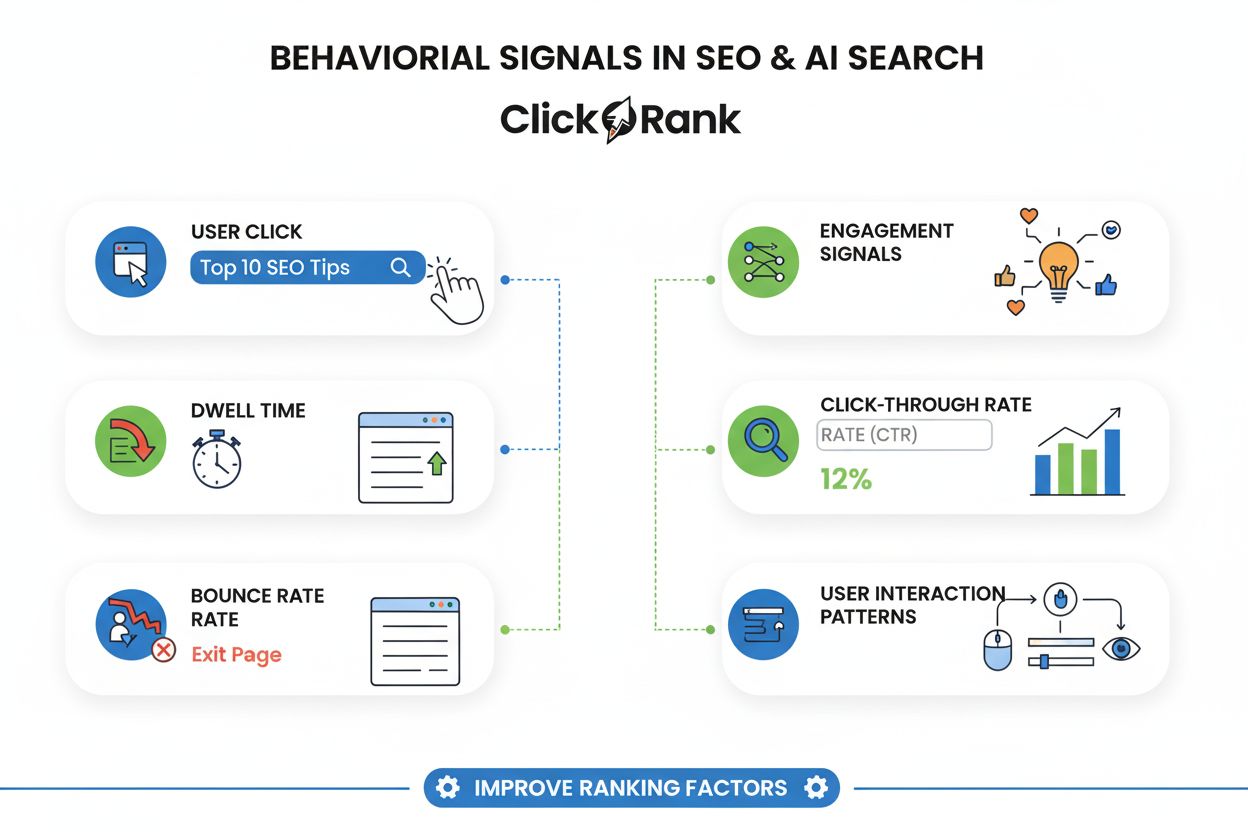
Behavioral signals measure user interactions like CTR, dwell time, and bounce rate. Learn how user action patterns affect SEO rankings and AI search visibility ...