
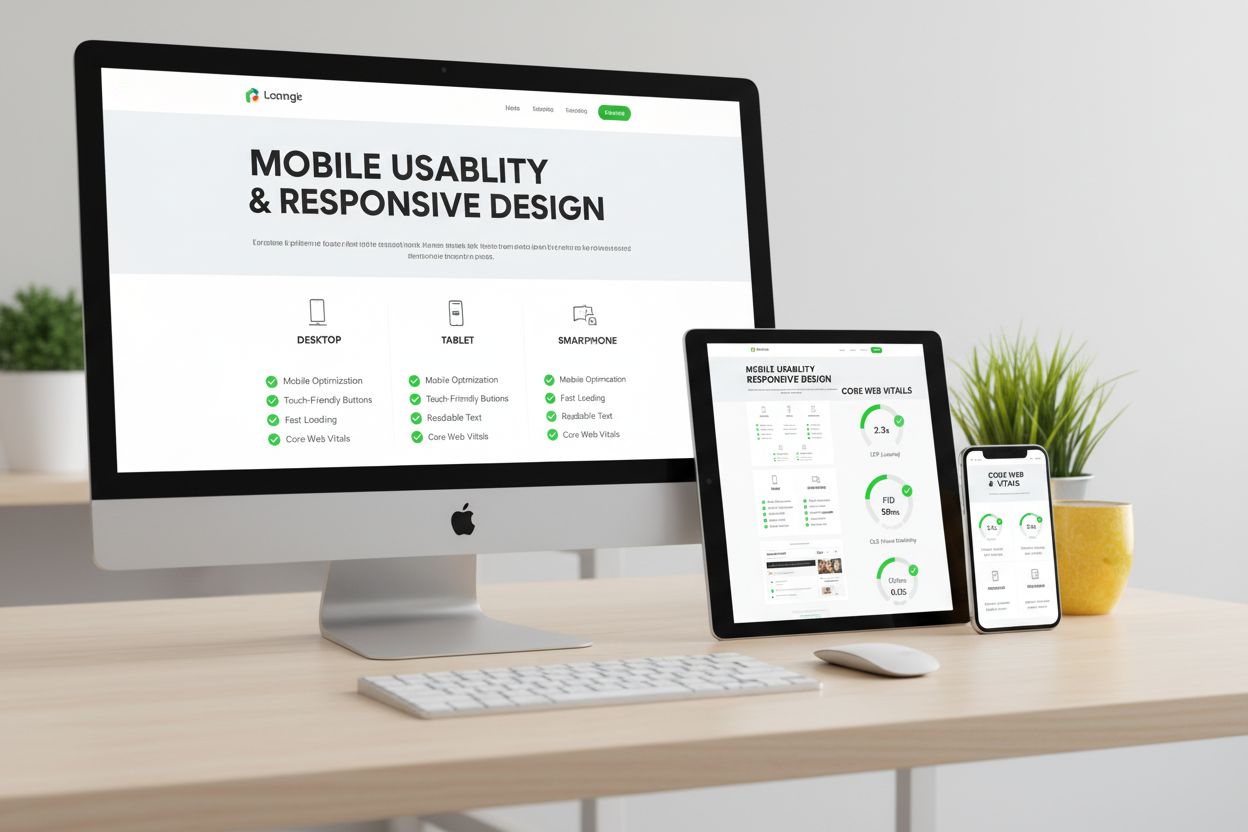
Mobile Usability
Mobile usability measures how well websites work on mobile devices. Learn what it means, why it matters for SEO and AI monitoring, and best practices for optimi...
11 min read
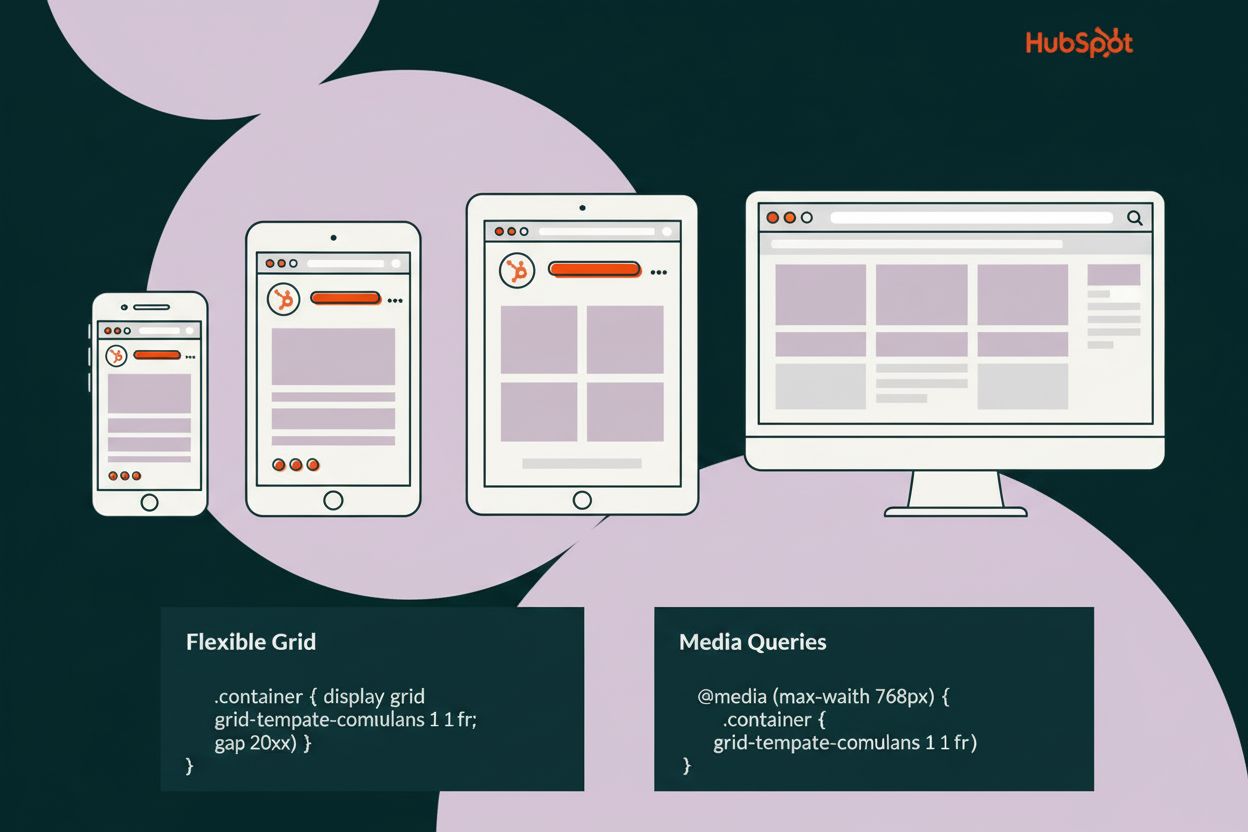
Responsive design is a web design approach that automatically adjusts website layouts, content, and functionality to fit any screen size or device, from mobile phones to desktop monitors. It uses flexible grids, fluid images, and CSS media queries to ensure optimal user experience across all devices without requiring separate versions of a website.
Responsive design is a web design approach that automatically adjusts website layouts, content, and functionality to fit any screen size or device, from mobile phones to desktop monitors. It uses flexible grids, fluid images, and CSS media queries to ensure optimal user experience across all devices without requiring separate versions of a website.
Responsive design is a web design methodology that enables websites to automatically adapt their layout, content, and functionality to fit any screen size, device orientation, or viewport dimension. Rather than creating separate versions of a website for different devices, responsive design uses a single, flexible codebase that intelligently reorganizes and resizes elements based on the user’s device characteristics. This approach ensures that whether a user accesses your website from a smartphone with a 360-pixel width, a tablet with an 810-pixel width, or a desktop monitor with a 1920-pixel width, they receive an optimized, fully functional experience tailored to their specific screen dimensions. The term “responsive design” was coined by Ethan Marcotte in 2010 and has since become the industry standard for modern web development, fundamentally changing how developers approach cross-device compatibility.
The concept of responsive design emerged from the necessity to address the explosive growth of mobile device usage in the early 2010s. Before responsive design became mainstream, developers faced a critical challenge: websites designed for desktop monitors looked terrible on mobile devices, with text becoming unreadable, images overflowing, and navigation becoming impossible to use. Companies had two options—create separate mobile websites or accept poor mobile experiences. Ethan Marcotte’s groundbreaking article in A List Apart introduced the concept of combining fluid grids, flexible images, and media queries to create layouts that could adapt to any screen size. This innovation eliminated the need for multiple website versions and provided a scalable solution for the rapidly diversifying device landscape. Today, responsive design is not just a best practice—it’s a fundamental requirement, with 62.54% of global website traffic coming from mobile devices in 2025, according to Statista. The evolution from fixed-width layouts to fluid, responsive systems represents one of the most significant paradigm shifts in web development history.
Responsive design relies on three fundamental technical pillars: fluid grids, flexible images, and CSS media queries. Fluid grids replace fixed pixel-based layouts with proportional measurements using percentages or relative units like em and rem. Instead of setting a container to a fixed 960 pixels wide, a responsive grid might use width: 100% or width: calc(100% - 2rem), allowing the layout to scale proportionally with the viewport. Flexible images are implemented using CSS properties like max-width: 100% and height: auto, ensuring images scale down to fit their containers without exceeding their original dimensions or becoming pixelated. CSS media queries are conditional CSS rules that apply different styles based on device characteristics such as screen width, height, device orientation, or pixel density. The syntax @media screen and (max-width: 768px) { … } allows developers to define breakpoints where the layout changes to accommodate different screen sizes. Modern responsive design also leverages advanced CSS layout systems like Flexbox and CSS Grid, which are inherently responsive and provide more powerful tools for creating flexible layouts with minimal media queries. The viewport meta tag, , is essential for telling mobile browsers to render pages at the device’s actual width rather than assuming a desktop width.
| Aspect | Responsive Design | Adaptive Design |
|---|---|---|
| Layout Approach | Fluid, continuously adjusts to any screen size | Fixed layouts for specific predefined breakpoints |
| Codebase | Single codebase serves all devices | Multiple codebases for different device categories |
| Flexibility | Highly flexible, future-proof for new devices | Limited to predefined screen sizes |
| Development Cost | Lower cost, single version to maintain | Higher cost, multiple versions to develop and maintain |
| Performance | Optimized through progressive enhancement | Can be optimized for specific devices |
| Browser Detection | Not required, CSS-based adaptation | Often uses server-side device detection |
| Best For | New projects, long-term scalability | Existing sites being refreshed, specific device optimization |
| User Experience | Seamless across all devices | Tailored experience for specific devices |
| SEO Impact | Preferred by Google, mobile-first indexing friendly | Can create duplicate content issues |
| Implementation Time | Moderate, requires planning and testing | Longer, requires multiple design iterations |
Mobile-first design is a strategic approach within responsive design that prioritizes designing for the smallest screens first, then progressively enhancing the experience for larger screens. This methodology fundamentally changes the development workflow—instead of starting with a desktop layout and trying to squeeze it onto mobile screens, developers begin with a minimal, essential mobile experience and add complexity as screen space increases. The mobile-first approach offers several critical advantages: it forces designers to prioritize content and functionality, resulting in cleaner, more focused interfaces; it reduces CSS file size by avoiding unnecessary styles that must be overridden for mobile; and it naturally aligns with modern web performance best practices. With mobile devices accounting for 62.45% of global internet traffic, designing mobile-first ensures the majority of users receive an optimized experience from the start. This approach also improves SEO performance because Google’s mobile-first indexing means the search engine primarily evaluates the mobile version of websites. Developers using mobile-first design typically structure their CSS with base styles for mobile, then use media queries with min-width conditions to add styles for tablets and desktops: @media screen and (min-width: 768px) { … }.
Breakpoints are specific screen widths where the layout changes to accommodate different device sizes. Rather than designing for every possible screen resolution, developers identify key breakpoints where the design naturally breaks and needs adjustment. Common responsive design breakpoints include: 320-480px for small mobile phones, 481-768px for larger phones and small tablets, 769-1024px for tablets in landscape orientation, 1025-1200px for laptops and small desktops, and 1201px and above for large desktops and ultra-wide monitors. However, modern best practices emphasize setting breakpoints based on content needs rather than specific devices. According to HubSpot’s research, the most prevalent mobile viewport is 360 × 800 px (10.27% of global mobile usage), followed by 390 × 844 px (6.26%) and 393 × 873 px (5.23%). For tablets, 768 × 1024 px dominates with 15.18% usage, while 1920 × 1080 px remains the most common desktop resolution at 20.28%. Using relative units like em or rem for breakpoints instead of fixed pixels provides better accessibility and flexibility, as breakpoints scale with user font size preferences. The concept of “designing to the content” means adjusting breakpoints where the layout actually needs to change, rather than forcing content into predetermined device categories.
CSS media queries are the technical foundation enabling responsive design, allowing developers to apply conditional styling based on device characteristics. The basic syntax involves the @media rule followed by media type and feature queries: @media screen and (max-width: 768px) { .container { width: 100%; } }. Media queries can target various features including viewport width (width, min-width, max-width), viewport height, device orientation (portrait or landscape), pixel density (for retina displays), and even user preferences like prefers-reduced-motion for accessibility. Modern CSS supports logical operators—and, or, and not—enabling complex conditions: @media screen and (min-width: 768px) and (max-width: 1024px) { … }. Mobile-first media queries use min-width conditions, progressively adding styles as screens get larger, while desktop-first approaches use max-width conditions, removing styles for smaller screens. Best practices recommend using relative units for breakpoints (em or rem) rather than pixels, as they respect user font size settings and provide better accessibility. The CSS Grid and Flexbox layout systems have reduced the need for extensive media queries—these modern layout methods are inherently responsive and automatically adjust to available space. Developers can also use CSS custom properties (variables) to store breakpoint values, making maintenance easier: –mobile-breakpoint: 768px; then using calc() functions to create responsive values that scale smoothly across screen sizes.
Responsive images are critical for responsive design, as serving the same large desktop image to mobile users wastes bandwidth and slows page load times. The HTML <picture> element and <img> srcset and sizes attributes enable serving different images based on device characteristics. The picture element allows developers to specify multiple image sources with media queries: 
 . Fluid images use CSS properties like max-width: 100% and height: auto to scale images proportionally within their containers. Modern image formats like WebP provide better compression for web delivery, and developers should optimize images using tools like ImageOptim or TinyPNG before uploading. Responsive video implementation uses similar techniques—wrapping videos in containers with aspect-ratio CSS properties ensures they maintain proper proportions across screen sizes. The CSS aspect-ratio property (aspect-ratio: 16 / 9) is particularly useful for maintaining video and image proportions without requiring padding-bottom hacks.
Responsive typography ensures text remains readable and visually appropriate across all screen sizes. Rather than using fixed font sizes, responsive design employs relative units like em, rem, and viewport units (vw, vh). The rem unit (root em) is preferred for most typography, as it scales based on the root font size, typically 16px by default. Setting html { font-size: 16px; } and then using rem for all elements (h1 { font-size: 2rem; }) creates a scalable typography system. Viewport units (vw for viewport width) enable fonts to scale fluidly with screen size: h1 { font-size: 6vw; } makes the heading 6% of the viewport width. However, using only viewport units prevents users from zooming text, so the recommended approach combines fixed and fluid units: h1 { font-size: calc(1.5rem + 4vw); }. This formula ensures the heading has a minimum size (1.5rem) while also scaling with viewport width. Media queries adjust font sizes at specific breakpoints: @media (max-width: 768px) { h1 { font-size: 1.5rem; } } @media (min-width: 1200px) { h1 { font-size: 3rem; } }. Line height and letter spacing should also be responsive—longer lines on desktop screens benefit from increased line height (1.6-1.8), while mobile text typically uses tighter spacing (1.4-1.5). Responsive typography improves readability, reduces cognitive load, and enhances overall user experience across devices.
The business case for responsive design is compelling and data-driven. Google’s mobile-first indexing means the search engine primarily crawls and ranks the mobile version of websites, making responsive design essential for SEO performance. According to Google Search Central, responsive design eliminates common indexing problems, reduces duplicate content risks, and ensures all users access the same content at the same URL. With 62.54% of global website traffic coming from mobile devices in 2025, websites without responsive design are effectively excluding the majority of potential visitors. Studies consistently show that responsive websites have significantly lower bounce rates—users are more likely to stay on sites that display properly on their devices. E-commerce data reveals that over 75% of online sales are projected to come from mobile devices in 2025, making responsive design directly tied to revenue generation. Responsive design also reduces development and maintenance costs by eliminating the need for separate mobile and desktop versions. A single responsive codebase requires fewer resources to update, test, and deploy compared to maintaining multiple versions. Additionally, responsive design improves Core Web Vitals metrics—Google’s ranking factors that measure page experience—by enabling optimized performance across devices. Companies that invest in responsive design see improved user engagement, higher conversion rates, better search rankings, and reduced bounce rates, directly impacting business metrics and bottom-line profitability.
Successful responsive design implementation requires a systematic approach combining planning, coding discipline, and thorough testing. Start with a mobile-first approach, designing the smallest screen experience first, then progressively enhance for larger screens. Use semantic HTML to create meaningful document structure that works well with responsive CSS. Implement flexible layouts using Flexbox and CSS Grid rather than relying solely on media queries—these modern layout systems automatically adapt to available space. Set breakpoints based on content needs rather than specific devices, testing where the layout actually breaks. Use relative units (em, rem, %, vw) instead of fixed pixels for better scalability and accessibility. Optimize images and media using responsive image techniques, modern formats, and compression. Test extensively across real devices and browsers, not just browser developer tools—use platforms like BrowserStack or LambdaTest to test on actual devices. Implement performance monitoring to ensure responsive designs load quickly on mobile networks. Use CSS custom properties (variables) to manage breakpoints and values consistently. Validate that touch targets are appropriately sized (minimum 44x44 pixels) for mobile users. Test keyboard navigation and screen reader compatibility to ensure accessibility across devices. Monitor Core Web Vitals metrics (Largest Contentful Paint, First Input Delay, Cumulative Layout Shift) to ensure responsive designs meet Google’s performance standards.
The future of responsive design continues to evolve with advancing web technologies and changing user behaviors. Container queries represent a significant advancement, allowing styles to adapt based on the size of a component’s container rather than the viewport—this enables truly modular, reusable components that work in any context. CSS subgrid provides more powerful grid layout capabilities, enabling nested grids to align with parent grids for more sophisticated responsive layouts. Aspect ratio CSS property simplifies maintaining proper proportions for images and videos without requiring padding-bottom hacks. Dynamic viewport units (dvh, dvw, lvh, lvw, svh, svw) address mobile browser UI challenges where viewport height changes as browser chrome appears and disappears. Responsive design systems are becoming increasingly sophisticated, with design tokens and component libraries enabling consistent responsive experiences across entire organizations. AI-driven responsive design tools are emerging to automatically generate responsive layouts and suggest optimal breakpoints based on content analysis. The integration of progressive web apps (PWAs) with responsive design creates app-like experiences that work seamlessly across devices. Voice interfaces and smart speakers are expanding the definition of responsive design beyond visual screens to include audio and conversational interfaces. As 5G networks become more prevalent, responsive design will increasingly focus on optimizing for high-bandwidth experiences while maintaining fallbacks for slower connections. The convergence of responsive design with accessibility standards (WCAG 2.1 and beyond) ensures that responsive websites are not just visually adaptive but also inclusive for users with disabilities. The future emphasizes performance-first responsive design, where optimization for speed and efficiency is built into the responsive design process from the beginning rather than added as an afterthought.
+++
Responsive design is a web design approach that automatically adjusts website layouts, content, and functionality to fit any screen size or device, from mobile phones to desktop monitors. Rather than creating separate versions of a website for different devices, responsive design uses a single, flexible codebase that intelligently reorganizes and resizes elements based on the user’s device characteristics. This ensures that whether a user accesses your website from a smartphone with a 360-pixel width, a tablet with an 810-pixel width, or a desktop monitor with a 1920-pixel width, they receive an optimized, fully functional experience tailored to their specific screen dimensions. The term “responsive design” was coined by Ethan Marcotte in 2010 and has since become the industry standard for modern web development, fundamentally changing how developers approach cross-device compatibility.
The concept of responsive design emerged from the necessity to address the explosive growth of mobile device usage in the early 2010s. Before responsive design became mainstream, developers faced a critical challenge: websites designed for desktop monitors looked terrible on mobile devices, with text becoming unreadable, images overflowing, and navigation becoming impossible to use. Companies had two options—create separate mobile websites or accept poor mobile experiences. Ethan Marcotte’s groundbreaking article in A List Apart introduced the concept of combining fluid grids, flexible images, and media queries to create layouts that could adapt to any screen size. This innovation eliminated the need for multiple website versions and provided a scalable solution for the rapidly diversifying device landscape. Today, responsive design is not just a best practice—it’s a fundamental requirement, with 62.54% of global website traffic coming from mobile devices in 2025, according to Statista. The evolution from fixed-width layouts to fluid, responsive systems represents one of the most significant paradigm shifts in web development history.
Responsive design relies on three fundamental technical pillars: fluid grids, flexible images, and CSS media queries. Fluid grids replace fixed pixel-based layouts with proportional measurements using percentages or relative units like em and rem. Instead of setting a container to a fixed 960 pixels wide, a responsive grid might use width: 100% or width: calc(100% - 2rem), allowing the layout to scale proportionally with the viewport. Flexible images are implemented using CSS properties like max-width: 100% and height: auto, ensuring images scale down to fit their containers without exceeding their original dimensions or becoming pixelated. CSS media queries are conditional CSS rules that apply different styles based on device characteristics such as screen width, height, device orientation, or pixel density. The syntax @media screen and (max-width: 768px) { … } allows developers to define breakpoints where the layout changes to accommodate different screen sizes. Modern responsive design also leverages advanced CSS layout systems like Flexbox and CSS Grid, which are inherently responsive and provide more powerful tools for creating flexible layouts with minimal media queries. The viewport meta tag, , is essential for telling mobile browsers to render pages at the device’s actual width rather than assuming a desktop width.
| Aspect | Responsive Design | Adaptive Design |
|---|---|---|
| Layout Approach | Fluid, continuously adjusts to any screen size | Fixed layouts for specific predefined breakpoints |
| Codebase | Single codebase serves all devices | Multiple codebases for different device categories |
| Flexibility | Highly flexible, future-proof for new devices | Limited to predefined screen sizes |
| Development Cost | Lower cost, single version to maintain | Higher cost, multiple versions to develop and maintain |
| Performance | Optimized through progressive enhancement | Can be optimized for specific devices |
| Browser Detection | Not required, CSS-based adaptation | Often uses server-side device detection |
| Best For | New projects, long-term scalability | Existing sites being refreshed, specific device optimization |
| User Experience | Seamless across all devices | Tailored experience for specific devices |
| SEO Impact | Preferred by Google, mobile-first indexing friendly | Can create duplicate content issues |
| Implementation Time | Moderate, requires planning and testing | Longer, requires multiple design iterations |
Mobile-first design is a strategic approach within responsive design that prioritizes designing for the smallest screens first, then progressively enhancing the experience for larger screens. This methodology fundamentally changes the development workflow—instead of starting with a desktop layout and trying to squeeze it onto mobile screens, developers begin with a minimal, essential mobile experience and add complexity as screen space increases. The mobile-first approach offers several critical advantages: it forces designers to prioritize content and functionality, resulting in cleaner, more focused interfaces; it reduces CSS file size by avoiding unnecessary styles that must be overridden for mobile; and it naturally aligns with modern web performance best practices. With mobile devices accounting for 62.45% of global internet traffic, designing mobile-first ensures the majority of users receive an optimized experience from the start. This approach also improves SEO performance because Google’s mobile-first indexing means the search engine primarily evaluates the mobile version of websites. Developers using mobile-first design typically structure their CSS with base styles for mobile, then use media queries with min-width conditions to add styles for tablets and desktops: @media screen and (min-width: 768px) { … }.
Breakpoints are specific screen widths where the layout changes to accommodate different device sizes. Rather than designing for every possible screen resolution, developers identify key breakpoints where the design naturally breaks and needs adjustment. Common responsive design breakpoints include: 320-480px for small mobile phones, 481-768px for larger phones and small tablets, 769-1024px for tablets in landscape orientation, 1025-1200px for laptops and small desktops, and 1201px and above for large desktops and ultra-wide monitors. However, modern best practices emphasize setting breakpoints based on content needs rather than specific devices. According to HubSpot’s research, the most prevalent mobile viewport is 360 × 800 px (10.27% of global mobile usage), followed by 390 × 844 px (6.26%) and 393 × 873 px (5.23%). For tablets, 768 × 1024 px dominates with 15.18% usage, while 1920 × 1080 px remains the most common desktop resolution at 20.28%. Using relative units like em or rem for breakpoints instead of fixed pixels provides better accessibility and flexibility, as breakpoints scale with user font size preferences. The concept of “designing to the content” means adjusting breakpoints where the layout actually needs to change, rather than forcing content into predetermined device categories.
CSS media queries are the technical foundation enabling responsive design, allowing developers to apply conditional styling based on device characteristics. The basic syntax involves the @media rule followed by media type and feature queries: @media screen and (max-width: 768px) { .container { width: 100%; } }. Media queries can target various features including viewport width (width, min-width, max-width), viewport height, device orientation (portrait or landscape), pixel density (for retina displays), and even user preferences like prefers-reduced-motion for accessibility. Modern CSS supports logical operators—and, or, and not—enabling complex conditions: @media screen and (min-width: 768px) and (max-width: 1024px) { … }. Mobile-first media queries use min-width conditions, progressively adding styles as screens get larger, while desktop-first approaches use max-width conditions, removing styles for smaller screens. Best practices recommend using relative units for breakpoints (em or rem) rather than pixels, as they respect user font size settings and provide better accessibility. The CSS Grid and Flexbox layout systems have reduced the need for extensive media queries—these modern layout methods are inherently responsive and automatically adjust to available space. Developers can also use CSS custom properties (variables) to store breakpoint values, making maintenance easier: –mobile-breakpoint: 768px; then using calc() functions to create responsive values that scale smoothly across screen sizes.
Responsive images are critical for responsive design, as serving the same large desktop image to mobile users wastes bandwidth and slows page load times. The HTML <picture> element and <img> srcset and sizes attributes enable serving different images based on device characteristics. The picture element allows developers to specify multiple image sources with media queries: . Fluid images use CSS properties like max-width: 100% and height: auto to scale images proportionally within their containers. Modern image formats like WebP provide better compression for web delivery, and developers should optimize images using tools like ImageOptim or TinyPNG before uploading. Responsive video implementation uses similar techniques—wrapping videos in containers with aspect-ratio CSS properties ensures they maintain proper proportions across screen sizes. The CSS aspect-ratio property (aspect-ratio: 16 / 9) is particularly useful for maintaining video and image proportions without requiring padding-bottom hacks.
Responsive typography ensures text remains readable and visually appropriate across all screen sizes. Rather than using fixed font sizes, responsive design employs relative units like em, rem, and viewport units (vw, vh). The rem unit (root em) is preferred for most typography, as it scales based on the root font size, typically 16px by default. Setting html { font-size: 16px; } and then using rem for all elements (h1 { font-size: 2rem; }) creates a scalable typography system. Viewport units (vw for viewport width) enable fonts to scale fluidly with screen size: h1 { font-size: 6vw; } makes the heading 6% of the viewport width. However, using only viewport units prevents users from zooming text, so the recommended approach combines fixed and fluid units: h1 { font-size: calc(1.5rem + 4vw); }. This formula ensures the heading has a minimum size (1.5rem) while also scaling with viewport width. Media queries adjust font sizes at specific breakpoints: @media (max-width: 768px) { h1 { font-size: 1.5rem; } } @media (min-width: 1200px) { h1 { font-size: 3rem; } }. Line height and letter spacing should also be responsive—longer lines on desktop screens benefit from increased line height (1.6-1.8), while mobile text typically uses tighter spacing (1.4-1.5). Responsive typography improves readability, reduces cognitive load, and enhances overall user experience across devices.
The business case for responsive design is compelling and data-driven. Google’s mobile-first indexing means the search engine primarily crawls and ranks the mobile version of websites, making responsive design essential for SEO performance. According to Google Search Central, responsive design eliminates common indexing problems, reduces duplicate content risks, and ensures all users access the same content at the same URL. With 62.54% of global website traffic coming from mobile devices in 2025, websites without responsive design are effectively excluding the majority of potential visitors. Studies consistently show that responsive websites have significantly lower bounce rates—users are more likely to stay on sites that display properly on their devices. E-commerce data reveals that over 75% of online sales are projected to come from mobile devices in 2025, making responsive design directly tied to revenue generation. Responsive design also reduces development and maintenance costs by eliminating the need for separate mobile and desktop versions. A single responsive codebase requires fewer resources to update, test, and deploy compared to maintaining multiple versions. Additionally, responsive design improves Core Web Vitals metrics—Google’s ranking factors that measure page experience—by enabling optimized performance across devices. Companies that invest in responsive design see improved user engagement, higher conversion rates, better search rankings, and reduced bounce rates, directly impacting business metrics and bottom-line profitability.
Successful responsive design implementation requires a systematic approach combining planning, coding discipline, and thorough testing. Start with a mobile-first approach, designing the smallest screen experience first, then progressively enhance for larger screens. Use semantic HTML to create meaningful document structure that works well with responsive CSS. Implement flexible layouts using Flexbox and CSS Grid rather than relying solely on media queries—these modern layout systems automatically adapt to available space. Set breakpoints based on content needs rather than specific devices, testing where the layout actually breaks. Use relative units (em, rem, %, vw) instead of fixed pixels for better scalability and accessibility. Optimize images and media using responsive image techniques, modern formats, and compression. Test extensively across real devices and browsers, not just browser developer tools—use platforms like BrowserStack or LambdaTest to test on actual devices. Implement performance monitoring to ensure responsive designs load quickly on mobile networks. Use CSS custom properties (variables) to manage breakpoints and values consistently. Validate that touch targets are appropriately sized (minimum 44x44 pixels) for mobile users. Test keyboard navigation and screen reader compatibility to ensure accessibility across devices. Monitor Core Web Vitals metrics (Largest Contentful Paint, First Input Delay, Cumulative Layout Shift) to ensure responsive designs meet Google’s performance standards.
The future of responsive design continues to evolve with advancing web technologies and changing user behaviors. Container queries represent a significant advancement, allowing styles to adapt based on the size of a component’s container rather than the viewport—this enables truly modular, reusable components that work in any context. CSS subgrid provides more powerful grid layout capabilities, enabling nested grids to align with parent grids for more sophisticated responsive layouts. Aspect ratio CSS property simplifies maintaining proper proportions for images and videos without requiring padding-bottom hacks. Dynamic viewport units (dvh, dvw, lvh, lvw, svh, svw) address mobile browser UI challenges where viewport height changes as browser chrome appears and disappears. Responsive design systems are becoming increasingly sophisticated, with design tokens and component libraries enabling consistent responsive experiences across entire organizations. AI-driven responsive design tools are emerging to automatically generate responsive layouts and suggest optimal breakpoints based on content analysis. The integration of progressive web apps (PWAs) with responsive design creates app-like experiences that work seamlessly across devices. Voice interfaces and smart speakers are expanding the definition of responsive design beyond visual screens to include audio and conversational interfaces. As 5G networks become more prevalent, responsive design will increasingly focus on optimizing for high-bandwidth experiences while maintaining fallbacks for slower connections. The convergence of responsive design with accessibility standards (WCAG 2.1 and beyond) ensures that responsive websites are not just visually adaptive but also inclusive for users with disabilities. The future emphasizes performance-first responsive design, where optimization for speed and efficiency is built into the responsive design process from the beginning rather than added as an afterthought.
Responsive design is critical for SEO because Google uses mobile-first indexing, meaning it primarily crawls and ranks the mobile version of websites. According to Google Search Central, responsive design eliminates duplicate content issues, improves crawlability, and ensures all users access the same content at the same URL. With mobile devices accounting for 62.54% of global website traffic in 2025, responsive design directly impacts search rankings and visibility.
Responsive design uses fluid layouts that automatically adjust to any screen size using CSS media queries and flexible units, while adaptive design creates fixed layouts for specific predefined screen sizes. Responsive design requires a single codebase and is more cost-effective, whereas adaptive design requires multiple codebases for different devices. Responsive design is generally preferred for new projects due to its flexibility and future-proof nature.
Common responsive design breakpoints include: 480px for small mobile phones, 768px for tablets, 1024px for small desktops, and 1280px+ for large desktops. However, modern best practices recommend setting breakpoints where your design naturally breaks rather than using fixed device-based breakpoints. Using relative units like em or rem for breakpoints is preferred over absolute pixel values for better accessibility and flexibility.
Media queries are CSS rules that apply different styles based on device characteristics like screen width, height, or orientation. The syntax uses @media followed by conditions, such as @media screen and (max-width: 768px). When the condition is true, the CSS rules inside the media query block are applied. Media queries enable developers to create different layouts for different screen sizes without changing the HTML structure.
Mobile-first design means starting with styles for the smallest screens (mobile devices) and progressively adding complexity for larger screens using media queries. This approach ensures essential content works on all devices, reduces CSS file size, and improves performance. It forces designers to prioritize critical information and functionality, resulting in better user experiences across all devices.
Flexible grids use relative units like percentages instead of fixed pixels, allowing layouts to scale proportionally with screen size. Fluid images are set with max-width: 100% to scale down within their containers without exceeding their intrinsic size. Together, these techniques ensure that all page elements adapt smoothly to different viewport widths, maintaining proper proportions and readability across devices.
Popular responsive design frameworks include Bootstrap, Foundation, Tailwind CSS, and W3.CSS, which provide pre-built responsive components and grid systems. Modern CSS features like Flexbox and CSS Grid are inherently responsive and reduce the need for frameworks. Browser developer tools, testing platforms like BrowserStack, and virtual device testing tools help developers test responsive designs across multiple screen sizes and devices.
Responsive design improves performance by allowing optimization of images and content for specific devices, reducing unnecessary downloads on mobile. It enhances user experience by eliminating the need for zooming, panning, or horizontal scrolling. Studies show responsive websites have lower bounce rates, higher engagement, and better conversion rates. With 62.54% of traffic coming from mobile devices, responsive design directly affects business metrics and user satisfaction.
Start tracking how AI chatbots mention your brand across ChatGPT, Perplexity, and other platforms. Get actionable insights to improve your AI presence.
Mobile usability measures how well websites work on mobile devices. Learn what it means, why it matters for SEO and AI monitoring, and best practices for optimi...

Infinite scroll is a web design technique that automatically loads new content as users scroll down. Learn how it works, its benefits, drawbacks, and impact on ...
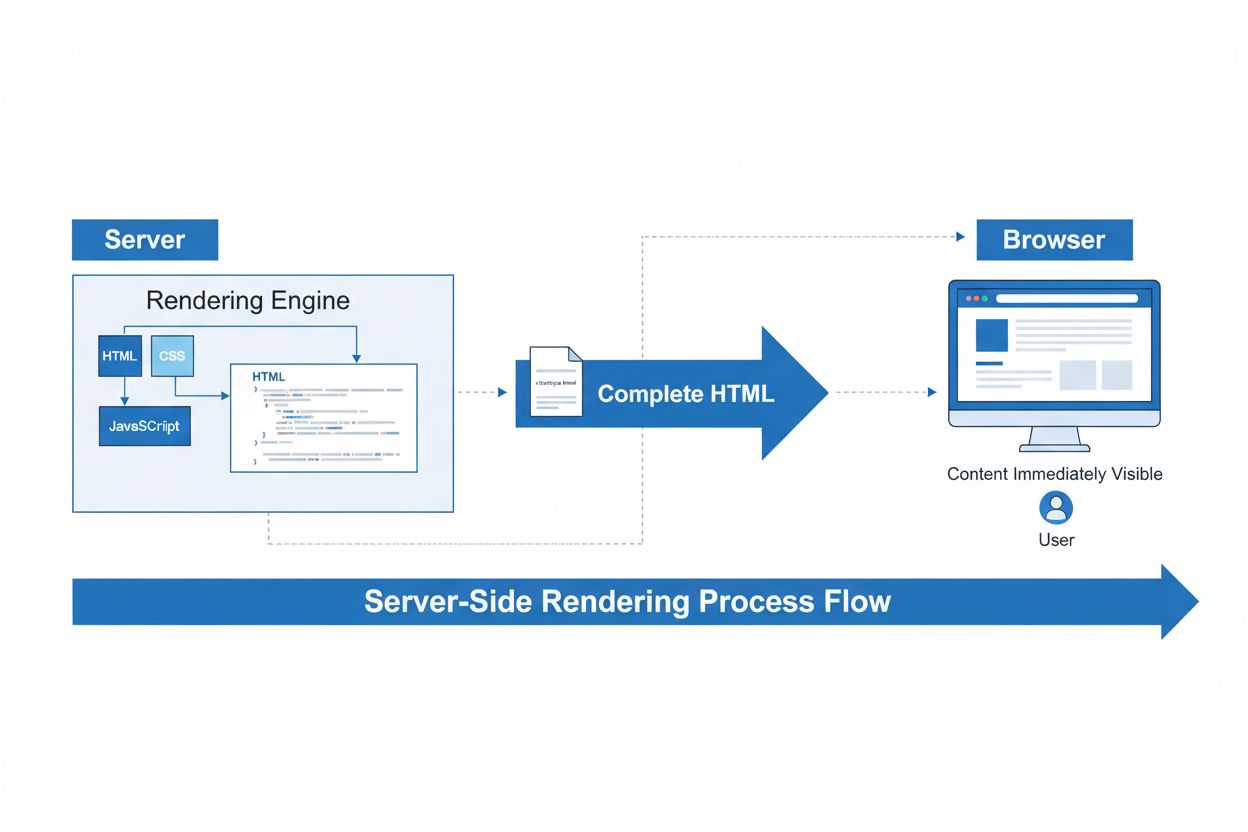
Server-Side Rendering (SSR) is a web technique where servers render complete HTML pages before sending them to browsers. Learn how SSR improves SEO, page speed,...
Cookie Consent
We use cookies to enhance your browsing experience and analyze our traffic. See our privacy policy.