


Return Merchandise Authorization
A Return Merchandise Authorization (RMA) is the formal approval and tracking number a retailer issues before accepting a returned product back from a customer. It creates a documented, trackable process that connects a specific return to a specific order, letting a business audit why items come back and process refunds or replacements accurately.
Definition of Return Merchandise Authorization
A Return Merchandise Authorization (RMA) is the formal process — and the resulting reference number — a retailer uses to approve and track a product return before it is physically shipped back. Rather than letting customers send items back unannounced, most e-commerce and retail businesses require a customer to first request a return, receive approval along with a unique RMA number, and then ship the item back with that number attached or referenced. The RMA number becomes the thread that ties the physical returned item to the original order, the stated reason for return, and whatever resolution — refund, replacement, or store credit — the business ultimately issues.
How the RMA Process Works
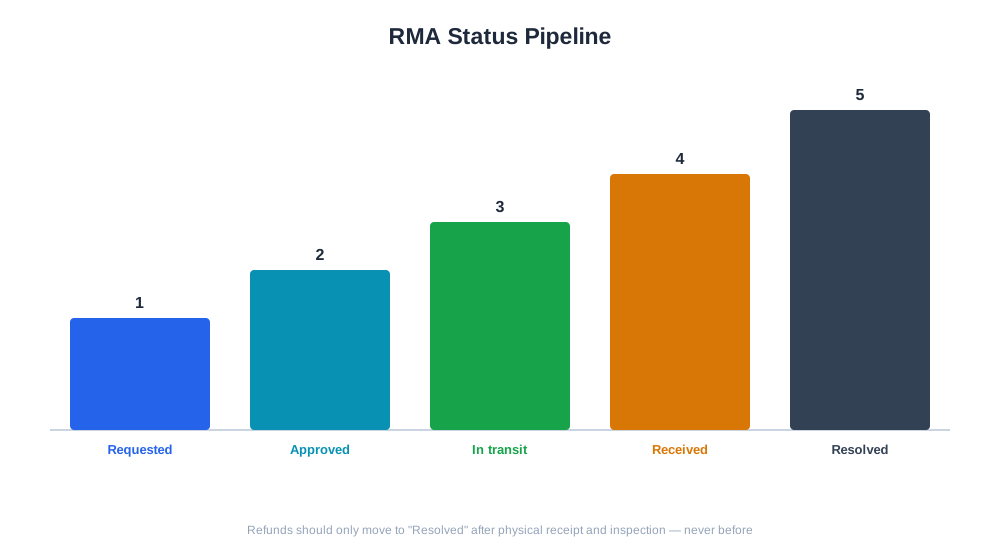
A typical RMA workflow moves through a defined sequence of statuses. First, a customer requests a return, usually specifying a reason (wrong size, defective, changed mind, arrived damaged). The retailer reviews the request against its return policy and, if approved, issues an RMA number along with return shipping instructions. The customer ships the item back, often with the RMA number printed on the label or included inside the package. Once the retailer receives the item, it is inspected against the stated condition requirements, and only then is the refund, replacement, or credit actually processed.
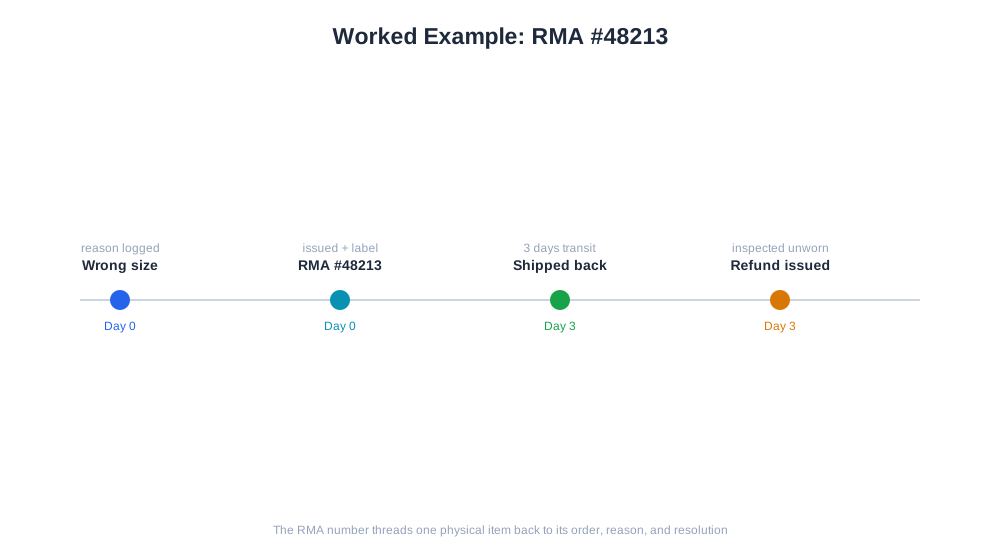
Worked example: a customer orders a jacket that arrives in the wrong size. They request a return through the store’s self-service portal, selecting “wrong size” as the reason. The system auto-approves the return under the store’s standard policy and issues RMA #48213, along with a prepaid return label. The customer ships the jacket back; three days later it arrives at the returns center, is inspected and confirmed unworn, and the refund is processed against RMA #48213 — closing the loop between the original order, the return request, and the final resolution.

Ready to Monitor Your AI Visibility?
Track how AI chatbots mention your brand across ChatGPT, Perplexity, and other platforms.
Why RMA Process Matters for E-commerce Brands
A well-run RMA process protects a business on two fronts: it prevents refunds from being issued for returns that never actually arrive, and it generates structured data on why products come back, which is valuable well beyond the individual transaction. Return reason data collected through the RMA process — sizing issues, product defects, inaccurate listings — can point directly at problems worth fixing upstream, whether that’s a product description, a sizing chart, or a manufacturing defect. Without a formal RMA system, this data is scattered across support tickets and emails, making it very difficult to spot patterns.
| RMA Status | What It Means | Typical Risk If Skipped |
|---|---|---|
| Requested | Customer has initiated a return request | Return arrives with no context or matching order |
| Approved | Retailer has authorized the return, RMA number issued | Refund could be issued for unapproved or ineligible returns |
| In transit | Item shipped back, not yet received | Refund processed before item is confirmed in hand |
| Received | Item arrived at returns center, pending inspection | Item accepted without condition verification |
| Resolved | Refund, replacement, or credit issued | Return reason data lost if not logged before closing |
RMA Process and AI-Driven Commerce
As more purchases originate from AI shopping assistants like ChatGPT Shopping or Perplexity Shopping, which summarize product details on a customer’s behalf rather than the customer browsing a full product page themselves, sizing and fit mismatches can become a more common return driver if the AI-summarized description omits detail the shopper would otherwise have checked. Tracking RMA reasons carefully helps a merchant notice whether returns are increasingly clustering around a specific reason tied to how a product is being described or discovered. AmICited’s eshop_list_status_map tool maps order and return statuses across a connected store, giving merchants visibility into exactly where RMAs sit in the pipeline — requested, approved, in transit, or resolved — without needing to dig through a platform’s native back office.
Stay Updated on AI Visibility Trends
Get the latest insights on AI mentions, brand monitoring, and optimization strategies.
Best Practices for RMA Process
- Require an RMA number before accepting any returned item to keep returns matched cleanly to the original order
- Never issue a refund until the returned item has actually been received and inspected, unless your policy explicitly allows refund-before-return
- Capture a specific return reason at the request stage, not just a generic “return” label, so the data is useful later
- Set clear service-level expectations for how quickly an RMA moves from received to resolved, since slow refund processing is a common source of customer complaints
- Review return reason trends by product regularly to catch sizing, quality, or listing accuracy issues early
Common RMA Process Mistakes
A frequent mistake is issuing refunds automatically once a tracking number shows the return item as shipped, without waiting for actual physical receipt and inspection — this exposes a business to loss if the package is lost, empty, or contains a different item than described. Another common issue is failing to require or properly capture a return reason at the point of request, which leaves a business with plenty of return volume data but no insight into why products are coming back, making it impossible to fix the underlying cause. Some retailers also let RMAs sit unresolved for too long between “received” and “refunded,” creating customer service escalations and chargebacks that a tighter internal SLA would have prevented. A more subtle problem is treating every return the same operationally regardless of reason — a defective product return should typically trigger a different internal review (potential supplier issue) than a simple size exchange, but a flat RMA process without reason-based routing treats them identically and misses signals that matter.