

Research Content - Data-Driven Analytical Content
Research content is evidence-based material created through data analysis and expert insights. Learn how data-driven analytical content builds authority, influe...
12 min read
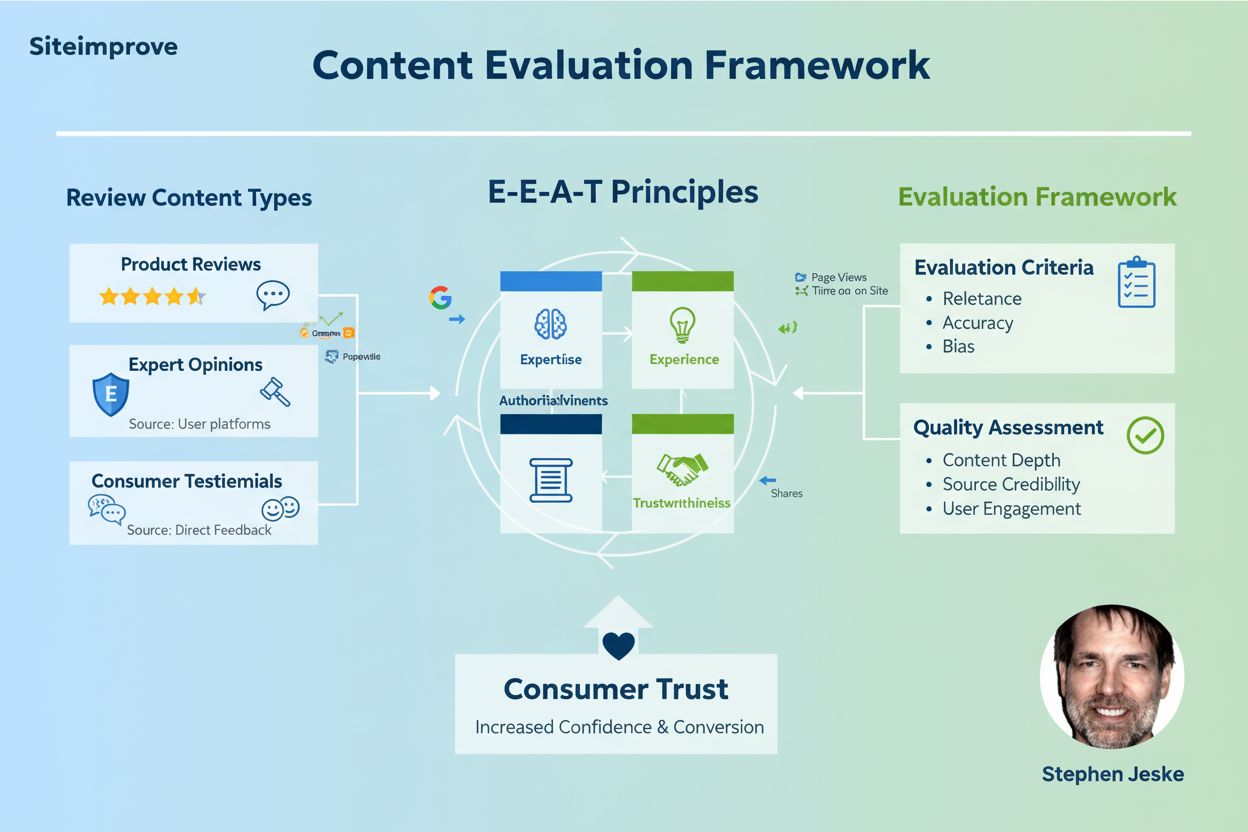
Review content encompasses evaluative and opinion-based material that assesses products, services, or topics through expert analysis, consumer feedback, and firsthand experience. This content type is critical for establishing E-E-A-T signals and influences consumer decision-making, brand reputation, and search engine rankings across platforms including AI systems like ChatGPT, Perplexity, and Google AI Overviews.
Review content encompasses evaluative and opinion-based material that assesses products, services, or topics through expert analysis, consumer feedback, and firsthand experience. This content type is critical for establishing E-E-A-T signals and influences consumer decision-making, brand reputation, and search engine rankings across platforms including AI systems like ChatGPT, Perplexity, and Google AI Overviews.
Review content is evaluative and opinion-based material that assesses products, services, topics, or experiences through expert analysis, consumer feedback, and firsthand experience. Unlike purely informational content, review content combines subjective evaluation with factual assessment, creating a unique content category that directly influences consumer decision-making and establishes critical E-E-A-T signals (Expertise, Experience, Authoritativeness, and Trustworthiness). This content type encompasses product reviews, expert opinions, consumer testimonials, service evaluations, and detailed assessments published across multiple platforms including e-commerce sites, review aggregators, social media, and increasingly, within AI-generated responses from systems like ChatGPT, Perplexity, and Google AI Overviews. The significance of review content extends beyond traditional search rankings—it now plays a vital role in how AI monitoring platforms track brand visibility and how generative AI systems cite sources when answering consumer questions.
The influence of review content on purchasing behavior cannot be overstated. According to recent data, 93% of consumers read online reviews before making a purchase, and 93% of consumers report that online reviews influence their purchasing decisions. This extraordinary adoption rate reflects a fundamental shift in how consumers evaluate products and services. More remarkably, 53% of consumers trust online reviews as much as personal recommendations from friends and family, demonstrating that review content has achieved parity with trusted personal networks. The average American consumer reads approximately 10 reviews before trusting a business, with 54.7% of consumers reading at least four product reviews before making a purchase decision. This behavior underscores the importance of review content quality and quantity for businesses seeking to establish credibility and drive conversions. The trust placed in review content is so significant that 58% of consumers are willing to pay more or travel further to visit companies with good reviews, indicating that positive review content directly impacts consumer willingness to invest additional resources.
Review content manifests in diverse formats, each serving distinct purposes within the consumer decision-making ecosystem. Product reviews focus on individual items, evaluating aspects like size, quality, ease of use, and overall satisfaction, typically appearing on product pages and e-commerce platforms. Expert opinions provide credibility through qualified reviewer credentials and industry recognition, offering specialized knowledge that consumers cannot easily verify independently. Consumer testimonials build social proof by showcasing real customer experiences and satisfaction levels. Service evaluations assess intangible offerings like hospitality, customer support, and professional services. Long-form detailed reviews provide comprehensive analysis with context and nuance, while short-form ratings and comments offer quick assessments and quick feedback. Video reviews have emerged as a powerful format, allowing consumers to see products in action and assess reviewer authenticity through visual cues. Peer reviews on platforms like Yelp, TripAdvisor, and Google Reviews aggregate community feedback, with Google housing 73% of all online reviews and 81% of consumers reading reviews specifically on Google. The diversity of review content formats ensures that consumers can access multiple perspectives and choose formats that best suit their information-processing preferences.
The relationship between review content and E-E-A-T signals is fundamental to modern search engine optimization and content credibility. Experience, the first component of E-E-A-T, is most directly demonstrated through review content that showcases firsthand product usage, personal experience, or direct service interaction. Google’s December 2022 Quality Rater Guidelines update specifically emphasized that review content with strong first-hand experience receives higher E-E-A-T scores, recognizing that consumers value authentic experiences over theoretical knowledge. Expertise in review content is established through reviewer credentials, professional qualifications, industry certifications, and demonstrated knowledge of the subject matter. Authoritativeness emerges when review content receives citations from other authoritative sources, generates backlinks from reputable websites, and builds a reputation within industry communities. Trustworthiness, the most critical E-E-A-T component, is established through transparent methodology, honest assessment of both strengths and weaknesses, clear disclosure of potential conflicts of interest, and consistency with other credible sources. Google’s systems increasingly recognize that review content demonstrating all four E-E-A-T components receives preferential treatment in search rankings, particularly for topics affecting consumer health, financial decisions, or safety—known as YMYL (Your Money or Your Life) topics. This emphasis on E-E-A-T in review content has created a competitive advantage for businesses that invest in generating authentic, credible reviews from qualified sources.
| Review Content Type | Primary Source | E-E-A-T Focus | Typical Length | Platform Examples | Consumer Trust Level |
|---|---|---|---|---|---|
| Product Reviews | Consumers/Customers | Experience, Trustworthiness | 100-300 words | Amazon, Yelp, Google | High (93% read before purchase) |
| Expert Opinions | Industry Specialists | Expertise, Authoritativeness | 500-2000 words | Professional blogs, publications | Very High (credibility-driven) |
| Consumer Testimonials | Verified Customers | Experience, Trustworthiness | 50-150 words | Brand websites, case studies | High (social proof) |
| Video Reviews | Content Creators | Experience, Authoritativeness | 5-20 minutes | YouTube, TikTok, Instagram | Very High (visual authenticity) |
| Long-form Reviews | Expert Reviewers | All E-E-A-T components | 1500+ words | Tech blogs, review sites | Very High (comprehensive) |
| Short-form Ratings | Consumers | Trustworthiness | 1-5 stars + comment | All platforms | Moderate (quick assessment) |
| Peer Reviews | Community Members | Experience, Trustworthiness | Variable | TripAdvisor, Glassdoor | High (community consensus) |
| Service Evaluations | Customers | Experience, Authoritativeness | 200-500 words | Google, Yelp, industry sites | High (outcome-focused) |
Review content addressing YMYL (Your Money or Your Life) topics—subjects affecting health, financial stability, safety, or societal well-being—must meet significantly higher standards for accuracy, expertise, and trustworthiness. Google applies stricter evaluation criteria to review content on YMYL topics, requiring clear author credentials, comprehensive fact-checking, citations from authoritative sources, and transparent disclosure of potential conflicts of interest. For example, review content about medical treatments, pharmaceutical products, or health supplements must be authored by qualified healthcare professionals or individuals with documented medical expertise, not merely consumers sharing personal anecdotes. Similarly, review content on financial products, investment strategies, or insurance policies should come from certified financial advisors or individuals with relevant professional credentials. The responsibility inherent in review content for YMYL topics is substantial—inaccurate or misleading reviews could directly harm consumers’ health outcomes, financial security, or physical safety. Google’s algorithms and human quality raters specifically evaluate review content on YMYL topics for potential harm, and pages demonstrating low E-E-A-T on these topics face significant ranking penalties. This heightened scrutiny has created an opportunity for businesses and content creators to differentiate themselves by producing exceptionally credible review content that exceeds minimum standards, thereby building competitive advantages in search visibility and consumer trust.
The emergence of AI-generated search results from systems like ChatGPT, Perplexity, Google AI Overviews, and Claude has fundamentally transformed how review content is discovered, cited, and valued. These AI systems analyze vast amounts of review content to synthesize answers to consumer questions, often citing specific reviews or review platforms as sources. Unlike traditional search engines that display links to review pages, AI systems extract and synthesize information from review content, creating new opportunities for brands whose reviews are cited and new challenges for those whose reviews are overlooked. AI monitoring platforms like AmICited now track how frequently brand-related review content appears in AI-generated responses, providing metrics for share of voice and competitive positioning within generative AI search results. This shift has created a new dimension of review content strategy—optimizing not just for traditional search engines but for AI citation and synthesis. Brands are discovering that review content demonstrating strong E-E-A-T signals, particularly firsthand experience and expertise, receives preferential treatment in AI-generated responses. The integration of review content into AI search results has also elevated the importance of review authenticity and accuracy, as AI systems are increasingly trained to identify and deprioritize fake or manipulated reviews. This evolution represents a significant opportunity for businesses to leverage authentic review content as a core component of their AI visibility strategy.
Despite the critical importance of review content for consumer decision-making and search rankings, the prevalence of fake reviews represents a significant threat to content integrity and consumer trust. 67% of consumers consider fake reviews a major problem, and 82% of consumers have read a fake review in the past year, indicating widespread awareness of review manipulation. Google reported that approximately 10.7% of reviews on Google are fake, followed by Yelp with 7.1% and TripAdvisor with 5.2%. The economic incentive for fake review content is substantial—businesses can artificially inflate ratings, competitors can post negative reviews to damage reputations, and review manipulation services operate at scale. Notably, 62% of consumers do not support brands that practice review censorship, indicating that consumers value authentic review content even when it includes negative feedback. This consumer preference for authentic review content has created a competitive advantage for businesses that maintain transparent review policies and actively encourage genuine customer feedback. Google’s algorithms have become increasingly sophisticated at detecting fake review content, using signals like reviewer history, review timing patterns, linguistic analysis, and cross-platform consistency to identify manipulation. The fight against fake review content has become a critical component of maintaining search visibility and consumer trust, with platforms investing heavily in review verification systems and authentication mechanisms. For businesses, the lesson is clear: authentic review content is not just ethically important—it’s strategically essential for long-term visibility and credibility.
Successful review content strategies require systematic approaches to generation, management, and optimization. Organizations should implement processes to actively encourage customers to leave review content, making the review process simple and accessible across multiple platforms. Timing is critical—requesting review content immediately after positive customer experiences, when satisfaction is highest, significantly increases review volume and quality. Responding to review content, both positive and negative, demonstrates engagement and commitment to customer satisfaction. Research shows that 88% of consumers expect businesses to respond to reviews, with 56% expecting responses within 24 hours. Businesses that respond to at least 25% of their reviews generate 35% more revenue than those that ignore feedback, demonstrating the direct business impact of review content management. Organizations should also implement quality standards for review content, ensuring that reviews are detailed, specific, and helpful to other consumers. Encouraging reviewers to include photos, videos, or detailed descriptions increases review content credibility and usefulness. For businesses operating in YMYL categories, additional rigor is necessary—ensuring that review content is accurate, fact-checked, and authored by qualified individuals. Monitoring competitor review content provides strategic insights into market positioning, customer pain points, and opportunities for differentiation. Finally, integrating review content into broader content marketing strategies—featuring reviews in case studies, testimonials, and marketing materials—amplifies the impact of authentic customer feedback and builds comprehensive E-E-A-T signals across digital properties.
The trajectory of review content is increasingly intertwined with advances in artificial intelligence, machine learning, and evolving search paradigms. As AI systems become more sophisticated in synthesizing information, the importance of authentic, credible review content will only increase. Google’s continued emphasis on E-E-A-T, particularly the Experience component added in December 2022, signals that review content demonstrating firsthand knowledge will receive preferential treatment in both traditional and AI-driven search results. The rise of user-generated content platforms and community-driven review sites suggests that consumers increasingly value peer perspectives over corporate messaging, creating opportunities for businesses that facilitate authentic review content generation. Emerging technologies like blockchain-based review verification and AI-powered authenticity detection may address fake review challenges, further elevating the value of genuine review content. The integration of review content into AI monitoring platforms like AmICited represents a fundamental shift in how brands measure visibility and success—moving beyond traditional search rankings to encompass presence in generative AI responses. As AI systems become primary discovery mechanisms for consumer information, the strategic importance of review content will expand beyond e-commerce and local services to encompass virtually all industries and topics. Organizations that invest in generating authentic, credible review content and monitoring its performance across AI platforms will gain significant competitive advantages in visibility, trust, and consumer engagement. The future of review content is not just about ratings and stars—it’s about establishing comprehensive E-E-A-T signals that resonate across human readers, search algorithms, and artificial intelligence systems alike.
Review content is evaluative and opinion-based, focusing on assessing products, services, or topics through expert analysis and firsthand experience, while informational content primarily educates without making judgments. Review content demonstrates E-E-A-T signals more directly through personal experience and expertise, making it particularly valuable for YMYL topics. Google's algorithms increasingly reward review content that shows genuine firsthand experience over purely informational pieces, especially in product evaluation and consumer decision-making contexts.
Review content directly demonstrates all four E-E-A-T components: Experience through firsthand product testing or usage, Expertise via qualified reviewer credentials, Authoritativeness through industry recognition and backlinks, and Trustworthiness via transparency and honest assessment. Google's December 2022 Quality Rater Guidelines update specifically emphasized that review content with strong first-hand experience receives higher E-E-A-T scores. This makes review content particularly valuable for establishing credibility and improving search rankings, especially for YMYL topics affecting consumer health, financial, or safety decisions.
Consumers rely on review content because it provides social proof, reduces purchase risk, and offers authentic perspectives from people with real experience using products or services. Reviews aggregate multiple viewpoints, helping consumers make informed decisions based on collective feedback rather than marketing claims alone. The transparency and honesty in review content build trust, with 53% of consumers trusting online reviews as much as personal recommendations from friends and family.
AI systems like ChatGPT, Perplexity, and Google AI Overviews cite review content as authoritative sources when answering consumer questions about products and services. These platforms prioritize review content that demonstrates E-E-A-T signals, particularly firsthand experience and expertise. AmICited and similar AI monitoring platforms track how often your brand appears in these AI-generated responses through review citations, helping you understand your visibility in generative AI search results.
Review content includes product reviews on e-commerce platforms, expert opinions from industry specialists, consumer testimonials, service evaluations, long-form detailed reviews, short-form ratings and comments, video reviews, and peer reviews on platforms like Yelp, TripAdvisor, and Google Reviews. Each type serves different purposes: product reviews focus on specific items, expert opinions provide credibility, and consumer testimonials build social proof. The diversity of review types allows consumers to access multiple perspectives before making decisions.
Businesses should use AI monitoring tools like AmICited to track brand mentions and review citations across ChatGPT, Perplexity, Google AI Overviews, and Claude. These tools provide insights into how your brand appears in AI-generated responses, which reviews are cited, and your share of voice compared to competitors. Regular monitoring helps identify opportunities to improve review visibility, address negative feedback, and understand how AI systems perceive your brand based on available review content.
For Your Money or Your Life (YMYL) topics affecting health, finances, or safety, review content must demonstrate the highest E-E-A-T standards, particularly expertise and trustworthiness. Google applies stricter evaluation criteria to YMYL review content, requiring clear author credentials, fact-checking, and citations from authoritative sources. Review content on YMYL topics like medical treatments, financial products, or safety equipment carries significant responsibility, as inaccurate reviews could harm consumers' health, financial stability, or safety.
Start tracking how AI chatbots mention your brand across ChatGPT, Perplexity, and other platforms. Get actionable insights to improve your AI presence.
Research content is evidence-based material created through data analysis and expert insights. Learn how data-driven analytical content builds authority, influe...

Learn what opinion content is, explore different types including editorials, op-eds, and commentary pieces, and understand how perspective-driven content impact...

Learn what an AI Content Score is, how it evaluates content quality for AI systems, and why it matters for visibility in ChatGPT, Perplexity, and other AI platf...